Showing posts with label Downtown OKC. Show all posts

Friday, January 20, 2012

DDRC: Large surface parking lot approved yesterday

It's so hard sometimes to keep up with the incompetent planning organs of this city that things slip through the cracks. I first saw that a large new surface parking lot was approved at NW 6th and Walker, from developers claiming a "need" for parking in this area?? Wow, I have no idea what 6th and Walker they're talking about, but that's news to me.

Nonetheless, it also appears that the planning recommendation was faulty, overlooked some obvious things, and helped push this permit through the process with little actual scrutiny. Read again: Little actual scrutiny.

Here is a letter that was included in the information on this project (as are most letters forwarded to Scottye Montgomery, who is the clerk for the DDRC). This letter is written by Dr. Lovallo, who I believe resides in SoSA (someone correct me if I'm wrong), which is the new district of modernist abodes "South of Saint Anthony" or essentially directly behind this new massive surface parking lot. To say that he has a stake in the appearance and development of Walker would be an understatement, but without further ado, his letter which says it all:

Dear Scottye,

I am asking that my comments be placed in the record for the hearing on this case.

I examined the parcel in question using Google Street View.

I found that the staff report is inaccurate in at least three (3) respects:

1) I was surprised to discover that the borders of the parcel facing Walker and facing 6th Street are effectively level with those streets. The only significant grade is at the SE corner near the alley.

2) I also note that the parcel has been built on in the past, with what appears to have been a house, indicated by the presence of steps facing Walker and a disused driveway entrance off of 5th.. Since the parcel was once suitable for construction, it should still be suitable for future construction. As noted by Lee Peoples, there are several houses in the immediate area that are built on much more imposing slopes, often with striking designs.

3) The staff report statement that the parking lot would be "somewhat obscured from view of pedestrians and drivers along Walker Ave" is patently incorrect. A pedestrian viewing that parcel from Walker or 5th would have a clear view of any parking lot.

Therefore, I cannot concur with the City Planning report that this minor elevation change at the alley makes the parcel suitable for a parking lot and unsuitable for other development. In fact this is a prime site on Walker. The staff report is misleading as written.

I request that the Downtown Design Review Committee reject this application.

Best regards,

Bill

William R. Lovallo, Ph.D.
Professor of Psychiatry and Behavioral Sciences
University of Oklahoma Health Sciences Center
VA Medical Center (151A)
921 NE 13th Street
Oklahoma City, OK 73104


By the way, if you happen to come across our development standards on the ground there, could you please pick them up for us? Thanks.

Thursday, January 19, 2012

The forgotten voter mandate

City Council, this is your mandate that you have forgotten (or done everything you can to try to forget). Don't forget, at any point, that usurping this pecking order in any way should be taken as direct infringement on the "will of the people" and all that jazz.


What's that project listed there at the bottom, very last? The one that nobody appears to have wanted. Oh yeah, the most expensive project, the convention center.

Tuesday, January 17, 2012

The Top Ten Things of Two Thousand 11

Top 10 things that worked and did not work in 2011 (aside from timely blog posts)…
What better way to remember 2011 than examining what worked, and what didn’t work at all (that Top 10 will be coming later). At the same time we will be offering insights on what we should continue to go with for 2012, and at the same time recommending changes to make for an even better 2012. For downtown at least, it will be hard to top 2011, realistically-speaking. Oh, it was the best of worlds, and it was also the worst of worlds (yet not as often) as the excessive waste of tremendous resources is even more frustrating than not even having those resources or possibilities to begin with. This is our chance OKC, we have to capitalize!

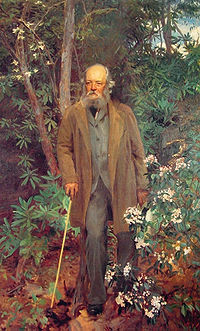
This post is also dedicated to Frederick Law Olmsted, the world's greatest landscape architect of all time, or if you will, a "park-itect." Olmsted was the architect of NYC's Central Park, not to mention Yellowstone National Park, and hundreds of other landmarks. There were (or still are) a number in Buffalo, NY even, He was also the architect of one Boston's key links in the "Emerald Necklace" (the string of iconic parks that define Boston) which would later bear his name as Olmsted Park. It is impossible to talk about America's best parks without a discussion that begins and ends with the architect who was also a firm abolitionist, opposed to the very slave labor that states and cities used to build the parks he would design. Just as OKC today is a mixture of good and bad, here lies the crux of good urban design more often than not: It can come from the best of times, and it can come from the worst of times. But either way, it is true to form and true to heart. Nothing is more American than a good, well-designed city.

Top 10 Things That Worked

1. Construction workers, thousands of them, on the Devon, Chesapeake, and SandRidge campuses (campii?) definitely worked. They all worked overtime, around-the-clock, in fact. As the big 2 energy companies in OKC continued to expand, so did the scope of construction, and the pace. Devon Tower shot up like a weed to tower over the skyline, and Chesapeake’s retail development along Classen quickly became one of the city’s premier shopping developments. Chesapeake’s new office buildings east of Classen will break from the Georgian dormer-style buildings that the first 15 or so CHK buildings resemble. They will be ultra-modern and much, much larger in footprint as well. Could a tower be in the works? Devon-related construction may continue longer than any of us expect as credible rumors are surfacing that developer Nicholas Preftakes, who has bought up much of the Arts District, is working in concert with Devon to spur some development around the new Devon World Headquarters. A mixed-use response to CHK, perhaps? The SandRidge buildings also came down as work continued inside the old KMG tower.

2. NW 9th Street, still somewhat in its infancy, continued to work up a storm in 2011. Steve Mason, and we have to believe at this point that the district has worked up a good amount of synergy revolving around other players now (particularly the Flaming Lips), stayed true to what made 9th Street first blast onto the stage in 2008: Retaining and restoring battered, blighted warehouses, garages, and shacks—turning them into showcases of the eclectic and imposing monuments to the unimposing. In 2007, when Mason began his development push, 9th Street consisted of vacant land, an abandoned warehouse, a garage with cool old cars in it (Mel’s), an abandoned garage, and some wooden shacks further down the street. By simply repairing what was already there, today you have the Flaming Lips’ “The Womb,” S&B Burger Joint, The Iguana, Shop Good, Pachinko Parlor, and that’s just on 9th—on Broadway, Mason has added more retail along with what has become one of OKC’s most popular coffee shops, Coffee Slingers. Don’t look now, but NW 9th and NW 16th have quickly become the epicenter of LOCAL retail. What if the NW 9th approach was replicated say, in Core2Shore? Just saying…

3. Chesapeake worked wonders to bring top-flight retailers to OKC in 2011. They even offered an incentive out of their own pockets (without even asking for a TIF, which would have been controversial) for Whole Foods to open shop. Whole Foods, which went with a relatively small store footprint, was not expecting the OKC store to be a huge success. It was bigger than a huge success and now Whole Foods is reportedly eyeing locations for metro store #2. You really have to question that anti-Oklahoma bias down there in Austin if the Whole Foods corporate people had no idea that OKC would be a big success, but luckily now it appears they’re over that. Chesapeake also brought in another metro-first retailer in Anthropology, with undoubtedly more to come, including all of the local retailers that they lined their Classen Curve development with. It stands to reason that Whole Foods isn’t the only one receiving some kind of incentives from CHK—and it’s evident that CHK has big things up their sleeves, or else there is no way they would be going to the lengths they’ve gone to so far on this project. It just doesn’t make sense to hire Rand Elliott and pay off tenants for disparate parts of basically just a strip mall and a grocery store (yeeah—very nice ones, I admit). Rumors include housing being built between WF and NW 63rd and redevelopment of the old Nichols Hills Plaza, and the CHK Real Estate Binge goes much further than those properties, too. They're also behind an interesting LEED-certified "modern micro community" on NW 56th. I guess there goes the old Meadowbrook Acres 'hood...

4. OKC Talk worked (and likely prevented many people from working) in 2011. I understand the skeptics here, probably largely driven out of nervousness. OKC Talk has had a spotty past, to tell the truth, and in my opinion it used to be best to avoid. It was just typical of an online forum where sad people can hide behind anonymity and engage in flame wars, thus filling that void in their personal lives and taking it out on others without the time or patience to put up. It was a bit much to keep up with when I barely have the personal time to do right by this blog. However, OKC Talk’s Pete Brzycki has changed all that since he bought the site (for a large sum, reportedly) and maintained it to the highest level. Pete’s stewardship has turned OKC Talk, of all things, into a true force to be reckoned with in OKC politics. OKC Talk is the haven for mavens of OKC’s development and neighborhood news. Skeptical? Believe it. Big-time developers, like Bricktown’s Jim Pitman, big-time local journalists like the Oklahoman’s Steve Lackmeyer, and big-time local volunteers and activists such as most of the M3 Streetcar Subcommittee, are all not just posters on the site, but major contributors for the most part. No doubt there exists innumerable others, and we know that the site is daily reading for all of OKC’s leaders. Comments and trends that begin to resonate on this site take hold out there in the real world, in the community meetings and committee proceedings that define downtown affairs. OKC Talk has emerged as a force not just to be reckoned with, but also a force with tremendous staying power. That is in no small part due to a passionate OKC expat for whom stewardship (and funding) of this tremendous online resource is a way to give back to his hometown. Just as OKC Talk, with millions of page hits (I don’t know, maybe daily??) has made a true impact (mostly as an ultimate democratization force), OKC owes Pete a true thank-you.

5. Downtown restaurants worked, as well. Downtown, and its many districts that form this part of the city, virtually became a huge restaurant district in 2011. Every district is now anchored by a restaurant that is either very popular, or has the potential to be. Perhaps one of the biggest restaurant openings was that of the new Hideaway Pizza on North Broadway in Automobile Alley. Another new restaurant, Joey’s Pizza (relocated from Classen), anchors the old Film Row district. NW 9th is anchored by Iguana, Mid-town is anchored by McNellie’s (still the biggest restaurant up there), Deep Deuce is anchored by the Deep Deuce Bar & Grill, and so on. More restaurants even opened up in Bricktown, including some chains like Texadelphia. Can all these restaurants be sustained, after there were already a great many going into last year, no doubt. There has never been a restaurant demand study done, so we will really begin to test that demand, I think. One positive will be a huge number of “rooftops” coming onto the market downtown, which will inject downtown with a local customer base for a change.

6. Ed Shadid definitely politicked in 2011. I was at first concerned by Ed’s rhetoric when he initially popped onto the scene during his campaign. After it became clear that Ed would be a true supporter of quality of life, there was a rally to get him elected over a well-proved economic development cartel called “OKC Momentum.” Ed handed them a landmark defeat and then continued to make splashes by taking on deals that sounded bad, and he embarrassed City Hall by shining light on decisions that made very little sense. He even accomplished a major civil rights landmark as he got sexual orientation added to the city’s non-discrimination policy. Still, anytime you embarrass high-ups in this city, there’s a chance of being counter-productive. The jury is out on the real progress Ed has made, but he has performed admirably in the role of Downtown Don Quixote, if you ask the Oklahoman at least.

7. TIF deals worked pretty well in 2011, except when they didn’t (in the case of Bomasada). The Alliance for Economic Development, led by former assistant City Manager Cathy O’Connor, was successful in leveraging major downtown developments with TIF deals to ensure fruition AND to ensure quality standards in development. In fact, all of the recipients of these TIFs have proven their commitment to the utmost building standards. Gary Brooks, who won the OCURA bid for the former Mercy Hospital site, later on announced (long after winning the bid) that the project would be the first LEED-certified mixed-use project in the state. Richard McKown (LEVEL developer) and Ron Bradshaw (Maywood Park developer) both pledged to use real stucco, instead of EIFS, with two enormous mixed-use developments that will go a long ways toward filling in Deep Deuce, along with an ultra-sleek Aloft Hotel being developed by hotelier and local architect Jim Thompson. Now the ultimate test to see just what kind of a miracle a Cathy O’Connor TIF deal can do will be to see what happens with the Judy Hatfield’s Carnegie project (pictured).

8. OKC Momentum worked hard in 2011 (but others worked harder). For better or for worse, there was an anonymous cartel of elite interests here in OKC (or perhaps Nichols Hills, rather) that attempted to buy Ward 2. The problem was that Ward 2 could not be bought because this ward is the best-organized, most-active, and boldest ward in the entire city. Ward 2 has a history of electing trendsetters and visionaries. Patience Latting, OKC’s first and only female mayor, cut her teeth politically in Ward 2. Many excellent statewide leaders (like Bob Anthony) got their start (well, politically at least) with some modest community organizing in Ward 2. Gazette Published Bill Bleakly wrote an admirable piece about the legacy of this tremendous ward, in which he mentions the names of many people you’ve either forgotten about or never heard of to begin with, but the point is that Ward 2 always sends somebody significant to the Horseshoe. The outgoing councilor, Sam Bowman, was a helluva councilman. Talk about a true civic dignitary and a class act. OKC Momentum through hundreds of thousands of dollars, not to mention primetime ad spots on local news, and still couldn’t win the hearts and souls of Ward 2. Dr. Shadid’s huge landslide victory, despite losing fundraising and spending by a landslide, didn’t just reaffirm Ward 2’s values. But it was earth-shattering for OKC because we’ve never had a council election like that before, and the good guy won. “Momentum” used to be a harmless cliché used ad nauseum around OKC, now it is a punch line and perhaps even a dirty word, which is also profound for two big reasons: Firstly, it was time to get a new word anyway, and secondly, good people are going to stand up to bulldozing anything and everything just for progress. No more progress for progress’ sake. Frederick Law Olmsted, the finest park-itect the world has ever known, once said: “The possession of arbitrary power has always, the world over, tended irresistibly to destroy humane sensibility, magnanimity, and truth.” That’s the way anonymous elite interests prefer to carry out the business of the people when the people, especially of Ward 2, clearly have other things in mind.

9. Quality of life improvements (including the Myriad Gardens) didn’t just work in 2011, they kicked ass. Project 180 is in deep trouble right now, they underestimated their expenses, overestimated tax revenue from Devon Tower (which was built for much, much cheaper than expected), and over-leveraged themselves on a bond deal with Devon (rather than waiting for the TIF money to accrue over time). But never mind that fiasco. I don’t care how angry you are about the cost overruns, even if we were $100 million over budget just on the Myriad Gardens alone, it would have been worth it. For me, the chance to get out and walk around and enjoy this park was elation beyond what I would have expected in my wildest dreams for 2011—you can’t help but feel like you are in Boston or Portland. This is a park for humans. It’s a beautiful park. It’s also a park that is clearly planned to make a visual impact. The old Myriad Gardens just weren’t that way. To put it in terms that everyone will understand, the trees weren’t lined up well, the paths made no sense, there was no visual definition that played off of anything. Myriad Gardens 2.0 would make Frederick Law Olmsted proud indeed. It will soon be the pride of Oklahoma when the Festival of the Arts rolls around this Spring, and 500,000+ people are instantly blown away. It doesn’t stop there. Actual (dedicated) bike lanes have been spotted on some downtown streets; I myself nearly had a heart attack when I first saw this. Also don’t forget the Oklahoma River, as Boathouse Row continued to finish impressive projects, break ground on other previously announced ones, and continue to roll out other impressive proposals (such as a new children’s building, that has been removed from their website since I last saw it??). We still have the MAPS3 Central Park and other features yet to come! Could it be that a city that lacked a single decent park could become a city chock-full of quality urban greenspaces? This in and of itself is all the difference in the world, and I believe the difference will manifest itself shortly not just with new development, but with tangible quality of life improvements. You can NEVER have too many good parks, especially when you used to have none, truthfully.

10. SkyDance Bridge worked in 2011, even if only for the last two weeks of the year. I was skeptical of this one. It looked like we were in for another wasteful and disappointing project. ODOT goofed and then demanded that the alignment be altered, negating what would have been an axis leading straight to the Devon atrium, and then cost overruns meant that a suspension bridge (where the scissor tail feature served a structural purpose) had to become a simple truss bridge, the cheaper option, rendering the scissor tail to look like a goofy cosmetic addition in depictions. Sometimes however, you can’t always judge a project by bad architectural renderings. In real life, this project is stunning, and perhaps the truss bridge feature is even an improvement. It has undoubtedly added more jagged edges as a defining element of this bridge, accentuating the “feathers” of the scissor tail piece. By the way, the entire bridge was lit-up with shifting LED lights on the very last evening of 2011, and it was truly breathtaking. It was mesmerizing even from as far away as the I-35 bridge. Can you imagine that very view in a year (to an out of-towner) with the new OKC skyline in full view, that bridge lit up, the bridges with their LED light panels, Boathouse Row finished, those boathouses lit-up impressively, and more trees planted along that river? I’m. Having. Trouble. Seeing. Straight. So. Excited. For. The. Future. Of this.

By the way, isn't Will Hider an incredible photographer? You can also thank OKC Talk for his talent being discovered.

Sunday, January 15, 2012

Culture may lose afterall


This old news clipping (from the first closing in that building) was posted on OKC Talk today, and I thought it was extremely prophetic. Wow.

Those damn hippies and their monumental downtown performing arts venues...

Sunday, January 1, 2012

Cityshot(s): Merry belated Christmas

For those of you who have visited the blog lately and only seen a way-too-early New Years post and no mention of Christmas, yes we do in fact celebrate Christmas at this blog. I have just been inexcusably late at getting around to it because of getting busy with family and other stuff I do while I'm home for the holidays.

That said, what better (late) Christmas gift than downtown Christmas pics? Let's remain cognizant of what a great downtown Christmas scene we used to have, but to tell the truth, I don't think downtown has ever looked better during the holidays than now. Not even in the hey day was it as spectacular and unique as today, and that's largely in part due to the lights along Automobile Alley.


And of course, Bricktown was all decked out also:


Saturday, December 24, 2011

Crazy prediction for 2012: FNC

Steve Lackmeyer has been covering the heck out of the Yashoua-however-you-spell it indictment. The Village Voice, one of the nation's most respected alternative news outlets (think Gazette, but with history) has named Yash one of NYC's worst slumlords. The head honcho of LA-based Milbank Real Estate, and notorious absentee landlord/slumlord of OKC's once-proud First National Center, is looking at some hard prison time that might be well-deserved just for how he's ruined the Arcade level of the FNC. I'd put him in prison and throw away the key just for that (kidding, slightly). He's not an investor; he's a divestor.

The FNC is one of OKC's most iconic buildings. This property can not afford to go through another cycle of these kinds of owners. Something has to be done if we want to rescue this building.

So here it is, my crazy prediction for 2012 (a few days early nonetheless): A local group of investors, it may or may not include some of the usual suspects and/or "Allied" Alliance "Allies," will form together and make a play for ownership of the FNC. The city will get involved and try hard to put together another Skirvin-type deal, it will be difficult simply because Empowerment Zone resources have been spent already and that pot of money won't be replenished until either the Skirvin is totally paid off or it gets sold to a bigger hotel chain. I think the Skirvin is fine the way it is, but I'm also confident that the City can put together some kind of deal here. It may just be a typical TIF that the Alliance is offering up to anyone, and that could work.

But I believe we are getting closer and closer to a local investment group making a play to save the FNC. That's undoubtedly an optimistic prediction, so who knows, but one can certainly hope. As for what we might see, I have no idea. I have to believe that if it's led by local investors (who aren't the MidtownR people) the redevelopment project will be as unimaginative as possible.

Maybe even all office, considering that's back in demand right now, and these people believe that downtown can thrive as 100% office and that even constitutes "mixed-use." Regardless of whatever it becomes, I just hope to see the FNC saved one day. But the Mercantile Building in Downtown Dallas would serve as a smashing mixed-use (condo and hotel) example, and a very similar situation I believe, as well.

Friday, December 23, 2011

LEVEL update pics


Construction update on LEVEL: Friday, Dec. 23rd, 2011. The stucco was being applied to the south edifice--it's definitely a great touch, and looks even better than in the renderings. This is great news for those who were slightly disconcerted that the stucco might be mistaken in appearance for EIFS. The black-gray brick on the street level has been added to the east side, along Walnut Avenue, and boy is it sharp as well. Think Central Avenue Villas.

Even better is the idea that -shocking- we can take a developer at his word when he says he will design and build a quality project.

Monday, December 19, 2011

New parking sites

For those who haven't heard, COTPA is selling off parking garage after parking garage, which is building up funding for...new parking garages! I have some thoughts on those, first based on comments in the Oklahoman article.

Pete White is excited about the site at NW 10th and Robinson. Jim Couch says that regardless of whether they decide to target the office needs or mixed-use needs, both would be wins as far as downtown parking goes.

Theoretically, Couch is right. However the only problem with that is that this city currently has zero public parking facilities in mixed-use districts. All of this city's parking garages have been in the office core of downtown, which is anything but mixed-use and will remain that way for a while.

The proposed sites are as follows (I went ahead and ranked the sites based on favorability overall, but I admit I haven't really thought a whole lot about ALL of the sites yet):


I think that some of these sites have a lot of strengths. Immediately rising to the top of the list are the two proposed sites that bookend the streetcar system (1 & 2), for strategic purposes. These sites (SW corner of Bricktown and 10th and Robinson), rise above the fray for a multitude of reasons.

Mixed-use: Both of these sites serve mixed-use areas that have a strong need for a parking solution, which I'll talk about more. But I do believe that serving the mixed-use areas, and just developing mixed-use in general, needs to be a higher priority. We have office towers. We have office space. Available office space. Garages that serve office workers. And so on. As far as mixed-use goes, well, it's another situation altogether. We know that this needs to be a priority. We also know that most of the downtown "renaissance" has been spearheaded by adding some mixed-use development.

Parking need: A year ago we did not think there would be any parking need for the office core. Today, it looks like there is a need that exists. But we have known that Bricktown needed a parking solution for a LONG time. That parking crunch could be solved by adding more street parking, like is going to be done along N. Broadway. Speaking of Automobile Alley, we know that there is a strong need for parking around NW 9th, where retail has a foothold downtown. These small businesses and trendy restaurants don't have the resources to deal with parking on their own. However, a block or two away, parking can be easily found. Bricktown obviously has the strongest need.

Transit synergy: It would be vital for a new downtown parking masterplan to take advantage of the new streetcar system, which will serve as a walkability extender (extending the length of "walkable trips" across downtown). So any proposed site that isn't right on the tram route should be thrown away automatically. Furthermore, the Bricktown site happens to be right where there is a proposed garage to serve the OKC Transit Hub, which will be developed out of the old Santa Fe Depot facility. The parking garage would be needed for commuter rail and Amtrak rail, and would be connected via underground tunnels. We would need to talk about how to fund that if that site isn't chosen as the next public parking garage that we now have funds to build.

Contributing to infill: Downtown needs infill. This is another established goal that public actions NEED to be contributing to solving. One of the proposed sites, the one at W. Main and Dewey-to-Shartel, would involve a number of building demolitions on a block with enormous preservation potential. W. Main is another one of those incredible old streetwalls that remain on the edge of downtown's office core. Let's preserve the density we have, and build density where we don't have it, and the CITY shouldn't be doing anything to contradict those goals at the very least. Sites that have the potential to support future development should be given priority as well.

The garages closer to the center fail to do this, although to this end, I would also not write off the site across from City Hall. I think that the Arts District, particularly the Preftakes-owned buildings, could become the next hotspot downtown. This garage could support that and also prevent other building demolitions for parking, which have been rumored from Preftakes for a while. Also as far as future development goes, we know that NW 10th is becoming a vital corridor, so I'd consider that a worthwhile site, and there is also a lot of development left to be done in Bricktown up against the tracks (including a site that Hogan is rumored to be developing soon south of Reno).

Accessibility: Access to the most efficient traffic flow will obviously be another important consideration. One thing I would remind people of is the pending demolition of the Crosstown Expressway land bridge--the replacement at-grade expressway will be right up against the proposed Bricktown garage. You don't get better access to traffic flow in and out of downtown than that. This also has the potential to serve proposed mixed-use sites along the "boulevard," provided that any of these blocks are left untouched once this convention complex gets built. This could be good and bad. If this "boulevard" is an auto highway like planned, a parking garage would just make that even worse. Instead of "Champs d'Elysses" you have essentially..E.K. Gaylord deux. NW 10th, being that emerging vital corridor, is also great from an accessibility standpoint. The other sites mostly involve a great deal of zig-zagging and circling construction sites to get to.

We will just have to watch the Alliance closely (or as close as possible) and see which direction they're thinking about going in. But while Couch is right that theoretically there are many different needs to serve in terms of parking, there aren't just all right answers--it may seem this way when you live your life in a vacuum of power and cronyism like Couch. There are wrong answers and right answers, even if only because we have office and don't have mixed-use. I would say though that it goes beyond that. Downtowns across the nation, no world, have identified the need for as much mixed-use as possible. Mixed-use is potentially going strong 24/7. When your downtown caters to office needs, it rolls up its sidewalks and closes all of its doors at 5. That's what kind of downtown we HAVE.

And here, we start looking at the differences in leadership styles. The more progressive, proactive cities are being led by transformational leaders. A transformational leader is somebody who ignores the status quo and says, "Yeah, that's how things are, but this is how things could be. This is the goal to be working toward." Meanwhile, a caretaker leader just covers their bases and propagates the status quo. These people shy away from visionary ideas. A caretaker leader would prefer to keep doing what we've been doing with parking (obviously with much success - not) whereas a transformational leader would explore the potential for a parking solution to continue turning the land use dilemma around.

Tuesday, December 6, 2011

Bulldozer-happy morons strike again


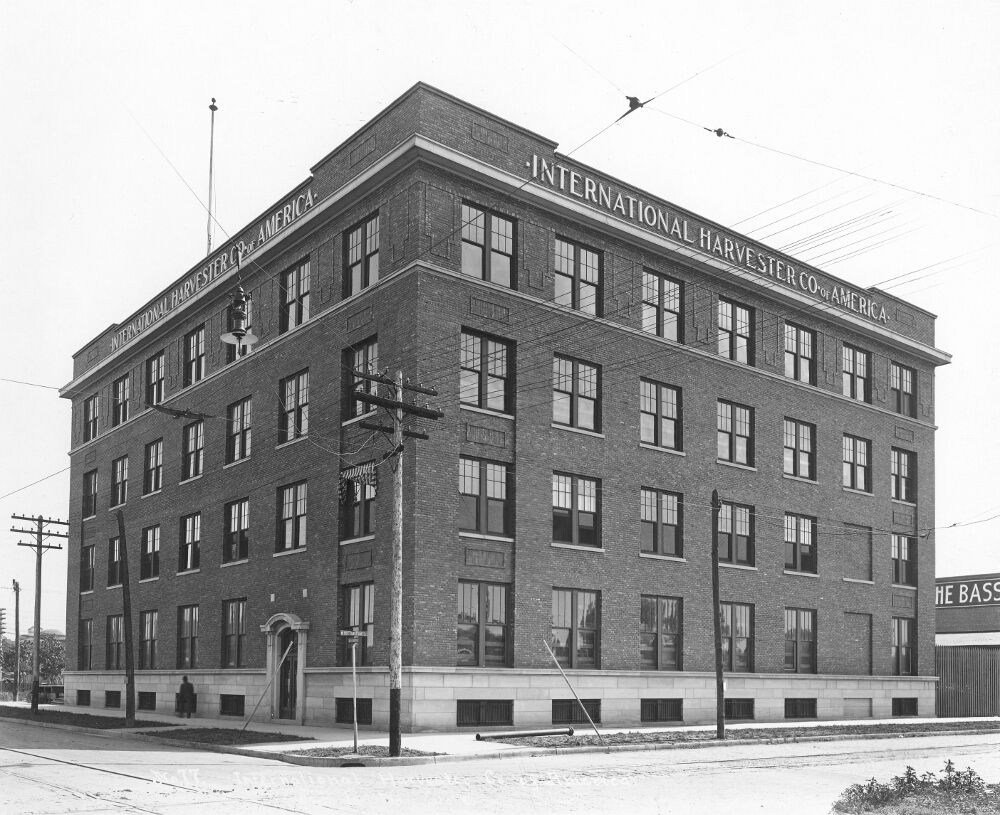
This building was targeted by demolition earlier because the convention center super-block was going there. Instead, that convention center super-block got moved to just about the only potentially worse site they could have come up with.

So why is the International Harvesters building still on for demolition? This is yet just another great old building coming down. This city is becoming demo-happy as it was in the 1970s. Deja vu. Anyone who claims to be pro-preservation is just offering up lip service.

I'm just not sure this city is interested in historic preservation, urban design, sustainable development, and quality environments. And the means in which this city throws slings at those things are ridiculously over-funded (convention center) and the means in which they claim to care about those things (streetcar, parks, streetscapes, etc) are ridiculously under-funded by comparison.

This building is in the C2S region. There is also a very good corridor of historic buildings along SW 3rd with great potential. It will also likely be leveled if certain folks have their way. I'm beginning to think C2S is a disastrous undertaking that should have never even begun, not for the bad it looks like it is going to do, and not even for the supposed good we were told would come out of it.

C2S is nothing but an urban planning folly and a sham at that.

Saturday, November 19, 2011

Here's a new culprit for you


Here's the thing that frustrated me about Bricktown: The amount of taxpayer dollars we have pumped into this tiny little district and the miniscule ROI that we have seen following that.

Basically it follows the exact same narrative of other public economic incentives that never work. Hey developers, we're going to throw an insane amount of cash your way by investing in this district so that your land values rise. Oh, but then we're not going to come in and direct development in ANY meaningful way at all. Corporate welfare + deregulation.

Nevermind that the PUBLIC made Bricktown, and now it has totally lost control over how that district develops. Quality standards have spiraled down hill. The Bricktown Suburban Design committee is a laughing stock. We can't even use the argument of "protecting the public investment (ie: the canal)" any long at this point. Bricktown developers and parking lords are out of control.

So there you have it, the concept of Bricktown as a failed Reaganomic dream. But why would we expect anything else? That's what the people of this city believe in. Furthermore, the woman that we put in charge of the Bricktown Suburban Design Committee is in the Bricktown parking business herself! She's also in the Bricktown land values squatting business herself.

This is the Rock Island Plow Building, at the corner of Reno and Oklahoma Avenue, overlooking the canal as well. This building, owned by Bricktown Suburban Design Committee Chairwoman Avis Scaramucci, is falling down on itself and is one of Bricktown's largest eyesores. Years have passed since Scaramucci bought this building. At the time we all hoped that she would renovate it, but I think we gave Avis too much credit at the time, and in reality she's probably just waiting to get a pay day from another interested buyer.

Does a single successful restaurant make someone the "Queen of Bricktown?" So far Avis has done nothing to prove that she wasn't one and done in terms of Bricktown development, and how did this get to be the person chairing the Bricktown Suburban Design Committee?

The problem with Bricktown is that we (the public, the city, MAPS, etc) probably invested TOO much in the district all at once. Districts don't develop instantly, yet Bricktown's land values skyrocketed as much as 300%--instantly. The development could never have kept up with that kind of a spike in land values. Therefor the people who benefited the most weren't developers that couldn't keep up, but rather property owners who could sit on properties--especially if they had enough in the bank that they could absorb the cost of long-term ownership, which sometimes included doing bare minimum improvements just to keep these buildings standing. Sometimes the bare minimum improvements actually do more harm than good in the long run, structurally and especially aesthetically.

Avis Scaramucci has embodied these problems and more, all the while getting credit as the "Queen of Bricktown" as though her leadership is all that's keeping the district together or something. Another common complaint with the district is that it is too bogged down with restaurants. Score another for Avis. Perhaps the biggest indictment is all this chumminess and lack of accountability. Maybe that's what there should be, after all.

Saturday, November 12, 2011

Really, Dowell?


I am beginning to question Rick Dowell's sense of taste. Apparently he finds the absolutely hideous Sheraton colors to be inspirational?? I don't know what else to say.

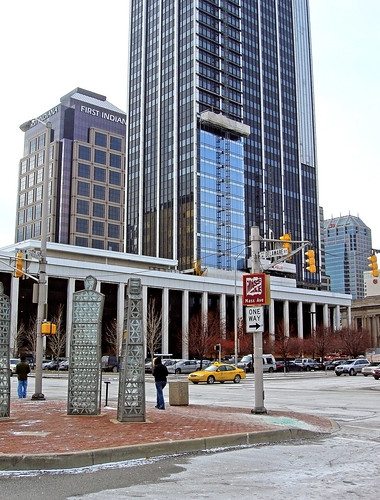
SandRidge's architects like to bulldoze a quarter of downtown but at least their new structures are architecturally acceptable, granted, the Dowell Center is a tough one to remake. The whole thing needs to be recladded, truthfully. It can be done. Look at this Indy skyscraper (One Indiana Place) as an example:


I really don't mean to be piling onto Dowell, who has done excellent work in the past. However, he doesn't understand the value of working with the community (which goes beyond just being stubborn), and this is just plain ugly. He was in cahoots with SR over the sinister demo plan for this??

My third-straight post under the label of "bad projects." But trust me, there ARE good projects out there.

Friday, September 9, 2011

A-Alley: A distinct vibe emerges

I want to take the time to post some more photos I took last week that I think demonstrate how a very distinct vibe is developing along North Broadway. Can Automobile Alley become a "landmark" corridor for us? Admittedly, it has a ways to go, but the potential is there. It's really coming along, and it's hard NOT to speculate about how North Broadway is booming.


1100 N. Broadway continues improvements. I get the impression that Howard and Clagg and Co. are a little hesitant about finding a tenant for it, since they have been finding temporary uses for this space for the last while. OKC Cityscape was really fantastic there, and I already kind of miss the bright LEGO blocks that were affixed to the front of the building. I wonder if there is a way that they can make OKC Cityscape work as a year-round thing in this space, should it ever be able to cover its own rent. It was way more successful there than in Penn Square, where rent is quite expensive.


It's hard to not love the view down Broadway.


1101 N. Broadway is also starting to come around, I have noticed drastic improvement recently so it appears that renovations are now fully underway. This building has an interesting recent history, as I remember in '06 or '07 there was a deal to turn it into the "Chandelier Lofts" and construct a glass annex next door, to the north. When they instead just sold it off to Greg Banta, who was on a Mid-town buying rampage at the time, it was assumed it would still get developed quickly. Here's hoping that the building eventually becomes lofts, which it seems very well-suited for.


I think we can also look back on the OKC Community Foundation as a very good project, also. At the time I was annoyed that it was developed by a non-profit agency, as there WAS a report out at the time that proved 10th and Broadway was the best fit for a "major development" and I thought with the land being donated either way, it would have been a great opportunity to try for a development home run. That was before 2008 and any major development play would have at least been complicated by the economy anyway. This is a decent, quality project. I feel like the design is very conducive to the neighborhood, I just wish the Community Foundation hadn't demo'd more buildings for unneeded parking.


This sculpture, very tame and conservative in its motif, also went up at the same time as The Womb (in the background) came about. Whether this is the Community Foundation's attempt to "cover up" that loud building in the background, or compliment it with its own artistic touch, is anyone's guess. But what I do know is that when it comes to public art, the more the merrier!


Of course, how could anyone not be enamored with the loud mural covering the new art gallery called The Womb? I think everything about this gallery is brilliant, and I think it's about time we have a "big-city" gallery that seeks to push the envelope, in many different ways! This adds many new dimensions, and talk about a potential neighborhood asset. I anxiously await to see how The Womb will fit into the strong synergy budding amongst the other attractions around 9th and Broadway, such as Shop Good, Coffee Slingers, The Iguana, Sara Sara, Pachinko Parlor, et al.


What is so special about this A-Alley vibe is that it has such a great mix of locally-owned EVERYTHING. Art and culture courtesy of the Flaming Lips, awesome restaurants, a cool local coffee shop, and -GASP- actual retail (Shop Good, Sara Sara Cupcakes, Rawhide furniture, and the newly relocated antique/vintage furniture business). But another great asset will be the new Hideaway. Oklahoma family like Hideaway, and while it's image isn't exactly conservative (so it won't buck the vibe on N. Broadway), it's fairly tame and "family-safe" thus it will be a predictable draw for the mainstream.


To top it off, another nod to Steve Mason's rooftop garden. Every building in this district needs to have a rooftop deck like this, for soaking in the action from above on perfect sultry summer evenings.

Sunday, August 28, 2011

The truth about the "Chamber junta"


I want to start revving up my reaction against the convention center site location again. I have a feeling the location debate was blown wide open by the council standing firm against a $30 million budget increase for the project. Obviously it won't affect anything. Anything that anyone, or however MANY people say, even if they are echoed by a councilman sitting on the horseshoe--won't have any chance in effecting a change in course on this convention center.

Explaining this absolutely ridiculous CC subcommittee, who do they think they are?
A lot of attention around the rogue MAPS 3 Convention Center Subcommittee, that so-called "Chamber junta" as they have been aptly labeled by all of the alternative media, has focused on the role of Larry Nichols. Nichols is a local civic warrior who is pushing relentless for what he sees as OKC's best interest, and his influence and power is surging. As he minimized his day-to-day role in running Devon to focus more on his civic ambitions, he has taken the bull by the horns when it comes to this city (I think a very apropos analogy), and I suppose one could say that the arrival of his influence in the last year or so has been felt with the subtlety of a steer mounting a comely heifer. Every conspiracy theorist in town is wanting to blame anything that smells fishy on him, and every respectable leader in town is too afraid to even set the record straight because they don't want to mis-speak when it comes to Nichols. But Nichols is not a corrupt overlord, and I like to believe his interests are mostly above-board. There, I said it, sue me.

This whole "let's lynch Larry Nichols" thing has been a distraction from what I think is the real problem with this "Chamber junta." There are a lot of hotel owners and operators and assorted interests aligned with them that are on this subcommittee. I mean existing hotels, like the Skirvin, Colcord, Renaissance, Courtyard, Sheraton, and so on. The hotel operators that have the most local influence are immediately around the Cox Center, not by virtue of their Broadway or Robinson address, but by virtue of their working relationship with the CVB. The CVB wants to maintain those relationships, for right or for wrong, in spite of what we obviously know that these hotels are amazingly inadequate for handling the convention needs of a "Tier 2" city. We need to start from scratch because a scattering of around 800 rooms over 4-5 separate hotels is a joke and is not going to impress anyone.

In fact, we were going to locate this thing across from the current I-40, and the proximity concern raised by planners had nothing to do with THESE hotels but rather to Bricktown. We have known, mostly all along, that we will have to start over on the hotel front. But we also didn't think we would have to start over on the entertainment and restaurant front, we expected to keep using Bricktown for that, and we also knew that would be a lot harder to recreate in Core2Shore than the hotels would be.

Basically our hotel picture is a small scattering of rooms around the Cox, and probably an equally sized (albeit getting larger with the aLoft) cluster of rooms around Bricktown. Why is ONE of these clusters, particularly the one that is going to be smaller soon, more important to stay close to than the other? Ask that question. The answer is that this has everything to do with these hotels exerting local influence on the convention and hospitality industry, which is running this convention center subcommittee. Obviously, these hotels are at capacity with their current monopoly on the hotel market. More hotels means they will take a hit and may-gasp-only be fairly profitable. (Let's not understate the booming state of the downtown hotels, which are all benefiting from increasing demand and abnormally low supply for a city our size) These guys aren't going to go out of business by bringing in more hotels or starting over with the convention-front, but they won't enjoy being booked solid anymore.

And I've been told by a past president of the Bricktown Association in person that they feel helpless in advancing their cause for anything against these bigger interests because they already have the Ballpark and the Canal. They wish they could pick up "that damn ballpark" and move it to Core2Shore if it's the reason their concerns don't get heard. It may seem insane to outsiders to say that Bricktown interests are being trumped by hotel operators, but it's just the truth that I see.

Can urbanism stand on its own as an agenda?
The interesting thing about OKC's activist circles is that all of the progressives have traditionally been tied to the economic development agenda for the sake of survival. Without the economic development agenda or dare I say "momentum," there is no push for a progressive agenda either. The Chamber can at least make token progress on the issues that progressives care about.

I want to pose a big question. Can a progressive agenda for urbanism and sustainability stand on its own, and take on competing factions on its own? I see MAPS 3 as resembling a bond between progressives and juntas, both attracting voter support from different ends, and I see the last few months as this show of bait-and-switch. Progressive votes were baited with certain items, and then the switch came when the convention center nobody wanted became the new priority, at the expense of other projects. Did progressives really get a bad deal? The streetcar and park might not even be happening without the convention center. We know that voters overwhelmingly took sides with the progressive items and did not like that convention center at all, but--do we have anything else resembling real proof that a progressive agenda can stand on its own and not depend on whoring itself out to the convention center interests?

This past marriage of convenience of progressive issues and the chamber junta makes for odd bed fellows indeed.

Sunday, May 22, 2011

How good developments go bad

This will be a post dedicated specifically to how developments get proposed, or rumors about, and then the developments halt and get to the point where they're dead on arrival. Since it's just a blog post, I'll make it short, and just focus on the primary reasons I've seen since I've been giving up my life to track OKC developments (kidding--well, mostly). The main reasons are unaccounted economic changes, incompetent development teams, what I like to call "strict 2009 adherence to 2007 ideas," and another big one is the limbo caused by big-ticket public projects, many of which are still up in the air.

I will also try and relate this back today, with the implications of post-MAPS3 passage Oklahoma City. Remember: We were supposed to see all of this amazing amount of spin-off development.

This is the Flatiron project, on Harrison Avenue, just north of Deep Deuce--proposed by Grant Humphreys who has been a successful, innovative urban developer. So what could have gone wrong (because this project is definitely been dead for a while, in spite of past efforts to revive it)? Humphreys was somewhat over-extending himself, especially at a time when he was still heavily leveraged in the Block 42 project which he finished a few years ago and has recently still been selling off the last units in that project. Block 42 was an innovative project for OKC because it combined townhomes and flats in a building with a striking urban design, so price points were high. It was also competing with several other projects within the immediate 3-block vicinity. The Flatiron project also called for a lot of mixed-use space, and I imagine it was difficult to find high-end commercial tenants to sign-up for an outpost location at a time when even Bricktown was losing retailers. It's a shame because it would have been an awesome project, but Humphreys will be back downtown, and is currently working on Carlton Landing at Lake Eufala.

The Cotton Exchange is an especially interesting project because it's up there with the old "Factory" proposal as the projects I most wish could have happened. I won't get into the details of how much I love this project, but it would have been a great one. It offered prime commercial space right on the canal as well as with frontage on Mickey Mantle, and it also offered a good amount of residential which Bricktown badly needs. The Centennial was a huge success, so it begs the question why OKC can't support this kind of quality mixed-use development, even though we surely haven't seen much of it. The developer, Gary Cotton, was in trouble though. He didn't have the resources to pull the project off--he had a little bit of equity from the sale of the Bricktown "Mercantile" building. He needed other investors but didn't want to listen to other ideas, from what I've heard. It's still a shame that this didn't go forward because he was using the brokerage team that The Centennial used (which sold out, and still had many interested clients), and because other experienced Bricktown businessmen were offering lots of advice. He also benefited from not just lots of Oklahoman and blogosphere coverage, but even got TV news coverage, which downtown development rarely gets.

Many people got very excited when Tom McDaniel announced that OCU wanted to move its law school to the gargantuan Fred Jones auto factory, which is an awesome historic building. The deal died when Tom McDaniel stepped down as president of OCU and a new guy came in, who didn't like the idea so much. But it's hard not to note the sequence of events: Chamber officials promise there will spin-off MAPS development, Tom McDaniel announces OCU will develop law school downtown if MAPS passes, MAPS passes, Tom McDaniel becomes chair of MAPS Citizens Oversight Board, downtown law school plans are nixed. I would chalk this one up to political problems, if the new leader of OCU doesn't like the idea, then I don't see how anyone is going to "force" him to follow through.

For years, the Union Bus Station was a magnet for vagrants, which caused problems for the developers on both sides of the facility who wanted it gone. First, Dick Tanenbaum, redeveloper of The Montgomery on Walker, wanted to buy the bus station and close it down, and put a jazz club inside of it. It would have been a win-win, downtown didn't need the Greyhound station anymore, it was a blight, it attracted vagrants, he could have renovated it and turned it into a historic gem and just put a jazz club inside of it, which would have turned a problem for the neighborhood into an asset for the neighborhood. That's what you call making lemonade out of lemons. Obviously Tanenbaum, a veteran Central Oklahoma developer, had the resources to make it happen. One problem: The owner was pesky and had no intentions of moving, and was difficult to deal with. So Tanenbaum gave up and turned his files over to Nick Preftakes who was on his way to acquiring the whole block anyway. Preftakes also found the owner to be pesky, but by using his properties positioned all around the station, he was able to make it difficult for the bus station to remain there, and forced its closure that way. One problem now: The owner still doesn't want to sell to Preftakes, and harbors a grudge, seemingly. Well let's be honest, when Preftakes put up a property fence just to make it difficult for buses to make wide turns, that wasn't very nice. So I'm not sure Preftakes is going to get to include this parcel in his block in the end, anyway. I just hope the building gets restored somehow, and not leveled.

How could I not bring this one up? haha.. The Braniff Lofts proposal, from 2006 and 2007, would have been a really vital piece toward preventing a controversy (and a tragedy) that would soon follow. A group of investors local of investors ("Corporate Redevelopment LLC"), many with significant Downtown OKC experience and have been mentioned often on this blog, were negotiating with Kerr McGee to acquire these abandoned buildings surrounding their headquarters for redevelopment purposes. The plan was to, at the very least, use the Braniff building AND the KerMac building and convert the two into lofts--the developers at the time were convinced they had a winner, and many onlookers are still convinced the proposal could have been a winner. The deal fell apart because KMG was acquired by Anadarko Energy who refused to honor the deal between the investors and KMG. SandRidge acquired the block and demolished the buildings to make way for a corporate plaza. These buildings, except for the Braniff Building which was lucky enough to already be on the historic register, are goners and lofts or mixed-use of any kind on this block will never have an opportunity to happen. I would chalk this one up to corruption at many junctions.

It appeared to be one of the turning points of downtown development when the Downtown Ford announced it was closing and was demolished. The land owners, Fred Hall and Bob Howard announced potentially ambitious plans to redevelop the large site into a huge mixed-use development. The Jones-Hall family has been involved in other deals, and was involved in the OCU deal that fell through, and Howard has been engaged in redevelopment of of Mid-town lately, so there is no doubt that the development wherewithal and resources were in place. The site could have possibly been the largest mixed-use downtown development to date. "It's no surprise, and it fits our long-term plans to develop that site into commercial retail and housing," remarked Hall, at the time. It was lauded as a success of MAPS spin-off. Why did the deal fell through? Because it got gobbled up by a MAPS subcommittee that insisted the convention center needed to go on THE most promising piece of real estate in all of OKC.

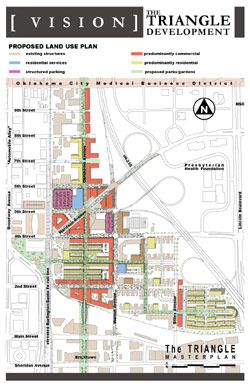
I'll make this my last one, and I think it's a big one. No matter how you slice it, The Triangle masterplan died. At a time when the possibilities for bubble-style downtown development appeared endless, the plan seemed fail-safe. A group of investors including Bert Belanger, Ron Bradshaw, among others, would team up to do a ton of development in a small area. However each one encountered difficulties selling units of their first project and then 2008 hit, and it became apparent that downtown development could not go forward purely driven by speculation on condo units. The group broke up, although they are still individually engaged in development in the "triangle" area, although hardly according to the original plan. And some new investors have popped up and added projects such as LEVEL and Aloft.

So, here you see a multitude of reasons. In every one of these cases, it is a shame that the development died, although this is not always the case--sometimes developments are bad and projects dying would be good. However, there HAS to be a way to meet over these kinds of things and compromise. Bad developments need input for improvement before they actually apply for the permit. Good developments need input to ensure their success. This goes both ways, the process shouldn't JUST be about putting pressure on bad projects. Furthermore, a lot of these reasons are preventable. Switching to a more sustainable economic model for real estate would have prevented a lot of the post-2008 development lethargy we were seeing until recently--the economy never stops, sometimes it contracts, and even that presents an opportunity (for more modest real estate deals). For instance, people still need housing when they can't afford a mortgage, which is why for-rent housing has thrived in the post-2008 economic climate. Capitalizing on that could have prevented a lot of these projects from collapsing. Also, a LOT of stuff is in limbo when we have these big-ticket items in limbo. Do you think somebody wants to build a mixed-use or housing investment when they aren't yet 100% certain where the streetcar route will go? Do you think somebody wants to invest in a huge hotel project without knowing where the new convention center and likewise, streetcar lines, will go? Of course not!

One thing that has been an absolute failure thus far is MAPS accounting for the spin-off development. It was one of the most persuasive reasons why we passed MAPS3. We wanted to buy into a vision for building a city, not just for building a single park or an isolated convention center. These things aren't being coordinated AT ALL. There is no single planning document that has more than one big-ticket public investment component in it. There are however millions of planning documents, district masterplans, streetcar route ideas, convention center proposals, and so on and so forth. Nobody is proposing that this stuff come together. Furthermore, a lot of the interests behind certain projects need to step down and realize that their project isn't the center of the universe. The end goal is spin-off development, not having a city built around a convention center. When you eat your most promising site for mixed-use development to put the convention center on it, you miss the mark. You can have your cake and eat it too. The convention center subcommittee needs to address the goals of downtown as a whole just as every other subcommittee needs to be concerned about it. Ignoring the big picture is setting us up for failure at a time that immense resources have opened up such an enormous opportunity.

Every MAPS3 subcommittee needs to be tasked with the exact goal, and it needs to be an overarching goal of what we as a city hope to create with this opportunity. Each subcommittee needs to be opening its meetings discussing this goal, whether it be attracting investment, or improving quality of life. There needs to be a singular vision shared by all. Right now what we have is a convention center subcommittee that has run amock with the process, stepping on other projects to make sure that at the very least the convention center gets done, and running completely contrary to the goal of MAPS.

These guys need to sit down and analyze universal MAPS goals. They need to ponder what they as a convention center subcommittee can do to improve quality of life and attract mixed-use development to downtown. I'll tell you one thing: You can do a LOT more to accomplish this than by eating the best real estate in the entire city for your convention center, which is going to happen anyway. That makes no sense whatsoever.