Showing posts with label economy. Show all posts

Wednesday, February 9, 2011

"It's [not] the economy, stupid"

Everyone stop what you're doing, there's a really quick important message you need to see: Stop blaming the economy. It's getting old. By now, if you're a successful developer whose head isn't up your bum, you've figured out how to make things work.

This guy (Stanton Nelson), is not a successful developer. His project, the University North Park/University Town Center (not), has been in limbo for a few years. It started with a bang, winning approval from Norman residents for a TIF district which helped pay for basic infrastructure, lured an Embassy Suites hotel as an anchor, and he was able to build big retail anchors such as a Super Target and Kohl's among others.

Then the problem came with what was next: The lifestyle center, which he was contractually obligated to build, was supposed to be built in the next phase, due east (across the super-nice 24th Street with curves that the city built him) from the Target. Was it the economy, or was it that he was never prepared or willing to build the lifestyle center from the beginning? You decide. But one thing is clear, this guy was a clown from the beginning, and Normanites were delusional to ever believe him while he was blowing smoke and naming potential tenants that wanted to sign with him, tenants such as: Oh yeah, Restoration Hardware, Banana Republic, Urban Outfitters, Anthropologie, Trader Joe's, a Whole Foods of course, and a whole host of other big-name retailers that OKC and Tulsa have even been clamoring for (except Tulsa already has several of them). First mistake: real developers don't drop names like that. Second mistake: real developers don't do things contingent on taxpayer help, without which their project is doomed. Third mistake (lookin at you, OU): real developers don't name a project after a university that is located 3-4 miles away.

This guy is not a real developer.

Now Norman is looking to move on. He will likely not be involved in this development much longer, so Norman is hoping for the best case scenario: move on, shut him down with penalties, and get a more competent developer to come in. Sounds good.

The problem is that it hinges on the development of the Legacy Park. The contract the city and he entered into was that the city would build the park, he would build the lifestyle center. If one party failed, the failing party would pay a penalty to the other, in this case, it will be the developer. The city will spend $5.9 million on the park and then probably get that back under the terms of the penalties, but in order to prevent that from happening, the developer is refusing to donate the land to the city in the first place, which was also in the contract.

He's citing economic problems for why he can't donate the land to the city. It's great that he's looking out for the city's best fiscal interest, but it's plainly obvious he's just trying to prevent what would proceed after that from his failure to develop the lifestyle center, I believe by 2016 (it is now 2011, obviously..4-5 years into the development schedule of this project). Call a spade nothing but a spade. The city has the money because it comes from the TIF, which has been generating a lot of revenue ever since Target went in, and would generate even more revenue for the city if Stanton Nelson were actually a serious developer capable of pulling this project off.

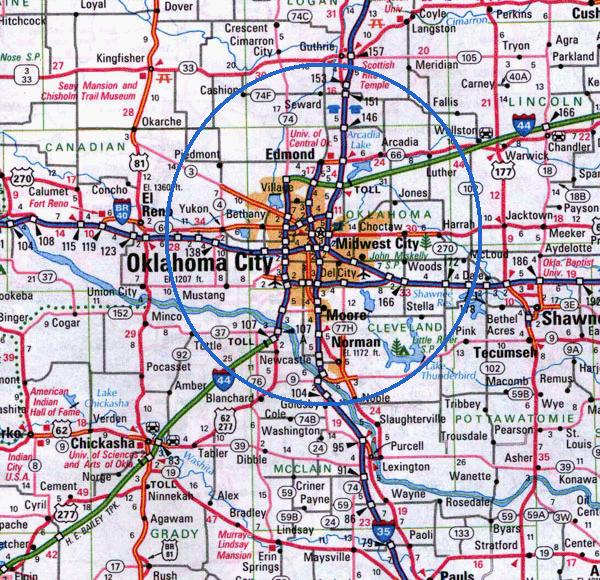
Here's my take: Recall James Carville's famous quote, "It's the economy, stupid." In this case, Mr. Nelson, "It's not the economy, stupid. It's you." Look all around the metro, and even more, look in some of the cities across the nation that are still being very successful. Large developments are still occurring, quite contrary to Nelson's lame argument that "nobody is building lifestyle centers right now." Which begs the question, if that were true, then what ARE they building? Because Moore is moving forward with the Fritts Farm project (Target has already broken ground WITHOUT taxpayer subsidies in this case), the Moore Warren is fixing to pull of another ambitious expansion that will make it truly impressive, and among countless other projects, even Midwest City is going forward with the next expansion phase of their town center which is far better than anything built in this area of Norman lately. In West OKC, the walls have been going up for a few months on the massive new outlet mall out there. You don't think that project could be pulled off if "nobody is building lifestyle centers right now" ?? The City of OKC invested in that project purely to defend its tax base from the other ankle-biting suburbs.

Clearly the economy is not stopping the momentum in Moore, which is continuing to literally suck the life out of Norman's tax base at this point. This is something that the City Council, looking for its livelihood to support its civic services and infrastructure, is most concerned with. A guy who can not build a lifestyle center in a development that is already anchored by an Embassy Suites, a city-developed park, a Super Target, a Kohl's, and more--and then makes lame excuses for himself, is not just a failure in this particular project, but is a total all-around business failure. I am a college kid, give me a chunk of land already anchored by all of these things that other retailers would clamor to be around, and I could do better than what Stanton Nelson wants to finish out his development with: Jack in the Box, GameStop, Portrait Studio, Discount Tires.

I think penalties are a euphemism for how the City of Norman should treat this guy, who must be a secret double agent developer working for Moore on a mission to prevent Norman from growing its tax base and retail amenities. That is the only explanation I can think of. I'd say the city needs to file as many actions as possible to take this guy to the cleaners literally (or whatever he built instead of say, the GAP, or Dillard's).

Friday, November 27, 2009

Why should I support MAPS?

A good question was posed in a comment that I hadn't responded to until now. I saw the comment two days ago and thought it as a great subject to cover in a whole post, so that's why I waited till now to respond. In all honesty, I don't think the subject has been addressed: say you're a suburb person who's still undecided, a family man who has had trouble utilizing downtown fully (i.e., Bricktown isn't the most 'family friendly' place), who prefers to shop in Yukon and Quail Springs, how does MAPS benefit YOU -- why should YOU vote yes on Dec. 8th?

That is a good question.

While I can come up with a few creative ways to utilize MAPS, some that are probably semantics (like Steve alludes to the pay-to-park areas of Bricktown, when I've never paid for parking in Bricktown in my life), the best reason why such a person's MAPS support is needed is because of what it does for the overall city. Even if someone had might as well live in Edmond or Moore city limits, they should support MAPS for the impact that it has on the entire OKC metropolitan area.

Outlying areas of OKC stand to gain from MAPS in two ways: the quality of life amenities are available to anyone in Central Oklahoma, and the economic impact is enjoyed by everyone in Central Oklahoma. Even if you aren't going to NBA games, attending the symphony, or catching ball games at the Brick, chances are a lot of people in your community are. So the quality of life impact is still in your community, and there are people in your community who will still have the opportunity to take advantage of those things.

Furthermore, the entire metro area was suffering when OKC was a place "nobody would want to live in." Now that OKC is a desirable metro to live in, the entire Central Oklahoma region benefits from economic expansion. A lot of the economic expansion that's resulted from OKC's raised profile has occurred in the suburbs. While none of these projects are included in the $5 billion economic impact of the $360 million MAPS 1 package (which only includes private investment downtown directly linked to MAPS), they are still a result of economic development initiatives such as MAPS 1. Think of all of the major employers that are now up on Memorial Road, or think of all of the new private sector jobs down by Tinker, or new companies that have set up in Edmond or Norman.

Will MAPS 3 actually raise the bar for the metro-wide economy? Undoubtedly. The overall focus of MAPS is cumulative, and the projects support each other, so that pet project bickering doesn't defeat any one proposal. Some of the projects, the ones that citizens don't always see themselves using the most, are probably the ones that will actually benefit the economy the most. So in other words, if you're someone who just doesn't come downtown that much, there are still projects that resemble your tax dollars hard at work for you that are benefiting you without having to come downtown. The convention center is the #1 such item. The convention center will be bringing business people to OKC, having them spend dollars generated in another city here in this city, raise OKC's profile in the business world (which will have intangible value), and by having such a state-of-the-art corporate amenity in downtown, it will help us attract more corporations to more their HQs to Oklahoma. More importantly, it will provide resources to help grow Oklahoma-based companies.

Repudiating government
Steve brings up another excellent point: "But now in these tougher economic times where the federal government wants to take more such as forced health insurance with large tax increases- and I really can't do much about it because far left Dems are in charge - I feel this is something I can say no to. It's not "fair" but it's the environment MAPS3 is in."

I like to think of the different levels of government as being fairly separate, and while the federal government apparently can absolutely ignore the people in a state like Oklahoma, there are governments that can not. State, county, and city governments don't have the same aptitude for criticizing, ignoring, and offending Oklahoma values, because they actually answer to our values (and economic development has traditionally been a Republican priority here). MAPS 3 is Oklahoma City's response to the Stimulus, because the Stimulus did absolutely nothing for us. Maybe MAPS 3 can even be used as an example by the media to make the Stimulus look even worse, when it is enacted and actually fulfils every one of its promises: it will create direct jobs (thousands of construction jobs), it will create indirect jobs (economic expansion), it will improve quality of life, it will leave a lasting impact, it will unify a community much like the first MAPS did, and more.

All of these things it will do because the first MAPS did, all of these things the Stimulus will fall well short of and there's nothing we can do about that, unfortunately. All we can do is take charge of OKC's economy so that we are controlling our own future, so that we never sink to the level of the communities that actually are in the unfortunate predicament of relying on the federal government Stimulus (i.e., places like California and Michigan).

Monday, April 6, 2009

Out of the woods yet?

I think it's time for some critical evaluations of our hometown. Take a look at these population growth percentages by decade.

1890 4,151
1900 10,037
141.8%
1910 64,205
539.7%
1920 91,295
42.2%
1930 185,389
103.1%
1940 204,424
10.3%
1950 243,504
19.1%
1960 321,599
32.1%
1970 368,164
14.5%
1980 404,014
9.7%
1990 438,922
8.6%
2000 506,132
15.3%
Est. 2007 547,274
8.1%
Ignoring the city's founding, you can see where the initial rapid growth of OKC eventually leveled off after 1940 but picked up speed again. This time not because more free land was opened up for settlement and the opportunities to start new lives; but because the oil business had become more entrenched in OKC. Oil-reliant businesses boomed, too. Banks were established that specialized in financing oil speculation (like the Penn Square National Bank) and manufacturers of oil field equipment boomed. Between 1940 and 1950, OKC grew nearly 20%; Between 1950 and 1960, 32%--can you say Austin, TX?

Then the 1980s came and hard times fell upon Oklahoma. Growth slowed to 8.6% during the 80s and picked back up slightly to 15% for the 90s, and it will barely peek above 10% for the 2000s unless net migration suddenly picks way up. Looking at this population growth, can we honestly say that right NOW in 2008, OKC's economy is back to being out of the recession?

Sure, one can point to all of the great rankings. Most Recession Proof City, in a nutshell. That speaks wonders as a testiment to a city's sound fiscal policies. Mayor Mick should be proud (and is). But on closer examination, can't one conclude that this current recession is leveraged on the collapse of high-finance? Something Oklahoma isn't really effected by. Some of the places most affected by this recession include California, Nevada, Arizona, Florida, and Georgia--some of the states that benefited the most from economic expansion ever since the oil bust. Their economies grew so much that money was being thrown around freely and carelessly, eventually causing chaos in the financial system. In OKC money was never being thrown around freely and carelessly (whether you agree with that or not, everyone agrees there was never a housing bubble here). We were not a part of the high, and we are not a part of the low. But presuming that the rest of the nation's economy recovers soon--where does that leave Oklahoma?

I see two scenarios:
  • The first is one of prosperity, because once the credit markets thaw there will be a lot of money to invest in real estate. Developers will be looking for markets that are deemed very safe, which would be OKC.
  • The second one is one of average plight. OKC goes back to being nothing special, as companies will consider it safe to invest or even "over-invest" in glamorous locations with the best demographics.
The thing that hurts OKC the most is the simple fact: People are not flocking there, and have not for a very long time. There will always be the unfair characterization that the culture is not known for opening up to diversity and the fair characterization that education attainment is lacking in Oklahoma due to the brain drain that sends our college graduates to Texas and New York, among other places.