The Bricktown Suburban Design Committee is absolutely pathetic. Not a whole lot that's new there, but it is what it is. The bar is now officially set so low it's even lower than Lower Bricktown.
We now have a parking "garage" (basically one elevated level of parking) overlooking people and canal taxis as they pass the canal. A surface parking lot would be better. This "garage" will essentially be a surface parking lot raised above the canal.
Does anyone even take pride in this city even more? This spot of land possibly had more potential than any other plot in downtown. Since when did we just start passing sub-par suburban developments in BRICKTOWN, surface parking and all? Pathetic.
Bob Bright is a joke. Someone who has to ask whether Wanda Jackson Way is an alley or a road is a joke, especially if they were somehow appointed to serve on the committee overseeing urban design in BRICKTOWN. The others who approved this development (ALL except Tom Wilson) are also just as pathetic as this development, except also spineless.
Stay tuned and I'll tell you how I really feel at a later date.
Avis Scaramucci and Phil Miller, where were you guys, why didn't you vote? Do you all care to prevent what is happening to Bricktown, or is urban design (the name of the committee you sit on) not important after all for an "urban" district?
Showing posts with label suburbs. Show all posts
Showing posts with label suburbs. Show all posts
Thursday, November 10, 2011


Tuesday, April 19, 2011
"Eastern Bloc" architecture = bad?
As many know, I've been a ways from OKC lately. Indeed so much has been happening lately, as many decisions are going to be coming to a head here soon. My personal life has mostly consisted of extensive travels across Europe, then returning to the north for 3-4 days at a time to placate my professors, and then departing again. For example, I spent last week in Russia. Moscow is amazing. I got back today and I have 3 days here, leaving Thursday for the Netherlands, where I've already spent quite a bit of time in the last few months. So it's been a busy time for me. Uppsala. Stockholm. Tallinn. Helsinki. Germany. Amsterdam. Copenhagen. And in the last week, Moscow and St. Petersburg.
One of the things I am struck by is the prevalence of so-called "Eastern Bloc" architecture (or more commonly called "Commie Bloc" colloquially) not just in Russia, but everywhere in Europe. Even in Stockholm, in my opinion Europe's most advanced city by a long shot, the "Eastern Bloc" is the prevalent suburban building form. Maybe it's a cold country thing, but just the idea of it doesn't seem very attractive. Likewise, Europeans are often repulsed by the idea of America's cutesy little cookie cutter houses with just enough wasted space to pretend to be landscaped. Considering that's what I grew up in, obviously I'm not repulsed by it, as much as I wish OKC would move beyond that kind of prevailing housing style. It's just the vernacular architecture, as it would be called academically.
It's very unfortunate that I haven't had much time to weigh in on the rapidly moving developments shaping downtown OKC, or even to provide some kind of narrative of my travels on here--though I will start doing that soon, especially when I stay in one place after this upcoming Netherlands weekend trip.. But one thing that's struck me is how the "commie blocs" really aren't that bad. Actually, a lot of them are renovated and fairly nice inside. Most are usually surrounded by parks that are maintained by more than one person, obviously. In effect, imagine if one neighborhood instead bundled all of its front yards and back yards and gardens into one huge green space in front of everyone's front door.
Even in Russia, where sometimes commie bloc suburbs are the slum neighborhoods (compare to American inner cities), many blocs are actually in very desirable neighborhoods. Generally, a Russian city will be comprised about half-and-half of historic center city, architecture often ranges from baroque to art deco, and beyond which are the suburb blocs. Beyond the suburb blocs is a new phenomenon of American-style suburbs, which is surprising to see, but growing very large--indicative of a very large country with rapidly expanding resources and a penchant for flaunting that. As far as the blocs go, they themselves come in many different varieties.
There are Stalin blocs, Krushchev blocs, Brezhnev blocs, and so on. Stalin may have been the most evil man to walk the planet, but at least he hired some impressive architects. Krushchev was the one who really got the ball rolling on blocs in a huge way. Krushchev was a liberal who focused on undoing the damage done by Stalin and embarked on building quality blocs to solve the USSR's housing shortage at the time, with many families still sharing cramped flats in areas that were prime real estate. Brezhnev was a conservative who presided over the USSR at a time with terrible inflation and other economic problems beginning to manifest, and the durability of blocs built under him decreased as the size of the blocs dramatically increased. Brezhnev blocs were built with the intention of replacing them every 30 years, the only problem with that is that the Soviet Union no longer existed when that 30 year timeframe elapsed and now ownership in the blocs is too haphazardly distributed to individuals (in many fmr USSR countries the flats were just handed over to the occupants at the time) to be able to organize massive improvement projects.
So in this sense, I can't help but draw parallels to American suburbs, which are often very temporary structures as well. You build one ring of suburbs, then as that clump of cookie cutters deteriorates over 30 years, the people with the means to do so just move further out while the rest of us are saddled with this problem of unattractive and generally unusable neighborhoods.
Compared to that first ring of suburbs that have since deteriorated in OKC (think inner south side, Del City, NE OKC), do you really think that these blocs in East Berlin look that bad?

These blocs are about as archetypical as you can get, blocky style, square buildings, 5-stories, potentially ghastly colors, etc. They have been well-maintained and renovated, they are in a nice part of East Berlin, granted, but as other areas of Eastern Europe continue to improve, I'm optimistic more and more of these blocs will be renovated as such and probably sold for high rents, as is happening all over Eastern Europe already. Try getting a small studio flat inside Moscow for under $1 Million (actually, it's close to impossible).
Actually, when I see those buildings and others like them, I think that they look kinda cool and urban. They've dressed them up and given that these were actually built along a streetwall reinforcing a great street, for me it is a positive environment. There are probably some very expensive lofts, offices, or galleries in this building. Just think, what kind of adaptive reuse could someone get out of Del City-style neighborhoods?
This design for the Wiggin proposal for the former Mercy Hospital site in Mid-town has been called "Eastern Bloc" architecture. Or actually, I like the OCURA committee report's euphemism for that: "Institutional." Really? It is a blocky building, with edgy urban accents, and brick masonry. If this is "Eastern Bloc" architecture, then all of Bricktown is Eastern Bloc motif. Or, excuse me, I meant to say "institutional."
One of the things I am struck by is the prevalence of so-called "Eastern Bloc" architecture (or more commonly called "Commie Bloc" colloquially) not just in Russia, but everywhere in Europe. Even in Stockholm, in my opinion Europe's most advanced city by a long shot, the "Eastern Bloc" is the prevalent suburban building form. Maybe it's a cold country thing, but just the idea of it doesn't seem very attractive. Likewise, Europeans are often repulsed by the idea of America's cutesy little cookie cutter houses with just enough wasted space to pretend to be landscaped. Considering that's what I grew up in, obviously I'm not repulsed by it, as much as I wish OKC would move beyond that kind of prevailing housing style. It's just the vernacular architecture, as it would be called academically.
It's very unfortunate that I haven't had much time to weigh in on the rapidly moving developments shaping downtown OKC, or even to provide some kind of narrative of my travels on here--though I will start doing that soon, especially when I stay in one place after this upcoming Netherlands weekend trip.. But one thing that's struck me is how the "commie blocs" really aren't that bad. Actually, a lot of them are renovated and fairly nice inside. Most are usually surrounded by parks that are maintained by more than one person, obviously. In effect, imagine if one neighborhood instead bundled all of its front yards and back yards and gardens into one huge green space in front of everyone's front door.
Even in Russia, where sometimes commie bloc suburbs are the slum neighborhoods (compare to American inner cities), many blocs are actually in very desirable neighborhoods. Generally, a Russian city will be comprised about half-and-half of historic center city, architecture often ranges from baroque to art deco, and beyond which are the suburb blocs. Beyond the suburb blocs is a new phenomenon of American-style suburbs, which is surprising to see, but growing very large--indicative of a very large country with rapidly expanding resources and a penchant for flaunting that. As far as the blocs go, they themselves come in many different varieties.
There are Stalin blocs, Krushchev blocs, Brezhnev blocs, and so on. Stalin may have been the most evil man to walk the planet, but at least he hired some impressive architects. Krushchev was the one who really got the ball rolling on blocs in a huge way. Krushchev was a liberal who focused on undoing the damage done by Stalin and embarked on building quality blocs to solve the USSR's housing shortage at the time, with many families still sharing cramped flats in areas that were prime real estate. Brezhnev was a conservative who presided over the USSR at a time with terrible inflation and other economic problems beginning to manifest, and the durability of blocs built under him decreased as the size of the blocs dramatically increased. Brezhnev blocs were built with the intention of replacing them every 30 years, the only problem with that is that the Soviet Union no longer existed when that 30 year timeframe elapsed and now ownership in the blocs is too haphazardly distributed to individuals (in many fmr USSR countries the flats were just handed over to the occupants at the time) to be able to organize massive improvement projects.
So in this sense, I can't help but draw parallels to American suburbs, which are often very temporary structures as well. You build one ring of suburbs, then as that clump of cookie cutters deteriorates over 30 years, the people with the means to do so just move further out while the rest of us are saddled with this problem of unattractive and generally unusable neighborhoods.
Compared to that first ring of suburbs that have since deteriorated in OKC (think inner south side, Del City, NE OKC), do you really think that these blocs in East Berlin look that bad?
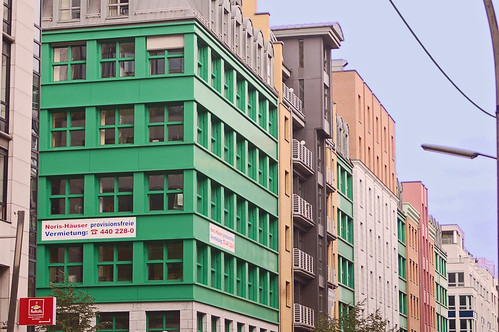
These blocs are about as archetypical as you can get, blocky style, square buildings, 5-stories, potentially ghastly colors, etc. They have been well-maintained and renovated, they are in a nice part of East Berlin, granted, but as other areas of Eastern Europe continue to improve, I'm optimistic more and more of these blocs will be renovated as such and probably sold for high rents, as is happening all over Eastern Europe already. Try getting a small studio flat inside Moscow for under $1 Million (actually, it's close to impossible).
Actually, when I see those buildings and others like them, I think that they look kinda cool and urban. They've dressed them up and given that these were actually built along a streetwall reinforcing a great street, for me it is a positive environment. There are probably some very expensive lofts, offices, or galleries in this building. Just think, what kind of adaptive reuse could someone get out of Del City-style neighborhoods?
This design for the Wiggin proposal for the former Mercy Hospital site in Mid-town has been called "Eastern Bloc" architecture. Or actually, I like the OCURA committee report's euphemism for that: "Institutional." Really? It is a blocky building, with edgy urban accents, and brick masonry. If this is "Eastern Bloc" architecture, then all of Bricktown is Eastern Bloc motif. Or, excuse me, I meant to say "institutional."
Friday, February 18, 2011
The latest on UNP
Here is the new updated flier for the University North Park project. This is an absolute crime. That whole deal is as corrupt as it gets. The old switch and bait, once the citizens give the developer the TIF he wants.
What's a shame is that there are other developers who build shoddy strip mall crap, probably a little better than this, who still play by the rules and pay property taxes and don't get the city to build parks and infrastructure for them. What kind of a message does this say toward that? What kind of a message does this say in terms of validating the free market? All this is: corruption, cronyism, lack of vision, and incompetence.
And the saddest thing is that OU's foundation was behind this project from the beginning.
Sunday, February 13, 2011
Choctaw Town Square
Interesting things happening in Choctaw. They actually broke ground on their new Town Square development, at 23rd and Henney.
Somewhat, urban? Interesting indeed.
Choctaw Town Square Development from Mark Seibold on Vimeo.
Somewhat, urban? Interesting indeed.
Wednesday, February 9, 2011
"It's [not] the economy, stupid"
Everyone stop what you're doing, there's a really quick important message you need to see: Stop blaming the economy. It's getting old. By now, if you're a successful developer whose head isn't up your bum, you've figured out how to make things work.
This guy (Stanton Nelson), is not a successful developer. His project, the University North Park/University Town Center (not), has been in limbo for a few years. It started with a bang, winning approval from Norman residents for a TIF district which helped pay for basic infrastructure, lured an Embassy Suites hotel as an anchor, and he was able to build big retail anchors such as a Super Target and Kohl's among others.
 Then the problem came with what was next: The lifestyle center, which he was contractually obligated to build, was supposed to be built in the next phase, due east (across the super-nice 24th Street with curves that the city built him) from the Target. Was it the economy, or was it that he was never prepared or willing to build the lifestyle center from the beginning? You decide. But one thing is clear, this guy was a clown from the beginning, and Normanites were delusional to ever believe him while he was blowing smoke and naming potential tenants that wanted to sign with him, tenants such as: Oh yeah, Restoration Hardware, Banana Republic, Urban Outfitters, Anthropologie, Trader Joe's, a Whole Foods of course, and a whole host of other big-name retailers that OKC and Tulsa have even been clamoring for (except Tulsa already has several of them). First mistake: real developers don't drop names like that. Second mistake: real developers don't do things contingent on taxpayer help, without which their project is doomed. Third mistake (lookin at you, OU): real developers don't name a project after a university that is located 3-4 miles away.
This guy is not a real developer.
 Now Norman is looking to move on. He will likely not be involved in this development much longer, so Norman is hoping for the best case scenario: move on, shut him down with penalties, and get a more competent developer to come in. Sounds good.
The problem is that it hinges on the development of the Legacy Park. The contract the city and he entered into was that the city would build the park, he would build the lifestyle center. If one party failed, the failing party would pay a penalty to the other, in this case, it will be the developer. The city will spend $5.9 million on the park and then probably get that back under the terms of the penalties, but in order to prevent that from happening, the developer is refusing to donate the land to the city in the first place, which was also in the contract.
He's citing economic problems for why he can't donate the land to the city. It's great that he's looking out for the city's best fiscal interest, but it's plainly obvious he's just trying to prevent what would proceed after that from his failure to develop the lifestyle center, I believe by 2016 (it is now 2011, obviously..4-5 years into the development schedule of this project). Call a spade nothing but a spade. The city has the money because it comes from the TIF, which has been generating a lot of revenue ever since Target went in, and would generate even more revenue for the city if Stanton Nelson were actually a serious developer capable of pulling this project off.
Here's my take: Recall James Carville's famous quote, "It's the economy, stupid." In this case, Mr. Nelson, "It's not the economy, stupid. It's you." Look all around the metro, and even more, look in some of the cities across the nation that are still being very successful. Large developments are still occurring, quite contrary to Nelson's lame argument that "nobody is building lifestyle centers right now." Which begs the question, if that were true, then what ARE they building? Because Moore is moving forward with the Fritts Farm project (Target has already broken ground WITHOUT taxpayer subsidies in this case), the Moore Warren is fixing to pull of another ambitious expansion that will make it truly impressive, and among countless other projects, even Midwest City is going forward with the next expansion phase of their town center which is far better than anything built in this area of Norman lately. In West OKC, the walls have been going up for a few months on the massive new outlet mall out there. You don't think that project could be pulled off if "nobody is building lifestyle centers right now" ?? The City of OKC invested in that project purely to defend its tax base from the other ankle-biting suburbs.
Clearly the economy is not stopping the momentum in Moore, which is continuing to literally suck the life out of Norman's tax base at this point. This is something that the City Council, looking for its livelihood to support its civic services and infrastructure, is most concerned with. A guy who can not build a lifestyle center in a development that is already anchored by an Embassy Suites, a city-developed park, a Super Target, a Kohl's, and more--and then makes lame excuses for himself, is not just a failure in this particular project, but is a total all-around business failure. I am a college kid, give me a chunk of land already anchored by all of these things that other retailers would clamor to be around, and I could do better than what Stanton Nelson wants to finish out his development with: Jack in the Box, GameStop, Portrait Studio, Discount Tires.
I think penalties are a euphemism for how the City of Norman should treat this guy, who must be a secret double agent developer working for Moore on a mission to prevent Norman from growing its tax base and retail amenities. That is the only explanation I can think of. I'd say the city needs to file as many actions as possible to take this guy to the cleaners literally (or whatever he built instead of say, the GAP, or Dillard's).
Friday, November 27, 2009
Why should I support MAPS?
 A good question was posed in a comment that I hadn't responded to until now. I saw the comment two days ago and thought it as a great subject to cover in a whole post, so that's why I waited till now to respond. In all honesty, I don't think the subject has been addressed: say you're a suburb person who's still undecided, a family man who has had trouble utilizing downtown fully (i.e., Bricktown isn't the most 'family friendly' place), who prefers to shop in Yukon and Quail Springs, how does MAPS benefit YOU -- why should YOU vote yes on Dec. 8th?
That is a good question.
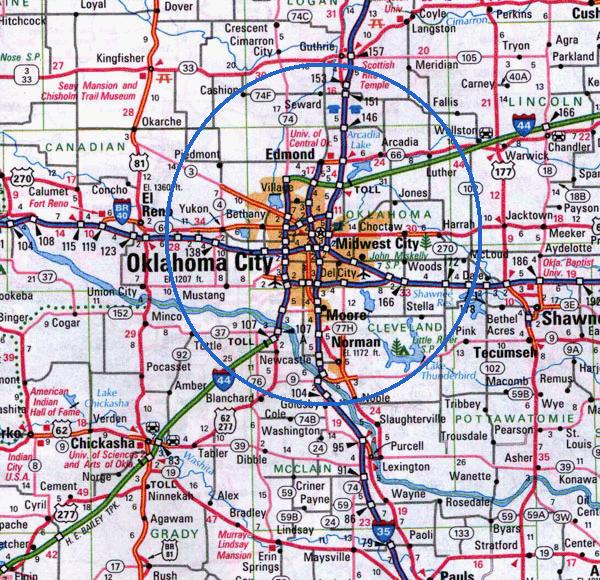
 While I can come up with a few creative ways to utilize MAPS, some that are probably semantics (like Steve alludes to the pay-to-park areas of Bricktown, when I've never paid for parking in Bricktown in my life), the best reason why such a person's MAPS support is needed is because of what it does for the overall city. Even if someone had might as well live in Edmond or Moore city limits, they should support MAPS for the impact that it has on the entire OKC metropolitan area.
Outlying areas of OKC stand to gain from MAPS in two ways: the quality of life amenities are available to anyone in Central Oklahoma, and the economic impact is enjoyed by everyone in Central Oklahoma. Even if you aren't going to NBA games, attending the symphony, or catching ball games at the Brick, chances are a lot of people in your community are. So the quality of life impact is still in your community, and there are people in your community who will still have the opportunity to take advantage of those things.
 Furthermore, the entire metro area was suffering when OKC was a place "nobody would want to live in." Now that OKC is a desirable metro to live in, the entire Central Oklahoma region benefits from economic expansion. A lot of the economic expansion that's resulted from OKC's raised profile has occurred in the suburbs. While none of these projects are included in the $5 billion economic impact of the $360 million MAPS 1 package (which only includes private investment downtown directly linked to MAPS), they are still a result of economic development initiatives such as MAPS 1. Think of all of the major employers that are now up on Memorial Road, or think of all of the new private sector jobs down by Tinker, or new companies that have set up in Edmond or Norman.
 Will MAPS 3 actually raise the bar for the metro-wide economy? Undoubtedly. The overall focus of MAPS is cumulative, and the projects support each other, so that pet project bickering doesn't defeat any one proposal. Some of the projects, the ones that citizens don't always see themselves using the most, are probably the ones that will actually benefit the economy the most. So in other words, if you're someone who just doesn't come downtown that much, there are still projects that resemble your tax dollars hard at work for you that are benefiting you without having to come downtown. The convention center is the #1 such item. The convention center will be bringing business people to OKC, having them spend dollars generated in another city here in this city, raise OKC's profile in the business world (which will have intangible value), and by having such a state-of-the-art corporate amenity in downtown, it will help us attract more corporations to more their HQs to Oklahoma. More importantly, it will provide resources to help grow Oklahoma-based companies.
Repudiating government
Steve brings up another excellent point: "But now in these tougher economic times where the federal government wants to take more such as forced health insurance with large tax increases- and I really can't do much about it because far left Dems are in charge - I feel this is something I can say no to. It's not "fair" but it's the environment MAPS3 is in."
 I like to think of the different levels of government as being fairly separate, and while the federal government apparently can absolutely ignore the people in a state like Oklahoma, there are governments that can not. State, county, and city governments don't have the same aptitude for criticizing, ignoring, and offending Oklahoma values, because they actually answer to our values (and economic development has traditionally been a Republican priority here). MAPS 3 is Oklahoma City's response to the Stimulus, because the Stimulus did absolutely nothing for us. Maybe MAPS 3 can even be used as an example by the media to make the Stimulus look even worse, when it is enacted and actually fulfils every one of its promises: it will create direct jobs (thousands of construction jobs), it will create indirect jobs (economic expansion), it will improve quality of life, it will leave a lasting impact, it will unify a community much like the first MAPS did, and more.
All of these things it will do because the first MAPS did, all of these things the Stimulus will fall well short of and there's nothing we can do about that, unfortunately. All we can do is take charge of OKC's economy so that we are controlling our own future, so that we never sink to the level of the communities that actually are in the unfortunate predicament of relying on the federal government Stimulus (i.e., places like California and Michigan).
Tuesday, November 3, 2009
Calgary: Urban and Suburban

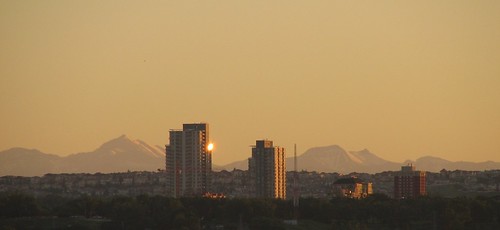
If I haven't mentioned lately how strongly I feel about Calgary being "God's Country" let me go ahead and say that now. Man I love it here. And for the record, even though I might put up some pics I've taken around Calgary lately, this pic was shot by SurrealPlaces on SSP. I just think it really shows the vastness of the Calgary skyline looming in the distance of some nice topography.
Even though the urbanites here in Calgary have a strong dislike of the suburban sprawl that has been occurring here, I just keep reminding them how much worse it could be. Calgary still has a huge downtown population, and is adding thousands each year. The entire metro is pretty accessible with a great highway network and great LRT (c-Train) access. This is something that OKC could easily become in 20-30 years if it invests in all the right infrastructure.
Monday, August 3, 2009

Saturday, July 18, 2009
Norman's University Town Center..renderings
I was cleaning out my hard drive and came across these, some renderings that I had for the Town Center that will eventually get built as a part of University North Park/University Town Center. It's such a shame, how many excellent projects OKC had in the works that got momentarily derailed by the national economy. It's fortunate that most of these developments haven't been canceled, just pushed back until there is some recovery and loosening up in the national retail market.


So in the meantime feast your eyes on these:


Friday, September 19, 2008
Subscribe to:
Posts (Atom)