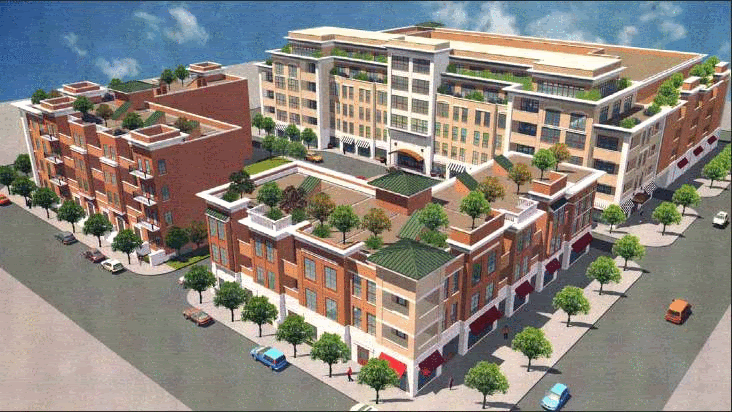
Go get 'em, Steve. Apparently a number of Heritage Hills residents are raising concerns about the quality of The Edge project by Gary Brooks.
Look, I didn't like the project BEST, but I can admit it's a good project. I moved on from arguing about OCURA/Alliance's flawed selection process, and if I can move on from something, that's probably saying a lot.
But for Heritage Hills residents, I guess paying a whopping $1,000/mo rent for a 1 br apartment will spoil the neighborhood. Are these people pretending there aren't still a few flophouses still in operation around Mid-town??
Brooks has done nothing but reassure skeptics of his development with moves like the recent announcement that they'll pursue LEED certification (silver, as I recall). This will be the first LEED certified mixed-use project in Oklahoma, a designation that was probably going to go to Grant Humphreys' Flatiron before that project died.
I am a critical guy, that secret is certainly out. I am also going to be pretty outspoken about my criticisms, as I was with this project for a while. What I love, and I mean really love (what keeps me going), is when I can admit I was wrong and I have to eat my own words. I'm happily eating my words so far on this project, but I don't want to knock on wood since The Edge only just got the building permit this month.
Perhaps some Heritage Hills residents will also enjoy eating their words once this project is a pleasant surprise to them. I think it will be an excellent contribution to Mid-town.
Everything you could possibly want in this project is there: They made site plan concessions to incorporate the streetcar curve, this will be very transit-oriented. They added ground floor retail when the city pressed them on it. And as I've repetitively mentioned, it will be LEED. I think that the targeted demographics (young professionals looking to pay $1,000/mo for 1 really nice bedroom) is also just perfect.
Showing posts with label OCURA. Show all posts
Showing posts with label OCURA. Show all posts
Thursday, January 12, 2012


Tuesday, April 26, 2011
Allied Powers
JoeVan Bullard resigns as Urban Renewal Director. Well, this was probably coming, with all of the heat OCURA has been under.
But it seems like that was rather anti-climatic. At any rate, everything that follows is incredibly confusing. We've been operating with OCURA for many decades now. First OCURA was powerful and all of downtown development revolved around it, and since it's become less omnipotent and more of an agent that the city can use to encourage more private development in an area.
Now here's a curve ball. Larry Nichols is back as Chairman. If you recall, Nichols resigned right after Devon Tower was first announced to avoid a conflict of interest in the land deal that followed. Now they propose to collapse OCURA into this new overarching "Alliance for Economic Development" which will operate as a non-profit tasked with extraordinary influence by City Hall. They say they want this to help them pursue large-scale Core2Shore redevelopment, which makes sense.
It's still hard not to feel uncomfortable with a restructuring of such power. Let's not pretend that the proposed Alliance will not have extraordinary power. Even if it just assumes OCURA's role, that is still a lot of power, especially as the city will probably acquire more pivotal development plots of land. Then they're wanting to bring even more responsibilities into the fold of this new organization, essentially every economic development responsibility that either City Hall, the Chamber, or the CVB are currently already pursuing. That's a LOT.
Kathy O'Connor and others have said that this Alliance would not wield any power. It's statements like that which make me want to run away as far as possible from this thing. I would feel a thousand times more comfortable if they were straight-forward about the power (aka "responsibilities") of this organization.
And that's not even getting into the point of contention regarding the make-up of this Alliance..
But it seems like that was rather anti-climatic. At any rate, everything that follows is incredibly confusing. We've been operating with OCURA for many decades now. First OCURA was powerful and all of downtown development revolved around it, and since it's become less omnipotent and more of an agent that the city can use to encourage more private development in an area.
Now here's a curve ball. Larry Nichols is back as Chairman. If you recall, Nichols resigned right after Devon Tower was first announced to avoid a conflict of interest in the land deal that followed. Now they propose to collapse OCURA into this new overarching "Alliance for Economic Development" which will operate as a non-profit tasked with extraordinary influence by City Hall. They say they want this to help them pursue large-scale Core2Shore redevelopment, which makes sense.
It's still hard not to feel uncomfortable with a restructuring of such power. Let's not pretend that the proposed Alliance will not have extraordinary power. Even if it just assumes OCURA's role, that is still a lot of power, especially as the city will probably acquire more pivotal development plots of land. Then they're wanting to bring even more responsibilities into the fold of this new organization, essentially every economic development responsibility that either City Hall, the Chamber, or the CVB are currently already pursuing. That's a LOT.
Kathy O'Connor and others have said that this Alliance would not wield any power. It's statements like that which make me want to run away as far as possible from this thing. I would feel a thousand times more comfortable if they were straight-forward about the power (aka "responsibilities") of this organization.
And that's not even getting into the point of contention regarding the make-up of this Alliance..
Wednesday, April 20, 2011
OCURA: How important is experience?
This is the funny thing, is that somehow OCURA or the committee advising them has warped the term experience, according to reports on Steve's blog into a positive for the Henderson proposal. The Henderson proposal includes an enormous suburban setback from Walker Ave and zero retail or anything else listed as desirable in the report.
But the experience is a particularly interesting point. If one were using actual logic diagrams to pin who has experience as a developer before, I think the report would have looked so much more different. I'm not even talking about the grids that are usually routinely used in these kinds of site decisions. I'm just talking about making a decision using logic. Neither of which were clearly done here, hell, apparently the developers weren't even allowed to make a 10-minute pitch for their project.
But, the point here is experience, and who's got it.
Mike Henderson:
Successful developer, overwhelmingly suburban
Familiar with OCURA processes
Had problems meeting deadlines in past
Had financial problems in past
Integrity issue, completely changed Legacy
Questions about delivering exactly what is proposed
Requesting HUD financing for development
Dick Tanenbaum:
Successful urban and suburban developer
Successful with apartment projects
Successful with mixed-use projects
Successful with historic projects
Not requesting HUD financing for development
Builds exactly what he proposes (in this case, a suburban complex)
Chuck Wiggin:
Successful urban developer
Successful with many DT Tulsa projects
Successful with historic projects
Successful with apartment projects
Successful with mixed-use projects
Familiar with OCURA processes
Had problems in past with deadlines
Mixed history in OKC, after Overholser Green
Requesting HUD financing
Did propose changes to OG after approval
Marva Ellard:
Successful urban developer
Especially committed to historic preservation
Successful with many DT OKC projects
Successful with apartment projects
Successful with historic projects
Familiar with OCURA processes
Got out of The Hill before it went negative
Ended up being proved right by OG
Builds exactly what she proposes
So it's funny, because if you're looking at people's PAST experience, it seems like OCURA is heavily lauding Mike Henderson. A more accurate tally would look more like, scored from 1-10:
Ellard: 10
Tanenbaum: 10
Wiggin: 8
Henderson: 6
Now obviously a lot more goes into this, because I'm not going to recommend Tanenbaum's development this time. I honestly have to wonder if he thought anyone else would submit a proposal, judging by what little attention he put into his project compared to other applicants. But if you're going by experience alone, obviously Henderson actually does not have a clear lead there. Anything but, in fact.
(I like the Wiggin and Ellard proposals.)
But the experience is a particularly interesting point. If one were using actual logic diagrams to pin who has experience as a developer before, I think the report would have looked so much more different. I'm not even talking about the grids that are usually routinely used in these kinds of site decisions. I'm just talking about making a decision using logic. Neither of which were clearly done here, hell, apparently the developers weren't even allowed to make a 10-minute pitch for their project.
But, the point here is experience, and who's got it.
Mike Henderson:
Successful developer, overwhelmingly suburban
Familiar with OCURA processes
Had problems meeting deadlines in past
Had financial problems in past
Integrity issue, completely changed Legacy
Questions about delivering exactly what is proposed
Requesting HUD financing for development
Dick Tanenbaum:
Successful urban and suburban developer
Successful with apartment projects
Successful with mixed-use projects
Successful with historic projects
Not requesting HUD financing for development
Builds exactly what he proposes (in this case, a suburban complex)
Chuck Wiggin:
Successful urban developer
Successful with many DT Tulsa projects
Successful with historic projects
Successful with apartment projects
Successful with mixed-use projects
Familiar with OCURA processes
Had problems in past with deadlines
Mixed history in OKC, after Overholser Green
Requesting HUD financing
Did propose changes to OG after approval
Marva Ellard:
Successful urban developer
Especially committed to historic preservation
Successful with many DT OKC projects
Successful with apartment projects
Successful with historic projects
Familiar with OCURA processes
Got out of The Hill before it went negative
Ended up being proved right by OG
Builds exactly what she proposes
So it's funny, because if you're looking at people's PAST experience, it seems like OCURA is heavily lauding Mike Henderson. A more accurate tally would look more like, scored from 1-10:
Ellard: 10
Tanenbaum: 10
Wiggin: 8
Henderson: 6
Now obviously a lot more goes into this, because I'm not going to recommend Tanenbaum's development this time. I honestly have to wonder if he thought anyone else would submit a proposal, judging by what little attention he put into his project compared to other applicants. But if you're going by experience alone, obviously Henderson actually does not have a clear lead there. Anything but, in fact.
(I like the Wiggin and Ellard proposals.)
Friday, September 17, 2010
Oh OCURA..

I originally came out as a huge proponent of Overholser Green. I argued that it was more appropriate for the location, given that the original proposal had a historic motif that fit in well with other nearby large upscale apartment buildings on the far north edge of Mid-town, such as the Seiber and the Aberdeen, among others. I thought it was urban enough that it was also appropriate for what we're trying to create in Mid-town. I also liked that it appealed to this imaginary pool of hundreds of people out there looking for million-dollar condos downtown.
 I thought such a pool of people existed..why? Because that's what OCURA said, that's what DT OKC Inc. said, that's what the Chamber said, and that's what tons of other people who knew their stuff were all saying. It made sense: In order to maximize demand at every single price point we would have to work our way down, first focus on the most upscale stuff and keep out anything under $1,500/mo because that may turn away some of this prospective demand. In hindsight it sounded so great and I was so convinced by this line of thinking that I am shocked I was not advocating for downtown to be surrounded by gated entrances and ramp up efforts to keep creative types out. After all, they bring undesirable elements, and we were truly pursuing downtown development while at the same time using an economic model not at all unsimilar to Edmond real estate. Marva Ellard was obviously right all along, well before the establishment realized it, and that's to her credit..unfortunately we'll just have to wait a while till we see her next project, hopefully.
I have obviously since changed my mind. In fact I wouldn't have if I hadn't seen the mistake of all these condos selling for almost a million dollars. I wouldn't have fallen for it in the first place had I understood basic economics, but luckily, some modicum of economic understanding does come hand in hand with learning about urban planning, architecture, and sustainability--the things I CAN talk about. You start from the ground up, always, everyone knows that, and downtown was a NEW and untested residential market for the most part.
How do we apply this knowledge to public policy? Simple, bid selection. When it comes to the big downtown projects I really believe that OCURA has never engaged in a corrupt deal. They've engaged in TONS of bad, knuckle-headed deals though. Their incompetence, perhaps unfamiliarity with their own rules, and general lackluster due diligence sure screwed Anthony McDermid as well as the people of OKC who drive past a mud field backing up to I-235 every day. It's simple though, they have always preferred $$$ condos in selecting bids, because that's what we thought we needed. And to this day, they are still operating like that due to how slow they are to catch on. Even DT OKC Inc. under its new leadership has caught on and is about to release a new housing survey that will give us some more realistic advice on how best to grow downtown. I hate surveys and I think they're a waste of time, but if it truly shows what we already know, hopefully that will be the evidence that OCURA needs to slowly reshift its strategy over the next few years. Evidently they are still grasping on to the faulty economics preached in the earlier half of this decade.
Bringing it back to Overholser Green, Chuck Wiggin is still trying to get this project off, despite that Overholser Green isn't even close to resembling what was originally approved. Even without any new news on the matter, the fact that the project is already up for its second (or third, I forget) timeline extension tells you that the project is dead and it is time to move on. There is nothing going to happen here. Give Wiggin another extension and he still can't guarantee that anything will happen, and his only response/excuse is to explain why we're in a recession--this despite that his units in the Mayo 420 project in Downtown Tulsa are selling just fine. What this is about is pride and giving too many chances to Wiggin just because he has already invested $200,000 personally into this project. I understand that, and it is important to take care of important development figures because we very much want Wiggin to continue to be involved in downtown development and he's done several great projects in the past. Sour grapes over this benefits nobody, but it could even be to Wiggin's benefit that his contract be yanked by OCURA and he be forced to move on as well, before he plunks down even more change into a project that is still doomed.
Sometimes there's nothing wrong with a site, just after reformatting a project over and over, it's just time to throw the towel in and take a step back and remove yourself from the situation. The old Mercy Hospital site is a great site, but it needs a fresh set of eyes to look it over. Enter Dick Tanenbaum, stage right. Tanenbaum, who has pulled off a ton of incredibly successful downtown apartment buildings (and learned his lesson with the unsuccessful condo conversion of the Montgomery), wants to build 250 apartment units, moderately priced, with mixed-use retail on site. And he says he can get it off the ground by early next year, in fact, he already has conceptual drawings that he can show interested parties. Ladies and gents, we have a winner.
When Wiggin claims that he should be granted an extension that he still may not be able to make any progress by even if he once again completely revamps the project to some unknown format that would be more economically feasible, which could be anything and OCURA would likely not insist on due diligence with that, and on the other hand Dick Tanenbaum can show you exactly what he wants to build and says he can get it off early next year--how can you not move on from Overholser Green? I think that nobody wins by looking at this as a Wiggin v. Tanenbaum issue. Nobody wins by looking at this as an Overholser Green v. Whatever, or even Overholser Green v. Mercy Park, issue.
The two most important points that win the argument at the end of the day in my opinion, and have been sorely overlooked are:
 1. This site is holding up progress elsewhere along Walker Avenue, and it is time to get a move on and finally get something going on here. The businesses along Walker Ave, such as Midtown Deli, Irma's, etc are surviving just on the lunch crowd and have only been staying open in hopes that the residential population around there will grow and be able to support dinner hours in the future. Banta would have developed the Osler and 1212 long ago had the Mercy Hospital site been redeveloped sooner, and now that those properties are in the hands of Bob Howard and Mickey Clagg, I see no reason for them to move on those properties until redevelopment commences on that site as well. I do however see every reason for them to prioritize those projects next ASAP once someone, anyone, breaks ground on the site further up Walker. That is the project that is holding a lot of the Walker Ave projects behind.
2. Even if Wiggin does revamp his project and get it off the ground, we have no say in that if he's given a contract extension, and that's not right. Developers should be awarded bids based on the project that they will build, and it is not right for developers to present a concept just to get the competitive bid and then completely reformat the project, even if they have a good excuse. The reason Wiggin got the bid was because OCURA liked his project the best, and that should be an obligation to build THAT project. OCURA should yank his bid just for deviating from the original plan, alone. OCURA should definitely not renew his contract just so that he can deviate even further from the original plan and not even present anything new to give us an idea of WHAT he's going to build, other than promise that he is working on it. OCURA should also grow some gonads, because this is how they've always operated from the start of time.
(This post is under review and will change from time to time, and I will add pictures later, so check back.)
Sunday, March 28, 2010
Doing a world of good in the inner city
A lot of times, I seem like a pretty critical guy--especially when it comes to the Oklahoma City Urban Renewal Authority, the Downtown Design Review Committee, the Central Oklahoma Transit & Parking Authority, the Mayor's office especially, and virtually everyone that's not the Chamber of Commerce. But here's the reality guys: OCURA, DDR, and COTPA are all doing an alright job. They deserve to be questioned, and hopefully all the constructive criticism I endlessly lavish on them can help them raise the bar. Here's some examples of each agency doing a world of good in the inner city.
 Starting with OCURA. OCURA has kind of become the whipping boy for crappy development on this blog, and the scapegoat that I like to blame everything on. That's not fair to them, and to paint an accurate reflection of the complete picture, I want to write about something REALLY, REALLY GOOD that OCURA has done, and that is where they have made a world of good in the inner NE side of OKC with the redevelopment of the JFK area. I sort of assume that this is one of the reasons why the new Douglass High School has been infinitely more successful than the new John Marshall High School gang-central, and the brand new U.S. Grant High School which is so gang-infested that OCPS decided last week to just close down. Douglass has shown how a high school and a neighborhood redevelopment project can go hand in hand and raise an entire community to a new level.
The JFK redevelopment project is a huge city area bounded by M.L.K. Ave. to Stonewall Ave, and NE Fourth St to NE Eighth St. Since 2003 the neighborhood, in the heart of a blighted ghetto area with some of the city's highest crime rates, has seen more than 100 new homes built since 2003. 20 years ago the entire area was leveled, and now OCURA is hoping to gain some neighborhood retail that people can walk to along the east end of the neighborhood. OCURA started out in the right direction by marketing the land to spec builders and giving them the land practically for free, but things really took off when they did the unconventional, and let single home buyers (rather than developers) purchase plots and build their own dream homes on the site--including that of Oklahoma Highway Patrolman Wayne Linzy, who has become a community pillar along with his big, oversized 3-car garage house. Word of mouth in the community among friends, family, and church members has turned the redevelopment project in Oklahoma City's African American community into OCURA's best mixed-use redevelopment project. Right now OCURA has agreements with builders to develop 39 more new homes in the next year. The new homes in JFK range in price from $100,000 to over $300,000, and the lower-end houses offer more value than homes in Moore or Edmond due to tax credits the builders have utilized.
In the heart of Oklahoma City's African American community, OCURA has done a world of good in the inner city that everyone in OKC can be proud of. By stepping in and facilitating the development of a true community centered around community churches, the new Douglass High School, new retail to come, and respectable friends and family who would have otherwise contributed to the inner city exodus, OCURA has helped lay a foundation for social change in the inner city. By turning the tide of failure and neglect into momentum of success and change, OCURA is truly helping strengthen an important community in OKC.
Another much maligned agency that's been doing very well lately is COTPA. And what a difference a year makes in the case of COTPA, although they've got their work cut out for them in terms of restoring their reputation. A year ago the criticism was that COTPA has ran its parking garages into the ground (to the point that they're eyesores), ran out any retail tenants, running the worst bus system in the nation, embarking on these laughable "transit" projects like the Spirit Trolleys and the Oklahoma River Cruises, and so on. COTPA was by all means an embarrassment. NOW though COTPA has gotten serious about fixing some of its down falls. There's been a lot of discussion about reforming the bus service and switching to a grid system, where routes just follow the street grid instead of complicated turns here and there. COTPA, from what I hear, is also about to renovate the Santa Fe Parking Garage, which is a start. They hope to give it a less offensive facade, and move in the Red Earth Museum to its ground floor space.

Most importantly with the new COTPA is getting serious about streetcar, since it looks as though whether or not COTPA gets it together, they will be overseeing the streetcar part of the project. But the good news is that COTPA is now taking a proactive role in the formation of the project, years after the Fixed Guideway Study was released. Unfortunately the FGS is still going to be guiding a lot of the discussion in the beginning, but it's a start nonetheless. What I'm talking about is the Let's Talk About Transit public forums. These will be a series of public forums, much like the Core 2 Shore meetings, that will shape the streetcar project. The focus will be on alternatives analysis, route selection, and educating the public..although I feel like the public is already pretty familiar with streetcar given that the item carried the MAPS 3 ballot for the most part.
The Let's Talk Transit movement is well underway, with the launching recently of the new website here. On the website you can give your input on the pending streetcar system. The 7 public meetings will take place over the course of March, April, and May. I'm also excited about these forums personally, as COTPA's PR firm contacted me about covering the meetings as an independent guest blogger. I'm excited to be able to help out however I can in contributing to a turnaround in COTPA's handling of transit. Here is the meeting schedule:
March 29, Noon -- Council Chambers
March 29, 6-8 pm -- Council Chambers
*April 13, 6-8 pm -- Hall of Mirrors
April 29, 6-8 pm -- Hall of Mirrors
May 11, 6-8 pm -- Hall of Mirrors
*May 27, Noon -- Council Chambers
*May 27, 6-8 pm -- Council Chambers
The star denotes meetings I will be covering. But I would encourage readers to make as many of these as they can and to speak up and make your ideas and concerns about transit heard. If you have a route suggestion, any opinion on streetcar, etc--it's all fair game, and that's the point of these forums. You can read about the other guest bloggers here, and also there will be an online message board soon where you can join and post freely about OKC transit. Your ideas will be heard and taken into account.
 Another downtown agency that's doing a good job, although they haven't necessarily been doing a bad job in the past, is DDR--the Downtown Design Review Committee. DDR is the committee that oversees building permit applications in the city core and analyzes the design merits of each application. It's board consists of volunteers who have a high level of expertise in Downtown, including architects such as Anthony McDermid, and developers such as Chuck Ainsworth. A lot of times it seems as though crappy property owners and their works slips through the cracks in the system, but sometimes Brewer projects in the past were just given permits without even being processed. And even Brewer projects have gotten remarkably better.
DDR is also the group that recently evaluated the contentious SandRidge proposal. They evaluated the arguments from both sides and tried to make sense of it all..they decided that the SandRidge people saying the India Temple can't be saved were pretty persuasive and the urbanists saying that the KerMac Bldg can be saved were also pretty persuasive. The solution, they decided, was to defer the decision on SandRidge Commons and take a field trip to the SandRidge site and evaluate the buildings for themselves. I am also glad that I had a chance to help the urbanist camp, as a letter I emailed to Scottye Montgomery that morning was read at the meeting earlier this month.
DDR decided to defer the SandRidge decision to a special meeting April 8, 2010 at 8.30 in the Council Chambers. Props to DDR, whatever they decide to do on the matter, for doing due diligence and getting to the bottom of the issue: whether the buildings can be preserved or not. DDR has a strong track record of reinforcing historical integrity issues and their members are highly responsive to citizen letters. DDR, just like OCURA in JFK and COTPA in turning itself around in general, is a city agency that is truly doing the work of the people.
 Starting with OCURA. OCURA has kind of become the whipping boy for crappy development on this blog, and the scapegoat that I like to blame everything on. That's not fair to them, and to paint an accurate reflection of the complete picture, I want to write about something REALLY, REALLY GOOD that OCURA has done, and that is where they have made a world of good in the inner NE side of OKC with the redevelopment of the JFK area. I sort of assume that this is one of the reasons why the new Douglass High School has been infinitely more successful than the new John Marshall High School gang-central, and the brand new U.S. Grant High School which is so gang-infested that OCPS decided last week to just close down. Douglass has shown how a high school and a neighborhood redevelopment project can go hand in hand and raise an entire community to a new level.
The JFK redevelopment project is a huge city area bounded by M.L.K. Ave. to Stonewall Ave, and NE Fourth St to NE Eighth St. Since 2003 the neighborhood, in the heart of a blighted ghetto area with some of the city's highest crime rates, has seen more than 100 new homes built since 2003. 20 years ago the entire area was leveled, and now OCURA is hoping to gain some neighborhood retail that people can walk to along the east end of the neighborhood. OCURA started out in the right direction by marketing the land to spec builders and giving them the land practically for free, but things really took off when they did the unconventional, and let single home buyers (rather than developers) purchase plots and build their own dream homes on the site--including that of Oklahoma Highway Patrolman Wayne Linzy, who has become a community pillar along with his big, oversized 3-car garage house. Word of mouth in the community among friends, family, and church members has turned the redevelopment project in Oklahoma City's African American community into OCURA's best mixed-use redevelopment project. Right now OCURA has agreements with builders to develop 39 more new homes in the next year. The new homes in JFK range in price from $100,000 to over $300,000, and the lower-end houses offer more value than homes in Moore or Edmond due to tax credits the builders have utilized.
In the heart of Oklahoma City's African American community, OCURA has done a world of good in the inner city that everyone in OKC can be proud of. By stepping in and facilitating the development of a true community centered around community churches, the new Douglass High School, new retail to come, and respectable friends and family who would have otherwise contributed to the inner city exodus, OCURA has helped lay a foundation for social change in the inner city. By turning the tide of failure and neglect into momentum of success and change, OCURA is truly helping strengthen an important community in OKC.
Another much maligned agency that's been doing very well lately is COTPA. And what a difference a year makes in the case of COTPA, although they've got their work cut out for them in terms of restoring their reputation. A year ago the criticism was that COTPA has ran its parking garages into the ground (to the point that they're eyesores), ran out any retail tenants, running the worst bus system in the nation, embarking on these laughable "transit" projects like the Spirit Trolleys and the Oklahoma River Cruises, and so on. COTPA was by all means an embarrassment. NOW though COTPA has gotten serious about fixing some of its down falls. There's been a lot of discussion about reforming the bus service and switching to a grid system, where routes just follow the street grid instead of complicated turns here and there. COTPA, from what I hear, is also about to renovate the Santa Fe Parking Garage, which is a start. They hope to give it a less offensive facade, and move in the Red Earth Museum to its ground floor space.
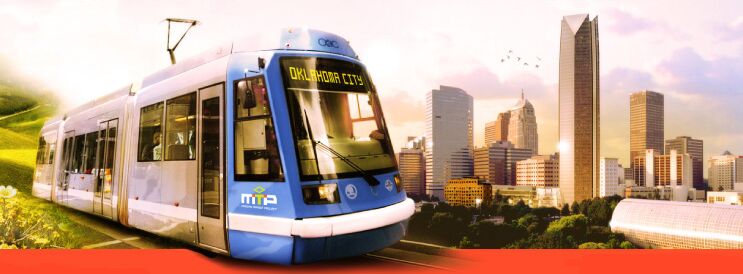
Most importantly with the new COTPA is getting serious about streetcar, since it looks as though whether or not COTPA gets it together, they will be overseeing the streetcar part of the project. But the good news is that COTPA is now taking a proactive role in the formation of the project, years after the Fixed Guideway Study was released. Unfortunately the FGS is still going to be guiding a lot of the discussion in the beginning, but it's a start nonetheless. What I'm talking about is the Let's Talk About Transit public forums. These will be a series of public forums, much like the Core 2 Shore meetings, that will shape the streetcar project. The focus will be on alternatives analysis, route selection, and educating the public..although I feel like the public is already pretty familiar with streetcar given that the item carried the MAPS 3 ballot for the most part.
The Let's Talk Transit movement is well underway, with the launching recently of the new website here. On the website you can give your input on the pending streetcar system. The 7 public meetings will take place over the course of March, April, and May. I'm also excited about these forums personally, as COTPA's PR firm contacted me about covering the meetings as an independent guest blogger. I'm excited to be able to help out however I can in contributing to a turnaround in COTPA's handling of transit. Here is the meeting schedule:
March 29, Noon -- Council Chambers
March 29, 6-8 pm -- Council Chambers
*April 13, 6-8 pm -- Hall of Mirrors
April 29, 6-8 pm -- Hall of Mirrors
May 11, 6-8 pm -- Hall of Mirrors
*May 27, Noon -- Council Chambers
*May 27, 6-8 pm -- Council Chambers
The star denotes meetings I will be covering. But I would encourage readers to make as many of these as they can and to speak up and make your ideas and concerns about transit heard. If you have a route suggestion, any opinion on streetcar, etc--it's all fair game, and that's the point of these forums. You can read about the other guest bloggers here, and also there will be an online message board soon where you can join and post freely about OKC transit. Your ideas will be heard and taken into account.
Another downtown agency that's doing a good job, although they haven't necessarily been doing a bad job in the past, is DDR--the Downtown Design Review Committee. DDR is the committee that oversees building permit applications in the city core and analyzes the design merits of each application. It's board consists of volunteers who have a high level of expertise in Downtown, including architects such as Anthony McDermid, and developers such as Chuck Ainsworth. A lot of times it seems as though crappy property owners and their works slips through the cracks in the system, but sometimes Brewer projects in the past were just given permits without even being processed. And even Brewer projects have gotten remarkably better.DDR is also the group that recently evaluated the contentious SandRidge proposal. They evaluated the arguments from both sides and tried to make sense of it all..they decided that the SandRidge people saying the India Temple can't be saved were pretty persuasive and the urbanists saying that the KerMac Bldg can be saved were also pretty persuasive. The solution, they decided, was to defer the decision on SandRidge Commons and take a field trip to the SandRidge site and evaluate the buildings for themselves. I am also glad that I had a chance to help the urbanist camp, as a letter I emailed to Scottye Montgomery that morning was read at the meeting earlier this month.
DDR decided to defer the SandRidge decision to a special meeting April 8, 2010 at 8.30 in the Council Chambers. Props to DDR, whatever they decide to do on the matter, for doing due diligence and getting to the bottom of the issue: whether the buildings can be preserved or not. DDR has a strong track record of reinforcing historical integrity issues and their members are highly responsive to citizen letters. DDR, just like OCURA in JFK and COTPA in turning itself around in general, is a city agency that is truly doing the work of the people.
Sunday, February 21, 2010
OCURA: What a stellar track record
Gotta love gub'ment interference in downtown development, Oklahoma City Urban Renewal Authority (OCURA) especially, the folks who brought you Lower Bricktown, Bass Pro, The Hill at Bricktown, Overholser Green, and countless other downtown success stories. Pat yourself on the back, OCURA, because if not for you and your contributions toward expediting quality private development, OKC would still be a vibrant downtown. Wait, I meant a dead downtown.
So in this post we'll examine OCURA's stellar track record in advancing "quality" urban development in OKC.
 I think we can all appreciate the corrupt bidding process in which we ended up with Bass Pro, over other potentially more urban projects that had been pitched. The good news is that Bass Pro is virtually the extent of retail in Bricktown, and the rest of downtown. It also added something Bricktown was in desperate need of: surface parking. So all in all, a win-win. Plus the adjacent Lower Bricktown development was absolutely fool-proof. Even though The Centennial is the only remotely urban component of Lower Bricktown, even it is loosing retail tenants. (LiT went out of business.) LB's other clothing retailer, Firefly Clothing, also closed recently. So one bright spot for Lower Bricktown, the fact that it did at least have leasing, is now just one of many sore spots for the much-maligned project. Add to the fact that LB has never been finished, and likely won't ever be finished until the Crosstown comes tumbling down and replaced by an at-grade boulevard behind Lower Bricktown. As it happens, developers Stonegate Hogan were given a TIMELINE on the project, and the TIMELINE has since lapsed. Will OCURA ever close on the remaining canal-front land and take it back, and try and get some other developers to bid on it? Nah, never. This is not about good development, the City of OKC, protecting a public investment like the canal, or ANYTHING like that. This is about the good ol' boy system and pushing the interests of the developer, Stonegate Hogan.
 One of the few bright spots, if you're one of them out-of-touch urban advocates, is the Deep Deuce Apartments--but even Deep Deuce has one glaring downfall: it was NEVER completed, and won't EVER be completed as planned. So it's another example of where a developer proposes one thing, gets the bid, then does the ole switcharoo or doesn't even come close to finishing the development that they said they would do. Never mind the fact that the reason they were given the bid was to do the development they proposed, and nothing else. Integrity is not an important factor here, because OCURA doesn't actually care about "urban renewal."
 Funny thing about the Overholser Green project is that I actually defended OCURA here. I supported the Overholser Green project because it was a good project, and at the time, I didn't realize how it was financially unfeasible. The high-end nature of the project, especially the condominium aspect. In contract to Marva Ellard's competing proposal, a mixed-use project with rental residential and financing in place. Well it's obvious that OCURA couldn't have picked that project, because it actually had a relatively good chance of success. That would just completely throw OCURA's track record all out of whack. Now where we are is (3/4 years or so after the bid was awarded) Chuck Wiggin has stalled on the project. In fact he scaled it way down so that it was a much less significant project, and he still couldn't get it off. So basically after he was awarded the contract, he pulled the old switcharoo as so many of them do, and instead of pulling the contract AS OCURA SHOULD HAVE DONE, OCURA approved it again because they already awarded the contract. At that point and thereafter Wiggin could have done whatever the hell he wants, or doesn't want; he could have put a 7/11 on that land for all OCURA cared. The story more or less has been marked by what he doesn't want to do, and that is develop the land which has absolutely sat there and won't be developed any time soon. Thanks to everyone's favorite gub'ment agency.
 No downtown project exemplifies "FAILURE" like The Hill does, and that's bragging rights nobody can even come close to. This is the kind of project that OCURA really hangs its hat on, the bread and butter of what OCURA is all about as a corrupt government agency. I guess first you gotta begin with the corrupt bidding process, against two other more financially feasible projects, including a great mixed-use proposal from Anthony McDermid. Within the last 12 hours before the bid was awarded, Bill Canfield and Marva Ellard (developers of The Hill) notify OCURA that they're dropping their request for a TIF district as a part of the development. OCURA was legally required to notify McDermid and others of the change in the competing proposal, but failed to do so because it was late at night. McDermid later said that had he been notified, he also would have dropped his request for the TIF--but never got such a notice. Now that The Hill is what we're stuck with, as it's already under construction, it's become even more of a quagmire. The suburban design of the over-priced units have scared away any potential buyers, so the project has sold only 2 or 3 units, total. Without selling ANY units, Canfield couldn't pay contractors, so they stopped construction and probably hold liens on the project. The project can't even be closed on and reclaimed by OCURA at this point, because the few dozen townhomes that were built (out of 160 or so proposed) use up ALL of the street frontage that this project has. The only way thing that could be put on that site now is a big box retailer that needs highway visibility more than frontage (like BASS PRO, hint hint), or a commuter parking lot. That's it.
 We got LUCKY with this project. Here's another one where a developer (Mike Henderson) gets awarded a bid, based on a great proposal with snazzy architectural elevations..then he pulls the old switcharoo and we get Plainville. This project in no way resembles the high-design development that was anticipated during the bidding process. But the bright side is this: the project actually is URBAN, it's not necessarily UGLY, and it works. It also has 300 or so upscale rental units, and that's GREAT for downtown. OCURA accidentally stumbled upon a success here..but they should have held Henderson to his original design proposal, especially considering he got TIF funding for this. That's a public investment that OCURA should have been looking out for.
I could go on. The funny thing, as you read through the annals of downtown history and come across a chapter on Sycamore Square, is how we have literally repeated the Sycamore Square fiasco over and over and over and over in the last 5 years. Yes, it's true that downtown development has been booming, very successfully, in the last 5 years. There is a HUGE exception to that however, and that is any time OCURA is involved. OCURA stands for Oklahoma City Urban Renewal Authority, but I would seriously question, based on their track record, what the hell their problem is. I think here is a great example of where a government agency with a long acronym no longer comes even close to representing what its acronym stands for. So next time someone asks, "What does OCURA stand for?" The answer of course must be, "OCURA stands for O-C-U-R-A," not anything relating to urban or downtown or the community or anything like that.
Sadly, I think I could raise some very critical questions of Downtown Design Review these days, as well.
So in this post we'll examine OCURA's stellar track record in advancing "quality" urban development in OKC.
 I think we can all appreciate the corrupt bidding process in which we ended up with Bass Pro, over other potentially more urban projects that had been pitched. The good news is that Bass Pro is virtually the extent of retail in Bricktown, and the rest of downtown. It also added something Bricktown was in desperate need of: surface parking. So all in all, a win-win. Plus the adjacent Lower Bricktown development was absolutely fool-proof. Even though The Centennial is the only remotely urban component of Lower Bricktown, even it is loosing retail tenants. (LiT went out of business.) LB's other clothing retailer, Firefly Clothing, also closed recently. So one bright spot for Lower Bricktown, the fact that it did at least have leasing, is now just one of many sore spots for the much-maligned project. Add to the fact that LB has never been finished, and likely won't ever be finished until the Crosstown comes tumbling down and replaced by an at-grade boulevard behind Lower Bricktown. As it happens, developers Stonegate Hogan were given a TIMELINE on the project, and the TIMELINE has since lapsed. Will OCURA ever close on the remaining canal-front land and take it back, and try and get some other developers to bid on it? Nah, never. This is not about good development, the City of OKC, protecting a public investment like the canal, or ANYTHING like that. This is about the good ol' boy system and pushing the interests of the developer, Stonegate Hogan.
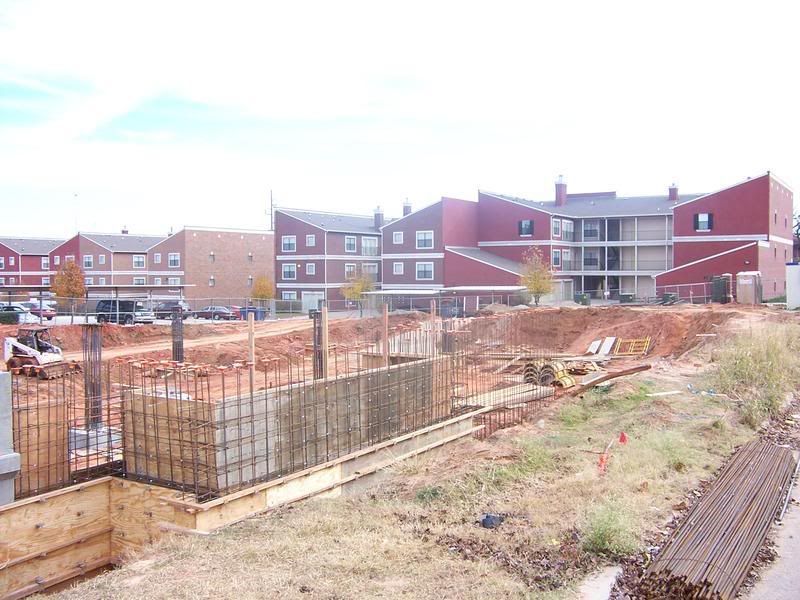 One of the few bright spots, if you're one of them out-of-touch urban advocates, is the Deep Deuce Apartments--but even Deep Deuce has one glaring downfall: it was NEVER completed, and won't EVER be completed as planned. So it's another example of where a developer proposes one thing, gets the bid, then does the ole switcharoo or doesn't even come close to finishing the development that they said they would do. Never mind the fact that the reason they were given the bid was to do the development they proposed, and nothing else. Integrity is not an important factor here, because OCURA doesn't actually care about "urban renewal."Funny thing about the Overholser Green project is that I actually defended OCURA here. I supported the Overholser Green project because it was a good project, and at the time, I didn't realize how it was financially unfeasible. The high-end nature of the project, especially the condominium aspect. In contract to Marva Ellard's competing proposal, a mixed-use project with rental residential and financing in place. Well it's obvious that OCURA couldn't have picked that project, because it actually had a relatively good chance of success. That would just completely throw OCURA's track record all out of whack. Now where we are is (3/4 years or so after the bid was awarded) Chuck Wiggin has stalled on the project. In fact he scaled it way down so that it was a much less significant project, and he still couldn't get it off. So basically after he was awarded the contract, he pulled the old switcharoo as so many of them do, and instead of pulling the contract AS OCURA SHOULD HAVE DONE, OCURA approved it again because they already awarded the contract. At that point and thereafter Wiggin could have done whatever the hell he wants, or doesn't want; he could have put a 7/11 on that land for all OCURA cared. The story more or less has been marked by what he doesn't want to do, and that is develop the land which has absolutely sat there and won't be developed any time soon. Thanks to everyone's favorite gub'ment agency.
 No downtown project exemplifies "FAILURE" like The Hill does, and that's bragging rights nobody can even come close to. This is the kind of project that OCURA really hangs its hat on, the bread and butter of what OCURA is all about as a corrupt government agency. I guess first you gotta begin with the corrupt bidding process, against two other more financially feasible projects, including a great mixed-use proposal from Anthony McDermid. Within the last 12 hours before the bid was awarded, Bill Canfield and Marva Ellard (developers of The Hill) notify OCURA that they're dropping their request for a TIF district as a part of the development. OCURA was legally required to notify McDermid and others of the change in the competing proposal, but failed to do so because it was late at night. McDermid later said that had he been notified, he also would have dropped his request for the TIF--but never got such a notice. Now that The Hill is what we're stuck with, as it's already under construction, it's become even more of a quagmire. The suburban design of the over-priced units have scared away any potential buyers, so the project has sold only 2 or 3 units, total. Without selling ANY units, Canfield couldn't pay contractors, so they stopped construction and probably hold liens on the project. The project can't even be closed on and reclaimed by OCURA at this point, because the few dozen townhomes that were built (out of 160 or so proposed) use up ALL of the street frontage that this project has. The only way thing that could be put on that site now is a big box retailer that needs highway visibility more than frontage (like BASS PRO, hint hint), or a commuter parking lot. That's it.
 We got LUCKY with this project. Here's another one where a developer (Mike Henderson) gets awarded a bid, based on a great proposal with snazzy architectural elevations..then he pulls the old switcharoo and we get Plainville. This project in no way resembles the high-design development that was anticipated during the bidding process. But the bright side is this: the project actually is URBAN, it's not necessarily UGLY, and it works. It also has 300 or so upscale rental units, and that's GREAT for downtown. OCURA accidentally stumbled upon a success here..but they should have held Henderson to his original design proposal, especially considering he got TIF funding for this. That's a public investment that OCURA should have been looking out for.
I could go on. The funny thing, as you read through the annals of downtown history and come across a chapter on Sycamore Square, is how we have literally repeated the Sycamore Square fiasco over and over and over and over in the last 5 years. Yes, it's true that downtown development has been booming, very successfully, in the last 5 years. There is a HUGE exception to that however, and that is any time OCURA is involved. OCURA stands for Oklahoma City Urban Renewal Authority, but I would seriously question, based on their track record, what the hell their problem is. I think here is a great example of where a government agency with a long acronym no longer comes even close to representing what its acronym stands for. So next time someone asks, "What does OCURA stand for?" The answer of course must be, "OCURA stands for O-C-U-R-A," not anything relating to urban or downtown or the community or anything like that.
Sadly, I think I could raise some very critical questions of Downtown Design Review these days, as well.
Monday, August 4, 2008
Mum's the word on the Colcord
In March Devon made history in OKC by announcing the undertaking to build a skyscraper that will become a new symbol of a city that has outgrown its comfortable symbols, and one that will not only be the city's tallest, but surely the entire State's, and believe it or not (@ incessant Oklahoma detractors), that's saying something. The state's 4 tallest buildings, all in Tulsa, range from 514-663 feet, which is far taller than anything in most states our size (SC and OR are closest in size). But skyscrapers in both OKC and Tulsa got a much humbler start, as they did everywhere they are found. The first skyscraper ever proposed in Oklahoma was the 12-story Chicago School-style building at the corner of Robinson and Sheridan. Interestingly enough the Colcord Building was planned by Charles Colcord to be a hotel, and while it began construction 2 years after statehood in 1909, it wasn't until being redeveloped in 2006 that it actually became a hotel.
 Furthermore the 12-story hotel building was originally planned to have a 'Phase 2' of construction during which the L-shaped building would be a U-shaped one, as shown in this rendering (from Doug's blog).
Today Devon Energy Corp announced that they are purchasing the Colcord Tower and that it will be incorporated into their new mixed-use headquarters campus that will break ground later this year, and change more than just OKC's skyline for quite a while. While mum is the word on their official plans, the following are evident:
 Now IMAGINE, for a second, the new Devon headquarters at this site. Imagine a 700-footer here at this corner, complete with the things I mentioned above, plus only the best in corporate creature comforts (employee food court, gym, etc) and what he's described as what will be "Oklahoma's grandest lobby" (though nothing will ever be as grand as the Art-Deco Great Banking Hall of the historic First National). Imagine an iconic plaza where the tower meets the Gardens, which you must imagine after significant Devon-funded improvements. Now imagine the U-shape of the Colcord finally coming to fruition. The construction could try to closely match the existing half (and show Bricktown a thing or two) or it could go contemporary, for contrast, which would be better for actually incorporating the Colcord into the site plan.
The benefits of incorporating the Colcord into the Devon's headquarters site plan could be incredible. For one, Devon could further impact downtown, especially the area surrounding the park. All of downtown's corporations benefit if downtown gets something it desperately needs, which right now, downtown needs to bump up its hotel count dramatically as it soldiers on toward becoming a Tier 2 city. More directly this gives Devon a place to lodge visiting employees, shareholders, public officials, etc., and with the excess rooms, Devon can use them to make partnership deals with other local partners of theirs. We know cross-town rival, Chesapeake Energy would scoff at the suggestion, but there are probably over a hundred energy companies located downtown, and Devon has to be on friendly terms with some of them!
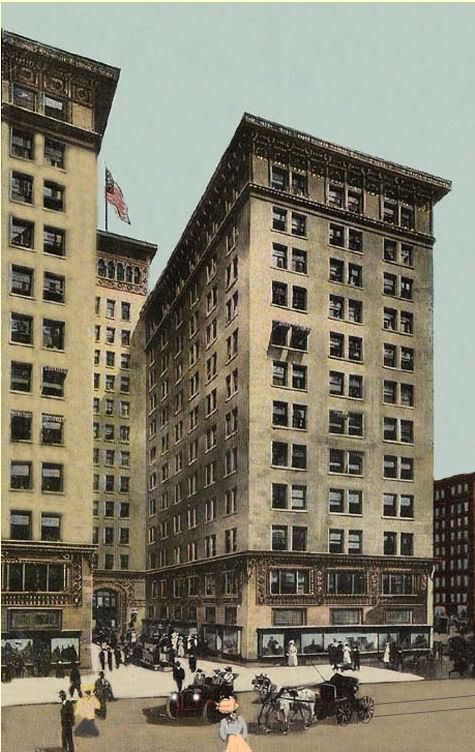 Furthermore the 12-story hotel building was originally planned to have a 'Phase 2' of construction during which the L-shaped building would be a U-shaped one, as shown in this rendering (from Doug's blog).
Today Devon Energy Corp announced that they are purchasing the Colcord Tower and that it will be incorporated into their new mixed-use headquarters campus that will break ground later this year, and change more than just OKC's skyline for quite a while. While mum is the word on their official plans, the following are evident:
- It will be an integral part of their corporate headquarters
- It will remain open during construction on the tower
- Devon clearly has a unique opportunity with the Colcord
- The Colcord was never actually completed
- The building will remain an upscale boutique hotel
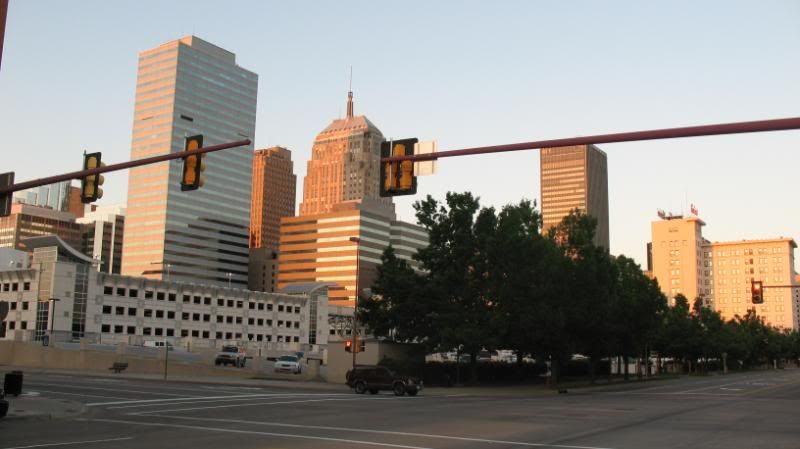 Now IMAGINE, for a second, the new Devon headquarters at this site. Imagine a 700-footer here at this corner, complete with the things I mentioned above, plus only the best in corporate creature comforts (employee food court, gym, etc) and what he's described as what will be "Oklahoma's grandest lobby" (though nothing will ever be as grand as the Art-Deco Great Banking Hall of the historic First National). Imagine an iconic plaza where the tower meets the Gardens, which you must imagine after significant Devon-funded improvements. Now imagine the U-shape of the Colcord finally coming to fruition. The construction could try to closely match the existing half (and show Bricktown a thing or two) or it could go contemporary, for contrast, which would be better for actually incorporating the Colcord into the site plan.
The benefits of incorporating the Colcord into the Devon's headquarters site plan could be incredible. For one, Devon could further impact downtown, especially the area surrounding the park. All of downtown's corporations benefit if downtown gets something it desperately needs, which right now, downtown needs to bump up its hotel count dramatically as it soldiers on toward becoming a Tier 2 city. More directly this gives Devon a place to lodge visiting employees, shareholders, public officials, etc., and with the excess rooms, Devon can use them to make partnership deals with other local partners of theirs. We know cross-town rival, Chesapeake Energy would scoff at the suggestion, but there are probably over a hundred energy companies located downtown, and Devon has to be on friendly terms with some of them!
Subscribe to:
Posts (Atom)