As many know, I've been a ways from OKC lately. Indeed so much has been happening lately, as many decisions are going to be coming to a head here soon. My personal life has mostly consisted of extensive travels across Europe, then returning to the north for 3-4 days at a time to placate my professors, and then departing again. For example, I spent last week in Russia. Moscow is amazing. I got back today and I have 3 days here, leaving Thursday for the Netherlands, where I've already spent quite a bit of time in the last few months. So it's been a busy time for me. Uppsala. Stockholm. Tallinn. Helsinki. Germany. Amsterdam. Copenhagen. And in the last week, Moscow and St. Petersburg.
One of the things I am struck by is the prevalence of so-called "Eastern Bloc" architecture (or more commonly called "Commie Bloc" colloquially) not just in Russia, but everywhere in Europe. Even in Stockholm, in my opinion Europe's most advanced city by a long shot, the "Eastern Bloc" is the prevalent suburban building form. Maybe it's a cold country thing, but just the idea of it doesn't seem very attractive. Likewise, Europeans are often repulsed by the idea of America's cutesy little cookie cutter houses with just enough wasted space to pretend to be landscaped. Considering that's what I grew up in, obviously I'm not repulsed by it, as much as I wish OKC would move beyond that kind of prevailing housing style. It's just the vernacular architecture, as it would be called academically.
It's very unfortunate that I haven't had much time to weigh in on the rapidly moving developments shaping downtown OKC, or even to provide some kind of narrative of my travels on here--though I will start doing that soon, especially when I stay in one place after this upcoming Netherlands weekend trip.. But one thing that's struck me is how the "commie blocs" really aren't that bad. Actually, a lot of them are renovated and fairly nice inside. Most are usually surrounded by parks that are maintained by more than one person, obviously. In effect, imagine if one neighborhood instead bundled all of its front yards and back yards and gardens into one huge green space in front of everyone's front door.
Even in Russia, where sometimes commie bloc suburbs are the slum neighborhoods (compare to American inner cities), many blocs are actually in very desirable neighborhoods. Generally, a Russian city will be comprised about half-and-half of historic center city, architecture often ranges from baroque to art deco, and beyond which are the suburb blocs. Beyond the suburb blocs is a new phenomenon of American-style suburbs, which is surprising to see, but growing very large--indicative of a very large country with rapidly expanding resources and a penchant for flaunting that. As far as the blocs go, they themselves come in many different varieties.
There are Stalin blocs, Krushchev blocs, Brezhnev blocs, and so on. Stalin may have been the most evil man to walk the planet, but at least he hired some impressive architects. Krushchev was the one who really got the ball rolling on blocs in a huge way. Krushchev was a liberal who focused on undoing the damage done by Stalin and embarked on building quality blocs to solve the USSR's housing shortage at the time, with many families still sharing cramped flats in areas that were prime real estate. Brezhnev was a conservative who presided over the USSR at a time with terrible inflation and other economic problems beginning to manifest, and the durability of blocs built under him decreased as the size of the blocs dramatically increased. Brezhnev blocs were built with the intention of replacing them every 30 years, the only problem with that is that the Soviet Union no longer existed when that 30 year timeframe elapsed and now ownership in the blocs is too haphazardly distributed to individuals (in many fmr USSR countries the flats were just handed over to the occupants at the time) to be able to organize massive improvement projects.
So in this sense, I can't help but draw parallels to American suburbs, which are often very temporary structures as well. You build one ring of suburbs, then as that clump of cookie cutters deteriorates over 30 years, the people with the means to do so just move further out while the rest of us are saddled with this problem of unattractive and generally unusable neighborhoods.
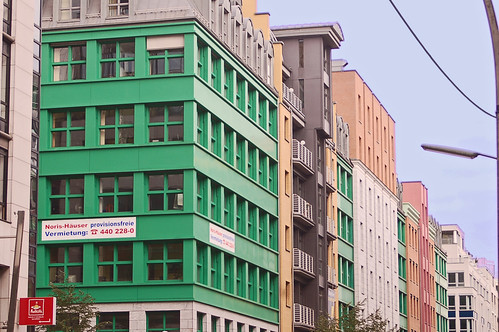
Compared to that first ring of suburbs that have since deteriorated in OKC (think inner south side, Del City, NE OKC), do you really think that these blocs in East Berlin look that bad?

These blocs are about as archetypical as you can get, blocky style, square buildings, 5-stories, potentially ghastly colors, etc. They have been well-maintained and renovated, they are in a nice part of East Berlin, granted, but as other areas of Eastern Europe continue to improve, I'm optimistic more and more of these blocs will be renovated as such and probably sold for high rents, as is happening all over Eastern Europe already. Try getting a small studio flat inside Moscow for under $1 Million (actually, it's close to impossible).
Actually, when I see those buildings and others like them, I think that they look kinda cool and urban. They've dressed them up and given that these were actually built along a streetwall reinforcing a great street, for me it is a positive environment. There are probably some very expensive lofts, offices, or galleries in this building. Just think, what kind of adaptive reuse could someone get out of Del City-style neighborhoods?
This design for the Wiggin proposal for the former Mercy Hospital site in Mid-town has been called "Eastern Bloc" architecture. Or actually, I like the OCURA committee report's euphemism for that: "Institutional." Really? It is a blocky building, with edgy urban accents, and brick masonry. If this is "Eastern Bloc" architecture, then all of Bricktown is Eastern Bloc motif. Or, excuse me, I meant to say "institutional."


 I don't want to come off as smug and overly self-appreciative, I know a lot of architects come off that way to a lot of people. The only recorded architect who was actually a "god" was Imhotep, who the Egyptians made a "god" for his design of the Egyptian pyramids..this despite what many architects undoubtedly think of themselves.
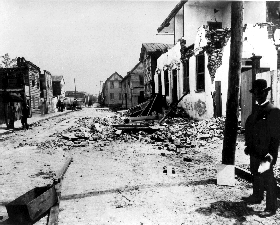 In Alaska there are building codes that are actually enforced, and the result when an earthquake hits, is very few casualties (comparatively). Charleston was hit by a 7.0 magnitude earthquake which leveled the city, and today there is subsiding earthquake threat along the South Carolina coast, believe it or not (not nearly as imminent as the Memphis area though, a disaster waiting to happen). The result is that the city of Charleston has building codes that are very, very similar to those of San Francisco--in fact that's why you see so few tall buildings in a city of 644,000 people (metro).
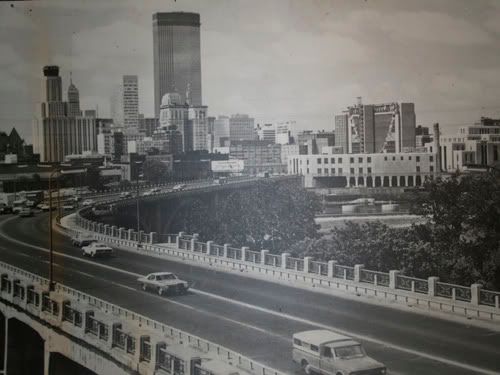 Minneapolis, 1970s