I will also try and relate this back today, with the implications of post-MAPS3 passage Oklahoma City. Remember: We were supposed to see all of this amazing amount of spin-off development.
 This is the Flatiron project, on Harrison Avenue, just north of Deep Deuce--proposed by Grant Humphreys who has been a successful, innovative urban developer. So what could have gone wrong (because this project is definitely been dead for a while, in spite of past efforts to revive it)? Humphreys was somewhat over-extending himself, especially at a time when he was still heavily leveraged in the Block 42 project which he finished a few years ago and has recently still been selling off the last units in that project. Block 42 was an innovative project for OKC because it combined townhomes and flats in a building with a striking urban design, so price points were high. It was also competing with several other projects within the immediate 3-block vicinity. The Flatiron project also called for a lot of mixed-use space, and I imagine it was difficult to find high-end commercial tenants to sign-up for an outpost location at a time when even Bricktown was losing retailers. It's a shame because it would have been an awesome project, but Humphreys will be back downtown, and is currently working on Carlton Landing at Lake Eufala.
 The Cotton Exchange is an especially interesting project because it's up there with the old "Factory" proposal as the projects I most wish could have happened. I won't get into the details of how much I love this project, but it would have been a great one. It offered prime commercial space right on the canal as well as with frontage on Mickey Mantle, and it also offered a good amount of residential which Bricktown badly needs. The Centennial was a huge success, so it begs the question why OKC can't support this kind of quality mixed-use development, even though we surely haven't seen much of it. The developer, Gary Cotton, was in trouble though. He didn't have the resources to pull the project off--he had a little bit of equity from the sale of the Bricktown "Mercantile" building. He needed other investors but didn't want to listen to other ideas, from what I've heard. It's still a shame that this didn't go forward because he was using the brokerage team that The Centennial used (which sold out, and still had many interested clients), and because other experienced Bricktown businessmen were offering lots of advice. He also benefited from not just lots of Oklahoman and blogosphere coverage, but even got TV news coverage, which downtown development rarely gets.
 Many people got very excited when Tom McDaniel announced that OCU wanted to move its law school to the gargantuan Fred Jones auto factory, which is an awesome historic building. The deal died when Tom McDaniel stepped down as president of OCU and a new guy came in, who didn't like the idea so much. But it's hard not to note the sequence of events: Chamber officials promise there will spin-off MAPS development, Tom McDaniel announces OCU will develop law school downtown if MAPS passes, MAPS passes, Tom McDaniel becomes chair of MAPS Citizens Oversight Board, downtown law school plans are nixed. I would chalk this one up to political problems, if the new leader of OCU doesn't like the idea, then I don't see how anyone is going to "force" him to follow through.
  For years, the Union Bus Station was a magnet for vagrants, which caused problems for the developers on both sides of the facility who wanted it gone. First, Dick Tanenbaum, redeveloper of The Montgomery on Walker, wanted to buy the bus station and close it down, and put a jazz club inside of it. It would have been a win-win, downtown didn't need the Greyhound station anymore, it was a blight, it attracted vagrants, he could have renovated it and turned it into a historic gem and just put a jazz club inside of it, which would have turned a problem for the neighborhood into an asset for the neighborhood. That's what you call making lemonade out of lemons. Obviously Tanenbaum, a veteran Central Oklahoma developer, had the resources to make it happen. One problem: The owner was pesky and had no intentions of moving, and was difficult to deal with. So Tanenbaum gave up and turned his files over to Nick Preftakes who was on his way to acquiring the whole block anyway. Preftakes also found the owner to be pesky, but by using his properties positioned all around the station, he was able to make it difficult for the bus station to remain there, and forced its closure that way. One problem now: The owner still doesn't want to sell to Preftakes, and harbors a grudge, seemingly. Well let's be honest, when Preftakes put up a property fence just to make it difficult for buses to make wide turns, that wasn't very nice. So I'm not sure Preftakes is going to get to include this parcel in his block in the end, anyway. I just hope the building gets restored somehow, and not leveled.
 How could I not bring this one up? haha.. The Braniff Lofts proposal, from 2006 and 2007, would have been a really vital piece toward preventing a controversy (and a tragedy) that would soon follow. A group of investors local of investors ("Corporate Redevelopment LLC"), many with significant Downtown OKC experience and have been mentioned often on this blog, were negotiating with Kerr McGee to acquire these abandoned buildings surrounding their headquarters for redevelopment purposes. The plan was to, at the very least, use the Braniff building AND the KerMac building and convert the two into lofts--the developers at the time were convinced they had a winner, and many onlookers are still convinced the proposal could have been a winner. The deal fell apart because KMG was acquired by Anadarko Energy who refused to honor the deal between the investors and KMG. SandRidge acquired the block and demolished the buildings to make way for a corporate plaza. These buildings, except for the Braniff Building which was lucky enough to already be on the historic register, are goners and lofts or mixed-use of any kind on this block will never have an opportunity to happen. I would chalk this one up to corruption at many junctions.
 It appeared to be one of the turning points of downtown development when the Downtown Ford announced it was closing and was demolished. The land owners, Fred Hall and Bob Howard announced potentially ambitious plans to redevelop the large site into a huge mixed-use development. The Jones-Hall family has been involved in other deals, and was involved in the OCU deal that fell through, and Howard has been engaged in redevelopment of of Mid-town lately, so there is no doubt that the development wherewithal and resources were in place. The site could have possibly been the largest mixed-use downtown development to date. "It's no surprise, and it fits our long-term plans to develop that site into commercial retail and housing," remarked Hall, at the time. It was lauded as a success of MAPS spin-off. Why did the deal fell through? Because it got gobbled up by a MAPS subcommittee that insisted the convention center needed to go on THE most promising piece of real estate in all of OKC.
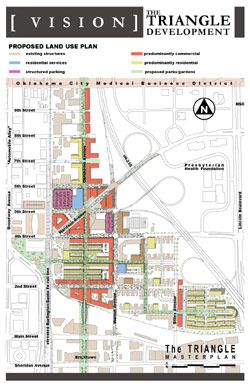 I'll make this my last one, and I think it's a big one. No matter how you slice it, The Triangle masterplan died. At a time when the possibilities for bubble-style downtown development appeared endless, the plan seemed fail-safe. A group of investors including Bert Belanger, Ron Bradshaw, among others, would team up to do a ton of development in a small area. However each one encountered difficulties selling units of their first project and then 2008 hit, and it became apparent that downtown development could not go forward purely driven by speculation on condo units. The group broke up, although they are still individually engaged in development in the "triangle" area, although hardly according to the original plan. And some new investors have popped up and added projects such as LEVEL and Aloft.
So, here you see a multitude of reasons. In every one of these cases, it is a shame that the development died, although this is not always the case--sometimes developments are bad and projects dying would be good. However, there HAS to be a way to meet over these kinds of things and compromise. Bad developments need input for improvement before they actually apply for the permit. Good developments need input to ensure their success. This goes both ways, the process shouldn't JUST be about putting pressure on bad projects. Furthermore, a lot of these reasons are preventable. Switching to a more sustainable economic model for real estate would have prevented a lot of the post-2008 development lethargy we were seeing until recently--the economy never stops, sometimes it contracts, and even that presents an opportunity (for more modest real estate deals). For instance, people still need housing when they can't afford a mortgage, which is why for-rent housing has thrived in the post-2008 economic climate. Capitalizing on that could have prevented a lot of these projects from collapsing. Also, a LOT of stuff is in limbo when we have these big-ticket items in limbo. Do you think somebody wants to build a mixed-use or housing investment when they aren't yet 100% certain where the streetcar route will go? Do you think somebody wants to invest in a huge hotel project without knowing where the new convention center and likewise, streetcar lines, will go? Of course not!
One thing that has been an absolute failure thus far is MAPS accounting for the spin-off development. It was one of the most persuasive reasons why we passed MAPS3. We wanted to buy into a vision for building a city, not just for building a single park or an isolated convention center. These things aren't being coordinated AT ALL. There is no single planning document that has more than one big-ticket public investment component in it. There are however millions of planning documents, district masterplans, streetcar route ideas, convention center proposals, and so on and so forth. Nobody is proposing that this stuff come together. Furthermore, a lot of the interests behind certain projects need to step down and realize that their project isn't the center of the universe. The end goal is spin-off development, not having a city built around a convention center. When you eat your most promising site for mixed-use development to put the convention center on it, you miss the mark. You can have your cake and eat it too. The convention center subcommittee needs to address the goals of downtown as a whole just as every other subcommittee needs to be concerned about it. Ignoring the big picture is setting us up for failure at a time that immense resources have opened up such an enormous opportunity.
Every MAPS3 subcommittee needs to be tasked with the exact goal, and it needs to be an overarching goal of what we as a city hope to create with this opportunity. Each subcommittee needs to be opening its meetings discussing this goal, whether it be attracting investment, or improving quality of life. There needs to be a singular vision shared by all. Right now what we have is a convention center subcommittee that has run amock with the process, stepping on other projects to make sure that at the very least the convention center gets done, and running completely contrary to the goal of MAPS.
These guys need to sit down and analyze universal MAPS goals. They need to ponder what they as a convention center subcommittee can do to improve quality of life and attract mixed-use development to downtown. I'll tell you one thing: You can do a LOT more to accomplish this than by eating the best real estate in the entire city for your convention center, which is going to happen anyway. That makes no sense whatsoever.