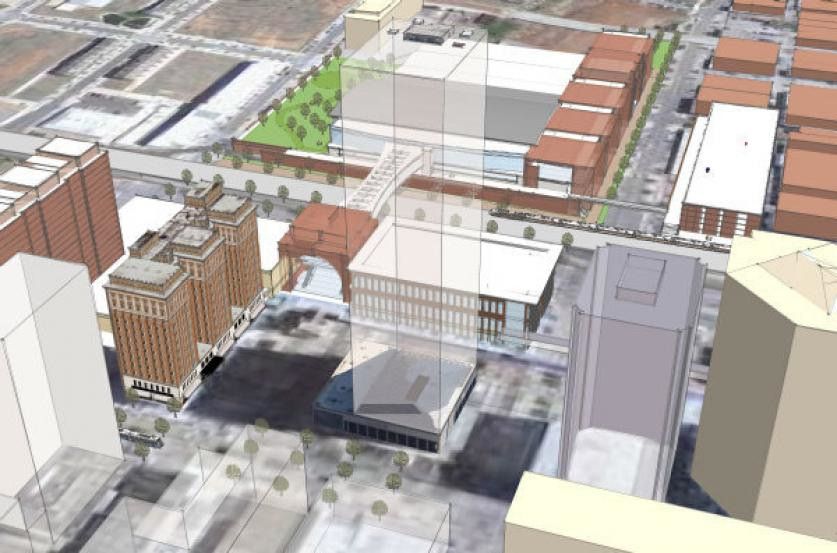
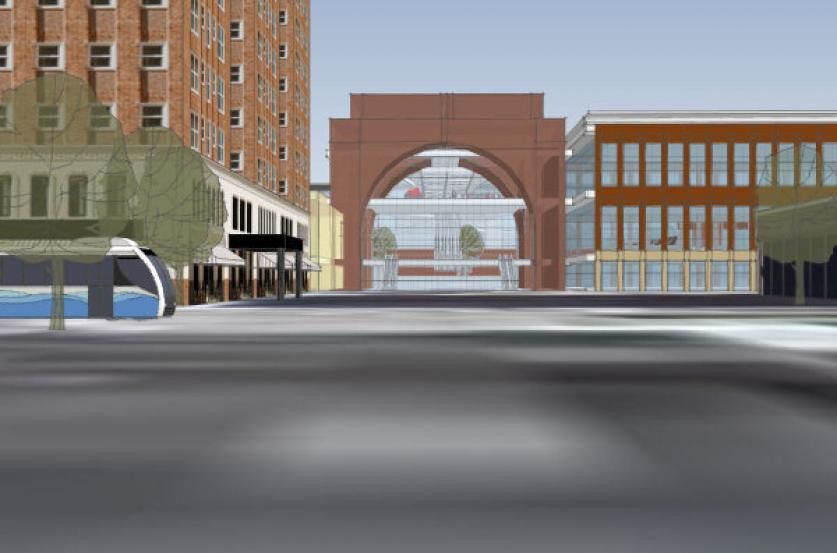
What's that project listed there at the bottom, very last? The one that nobody appears to have wanted. Oh yeah, the most expensive project, the convention center.
Showing posts with label convention center. Show all posts
Thursday, January 19, 2012
The forgotten voter mandate
City Council, this is your mandate that you have forgotten (or done everything you can to try to forget). Don't forget, at any point, that usurping this pecking order in any way should be taken as direct infringement on the "will of the people" and all that jazz.

What's that project listed there at the bottom, very last? The one that nobody appears to have wanted. Oh yeah, the most expensive project, the convention center.
Labels:
City Hall,
convention center,
Downtown OKC,
MAPS 3,
politics
Divisiveness: A means to a convention
The convention center boondoggle has to come to an end, or be reigned-in somehow, yet how do you reign-in something that we have no control over? The committee structure of MAPS3 virtually guarantees that there is no way to hold their feet to the fire when a convention center takes over and orders the other projects around. The individual sub-committees are made up of members hand-picked by Mayor Cornett, who by and large, is a part of this convention center cartel.
Then city staff appears to have a major, major, major role in shaping the public discourse. It was the timeline drafted by them and their consultants that moved rocketed the convention center from being the last project, as was promised during the campaign by the mayor and all MAPS3 campaign literature. That is all orchestrated by City Manager Jim Couch, whom you’d better believe wants this convention palace built, come hell or high water.
Civic activism often takes on many different shapes and colors. Oftentimes, truthfully, it’s a mere means to an end. A group has a goal, and then accomplishes its goal by whatever means necessary. That’s not what urban activists normally do. The group that is displaying “means to an end” motives and actions is the convention crowd.
These are the exact same people who came out with this ridiculous boulevard to be named “Oklahoma City Boulevard,” following Mayor Cornett’s brilliant PR suggestion (that’s sarcasm). Behind the scenes, Couch’s planning department is pushing for streetcar to follow the new boulevard. These people genuinely want the landmark corridor to come to fruition, as they understand how it would boost sense of place in our community. They want to create an active, attractive downtown.
But they want this convention center even more, and that’s going to inevitably be self-destructive to all these other goals. Deep into their power binge, they saw the opposition to putting the convention center on a high-profile tract of land adjacent to the new park, and decided to show just how powerful they really are by moving it to an even more high-profile tract of land. Check-mate, they say. This is the essence of self-destruction and immaturity.
If urban activists wanted to be immature, for example, they could shun Heritage Hills residents for the recent to-do over the Mercy redevelopment site, in which Heritage Hills preservationists had some major egg on their face. Yet, those preservationists are generally great believers in OKC and excellent people to have on your side. Yet, I don’t believe the urban activists will be as rash and immature as these oil execs and big-time lawyers calling the shots on this convention center. This is the break-down of an “Us vs. Them” dichotomy, which we all wish wasn’t emerging in this city, but let’s face it—it is, due to the divisiveness of these convention center interests and the “Momentum” that they’re drunk on.
That community togetherness and that formerly united civic vision for rebuilding our inner city IS the collateral damage of the convention center assault. How else do you get a city to prioritize a project that very few people wanted to pass in the first place?
Then city staff appears to have a major, major, major role in shaping the public discourse. It was the timeline drafted by them and their consultants that moved rocketed the convention center from being the last project, as was promised during the campaign by the mayor and all MAPS3 campaign literature. That is all orchestrated by City Manager Jim Couch, whom you’d better believe wants this convention palace built, come hell or high water.
Civic activism often takes on many different shapes and colors. Oftentimes, truthfully, it’s a mere means to an end. A group has a goal, and then accomplishes its goal by whatever means necessary. That’s not what urban activists normally do. The group that is displaying “means to an end” motives and actions is the convention crowd.
These are the exact same people who came out with this ridiculous boulevard to be named “Oklahoma City Boulevard,” following Mayor Cornett’s brilliant PR suggestion (that’s sarcasm). Behind the scenes, Couch’s planning department is pushing for streetcar to follow the new boulevard. These people genuinely want the landmark corridor to come to fruition, as they understand how it would boost sense of place in our community. They want to create an active, attractive downtown.
But they want this convention center even more, and that’s going to inevitably be self-destructive to all these other goals. Deep into their power binge, they saw the opposition to putting the convention center on a high-profile tract of land adjacent to the new park, and decided to show just how powerful they really are by moving it to an even more high-profile tract of land. Check-mate, they say. This is the essence of self-destruction and immaturity.
If urban activists wanted to be immature, for example, they could shun Heritage Hills residents for the recent to-do over the Mercy redevelopment site, in which Heritage Hills preservationists had some major egg on their face. Yet, those preservationists are generally great believers in OKC and excellent people to have on your side. Yet, I don’t believe the urban activists will be as rash and immature as these oil execs and big-time lawyers calling the shots on this convention center. This is the break-down of an “Us vs. Them” dichotomy, which we all wish wasn’t emerging in this city, but let’s face it—it is, due to the divisiveness of these convention center interests and the “Momentum” that they’re drunk on.
That community togetherness and that formerly united civic vision for rebuilding our inner city IS the collateral damage of the convention center assault. How else do you get a city to prioritize a project that very few people wanted to pass in the first place?
Sunday, August 28, 2011
The truth about the "Chamber junta"

I want to start revving up my reaction against the convention center site location again. I have a feeling the location debate was blown wide open by the council standing firm against a $30 million budget increase for the project. Obviously it won't affect anything. Anything that anyone, or however MANY people say, even if they are echoed by a councilman sitting on the horseshoe--won't have any chance in effecting a change in course on this convention center.
Explaining this absolutely ridiculous CC subcommittee, who do they think they are?
A lot of attention around the rogue MAPS 3 Convention Center Subcommittee, that so-called "Chamber junta" as they have been aptly labeled by all of the alternative media, has focused on the role of Larry Nichols. Nichols is a local civic warrior who is pushing relentless for what he sees as OKC's best interest, and his influence and power is surging. As he minimized his day-to-day role in running Devon to focus more on his civic ambitions, he has taken the bull by the horns when it comes to this city (I think a very apropos analogy), and I suppose one could say that the arrival of his influence in the last year or so has been felt with the subtlety of a steer mounting a comely heifer. Every conspiracy theorist in town is wanting to blame anything that smells fishy on him, and every respectable leader in town is too afraid to even set the record straight because they don't want to mis-speak when it comes to Nichols. But Nichols is not a corrupt overlord, and I like to believe his interests are mostly above-board. There, I said it, sue me.
This whole "let's lynch Larry Nichols" thing has been a distraction from what I think is the real problem with this "Chamber junta." There are a lot of hotel owners and operators and assorted interests aligned with them that are on this subcommittee. I mean existing hotels, like the Skirvin, Colcord, Renaissance, Courtyard, Sheraton, and so on. The hotel operators that have the most local influence are immediately around the Cox Center, not by virtue of their Broadway or Robinson address, but by virtue of their working relationship with the CVB. The CVB wants to maintain those relationships, for right or for wrong, in spite of what we obviously know that these hotels are amazingly inadequate for handling the convention needs of a "Tier 2" city. We need to start from scratch because a scattering of around 800 rooms over 4-5 separate hotels is a joke and is not going to impress anyone.
In fact, we were going to locate this thing across from the current I-40, and the proximity concern raised by planners had nothing to do with THESE hotels but rather to Bricktown. We have known, mostly all along, that we will have to start over on the hotel front. But we also didn't think we would have to start over on the entertainment and restaurant front, we expected to keep using Bricktown for that, and we also knew that would be a lot harder to recreate in Core2Shore than the hotels would be.
Basically our hotel picture is a small scattering of rooms around the Cox, and probably an equally sized (albeit getting larger with the aLoft) cluster of rooms around Bricktown. Why is ONE of these clusters, particularly the one that is going to be smaller soon, more important to stay close to than the other? Ask that question. The answer is that this has everything to do with these hotels exerting local influence on the convention and hospitality industry, which is running this convention center subcommittee. Obviously, these hotels are at capacity with their current monopoly on the hotel market. More hotels means they will take a hit and may-gasp-only be fairly profitable. (Let's not understate the booming state of the downtown hotels, which are all benefiting from increasing demand and abnormally low supply for a city our size) These guys aren't going to go out of business by bringing in more hotels or starting over with the convention-front, but they won't enjoy being booked solid anymore.
And I've been told by a past president of the Bricktown Association in person that they feel helpless in advancing their cause for anything against these bigger interests because they already have the Ballpark and the Canal. They wish they could pick up "that damn ballpark" and move it to Core2Shore if it's the reason their concerns don't get heard. It may seem insane to outsiders to say that Bricktown interests are being trumped by hotel operators, but it's just the truth that I see.
Can urbanism stand on its own as an agenda?
The interesting thing about OKC's activist circles is that all of the progressives have traditionally been tied to the economic development agenda for the sake of survival. Without the economic development agenda or dare I say "momentum," there is no push for a progressive agenda either. The Chamber can at least make token progress on the issues that progressives care about.
I want to pose a big question. Can a progressive agenda for urbanism and sustainability stand on its own, and take on competing factions on its own? I see MAPS 3 as resembling a bond between progressives and juntas, both attracting voter support from different ends, and I see the last few months as this show of bait-and-switch. Progressive votes were baited with certain items, and then the switch came when the convention center nobody wanted became the new priority, at the expense of other projects. Did progressives really get a bad deal? The streetcar and park might not even be happening without the convention center. We know that voters overwhelmingly took sides with the progressive items and did not like that convention center at all, but--do we have anything else resembling real proof that a progressive agenda can stand on its own and not depend on whoring itself out to the convention center interests?
This past marriage of convenience of progressive issues and the chamber junta makes for odd bed fellows indeed.
Labels:
Chamber,
City Hall,
convention center,
Downtown OKC,
MAPS 3,
politics
Tuesday, August 23, 2011
I'm argued out
For the last few weeks, things have been slow on here just because I have a lot of pics I took around town, construction progress related for the most part, and now I just can't even find the energy lately to get them off my phone and onto this blog. I am just all argued out. There is not much left after 3 years of advocating for urbanism in OKC.
Now I look around and I see what it's mostly come to. The Stage Center, one of Oklahoma's very few pieces of "starchitecture," is probably at the end, and the council is moving forward with this idiotic location for the convention center, and so on. You just can't win. These people look at the Stage Center and do not see architecture, but rather prime real estate that is worth a lot of money. They see the Myriad Gardens and the new planned MAPS 3 park and think dividing these with a convention center is a good idea. That last one is especially moronic.
Idiots. People are IDIOTS. And I have nothing else to say right now, I'm truly just at a loss. But not for long...just give me a week to take a deep breath.
Now I look around and I see what it's mostly come to. The Stage Center, one of Oklahoma's very few pieces of "starchitecture," is probably at the end, and the council is moving forward with this idiotic location for the convention center, and so on. You just can't win. These people look at the Stage Center and do not see architecture, but rather prime real estate that is worth a lot of money. They see the Myriad Gardens and the new planned MAPS 3 park and think dividing these with a convention center is a good idea. That last one is especially moronic.
Idiots. People are IDIOTS. And I have nothing else to say right now, I'm truly just at a loss. But not for long...just give me a week to take a deep breath.
Thursday, May 26, 2011
Breaking MAPS3 news
Jeff Bezdek is reporting on OKC Talk that the MAPS 3 Citizens Oversight Committee approved the "Option 1" timeline. I know that this puts SOME OF the streetcar project within expected timeline delivery, but not sure about other projects, since the streetcar is obviously my main concern at this point. I think Option 1 might be the original timeline proposed earlier by ADG, the local consultant for MAPS3. This original proposal put the park first, the streetcar second, and the convention center last.
Will edit this as more details become available.
edit: Evidently "Option 1" is different from the original timeline. Option 1 moves the convention center up 21 months in the timeline. It moves the Lower Park, Phase 4 river improvements (the "cosmetic improvements") , and Phase 2 of the streetcar project to the end of the timeline (anything beyond a 4-mile starter loop).
Well there you have it. Done deal.
Will edit this as more details become available.
edit: Evidently "Option 1" is different from the original timeline. Option 1 moves the convention center up 21 months in the timeline. It moves the Lower Park, Phase 4 river improvements (the "cosmetic improvements") , and Phase 2 of the streetcar project to the end of the timeline (anything beyond a 4-mile starter loop).
Well there you have it. Done deal.
Tuesday, May 10, 2011
"C2S North" site chosen
The "Core2Shore North" site was just chosen for the new convention center. That is the former Bob Howard Downtown Ford dealership site that a few months ago was going to be the site of a huge mixed-use development.
So now we will have a convention center in between two parks.
Too weary to go into all of the reasons why this is a horrible site, for OKC that is, I mean it's great for the conventions... well actually, first we're going to have a big vacant lot between the two parks for ten years until we break ground on the CC. Unless they get to move the site up, in which case, we won't get as much mileage of streetcar track because of this decision. Or something else would be impacted.
There might be some interesting solutions that can alleviate the negative convention center impact we're about to add downtown. I'm more interested in pursuing that public debate than attempting to oppose yet another high-profile decision that was already made mostly behind closed doors.
So now we will have a convention center in between two parks.
Too weary to go into all of the reasons why this is a horrible site, for OKC that is, I mean it's great for the conventions... well actually, first we're going to have a big vacant lot between the two parks for ten years until we break ground on the CC. Unless they get to move the site up, in which case, we won't get as much mileage of streetcar track because of this decision. Or something else would be impacted.
There might be some interesting solutions that can alleviate the negative convention center impact we're about to add downtown. I'm more interested in pursuing that public debate than attempting to oppose yet another high-profile decision that was already made mostly behind closed doors.
The question NOT asked
It's funny that right now, the convention center subcommittee of the MAPS3 Committee is meeting and they are going to make a very big decision that will impact downtown and Oklahoma City for a long time to come, as they name the location of the new convention center, a Phase 1 investment of $280 Million (Phase 2 I believe will make it approach $400 M). But it's really funny because there's a really important question that was never asked at any point during this process, and is probably not going to be asked today.
What is the best convention center for the REST of OKC, that doesn't revolve around the convention center?? They never considered that a convention center could possibly be less than ideal for any of these sites. We have proper analysis based on what is good for the convention center and for the convention attendees, and tons of studies done on that, tons of debating was done, great questions were asked. But I contend that is 1% of what should have been considered.
The other 99% of the puzzle that they totally ignored or didn't care about was the rest of OKC that won't go into that convention center. They didn't consider what was best for the park. Best for Core2Shore. Best for downtown retail. Best for downtown housing. Best for downtown nightlife. Best for downtown in general. They looked at this solely from the perspective of what is best for conventions, and that's it.
So ladies and gentlemen, here you have it. The #1 priority of MAPS3 and for all of downtown, our entire downtown investment strategy, is based on conventions. For better or for worse, this is the concept that we are using as the basis for the future downtown. Let's just rename it the Convention Center District right now, because that's the most important thing.
If not, we would have considered other things. Hard to argue otherwise. Maybe they would have considered at some point where the convention center would have best fit into an overall downtown masterplan that puts all of these huge investments and projects into one plan. Why can't we do that?!?
What is the best convention center for the REST of OKC, that doesn't revolve around the convention center?? They never considered that a convention center could possibly be less than ideal for any of these sites. We have proper analysis based on what is good for the convention center and for the convention attendees, and tons of studies done on that, tons of debating was done, great questions were asked. But I contend that is 1% of what should have been considered.
The other 99% of the puzzle that they totally ignored or didn't care about was the rest of OKC that won't go into that convention center. They didn't consider what was best for the park. Best for Core2Shore. Best for downtown retail. Best for downtown housing. Best for downtown nightlife. Best for downtown in general. They looked at this solely from the perspective of what is best for conventions, and that's it.
So ladies and gentlemen, here you have it. The #1 priority of MAPS3 and for all of downtown, our entire downtown investment strategy, is based on conventions. For better or for worse, this is the concept that we are using as the basis for the future downtown. Let's just rename it the Convention Center District right now, because that's the most important thing.
If not, we would have considered other things. Hard to argue otherwise. Maybe they would have considered at some point where the convention center would have best fit into an overall downtown masterplan that puts all of these huge investments and projects into one plan. Why can't we do that?!?
Wednesday, April 13, 2011
So much for that
Skirvin proposal, we hardly knew ye...
For the best. The committee now seems to be heavily leaning toward the former Bob Howard Downtown Ford site. The OG+E substation site has mysteriously risen from the grave.
Labels:
convention center,
Downtown OKC,
MAPS,
MAPS 3,
Skirvin Hotel
Tuesday, April 12, 2011
The Skirvin Proposal
I was currently in the midst of a large convention center post, with some thoughts on the progress so far from the MAPS 3 Convention Center Subcommittee. Well, evidently I was not about to have time to do such a blog post, if the Skirvin Partners would have anything to do with it. Do I think their proposal changes the game? Not in the slightest. But it becoming public does preclude anything else I might say, so perhaps it is best to just start with the now locally-famous Skirvin proposal.
I am going to cover this proposal in a completely unbiased way, since this is going to be controversial. I will give my strong opinion of this in a later post...
Background: OKC is building a new $280 million convention center. A centerpiece of the project that is not included in the budget will have to be a convention hotel, a hotel with minimum 700 rooms that can expand the convention center's ability to compete for vital larger conventions. The convention hotel, not being included in the budget, will have to be funded somehow. It will likely receive up to $60 million in city subsidies, money which will have to come from somewhere, but money which the city will likely get some ROI from (eg., it will probably be a loan).
Enter Skirvin:

The Skirvin Partners propose that their hotel be repositioned to serve as the city's convention hotel. It is a proposal for siting the convention center between Bricktown's Main Street and Deep Deuce's 2nd Street. Essentially, across the street from the new Maywood Lofts on 2nd, and across the street from the Sherman Iron Works bldg in Bricktown.
The Skirvin currently has about 225 rooms. That's a far cry from a convention hotel, so they propose adding a second tower just to the north of their property (where there is currently a bank drive-thru) that will have 425 rooms. Then things get interesting with the razing of the Santa Fe Garage, which provides 1,518 parking spaces for downtown workers. Then to replace these parking spaces, it's proposed to build an 800-1260 space parking garage on 2nd Street, where the Sherman Iron Works bldg currently is (Main/Oklahoma in Bricktown), possibly incorporating the historic building into a parking structure.

The Santa Fe Garage, which would be razed under this plan, would be replaced with a structure that features a large open "gateway," available office space that the Skirvin suggests could be ideal for the Chamber of Commerce, and more structured parking. This parking would accommodate between 575-895 spaces. Then it would ALL be incorporated with a large pedestrian bridge that crosses E.K. Gaylord and the BNSF tracks, connecting the new "Skirvin complex" and the convention center across the tracks.
One of the complexities happens to be that the site between Main and 2nd streets is currently a rail yard, one that is currently slated to become a high speed rail corridor. There is a proposed arc that cuts across the entire site (the non-utilized tracks currently veer to the north, but this would be a new arc that veers to the south merging with the BNSF tracks). The arc is important because ODOT's proposed high-speed rail corridor from OKC to Tulsa terminates where the Turner Turnpike terminates. So in order to get it further into downtown OKC, it has to come from the NE. So this will essentially be where the line changes from utilizing the BNSF track (that divides downtown and Bricktown) to where it veers to the NE toward the "Adventure District" and on to Tulsa.
While it is certainly true that high-speed rail is far from being funded at this point, especially given the current debt situation of the government, it is a salient fact to point out that there are still local plans to go forward with rail connections to the Adventure District and MWC/Tinker. These regions to the NE and E would be connected via this arc as well, with or without high-speed rail to Tulsa. Placing a convention center over this railyard could prove to be a fatal setback to rail connections to the NE. You could raise the convention center and allow the rail lines to pass underneath uninhibited, but doing so would likely put a convention center with the desired specifications well beyond the reach of $280 million.
Lastly, the Skirvin Partners have pointed to two factors that they feel make their proposal the best one for the city: 1, with the city having to come up with $60 million somewhere if they try and bring in a traditional convention hotel, they would be asking for "far less" of a subsidy. 2, they claim that Downtown OKC would not be able to absorb a new hotel with "more than 600 rooms" (ideally the convention center needs to have more than that) and they claim that using 225 existing rooms coupled with just 425 new rooms minimizes the risk of throwing off downtown's hotel room balance.
Some thoughts on this proposal coming up soon in a broader analysis of the convention center process so far...
I am going to cover this proposal in a completely unbiased way, since this is going to be controversial. I will give my strong opinion of this in a later post...
Background: OKC is building a new $280 million convention center. A centerpiece of the project that is not included in the budget will have to be a convention hotel, a hotel with minimum 700 rooms that can expand the convention center's ability to compete for vital larger conventions. The convention hotel, not being included in the budget, will have to be funded somehow. It will likely receive up to $60 million in city subsidies, money which will have to come from somewhere, but money which the city will likely get some ROI from (eg., it will probably be a loan).
Enter Skirvin:
The Skirvin Partners propose that their hotel be repositioned to serve as the city's convention hotel. It is a proposal for siting the convention center between Bricktown's Main Street and Deep Deuce's 2nd Street. Essentially, across the street from the new Maywood Lofts on 2nd, and across the street from the Sherman Iron Works bldg in Bricktown.
The Skirvin currently has about 225 rooms. That's a far cry from a convention hotel, so they propose adding a second tower just to the north of their property (where there is currently a bank drive-thru) that will have 425 rooms. Then things get interesting with the razing of the Santa Fe Garage, which provides 1,518 parking spaces for downtown workers. Then to replace these parking spaces, it's proposed to build an 800-1260 space parking garage on 2nd Street, where the Sherman Iron Works bldg currently is (Main/Oklahoma in Bricktown), possibly incorporating the historic building into a parking structure.
The Santa Fe Garage, which would be razed under this plan, would be replaced with a structure that features a large open "gateway," available office space that the Skirvin suggests could be ideal for the Chamber of Commerce, and more structured parking. This parking would accommodate between 575-895 spaces. Then it would ALL be incorporated with a large pedestrian bridge that crosses E.K. Gaylord and the BNSF tracks, connecting the new "Skirvin complex" and the convention center across the tracks.
One of the complexities happens to be that the site between Main and 2nd streets is currently a rail yard, one that is currently slated to become a high speed rail corridor. There is a proposed arc that cuts across the entire site (the non-utilized tracks currently veer to the north, but this would be a new arc that veers to the south merging with the BNSF tracks). The arc is important because ODOT's proposed high-speed rail corridor from OKC to Tulsa terminates where the Turner Turnpike terminates. So in order to get it further into downtown OKC, it has to come from the NE. So this will essentially be where the line changes from utilizing the BNSF track (that divides downtown and Bricktown) to where it veers to the NE toward the "Adventure District" and on to Tulsa.
While it is certainly true that high-speed rail is far from being funded at this point, especially given the current debt situation of the government, it is a salient fact to point out that there are still local plans to go forward with rail connections to the Adventure District and MWC/Tinker. These regions to the NE and E would be connected via this arc as well, with or without high-speed rail to Tulsa. Placing a convention center over this railyard could prove to be a fatal setback to rail connections to the NE. You could raise the convention center and allow the rail lines to pass underneath uninhibited, but doing so would likely put a convention center with the desired specifications well beyond the reach of $280 million.
Lastly, the Skirvin Partners have pointed to two factors that they feel make their proposal the best one for the city: 1, with the city having to come up with $60 million somewhere if they try and bring in a traditional convention hotel, they would be asking for "far less" of a subsidy. 2, they claim that Downtown OKC would not be able to absorb a new hotel with "more than 600 rooms" (ideally the convention center needs to have more than that) and they claim that using 225 existing rooms coupled with just 425 new rooms minimizes the risk of throwing off downtown's hotel room balance.
Some thoughts on this proposal coming up soon in a broader analysis of the convention center process so far...
Wednesday, March 23, 2011
Maybe C2S needs to be scrapped
I am thinking more and more lately that Core2Shore needs to be scrapped. Not even pursued. Not a dime spent in that direction, even though it's too late..
These are the reasons: Yes, it would be nice to have a model contemporary, urban city. Yes, C2S is a neat opportunity to build that. However, I don't trust OKC to build that. I don't trust OKC to turn what is essentially brownfield into a model urban city.
The urban boulevard would have been nice.
The urban central park would have been nice.
The convention center located across the tracks would have been nice.
The urban waterfront would have been nice.
All of these things and more would have been nice.
All of them are being screwed up. Either there is a grand conspiracy to prevent urban from ever happening, or this city is simply clueless when it comes to building urban things.
Consider the boulevard. It's not going to be anything close to a model urban boulevard. The city is insisting that someone other than the city pay for it, and that means ODOT--so it's going to meet their specifications for new roads. It will have super-wide lanes, 6 or 8 lanes, and it will have pedestrian tunnels and bridges encircling it in every direction. Not people-friendly at the street level. The boulevard is already going to be a cluster, there is nothing that can happen at this point to mitigate that. The plan for that is already set in stone. The city could tell ODOT last minute to drop the project and the city could pursue it on its own, and build a much simpler boulevard on its own, but that isn't going to happen.
Consider the central park. This last week the council voted to do a new pedestrian TUNNEL underneath Robinson, presumably, between the convention center (the site the mayor is HELLBENT on) and the central park. First, I was bracing for the impact of the park just being a front lawn for the convention center. I had no idea they would take that even further and have tunnels leading from the front door of the convention center to practically the middle of the park. That is turning out to be a nightmare worse than I would have ever imagined. You don't even at least have to cross the street there. Oy veigh...
What is wrong with crossing the street? Why do we need all these pedestrian tunnels and bridges? Are we planning for some alternative future universe where humans will no longer be born with 2 legs that work?? Unless we're trying to get people across I-40 or across the tracks, that seems totally worthless and unneeded. Why are we spending money on that? Ugh.
What is wrong with simple 4-lane boulevards (2 in each direction) with a wide landscaped median or something? That would cost a fraction of what this street-level superhighway that meets ODOT specs is going to cost. It would be less of an urban nightmare, as well.
This city does not need Core2Shore. It doesn't need anywhere new to build a park and a convention center, even though the park is already being built. It doesn't need any more available land downtown. Downtown already has a huge inventory of vacant lots and abandoned buildings that aren't close to finding uses. I am scared at what OKC is going to end up building in C2S.
And I'll tell you how this will end up: It will just be a continuation of the superblock cluster. There will be virtually zero mixed-use development around the park or anywhere in Core2Shore. It will be parking enterprises and low-impact development like maybe a few restaurants and maybe a convenience store. It will have all these super-wide streets and million-dollar infrastructure pieces that nobody uses unless there is a big convention or a big event in the park. It will be absolutely dead. It will feel like an expensive, government-built ghost town. It will go down in history as the biggest urban renewal folly since the 1970s, anywhere. It will absolutely fail to attract private investment because people will not want to go there. Everything in it will probably be named after Mayor Cornett.
That's not a legacy I would want. Perhaps it is absolutely for the best that the MAPS3 Convention Center Subcommittee decided to scrap the two C2S sites from consideration. I would much rather see what they can do within the context of an existing area, which will at the very least put limitations on the project. More limitations are what we need as long as somebody very high up is listening to morons who know nothing about urban planning.
These are the reasons: Yes, it would be nice to have a model contemporary, urban city. Yes, C2S is a neat opportunity to build that. However, I don't trust OKC to build that. I don't trust OKC to turn what is essentially brownfield into a model urban city.
The urban boulevard would have been nice.
The urban central park would have been nice.
The convention center located across the tracks would have been nice.
The urban waterfront would have been nice.
All of these things and more would have been nice.
All of them are being screwed up. Either there is a grand conspiracy to prevent urban from ever happening, or this city is simply clueless when it comes to building urban things.
Consider the boulevard. It's not going to be anything close to a model urban boulevard. The city is insisting that someone other than the city pay for it, and that means ODOT--so it's going to meet their specifications for new roads. It will have super-wide lanes, 6 or 8 lanes, and it will have pedestrian tunnels and bridges encircling it in every direction. Not people-friendly at the street level. The boulevard is already going to be a cluster, there is nothing that can happen at this point to mitigate that. The plan for that is already set in stone. The city could tell ODOT last minute to drop the project and the city could pursue it on its own, and build a much simpler boulevard on its own, but that isn't going to happen.
Consider the central park. This last week the council voted to do a new pedestrian TUNNEL underneath Robinson, presumably, between the convention center (the site the mayor is HELLBENT on) and the central park. First, I was bracing for the impact of the park just being a front lawn for the convention center. I had no idea they would take that even further and have tunnels leading from the front door of the convention center to practically the middle of the park. That is turning out to be a nightmare worse than I would have ever imagined. You don't even at least have to cross the street there. Oy veigh...
What is wrong with crossing the street? Why do we need all these pedestrian tunnels and bridges? Are we planning for some alternative future universe where humans will no longer be born with 2 legs that work?? Unless we're trying to get people across I-40 or across the tracks, that seems totally worthless and unneeded. Why are we spending money on that? Ugh.
What is wrong with simple 4-lane boulevards (2 in each direction) with a wide landscaped median or something? That would cost a fraction of what this street-level superhighway that meets ODOT specs is going to cost. It would be less of an urban nightmare, as well.
This city does not need Core2Shore. It doesn't need anywhere new to build a park and a convention center, even though the park is already being built. It doesn't need any more available land downtown. Downtown already has a huge inventory of vacant lots and abandoned buildings that aren't close to finding uses. I am scared at what OKC is going to end up building in C2S.
And I'll tell you how this will end up: It will just be a continuation of the superblock cluster. There will be virtually zero mixed-use development around the park or anywhere in Core2Shore. It will be parking enterprises and low-impact development like maybe a few restaurants and maybe a convenience store. It will have all these super-wide streets and million-dollar infrastructure pieces that nobody uses unless there is a big convention or a big event in the park. It will be absolutely dead. It will feel like an expensive, government-built ghost town. It will go down in history as the biggest urban renewal folly since the 1970s, anywhere. It will absolutely fail to attract private investment because people will not want to go there. Everything in it will probably be named after Mayor Cornett.
That's not a legacy I would want. Perhaps it is absolutely for the best that the MAPS3 Convention Center Subcommittee decided to scrap the two C2S sites from consideration. I would much rather see what they can do within the context of an existing area, which will at the very least put limitations on the project. More limitations are what we need as long as somebody very high up is listening to morons who know nothing about urban planning.
Labels:
C2S,
convention center,
Core to Shore,
MAPS 3,
urban planning,
urban renewal
Tuesday, February 1, 2011
Major irony
Anyone else notice the irony in the convention center study that council just approved? More on this later. Just a tease...
Hint: Go back and review groups that have conducted all of the prior studies on the convention center.
____________________
There answer is that the study is going to be executed by Populous. Populous is a spin-off of HOK, which is a large consulting firm that is probably the #1 experts in the field of arenas, stadiums, and convention centers. HOK did a convention center for us a year or so ago before the MAPS3 vote. So now the convention center studies are officially coming full circle. I wonder if this will even have the exact same people, exact same criteria, but shockingly different results?
I wonder what is going on...
P.S. It's also interesting, but maybe just to me, that Populous lists their Norman office on a page with the header "Kansas City Office" and uses a graphic that is basically the Calgary skyline, taken from the Stampede. They don't list an office in Calgary.
Hint: Go back and review groups that have conducted all of the prior studies on the convention center.
____________________
There answer is that the study is going to be executed by Populous. Populous is a spin-off of HOK, which is a large consulting firm that is probably the #1 experts in the field of arenas, stadiums, and convention centers. HOK did a convention center for us a year or so ago before the MAPS3 vote. So now the convention center studies are officially coming full circle. I wonder if this will even have the exact same people, exact same criteria, but shockingly different results?
I wonder what is going on...
P.S. It's also interesting, but maybe just to me, that Populous lists their Norman office on a page with the header "Kansas City Office" and uses a graphic that is basically the Calgary skyline, taken from the Stampede. They don't list an office in Calgary.
Labels:
C2S,
convention center,
Core to Shore,
Downtown OKC,
MAPS 3
Saturday, December 25, 2010
Christmas Wishlist 2010
As today happens to be Christmas Day, I thought I would take some time to lay out my ideal wishlist for OKC. It could be a lot longer obviously, as virtually everything could be done differently, more efficiently, and better. But I'll stick to the main points:
1. One thing I wish for is a serious Plan OKC process. In the coming weeks I am going to be trying to get together an urbanist group to do a Plan OKC "Meeting in a Box" over one evening. I would actually like to see OKC implement some innovative ideas (maybe even some that would make city planning conspiracy theorists' eyes bulge) that could legitimately curb sprawl. I'd like to see us creating fewer places devoid of real lasting value (thus creating future SLUMS) and like to see us move some more of our growth into the kind of development that will still be nice 30 years from now, and even still standing 100 years from now. I'm tired of cheap and low-quality being Oklahoma City's best selling-point. Even if that means prices are going to rise, we have to find a way to start building quality communities and to stop building slightly better than crappy communities. A friend once told me that OKC's motto is, "Better than crappy makes us happy." It's true, and how said is that?
2. When it comes to one of OKC's latest greatest projects with a 7-digit price tag, I'm not even going to say I hope for any kind of abstract, feel-good process with the convention center like an open or transparent process. I could care less about that at this point, because the bottom line is that if the convention center is right next to the park with no separation, it will ruin the park environment. If they think putting commie block apartments in the convention center facade is going to work, they must be kidding themselves. A convention hotel is not a mixed-use from a convention center, either. They need to either put the convention center somewhere else or if they insist on the mysterious OG+E payments, then they need to utilize my creative solution to set it back an entire block and bring Broadway back, allowing for a slender 1x4-block district to develop in between the two. The ULI panel noted that the convention center is being put on 40% more land than it needs, even if it's going to be expanded. Furthermore, I'm tired of the suburban thinking behind Core2Shore. There are block sizes and human scales that actually matter downtown. I get it that they don't understand or care about this, but you can't just recreate a site identical to what you'd do in the suburbs and put it downtown. In the suburbs you wouldn't notice an area (similar to what would end up running all the way from Park Avenue to Oklahoma River) that consists of over 100 normal sized city blocks consolidated into about 15 huge superblocks. Right now we have a large cluster of superblocks that has killed downtown, and ALL Core2Shore looks like it will do at this point is extend that huge miserable cluster further south. Has anyone noticed how the Myriad Convention Center and the Myriad Gardens interact with eachother?? "Oh, but it will be different this time.." If anyone buys that the nature of superblocks have changed, or that they can do the exact same thing and get a better result, they need to be locked up in the mental ward. Or shipped to Tulsa.
3. Come on Nick, tell us what you're planning. I mean Nick Preftakes, not myself. Years later I am still dying to find out what Nick Preftakes is planning to do with the entire block he bought up in the Arts District. I've been telling people it's going to be a game changer, especially with Devon Tower+park+retail+auditorium and the emergence of the Film Row area (which is coming along very nicely), the Arts District could potentially be unrecognizable if Preftakes announces a major development there. It will be absolutely essential that he maintains the historic integrity of the very-historic block, but there are some boarded up buildings there with some really amazing potential. It would be so worth it, especially when you look at the new lease on life the old Montgomery Ward building across the street got. The unfolding of these plans could potentially affect other things like the streetcar route. I've been telling people that I think the Arts District could potentially be a much bigger deal than it is now.
4. I want to see development in Bricktown get back to where it could be. I wish for Bricktown to come closer to being "completed" because once other districts get hot, it may never be able to attract more development. The big problem is that in my opinion Bricktown has gotten stale and has failed to reinvent itself in a long time, and in today's world, that can be fatal. Bricktown could suffer the same death that the West End did for a period if it fails to reinvent itself and stay fresh. It's not just for the sake of locals who have started to focus more on districts that are hotter right now, but for developers who are comparing cheaper asking prices somewhere like 10th Street or Broadway to astronomical ridiculously inflated asking prices in Bricktown, and the choice to pass on Bricktown becomes an easy one. I think Bricktown is relying too much on the streetcar spurring development along Sheridan to bother pursuing other ideas. The city absolutely is to blame, not the Bricktown merchants that put their money where their mouths are. Just because the ballpark and canal are in Bricktown doesn't mean that it's reached some invisible limit for how much city assistance a neighborhood can receive. Has the city turned its back on Bricktown?
5. The Bricktown point is a great segway into parking. Simply put, two things need to happen: It needs to be expressly codified into the city statutes that new surface parking downtown will not be tolerated, especially in lieu of previously standing buildings no matter the condition of said building, and parking lot moguls in areas like Bricktown need to be shut down and put out of business. Tell them to take their business to Tulsa or some city that will tolerate that, but we won't here in OKC, because a few of us are actually serious about building downtown up. How do you shut down the Bricktown parking lot lords? Public parking, and that can be done extremely easy. Watch closely a project that is underway with Automobile Alley to re-stripe North Broadway and take away a lane, add a turning lane, and change parallel parking to angled parking which will allow them to squeeze in hundreds more parking spaces. If they went with angled parking along every Bricktown street that is free or metered, they could easily shut down the Bricktown parking lots because more than enough parking would be available for free on the street. This should also be pursued in other districts if the results in A-Alley are as positive as it could very well turn out.
6. Oklahoma City has failed to grow downtown housing to the extent that we had hoped we would have by now. This is a simple fact in spite of the other fact that downtown housing is slowly on its way to becoming viable, with several hundred downtown residents moving in and taking up urban lifestyles. It could be more, it should have been more. The 2005 Downtown Housing Study said there was 5-year demand for thousands more units than we ended up getting built between 2005-10. Another downtown study that came out right around there recommended taking several steps to incentivize downtown development. Virtually none of those steps, except for rezoning, were actually followed through with. I assume the copies of it at the Planning Dept got filed in the big file cabinet full of other ignored downtown studies and surveys and reports and commissions. But it may be time to develop a REAL program designed to result in a boom in smaller infill projects. This needs to happen now, so that we can fix the problem with demand, before streetcar comes on line and results in a huge boom in infill and therefor makes the appearance of a problem go away. If we get the streetcar finished without an infill program, the results aren't going to be as positive as it would be if we got the streetcar in and an infill program. We need to evaluate our goals from 5 years ago, and the results we got, consider why it ended up that way (and be open-minded to reasons other than the popular excuse, "It's the economy, stupid"), and get back on track to recover lost projected units.
7. I want to see Full Circle move downtown. They could locate smack in between Heritage Hills and the booming downtown residential market. Downtown residential markets tend to be filled with creative types with disposable income WHO READ. If they went into a beautiful old building like The Packard at 10th/Robinson they'd have the potential to be one of the absolute coolest locally-owned bookstores in America. They already are, the only thing holding them back is their location in crappy (and rapidly-emptying) 50 Penn Place. Enough said.
Well that's the Top 6 at least. Quick summary: 1, Plan OKC; 2, convention center location; 3, Nick Preftakes development; 4, Bricktown development; 5, angled parking; 6, small infill program; 7, Full Circle.
I am thankful for all the really good things going on in OKC, for being included in a number of processes unfolding around downtown right now, and it's also good to be back in town. If anyone's interested in meeting for coffee or lunch, feel free to let me know, I'm always excited to meet with fellow urbanists. I know this blog doesn't get a lot of comments by the nature of the things it talks about, but I do appreciate the people who read this and hear me out on the ideas I have. Merry Christmas to all!
2. When it comes to one of OKC's latest greatest projects with a 7-digit price tag, I'm not even going to say I hope for any kind of abstract, feel-good process with the convention center like an open or transparent process. I could care less about that at this point, because the bottom line is that if the convention center is right next to the park with no separation, it will ruin the park environment. If they think putting commie block apartments in the convention center facade is going to work, they must be kidding themselves. A convention hotel is not a mixed-use from a convention center, either. They need to either put the convention center somewhere else or if they insist on the mysterious OG+E payments, then they need to utilize my creative solution to set it back an entire block and bring Broadway back, allowing for a slender 1x4-block district to develop in between the two. The ULI panel noted that the convention center is being put on 40% more land than it needs, even if it's going to be expanded. Furthermore, I'm tired of the suburban thinking behind Core2Shore. There are block sizes and human scales that actually matter downtown. I get it that they don't understand or care about this, but you can't just recreate a site identical to what you'd do in the suburbs and put it downtown. In the suburbs you wouldn't notice an area (similar to what would end up running all the way from Park Avenue to Oklahoma River) that consists of over 100 normal sized city blocks consolidated into about 15 huge superblocks. Right now we have a large cluster of superblocks that has killed downtown, and ALL Core2Shore looks like it will do at this point is extend that huge miserable cluster further south. Has anyone noticed how the Myriad Convention Center and the Myriad Gardens interact with eachother?? "Oh, but it will be different this time.." If anyone buys that the nature of superblocks have changed, or that they can do the exact same thing and get a better result, they need to be locked up in the mental ward. Or shipped to Tulsa.3. Come on Nick, tell us what you're planning. I mean Nick Preftakes, not myself. Years later I am still dying to find out what Nick Preftakes is planning to do with the entire block he bought up in the Arts District. I've been telling people it's going to be a game changer, especially with Devon Tower+park+retail+auditorium and the emergence of the Film Row area (which is coming along very nicely), the Arts District could potentially be unrecognizable if Preftakes announces a major development there. It will be absolutely essential that he maintains the historic integrity of the very-historic block, but there are some boarded up buildings there with some really amazing potential. It would be so worth it, especially when you look at the new lease on life the old Montgomery Ward building across the street got. The unfolding of these plans could potentially affect other things like the streetcar route. I've been telling people that I think the Arts District could potentially be a much bigger deal than it is now.
5. The Bricktown point is a great segway into parking. Simply put, two things need to happen: It needs to be expressly codified into the city statutes that new surface parking downtown will not be tolerated, especially in lieu of previously standing buildings no matter the condition of said building, and parking lot moguls in areas like Bricktown need to be shut down and put out of business. Tell them to take their business to Tulsa or some city that will tolerate that, but we won't here in OKC, because a few of us are actually serious about building downtown up. How do you shut down the Bricktown parking lot lords? Public parking, and that can be done extremely easy. Watch closely a project that is underway with Automobile Alley to re-stripe North Broadway and take away a lane, add a turning lane, and change parallel parking to angled parking which will allow them to squeeze in hundreds more parking spaces. If they went with angled parking along every Bricktown street that is free or metered, they could easily shut down the Bricktown parking lots because more than enough parking would be available for free on the street. This should also be pursued in other districts if the results in A-Alley are as positive as it could very well turn out.
6. Oklahoma City has failed to grow downtown housing to the extent that we had hoped we would have by now. This is a simple fact in spite of the other fact that downtown housing is slowly on its way to becoming viable, with several hundred downtown residents moving in and taking up urban lifestyles. It could be more, it should have been more. The 2005 Downtown Housing Study said there was 5-year demand for thousands more units than we ended up getting built between 2005-10. Another downtown study that came out right around there recommended taking several steps to incentivize downtown development. Virtually none of those steps, except for rezoning, were actually followed through with. I assume the copies of it at the Planning Dept got filed in the big file cabinet full of other ignored downtown studies and surveys and reports and commissions. But it may be time to develop a REAL program designed to result in a boom in smaller infill projects. This needs to happen now, so that we can fix the problem with demand, before streetcar comes on line and results in a huge boom in infill and therefor makes the appearance of a problem go away. If we get the streetcar finished without an infill program, the results aren't going to be as positive as it would be if we got the streetcar in and an infill program. We need to evaluate our goals from 5 years ago, and the results we got, consider why it ended up that way (and be open-minded to reasons other than the popular excuse, "It's the economy, stupid"), and get back on track to recover lost projected units.
7. I want to see Full Circle move downtown. They could locate smack in between Heritage Hills and the booming downtown residential market. Downtown residential markets tend to be filled with creative types with disposable income WHO READ. If they went into a beautiful old building like The Packard at 10th/Robinson they'd have the potential to be one of the absolute coolest locally-owned bookstores in America. They already are, the only thing holding them back is their location in crappy (and rapidly-emptying) 50 Penn Place. Enough said.
Well that's the Top 6 at least. Quick summary: 1, Plan OKC; 2, convention center location; 3, Nick Preftakes development; 4, Bricktown development; 5, angled parking; 6, small infill program; 7, Full Circle.
I am thankful for all the really good things going on in OKC, for being included in a number of processes unfolding around downtown right now, and it's also good to be back in town. If anyone's interested in meeting for coffee or lunch, feel free to let me know, I'm always excited to meet with fellow urbanists. I know this blog doesn't get a lot of comments by the nature of the things it talks about, but I do appreciate the people who read this and hear me out on the ideas I have. Merry Christmas to all!
Labels:
Arts District,
Bricktown,
Christmas,
convention center,
Core to Shore,
development,
Downtown OKC,
OKC,
parking
Sunday, December 19, 2010
Convention center search: Site selection nearing
The city is currently undertaking once again, another convention center study. There has been a number of highly-acclaimed consultants who have vehemently advised against the parkside convention center site. There was an OU presentation that proposed other potential sites, such as the Bob Howard Ford site north of the proposed boulevard and the steel yards in the east end of Bricktown. There have even been some Bricktown merchants surprised by that idea, and the steel yards are not a bad idea because it provides good access to Bricktown and doesn't block circulation because the site would just back up to 235. I don't think the idea will go very far though because it is nearly a mile from the CBD, which is just too far.
I also don't think that the Bob Howard site, the closest proposed site to the current CBD, is going to go very far. Fred Hall announced that he's closing his family's dealership last month and is going to pursue a massive mixed-use development of the entire 6-block site, which spans from Walker all the way to Robinson, from Reno to the proposed boulevard. One of the few vital components of the Core to Shore plan that is universally agreed on is the need to focus the signature retail on that site, and Fred Hall, with his resources and connections, is just the guy to pull it off, so that's great for OKC. I don't think Mayor Mick wants to put the convention center there because he was quoted in the paper saying it would cut off circulation to downtown, which is incredibly true. I don't think that the proposed site along East Main in Bricktown works either, although it's an interesting idea--putting it in the parking lots north of the East Main storefronts.
With that said, it looks like it should be south of the boulevard. That's by process of elimination, unless someone with credibility seriously comes in and suggests Meridian or something both suburban and nutty.
Moving on, this a brief critique of the parkside site:

This site can not be allowed to happen for many reasons. The obvious one is that the park frontage would be squandered. A convention center does not bring the vitality we want surrounding the park, and the idea of having apartments in the facade of the convention center is not an innovative solution to the convention center problem.
Pretend we're not even talking about a convention center, any kind of structure that is not broken up and 2-3-4 blocks long would have a negative effect, looming over the park. Hell, even if it weren't convention at all and were all apartments, a 2-3 block-long apartment building, basically an upscale commie bloc, still isn't exactly the development we're looking for. A mix of commie blox and convention center, I imagine, will have an effect fairly similar to a commie bloc and a convention center. As mentioned by the ULI report, it creates a dark wall effect and will cast a shadow on the park in the A.M., also something people will overlook but would have a potentially devastating impact on enjoying the sunrise in the park. The HOK report, another one of the many studies done, is no fan of the access to existing assets from the parkside site.
Jeff Speck though, another consultant, brought up the trump card, and probably the biggest concern for the parkside site. Superblocks. There are too many superblocks clustered together. In the above graphic, you'll notice I shaded the area of sueprblocks: in a huge cluster from I-40 all the way up to Park Avenue, there is not a single normal downtown block (except for the block with Devon's HQ and the Renaissance Hotel). A whole damn mile of urban renewal's effects. That would be truly devastating on the chances of spending all this money actually creating a world-class city. Never underestimate the importance of the little things, like the street grid. A street grid is extremely important, it impacts how the city flows. The reason the area south of I-40 died is probably not because of the I-40 land bridge itself, for proof, check out Omaha--a nearly identical city in many ways, that is seeing a lot of development in their "NoDo" area which is just on the other side of a very similar huge land bridge freeway.
The difference is that it lacks what likely did cause the death of downtown's south side--the superblocks simple cut it off from the rest of downtown. We have the Century Center, the Cox Center, the Ford Center, the Myriad Gardens, and EKG all clumped together like that. It shouldn't take a rocket scientist to tell that such a configuration of all these superblock sites right next to each other will likely cut off the circulation to South OKC. Broadway, which is normally the most important street in a city, dead-ends in front of the Cox Center. Main Street, also normally an important street in a city, dead-ends on both sides of the new Devon site, thanks to the failed 80s proposal to build a Galleria mall on those 4 blocks. So for people to claim Core to Shore will CHANGE ANYTHING by moving I-40 to make room for extending the cluster of superblocks further south is just absolutely insane. C2S's primary focus needs to actually be breaking up the superblock cluster. Restore some of the grid. Try and find ways to restore some of the N/S circulation through OKC.
Oh and by the way, the idea of a "pedestrian spine" along the Harvey axis was just killed by ODOT, who is requiring the pedestrian bridge to be moved a few hundred feet off-kilter from the proposed axis. So much for that idea.
Here are some proposed sites that I think would get Core 2 Shore a greater chance of success, and more importantly, ensure vitality around the park on at least 3 sides (assuming that the boulevard concept is going to be reworked). The key is that the park needs to be surrounded by mixed uses. Apartments in the facade, essentially the awesome combo of commie bloc AND convention center, isn't going to cut it. What will is enveloping the park with districts that will draw their identity from the park. The park is a space that needs to draw its definition of space from being well hemmed-in by streetwalls on all sides, but those walls can't be continuous, they need to be broken up, they need to be highly-interactive walls that give in to other walls, that give in the other walls. You can't eliminate the urban form and still expect urban, it just doesn't work that way, no matter how desperately you try to emulate Dallas.

Solution #1 puts the convention center in the lumberyard site and places the convention hotel next to the U-Haul building, or perhaps in the U-Haul building. What few people realize or remember is that the U-Haul building is actually not a high-rise shed, but there is a brick building with stories and a brick facade under that crappy sheet metal facade that could be totally renovated. Or the convention hotel could go next to it and leave the U-Haul building to be fixed by someone else. A pedestrian crossing could be put between the two allowing great access to the hotel and convention center. With great access to the boulevard, it's well-connected to the interstate system and within 1 block would be the park, the likely site of the transit hub, the Cox Center, Bricktown, and other hotels. Bricktown would benefit MOST from this proposed site, and keep in mind that is important because we can not risk losing what we currently have going at the benefit of possibly gaining something we can't count on. Bricktown merchants are said to rely 30-40% on business from convention guests, which is increasing as Bricktown continues to fall out of favor with locals (as it fails to reinvent itself and come up with anything new) and as OKC's convention industry continues to grow and emerge as one of the bigger convention destinations.
The convention center hotel in the corner of Bricktown could be a very nice atmosphere. The canal is eventually going to be extended to go through that block and if a convention hotel isn't built there, Randy Hogan or someone else will eventually come out with a development concept for that area. With the convention center, the convention hotel, a restored U-Haul building, and a canal extension through that area, it could be an incredibly serene, urban, and attractive environment.

This site provides medium benefit to Bricktown and Core 2 Shore. It places the convention hotel on the OG+E site, which the mayor has said will be acquired by the city out of the convention center budget no matter what, whether the convention center goes there or not. Mick Cornett is hell-bent on getting OG+E the $30 million he promised them, no matter what. Many of us have argued that the power substation does not need to move, and it can be covered with an attractive modern false facade--this has worked all over Europe, including in several cities in Germany, France, and The Netherlands. But if we're going to do this no matter what, and not even have a public debate about, we might as well develop the site that the city will own--so put the convention hotel there and invest in a pedestrian crossing with a completely safe, constantly accessible connection. The city will need to find some way to traverse Shields and the tracks--maybe with a skybridge over both, maybe with an at-grade pedestrian crossing, maybe raise Shields further up to not have to deal with it, or maybe a combination of these ideas.

This third proposal is one that I am shocked nobody has thought of yet. The ULI report stated that the city is wanting to reserve 40% more land than really needed for the convention center. I think this is a pretty major tidbit of info. In all of the above graphics I have gone with 2 blocks of medium-impact mixed-use development identical to the westpark neighborhood, but there's no reason that one block could not work in between the convention center and the park. This is extremely different from having apartments built into the facade of the convention center because the convention center is moved back up against the Shields land bridge and Broadway is brought back as a street and extended between the boulevard and the new I-40, with normal (or slightly compressed) city blocks broken up filling the room between Robinson and Broadway. This would leave Bricktown out, and Bricktown would suffer a loss of convention business, but that could be mitigated with a pedestrian corridor of some kind, but it would still be a long shot because of the sheer number of barrier to have to traverse in such a short distance. Bricktown would likely have to find a way to deal with 10-20% of its business coming from convention parties.
Please offer any kind of feedback you can think of. If you like these ideas, have come up with your own, or have any say on the matter you should probably find some venue to share your opinion on this matter with the City Council, the mayor's office, the MAPS oversight committee, or someone who is compiling the new study, or so on. There hasn't really been a public debate on this, but there should be, and it would be a doozey.
I also don't think that the Bob Howard site, the closest proposed site to the current CBD, is going to go very far. Fred Hall announced that he's closing his family's dealership last month and is going to pursue a massive mixed-use development of the entire 6-block site, which spans from Walker all the way to Robinson, from Reno to the proposed boulevard. One of the few vital components of the Core to Shore plan that is universally agreed on is the need to focus the signature retail on that site, and Fred Hall, with his resources and connections, is just the guy to pull it off, so that's great for OKC. I don't think Mayor Mick wants to put the convention center there because he was quoted in the paper saying it would cut off circulation to downtown, which is incredibly true. I don't think that the proposed site along East Main in Bricktown works either, although it's an interesting idea--putting it in the parking lots north of the East Main storefronts.
With that said, it looks like it should be south of the boulevard. That's by process of elimination, unless someone with credibility seriously comes in and suggests Meridian or something both suburban and nutty.
Moving on, this a brief critique of the parkside site:

This site can not be allowed to happen for many reasons. The obvious one is that the park frontage would be squandered. A convention center does not bring the vitality we want surrounding the park, and the idea of having apartments in the facade of the convention center is not an innovative solution to the convention center problem.
Jeff Speck though, another consultant, brought up the trump card, and probably the biggest concern for the parkside site. Superblocks. There are too many superblocks clustered together. In the above graphic, you'll notice I shaded the area of sueprblocks: in a huge cluster from I-40 all the way up to Park Avenue, there is not a single normal downtown block (except for the block with Devon's HQ and the Renaissance Hotel). A whole damn mile of urban renewal's effects. That would be truly devastating on the chances of spending all this money actually creating a world-class city. Never underestimate the importance of the little things, like the street grid. A street grid is extremely important, it impacts how the city flows. The reason the area south of I-40 died is probably not because of the I-40 land bridge itself, for proof, check out Omaha--a nearly identical city in many ways, that is seeing a lot of development in their "NoDo" area which is just on the other side of a very similar huge land bridge freeway.
The difference is that it lacks what likely did cause the death of downtown's south side--the superblocks simple cut it off from the rest of downtown. We have the Century Center, the Cox Center, the Ford Center, the Myriad Gardens, and EKG all clumped together like that. It shouldn't take a rocket scientist to tell that such a configuration of all these superblock sites right next to each other will likely cut off the circulation to South OKC. Broadway, which is normally the most important street in a city, dead-ends in front of the Cox Center. Main Street, also normally an important street in a city, dead-ends on both sides of the new Devon site, thanks to the failed 80s proposal to build a Galleria mall on those 4 blocks. So for people to claim Core to Shore will CHANGE ANYTHING by moving I-40 to make room for extending the cluster of superblocks further south is just absolutely insane. C2S's primary focus needs to actually be breaking up the superblock cluster. Restore some of the grid. Try and find ways to restore some of the N/S circulation through OKC.
Oh and by the way, the idea of a "pedestrian spine" along the Harvey axis was just killed by ODOT, who is requiring the pedestrian bridge to be moved a few hundred feet off-kilter from the proposed axis. So much for that idea.
Here are some proposed sites that I think would get Core 2 Shore a greater chance of success, and more importantly, ensure vitality around the park on at least 3 sides (assuming that the boulevard concept is going to be reworked). The key is that the park needs to be surrounded by mixed uses. Apartments in the facade, essentially the awesome combo of commie bloc AND convention center, isn't going to cut it. What will is enveloping the park with districts that will draw their identity from the park. The park is a space that needs to draw its definition of space from being well hemmed-in by streetwalls on all sides, but those walls can't be continuous, they need to be broken up, they need to be highly-interactive walls that give in to other walls, that give in the other walls. You can't eliminate the urban form and still expect urban, it just doesn't work that way, no matter how desperately you try to emulate Dallas.

Solution #1 puts the convention center in the lumberyard site and places the convention hotel next to the U-Haul building, or perhaps in the U-Haul building. What few people realize or remember is that the U-Haul building is actually not a high-rise shed, but there is a brick building with stories and a brick facade under that crappy sheet metal facade that could be totally renovated. Or the convention hotel could go next to it and leave the U-Haul building to be fixed by someone else. A pedestrian crossing could be put between the two allowing great access to the hotel and convention center. With great access to the boulevard, it's well-connected to the interstate system and within 1 block would be the park, the likely site of the transit hub, the Cox Center, Bricktown, and other hotels. Bricktown would benefit MOST from this proposed site, and keep in mind that is important because we can not risk losing what we currently have going at the benefit of possibly gaining something we can't count on. Bricktown merchants are said to rely 30-40% on business from convention guests, which is increasing as Bricktown continues to fall out of favor with locals (as it fails to reinvent itself and come up with anything new) and as OKC's convention industry continues to grow and emerge as one of the bigger convention destinations.
The convention center hotel in the corner of Bricktown could be a very nice atmosphere. The canal is eventually going to be extended to go through that block and if a convention hotel isn't built there, Randy Hogan or someone else will eventually come out with a development concept for that area. With the convention center, the convention hotel, a restored U-Haul building, and a canal extension through that area, it could be an incredibly serene, urban, and attractive environment.

This site provides medium benefit to Bricktown and Core 2 Shore. It places the convention hotel on the OG+E site, which the mayor has said will be acquired by the city out of the convention center budget no matter what, whether the convention center goes there or not. Mick Cornett is hell-bent on getting OG+E the $30 million he promised them, no matter what. Many of us have argued that the power substation does not need to move, and it can be covered with an attractive modern false facade--this has worked all over Europe, including in several cities in Germany, France, and The Netherlands. But if we're going to do this no matter what, and not even have a public debate about, we might as well develop the site that the city will own--so put the convention hotel there and invest in a pedestrian crossing with a completely safe, constantly accessible connection. The city will need to find some way to traverse Shields and the tracks--maybe with a skybridge over both, maybe with an at-grade pedestrian crossing, maybe raise Shields further up to not have to deal with it, or maybe a combination of these ideas.

This third proposal is one that I am shocked nobody has thought of yet. The ULI report stated that the city is wanting to reserve 40% more land than really needed for the convention center. I think this is a pretty major tidbit of info. In all of the above graphics I have gone with 2 blocks of medium-impact mixed-use development identical to the westpark neighborhood, but there's no reason that one block could not work in between the convention center and the park. This is extremely different from having apartments built into the facade of the convention center because the convention center is moved back up against the Shields land bridge and Broadway is brought back as a street and extended between the boulevard and the new I-40, with normal (or slightly compressed) city blocks broken up filling the room between Robinson and Broadway. This would leave Bricktown out, and Bricktown would suffer a loss of convention business, but that could be mitigated with a pedestrian corridor of some kind, but it would still be a long shot because of the sheer number of barrier to have to traverse in such a short distance. Bricktown would likely have to find a way to deal with 10-20% of its business coming from convention parties.
Please offer any kind of feedback you can think of. If you like these ideas, have come up with your own, or have any say on the matter you should probably find some venue to share your opinion on this matter with the City Council, the mayor's office, the MAPS oversight committee, or someone who is compiling the new study, or so on. There hasn't really been a public debate on this, but there should be, and it would be a doozey.
Labels:
C2S,
convention center,
Core to Shore,
Downtown OKC,
MAPS 3
Wednesday, October 6, 2010
Hiring a consultant..
Oh look, City Council is hiring another consultant. For the convention center, go figure. Maybe this consultant will tell them what they want? Either they must be really really hesitant to make a stance one way or another, or they just don't like what the last..7..consultants have had to say about the convention center.
I think OKC is becoming the consultant capital of the world. Might be a good business to get into, for anyone looking for a job. Does anyone else think this is ridiculous?
Labels:
City Council,
City Hall,
convention center,
MAPS,
MAPS 3
Thursday, July 1, 2010
What happened at City Council?
Nothing, really. The City Council, whether purposefully or accidentally, had an item on the docket not only referencing the park-adjacent convention center location but also committing over $1 million dollars in unused funds from the G.O. Bond to a highway ramp for Robinson. The funds are actually for a "ramp box" which is just a platform for complicated ingress onto the new Crosstown Expressway.
Basically, this whole I-40 project has turned into a disaster. Not only is it experiencing un-Godly cost overruns, but it was supposed to be an entirely depressed freeway like the Connector through Downtown-Midtown Atlanta. Well, surprise, there's a water table. So now it will only be 8 feet depressed, which means that I could stand up against the edge and easily touch the grass up on the ground. There are trucks that are at least 12 feet tall, and my suv is about 8 feet tall--to put into perspective how "depressed" this highway will be. The result is that we basically have an at-grade freeway and not a depressed freeway, which may cause this Core to Shore thing to need some complete rethinking. So much for removing a "barrier."
I also don't understand why the city is now having to pay for highway ramps, either. I thought ODOT was committing everything not covered by the feds. If anything, this is a very telling sign that the city is going to be picking up the entire tab for any kind of replacement boulevard for the present Crosstown. We knew that a while ago just looking at ODOT's 8-year plans, but now there can be no doubt. It would be nice if we could use any "uncommitted funds" from the G.O. Bond towards that, but apparently we're also paying for exit ramps..which I thought were typically included in a controlled-"access" highway. I still think that catapults strategically placed around the city would be far more efficient than what we've got.
I've come to the conclusion that so far this ramp and the $30 million that has been guaranteed to OG+E for the substation land do not preclude the locating of the convention center. There will need to be a Robinson ramp anyway because Robinson is going to be one of the entry points for the new Crosstown. The substation will also need to be gone regardless of where a convention center goes. If you put condos and retail there, those are also incompatible with a power substation next door no matter how fond you are of "grit" (which I am very).
The only thing that precludes the location of the convention center, which we're being told will be a "process," is the city's mindset. When you take the money to buy the OG+E land out of the convention center budget (apparently it was being factored into the $270 million share of MAPS 3), and when you have language on the city council agenda (that is supposedly accidental) referencing where the convention center WILL go, it's pretty evident that there is a "conspiracy," to use Mayor Mick's term for it, if he wants to go there..
Basically, this whole I-40 project has turned into a disaster. Not only is it experiencing un-Godly cost overruns, but it was supposed to be an entirely depressed freeway like the Connector through Downtown-Midtown Atlanta. Well, surprise, there's a water table. So now it will only be 8 feet depressed, which means that I could stand up against the edge and easily touch the grass up on the ground. There are trucks that are at least 12 feet tall, and my suv is about 8 feet tall--to put into perspective how "depressed" this highway will be. The result is that we basically have an at-grade freeway and not a depressed freeway, which may cause this Core to Shore thing to need some complete rethinking. So much for removing a "barrier."
I also don't understand why the city is now having to pay for highway ramps, either. I thought ODOT was committing everything not covered by the feds. If anything, this is a very telling sign that the city is going to be picking up the entire tab for any kind of replacement boulevard for the present Crosstown. We knew that a while ago just looking at ODOT's 8-year plans, but now there can be no doubt. It would be nice if we could use any "uncommitted funds" from the G.O. Bond towards that, but apparently we're also paying for exit ramps..which I thought were typically included in a controlled-"access" highway. I still think that catapults strategically placed around the city would be far more efficient than what we've got.
I've come to the conclusion that so far this ramp and the $30 million that has been guaranteed to OG+E for the substation land do not preclude the locating of the convention center. There will need to be a Robinson ramp anyway because Robinson is going to be one of the entry points for the new Crosstown. The substation will also need to be gone regardless of where a convention center goes. If you put condos and retail there, those are also incompatible with a power substation next door no matter how fond you are of "grit" (which I am very).
The only thing that precludes the location of the convention center, which we're being told will be a "process," is the city's mindset. When you take the money to buy the OG+E land out of the convention center budget (apparently it was being factored into the $270 million share of MAPS 3), and when you have language on the city council agenda (that is supposedly accidental) referencing where the convention center WILL go, it's pretty evident that there is a "conspiracy," to use Mayor Mick's term for it, if he wants to go there..
Labels:
C2S,
City Hall,
convention center,
Core to Shore,
MAPS,
MAPS 3,
politics
Friday, March 5, 2010
Told ya so!
For those who don't know, the Urban Land Institute Advisory Service Panel that was in town this week gave their report in the City Hall chambers this morning. Their task: to offer consultation regarding Core to Shore and MAPS 3, on behalf of the 21st century urban planning establishment.
And the planning establishment could certainly have a hey day in analyzing the things wrong with Core to Shore. The panel included numerous urban planning Masters', high-profile planning consultants, professors, and chaired by Bill Hudnut--who served Indianapolis as mayor for 16 years, bringing Indy to the forefront of urban planning, and also recently as mayor of Chevy Chase, MD (DC-area).
The recommendations with Core to Shore?
1. Move the convention center. They came to the same conclusions that all of us have, and even came up with one additional reason that local urban enthusiasts had overlooked: the shadow that a huge convention center would cast over the park. I'm not sure how strong of a point that would be, considering that appropriate private development would also cast something of a shadow during the morning, but the impact would be more with a convention center because it's one solid towering structure that isn't broken up at all.
2. Start the convention center first. The ULI panel recommended moving the convention center up from last to first as an economic priority and also to spur major development, especially what would probably be a boom in new hotels, including a convention hotel.
3. Convention hotel should be 700 rooms, $220 million likely, and up to 30% subsidized by OKC ($50 million). They didn't clarify on the subsidy, whether it should be a loan, a grant, or an investment share (which would entitle OKC to room revenues).
4. The envisioned boulevard is too wide, and the ULI panel has now become at least the millionth person to echo major concerns that the boulevard needs to be narrowed. The city should just accept this by now and take it as an opportunity to realize some cost savings on Core to Shore, considering that ODOT will pay for a "base thoroughfare" and any extra streetscape improvements will have to come from the city.
________________________
That's not to say that any one consultant is impervious to critiques, and surely they'll all say at least one thing that someone else can find disagreement with. But it does seem that there is a consensus developing between all of the OKC urban enthusiasts, Jeff Speck, many others, and now the ULI.
I think the ULI wants us to start thinking more about the convention center hotel, or at least, that's what I gather from this. They're not saying that the convention center is more important than streetcar or the park, but I think they're trying to send us a message to look beyond our rigid timeline. Mayor Mick and his planning croonies have cemented their positions and their plans based on the rigidity of what they see as a timeline when they HAVE to get the park finished, all based around the I-40 Crosstown Expressway relocation.
Well here's news for you, Mayor Mick: The Crosstown relocation has been a project more than ten years in the making, so no matter what, it is likely going to beat any MAPS 3 project to completion. The Core to Shore area will be an utter construction zone mess, much like downtown is fixing to become. Currently you can't even get across the Oklahoma River on hardly any N/S thoroughfare that crosses the I-40 relocation route, and it's not like the area serves a vital function that we need to minimize the construction impact at all costs. That's what Mayor Mick's timeline strives to do, is minimize construction impact. Downtown DOES however serve a vital function and it is hardly being spared construction impact. Just something to consider.
I think that the ULI also just wants us to start considering the technical ramifications of the convention hotel, in order for it to work. In a lot of cities, such as Indy, Dallas, San Antonio, and elsewhere--the convention hotel has been THE most-talked about downtown project in these cities. Obviously a convention hotel on the level of these cities in downtown OKC will hardly be "THE" downtown project, with such an abundance currently of headline projects going on right now. But this is just the perspective of the ULI panel, and in all honesty, a lot of these cities have made mistakes on the convention hotel..they see OKC joining the pack in this regard and they want OKC to avoid the same mistakes. Indy got several bids and ended up choosing the least aesthetically impressive out of 3, a mistake I hope OKC doesn't make (although just get ready for anything if OCURA has any say).
So all in all, just some things to consider. I certainly don't think that the convention center needs to be reprioritized and moved up to the top of the list, but I agree it needs to be considered more. It is the largest project of MAPS 3, and it likely will have the broadest impact, and I agree with the ULI that the project with the most economic impact should be done first. MAPS 3's timeline should be about maximizing its potential economic impact. I happen to believe that the streetcar system, with the potential to catalyze much more impressive downtown development along its route, will by far have the most economic impact.
And the planning establishment could certainly have a hey day in analyzing the things wrong with Core to Shore. The panel included numerous urban planning Masters', high-profile planning consultants, professors, and chaired by Bill Hudnut--who served Indianapolis as mayor for 16 years, bringing Indy to the forefront of urban planning, and also recently as mayor of Chevy Chase, MD (DC-area).
The recommendations with Core to Shore?
1. Move the convention center. They came to the same conclusions that all of us have, and even came up with one additional reason that local urban enthusiasts had overlooked: the shadow that a huge convention center would cast over the park. I'm not sure how strong of a point that would be, considering that appropriate private development would also cast something of a shadow during the morning, but the impact would be more with a convention center because it's one solid towering structure that isn't broken up at all.
2. Start the convention center first. The ULI panel recommended moving the convention center up from last to first as an economic priority and also to spur major development, especially what would probably be a boom in new hotels, including a convention hotel.
3. Convention hotel should be 700 rooms, $220 million likely, and up to 30% subsidized by OKC ($50 million). They didn't clarify on the subsidy, whether it should be a loan, a grant, or an investment share (which would entitle OKC to room revenues).
4. The envisioned boulevard is too wide, and the ULI panel has now become at least the millionth person to echo major concerns that the boulevard needs to be narrowed. The city should just accept this by now and take it as an opportunity to realize some cost savings on Core to Shore, considering that ODOT will pay for a "base thoroughfare" and any extra streetscape improvements will have to come from the city.
________________________
That's not to say that any one consultant is impervious to critiques, and surely they'll all say at least one thing that someone else can find disagreement with. But it does seem that there is a consensus developing between all of the OKC urban enthusiasts, Jeff Speck, many others, and now the ULI.
I think the ULI wants us to start thinking more about the convention center hotel, or at least, that's what I gather from this. They're not saying that the convention center is more important than streetcar or the park, but I think they're trying to send us a message to look beyond our rigid timeline. Mayor Mick and his planning croonies have cemented their positions and their plans based on the rigidity of what they see as a timeline when they HAVE to get the park finished, all based around the I-40 Crosstown Expressway relocation.
Well here's news for you, Mayor Mick: The Crosstown relocation has been a project more than ten years in the making, so no matter what, it is likely going to beat any MAPS 3 project to completion. The Core to Shore area will be an utter construction zone mess, much like downtown is fixing to become. Currently you can't even get across the Oklahoma River on hardly any N/S thoroughfare that crosses the I-40 relocation route, and it's not like the area serves a vital function that we need to minimize the construction impact at all costs. That's what Mayor Mick's timeline strives to do, is minimize construction impact. Downtown DOES however serve a vital function and it is hardly being spared construction impact. Just something to consider.
I think that the ULI also just wants us to start considering the technical ramifications of the convention hotel, in order for it to work. In a lot of cities, such as Indy, Dallas, San Antonio, and elsewhere--the convention hotel has been THE most-talked about downtown project in these cities. Obviously a convention hotel on the level of these cities in downtown OKC will hardly be "THE" downtown project, with such an abundance currently of headline projects going on right now. But this is just the perspective of the ULI panel, and in all honesty, a lot of these cities have made mistakes on the convention hotel..they see OKC joining the pack in this regard and they want OKC to avoid the same mistakes. Indy got several bids and ended up choosing the least aesthetically impressive out of 3, a mistake I hope OKC doesn't make (although just get ready for anything if OCURA has any say).
So all in all, just some things to consider. I certainly don't think that the convention center needs to be reprioritized and moved up to the top of the list, but I agree it needs to be considered more. It is the largest project of MAPS 3, and it likely will have the broadest impact, and I agree with the ULI that the project with the most economic impact should be done first. MAPS 3's timeline should be about maximizing its potential economic impact. I happen to believe that the streetcar system, with the potential to catalyze much more impressive downtown development along its route, will by far have the most economic impact.
Saturday, January 9, 2010
"Starchitecture" and "Superblock" madness
Why "Starchitecture" is to be feared:
The Russian government has a plan to "restore the prestige" of its cultural capitol, St. Petersburg, by moving natural gas company Gazprom (which controls 18% of worldwide production) from Moscow to St. Petersburg, amongst other "urban renewal" type projects. This right after the famous UNESCO-protected historic city turned 300 years old.
And I just have to question what they're thinking. They want to revitalize their nation's cultural capitol, so they do so how?--by getting a major corporation to move from Moscow? Let's follow the logic. Moscow is Europe's largest city, the only place in Russia where Gazprom would be allowed to build a 1,000 foot tall skyscraper (in fact there are other 1,000 ft tall scrapers going up in Moscow right now) and nobody would complain. People would praise the hideous suave obelisk design of this tower. Moscow is a city built on business and expansion and all of that. St. Petersburg is not, but nobody is denying that it's a "great" world city. So because it is a "great" world city, it's the perfect setting for..starchitecture! It needs some. So here you go:

Hideous, no? The design, by RMJM of London, was selected over much better designs in my opinion (particularly Libeskind's and Rem Koolhaas'), but the point remains that any kind of imposing structure on the UNESCO-protected St. Petersburg skyline (a collection of tall steeples rising over the city) is an assault to everything that this great city stands for, just as urban renewal tearing apart Oklahoma City's built environment destroyed the built remnants of the lives of city pioneers. It also destroyed our city's sense of self worth. There is greatness in preservation, and restoring something from the past, symbols of people and ideas that preceded you. There is not greatness in what replaces it, once you've destroyed something that mattered and obliterated it with cruel, imposing new structures that do not belong where they are put.
It's for this reason that all Russian architects boycotted the Gazprom design contest. The director of The Hermitage in St. Petersburg has advocated against it. The community, made of people who made a choice to live in a culturally-oriented city rather than a business-oriented city, is disgusted with the Gazprom City proposal. They want St. Petersburg City, not Gazprom City. But nonetheless there is nothing they can seem to do to disturb the drum beat of progress that promises to "restore the prestige," whatever that means.
Are there lessons to be learned here? Is there a clear-cut sense of "greatness" and is it possible that a 1,000 ft tall skyscraper is far from greatness after all? And just to be clear, if you're going to apply this to anything "big" being built/planned for OKC, it's not Devon Tower that I'm going after so much as it is the convention center or the idea of creating ANY more new superblocks in downtown. Devon Tower is utilizing an existing superblock that was already obliterated by urban renewal in the 60s.
The convention center project in OKC is our own little way of saying to the world that OKC has not learned its lesson from urban renewal, and you can add us to the list of cities in the year 2010 that either were great or COULD be great (our category) but still think urban renewal is cool. We think it's a great idea to combine superblocks, completely stint intimate city movement, basically fence off entire sections of our city away from typical development. It's almost hard to describe, it's like mixing two combustible liquids in an experiment, one thing that we're mixing is superblock facilities with specific uses and the other thing that we're mixing is development, private projects, buildings, things that people use, anything that makes up a city. Cities do not move around superblocks, they roll up and die in front of them. Superblocks block the free flow because they disrupt the grid system of streets that healthy cities depend on.
In St. Petersburg they tore down a section of their city for Gazprom. In Philadelphia they have torn down a section of their city for their convention center. In OKC we are turning down the opportunity for Core 2 Shore to be successful because of where we are going to put this convention center. There are better sites. There are ways to avoid becoming yet another city that doesn't get it AND add to our city's business amenities at the same time. We don't have to add our own unique example to the list of modern day urban renewal hall of shame. I get it that they want to market the convention center as being in front of the park. But isn't there more value in being able to market OKC for other things as being a genuinely "great" city? Why sell out? Is there even a cost benefit to it?

Out with the old, in with the new!
(By the way it's pretty revolting that a google img search for "St. Petersburg skyline" comes up with a city in Florida)
And I just have to question what they're thinking. They want to revitalize their nation's cultural capitol, so they do so how?--by getting a major corporation to move from Moscow? Let's follow the logic. Moscow is Europe's largest city, the only place in Russia where Gazprom would be allowed to build a 1,000 foot tall skyscraper (in fact there are other 1,000 ft tall scrapers going up in Moscow right now) and nobody would complain. People would praise the hideous suave obelisk design of this tower. Moscow is a city built on business and expansion and all of that. St. Petersburg is not, but nobody is denying that it's a "great" world city. So because it is a "great" world city, it's the perfect setting for..starchitecture! It needs some. So here you go:
Hideous, no? The design, by RMJM of London, was selected over much better designs in my opinion (particularly Libeskind's and Rem Koolhaas'), but the point remains that any kind of imposing structure on the UNESCO-protected St. Petersburg skyline (a collection of tall steeples rising over the city) is an assault to everything that this great city stands for, just as urban renewal tearing apart Oklahoma City's built environment destroyed the built remnants of the lives of city pioneers. It also destroyed our city's sense of self worth. There is greatness in preservation, and restoring something from the past, symbols of people and ideas that preceded you. There is not greatness in what replaces it, once you've destroyed something that mattered and obliterated it with cruel, imposing new structures that do not belong where they are put.
It's for this reason that all Russian architects boycotted the Gazprom design contest. The director of The Hermitage in St. Petersburg has advocated against it. The community, made of people who made a choice to live in a culturally-oriented city rather than a business-oriented city, is disgusted with the Gazprom City proposal. They want St. Petersburg City, not Gazprom City. But nonetheless there is nothing they can seem to do to disturb the drum beat of progress that promises to "restore the prestige," whatever that means.
Are there lessons to be learned here? Is there a clear-cut sense of "greatness" and is it possible that a 1,000 ft tall skyscraper is far from greatness after all? And just to be clear, if you're going to apply this to anything "big" being built/planned for OKC, it's not Devon Tower that I'm going after so much as it is the convention center or the idea of creating ANY more new superblocks in downtown. Devon Tower is utilizing an existing superblock that was already obliterated by urban renewal in the 60s.
In St. Petersburg they tore down a section of their city for Gazprom. In Philadelphia they have torn down a section of their city for their convention center. In OKC we are turning down the opportunity for Core 2 Shore to be successful because of where we are going to put this convention center. There are better sites. There are ways to avoid becoming yet another city that doesn't get it AND add to our city's business amenities at the same time. We don't have to add our own unique example to the list of modern day urban renewal hall of shame. I get it that they want to market the convention center as being in front of the park. But isn't there more value in being able to market OKC for other things as being a genuinely "great" city? Why sell out? Is there even a cost benefit to it?
Out with the old, in with the new!
(By the way it's pretty revolting that a google img search for "St. Petersburg skyline" comes up with a city in Florida)
Labels:
C2S,
comparing cities,
convention center,
Core to Shore,
MAPS,
OKC,
St. Petersburg,
urban renewal
Friday, January 8, 2010
Planning Dept memo: Stickin' it to Bricktown
Re: Stickin' it to Bricktown
Hey, here's a great idea. Let's put Bricktown out of business. Literally, we need to send a message to anyone considering going against the grain of urban renewal..and Bricktown did certainly develop against the grain of urban renewal. That is not acceptable. We realize that nearly half of Bricktown's business on busier nights is convention-related, so we can simply relocate the convention center from close proximity and completely shut down those businesses.
A message needs to be sent to any potential developers, investors, residents, tenants, business owners, and anyone else that challenges the authority of OCURA in affecting the course of downtown Oklahoma City's growth. This also goes for any people in our circle who might try to stall progress for "urban planning principles." Our stance is that urban planning idealists are misguided and not capable of visionary thinking. They can only criticize proposals, but offering positive suggestions that are viable is not something we expect of them.
It will be clearly understood that the future of downtown Oklahoma City is in the Core2Shore task force lands that the voters approved several large scale capital improvement projects for. The convention center WILL be next to the park, but until so, we'll continue to pretend to evaluate other sites. This is how we will market our city in postcards.
(This isn't anything close to an actual memo, and nobody is going out of their way to shut Bricktown down, but you get the point. Core2Shore has become bad news, plain and simple.)
Labels:
Bricktown,
C2S,
city planning,
convention center,
Core to Shore,
Downtown OKC,
MAPS,
OKC,
politics
Monday, January 4, 2010
Convention center search: The biggest just get bigger
The biggest convention centers just keep getting bigger, but do they get better? Boston Globe architecture columnist, Robert Campbell, writes that the proposed expansion of the Boston Convention Center must do more than make the facility bigger, but it must also make the convention center better for the surrounding neighborhood to take. The convention center opened in 2004 just south of Boston's Financial District and was designed by New York architect, Rafael Vinoly. With 516,000 sf of contiguous exhibition space alone it is one of the largest convention centers in the nation and the largest convention facility in all of New England. Boston officials want to double its size. Some Bostonians have criticized the efforts to expand the convention center on the basis of good urban planning.
So far, this huge new piece of Boston feels like a badly designed New Jersey office park. The streets are too wide (they’re highways in the city, really) and they are hopelessly disorienting. The signage is misleading and the buildings are too far apart to create interesting frontages. Who has ever taken a walk for pleasure in this part of Boston?
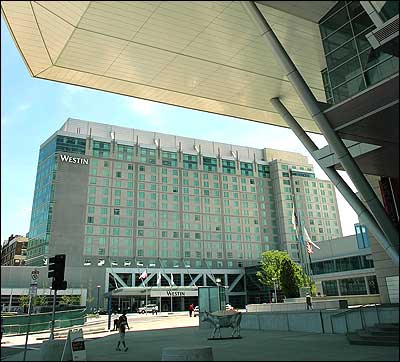
So with all the strides we've made in going back to the roots of urban planning in the last few years, is it surprising that a 1988 convention center is better than a 2004 convention center? Which facility do you think is better, and do you really think that the Boston Convention Center is really that bad for the surrounding area? You've read the analysis of other convention centers, how they relate to the human scale that surrounds the center beyond its front steps, and how these large buildings interact with the tiny ant (you) on the sidewalk. You be the judge.
Campbell also implores us to look at a handful of other convention centers. Philly as the good example, and Chicago as the bad example.
The facility is unlike any other in the world, absolutely huge, but there is no connectivity with the neighborhood around it. In fact there is no neighborhood around it, the convention center feels like it's in the middle of nowhere. For all of the money they've put into this thing, surely they don't want people bemoaning the site of the convention center? The West Bldg is the only part of it that really even has an opportunity for a decent frontage with a street, but it's a wasted opportunity as the facility just turns its back side to the road.
There is also a commuter rail station in the basement of the facility, transporting passengers between McCormick Place and the Inner Loop.

Is all really well in Philadelphia? I think Campbell may want to reconsider his recommendation on the Pennsylvania Convention Center, which is currently in the midst of a 878,455 sf, $800 million major expansion (the goal of which is to bring the total exhibition space at the PAC up to 1 million). Which by the way, I hope an important realization that goes without saying at this point in the Convention Center Search series is that "total sf" and "exhibition sf" are always completely different.
In the way of the expansion that shifts the convention center up to Broad Street are several historic buildings that Philly Inquirer architecture critic Ingra Saffron regrets the impending loss of. "The long, bland glass facade that Thompson, Ventulett, Stainback & Associates had designed for the convention center's Broad Street facade is a pretty meager replacement for this stout-hearted office building," said Saffron, in reference to one of the old buildings.
It's true that portions of the convention center, as Campbell wrote, are elevated above the ground level (with city life passing uninhibited underneath), but not all, and certainly not the new expansion portion to my knowledge (which consists of a quick search and skim reading on Philly issues). That still doesn't mean that there is a whole lot of interaction with the human scale, it just means that it isn't damaging the human scale (which I suppose a monolithic convention in the center of Philly could do anything but).
Campbell also celebrates the fact that the PCC is in the midst of Philly, surrounded by a great American city, whereas the BCC is removed from the heart. The tradeoff here of course is that expansions of the PCC mean great buildings must be leveled, whereas an expansion of the BCC, great buildings aren't going to be leveled, but rather, empty space built over, a new opportunity to make something urban out of something that is not.
Take it for what it is. It appears that the convention arms race doesn't slow down once a city cracks the top 10 convention centers, and in all likelihood, it will never slow down for OKC, even after building an all-new 550,000 sf facility south of downtown in addition to downtown's 1.1 million sf, 40-year old, Cox Center. The future of OKC in the aftermath of MAPS 3 is inevitably the pursuit of a convention center arms race, that's the bad news. The good news though far outweighs that negative: for once we are in the hunt with the cities we want to be, "big league" cities, and we control our destiny amongst our competition. Don't look now, but there are cities OUR size (like Nashville) adding $635 million convention centers.
Wednesday, December 23, 2009
Convention center search: Fixing the Cox (it can be done!)
I think that even if we get a real home-run convention center before 2020 that no matter what we're still in a position where we have to keep up with the Cox Center as well. Getting rid of the Cox Center after completing a new one is like taking one step forward and two steps backward. We need to analyze the heck out of what a huge mistake the Cox was, and get to a conclusion where we can fix it. And no, demolishing it is not the solution (not that it would hurt in my opinion). There is still hope for making the most out of the Cox.Remember that the Chamber report on convention center space in OKC recommendation that we're following was adding a certain amount of convention space to the market. That means keeping the Cox, too. And personally I think that this report low-balls the actual need because you'll notice that they just talk about Oklahoma County, which only has 706,617 residents..or comparable to the Omaha or Little Rock MSAs, but I digress. Bottom line on this matter: If we want to get rid of the Cox Center we should be prepared not to invest $280 million in a new center, but more like $500 million, in order to get 300,000 sf of prime exhibition space all brand-new, even when the Cox space is still fresh from a renovation.
Aren't we going to keep the Cox for its arena anyway? Remember that "58 steps" is the only thing keeping the Big 12 Basketball Tournament from being locked up permanently by KC. With the glitz and the glam of the new Sprint Center, their Municipal Auditorium (the site of the women's tourney) is still 13 blocks from the Power & Light District -- not 58 steps (across Reno Ave). Why not just keep up with the exhibition space attached to that arena if we're keeping the arena? Even if you disagree on the value of the Cox's convention space and only see merit to keeping the arena so we can keep getting Big 12 Basketball Tourneys, you must at least see the value in not having a huge facility that's falling apart in the middle of our downtown. We have too much of that right now. Imagine if the Cox suddenly got run-down like the Century Center across the street, what kind of dispersions that would cast on all of downtown. It would be like..gasp..Tulsa.
The problem right off the bat is that the Cox Center should never have been built where it was. Imagine for a second that we never razed the better part of half of our downtown area for the I.M. Pei Plan to Nowhere. What we would have is a Bricktown and MidTown without gaps, and even more urban areas to the south and west of downtown where currently all of the superblocks and blight are. Given that such a cool, urban city needed a convention center, where would you deal with that without disrupting the urban fabric? You could go to the edge of downtown, a strategic site would be between Deep Deuce and the OHC. Or perhaps in the rail yard along East Reno, along the BNSF line, or along the North Canadian River--nothing wrong with riverfront superblocks, because the grid system is going to end anyway. Well we don't have the luxury of talking about those sites. We have to make the best out of the convention center that has lain waste to a former urban neighborhood on the south side of downtown.
I've written in the past about my theory that the Cox/Ford/Myriad cluster of superblocks having done more to kill the C2S task force region than the I-40 Crosstown Expressway ever could have come close to. In fact I think it's highly suspect that a viaduct could be blamed for forming a border in the first place--that's why I-40 was built as a viaduct in the first place, so that the city could continue underneath it. The reality is that we have taken an area where the neighborhood was contiguous with the flow of downtown, and we disrupted that motion. We killed off Broadway. We blocked Harvey. We took life away from Robinson and Hudson. We added another pointless lifeless corridor to the mix, E.K. Gaylord. Today I think E.K. would be rolling the grave at the urban travesty of a street that is named after him, especially when you look at the urban grandeur that was once the young, promising Capitol City of Oklahoma.
To illustrate my point, let's break out the crayons! It's all about "flow" :

We turned ^ that into this..

Consider the First National Bank the epicenter of downtown--consider how the addition of the superblock sites affects flow from the epicenter? From the north, you don't notice it so much. North Downtown's afflictions have nothing to do with I.M. Pei (just Kerr McGee). But from the perspective of the south side of downtown, it's everything. In this sense, yes losing all of that great urban fabric hurt downtown no doubt, BUT what hurt even more was losing the flow from the epicenter to the south end of downtown. We rue the loss of the urban fabric, but I have never heard planners rue the loss of that flow which I believe to be the real culprit of our Core to Shore woes. Flow should be the main thing we are focused on restoring, because we're doing a bang-up job of restoring activity in key nodes of downtown, there just isn't any synergy between these areas. MidTown is bustling, Bricktown is healthy, Automobile Alley is alive, Arts District getting there, we're well on our way to restoring other areas too..we just need to bring it all in and connect it all. Streetcar will go a long ways towards helping us with that, but we still need to reexamine our grid system.
Here's an example of a downtown that still has its grid intact (Downtown Dallas). Looking at the map of DTD, you'll notice that there's adequate connectivity from Downtown into Uptown/Victory/Oak Park and other areas north of the Woodall Rogers Fwy. Yes, Woodall Rogers is still a dividing line but the key thing is that it doesn't disrupt the flow! Look at several of the key streets that cross the underground freeway--Houston, McKinney, Akard, and Pearl. DTD is coming back to life, and Victory, Uptown, and especially the McKinney Avenue streetfront are booming areas. They've had such an incredible amount of urban development that there is actually a glut of residential units on the market there, so essentially, they have the exact opposite problem that we do, and I'd rather be overdeveloped than underdeveloped!
..a downtown that doesn't breathe. The important thing that you'll notice by taking a look at the crayon maps of OKC above is that downtown is dead looong before you reach the Crosstown Expressway. These streets that we killed were once bustling corridors of commerce and city life. Broadway especially, as you can see in the photograph. Just like how a city is made of up neighborhoods, a downtown is made up of corridors like this. When historians wax nostalgic on downtown, they talk about how each echelon of society in OKC had a corridor that was its own: Park Ave was the most well-to-do, reserved for city leaders, lined with ritzy businesses and residences not to mention the offices of city leaders. The streets to the north side of downtown were well-to-do, the further south you got, the grittier it got (the cooler it got). Grand Boulevard was gritty, full of people, crazy, bustling--it was the Times Square of OKC. We killed downtown when we nullified our north-south running corridors, and let's face it: OKC is a north/south kind of city, you are always going to get to Point B from Point A by going north or south, not east or west. It's funny how the city develops like that over time, but it just does, and you can't fight it. That's why nobody really encounters downtown or any kind of "center city" activity when they cross over into North OKC from South OKC. The break in the system that hurts the most is Broadway, which was the most important street in downtown. Broadway dead-ends in front of the Cox Convention Center, so consider the intersection of Broadway and Sheridan "ground zero" for the urban butcher job.
The east and west sides are just huge bare walls, the only thing breaking them up is the entrance to the underground parking on Robinson and some mechanical equipment along E.K. Gaylord. F-. There is however a lot of potential for improving this though: there are some great opportunities for Santa Fe Depot-convention center synergy on the east side, as well as some great opportunities for park-convention synergy on the west side. It's just ridiculous to have an enormous bare expanse fronting those two possible diamonds in the rough.
For future reference, I plan on writing an equally long critical and provocative post in the near future on ripping out E.K. Gaylord. In this post I will talk all about the east side of the Cox, the possibilities for a multi-modal transit hub connecting multiple mass transit interfaces, and what to do about the nightmare that is E.K. Gaylord Boulevard--deadly to cross on foot, depressing to look at, the central artery of a downtown that has been plundered of its soul. So I'm just going to allude to a future post and leave the east side of the Cox alone for now, because that's a whole different can of worms.
I give you the existing floorplan for the Cox Center:
An improved version:

Now keep in mind all of this is coming from someone that knows nothing about convention centers! I don't claim to be an expert on the convention industry. I just know that more has to be done to make the Cox open up to the east and west side. On the west side there appear to be hallways that dead end--take a chunk out of that bare well along Robinson and open those hallways up to the city. There could be an entrance behind meet rooms 9-12 as well as on the SW corner, where you could extend a hallway and open it up to the intersection at Robinson and Reno. Between the two entrances, the remaining blank wall space should be spruced up with art work similar to the Tulsa Convention Center exterior artwork. What I would really like to see is a huge mural depicting the urban fabric that we lost in urban renewal, not as it appears in black and white postcards, but as it would appear in 2010 with vibrant businesses and peppered with modern touches.
There should also be another grand entrance facing the intersection of EKG and Reno. Here is where there is the opportunity for cutting a chunk of the Cox Center out that doesn't look to be vital and using that space for part of an intermodal transit hub. Without getting into the technical details of all that (saving it for a future post), there would be lots of people and lots of different forms of transit. Streetcar. Amtrak. Rubber tire trolleys. Taxis. City buses. Cars. People walking. It could encompass additional structured parking for personal vehicles or utilize the underground parking already beneath the Cox, and from the exterior the hub would be a glass facility that you can see inside and outside of, very open to the outside, and connected to the Santa Fe Depot, as well as perhaps the main entrance of the Ford Center (which is on the NE corner of the Ford along Reno). The key though is that any connections between the depot, the hub, Cox, Ford, and whatever else should be open to the outdoors. It should add to the street life, not be anything separate.
Maybe, just maybe, an idea that can be considered is a Broadway tunnel underneath the Cox and Ford centers. It would be expensive though, and I wouldn't call it a priority. It would be advantageous though to have traffic be able to flow smoothly from C2S straight up Broadway into North OKC. When you talk about creating connections between South OKC and North OKC, and how downtown should play a part in that, the idea of bringing Broadway could symbolize the turnaround of OKC. I wouldn't advocate it though because like said, it may be cost prohibitive to do so, esp considering the underground parking underneath the Cox, and it wouldn't be as easy as these other ideas I've thrown out there.
The ultimate idea has to be that the Cox Center is still a valuable facility. With 1.1 facility, it still has a lot to offer OKC. We have nothing to gain by demolishing it, and everything to gain by improving it. I know that we might not want to, I know that a lot of us were excited to think about a massive mixed-use development on the Cox site when we saw MAPS 3 pass. But keep this in mind: MAPS 3 convention center will only be around 500,000 sf, and 850,000 sf after an expansion. The Cox is 1.1 million sf located deep in the heart of downtown. This is Sheridan and Broadway, ground zero for where things began to go wrong with us from urban renewal. We have the opportunity to converge several different priorities and ideas out there and create real, sustainable future vitality. We want to extend the Canal. We want a transit hub for our streetcar system, and our future commuter system. We should want to do something about the Cox.
Subscribe to:
Posts (Atom)