Showing posts with label deep deuce. Show all posts

Friday, June 8, 2012

ODOT's legacy in DT OKC


This, the decimation of the real Deep Deuce neighborhood (not just the YP housing that has exploded in recent years), is the legacy of ODOT in downtown Oklahoma City. These are the people who are designing the Boulevard, erm, I mean I-40 Business Route.

Remember that. And to hades with ODOT and their proposal to re-construct bridges over Western, Classen, Reno, and probably Exchange. If you are outraged by ODOT's latest cluster, this Facebook group, Friends for a Better Boulevard, is led by a group of activists who are organizing to save this Boulevard, erm I mean I-40 Business Route project, from epic disaster - the kind of disaster that one of us will have to write a book about in 30 years.

And next time you drive I-235 through downtown, consider the wide-sloping grassy depression that decimated dozens of blocks of Deep Deuce urban fabric that would be infinitely cooler and better than Bricktown today. That legacy could only be brought to you by ODOT - not even OKC's epic urban renewal failures can approach the level of atrocity that has been ODOT's highway planning.

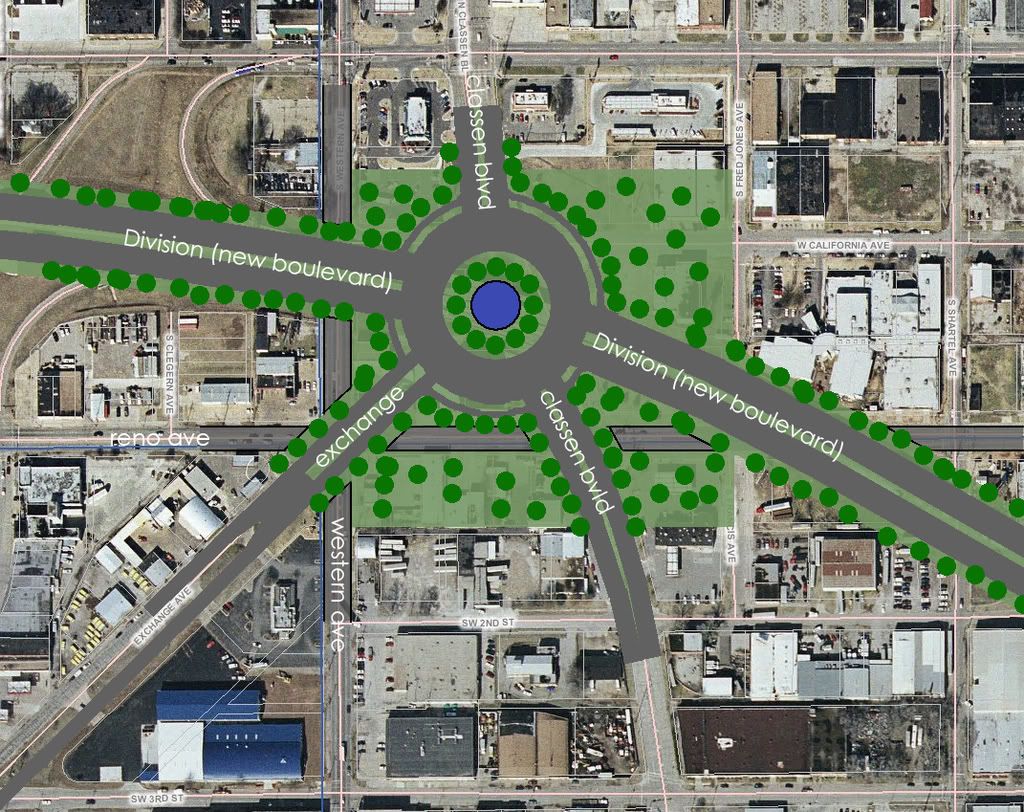
There are a lot of issues constantly facing downtown. I believe that this boulevard, and the advocacy behind a proposed traffic circle instead of ODOT's horrible proposal to build an earthen ramp for a boulevard that effectively only lasts 5 blocks between there and when it goes under ramps at the BNSF tracks, has risen to the forefront as the #1 issue facing downtown right now. And City Hall and Eric Wenger are making excuses and arguing on behalf of ODOT instead of embracing a plan generated by broad-based citizen advocacy.

The traffic circle:


More on this to come in the future, as this story evolves. I'll leave you with this final thought, that for me, is the most influential reason why we need the citizen-driven traffic circle proposal over ODOT's failed highway planning: Think of the infill development that could be created around a grand traffic circle like this, wasn't this the point of having this "boulevard" in the first place?

Council, city staff, developers, activists, and citizens.. I know you're lurking on this post. At least check out the Facebook group and take it upon yourself to learn more about the effort to avert this fiasco simply out of being good, informed citizens.

Friday, December 23, 2011

LEVEL update pics


Construction update on LEVEL: Friday, Dec. 23rd, 2011. The stucco was being applied to the south edifice--it's definitely a great touch, and looks even better than in the renderings. This is great news for those who were slightly disconcerted that the stucco might be mistaken in appearance for EIFS. The black-gray brick on the street level has been added to the east side, along Walnut Avenue, and boy is it sharp as well. Think Central Avenue Villas.

Even better is the idea that -shocking- we can take a developer at his word when he says he will design and build a quality project.

Sunday, May 22, 2011

How good developments go bad

This will be a post dedicated specifically to how developments get proposed, or rumors about, and then the developments halt and get to the point where they're dead on arrival. Since it's just a blog post, I'll make it short, and just focus on the primary reasons I've seen since I've been giving up my life to track OKC developments (kidding--well, mostly). The main reasons are unaccounted economic changes, incompetent development teams, what I like to call "strict 2009 adherence to 2007 ideas," and another big one is the limbo caused by big-ticket public projects, many of which are still up in the air.

I will also try and relate this back today, with the implications of post-MAPS3 passage Oklahoma City. Remember: We were supposed to see all of this amazing amount of spin-off development.

This is the Flatiron project, on Harrison Avenue, just north of Deep Deuce--proposed by Grant Humphreys who has been a successful, innovative urban developer. So what could have gone wrong (because this project is definitely been dead for a while, in spite of past efforts to revive it)? Humphreys was somewhat over-extending himself, especially at a time when he was still heavily leveraged in the Block 42 project which he finished a few years ago and has recently still been selling off the last units in that project. Block 42 was an innovative project for OKC because it combined townhomes and flats in a building with a striking urban design, so price points were high. It was also competing with several other projects within the immediate 3-block vicinity. The Flatiron project also called for a lot of mixed-use space, and I imagine it was difficult to find high-end commercial tenants to sign-up for an outpost location at a time when even Bricktown was losing retailers. It's a shame because it would have been an awesome project, but Humphreys will be back downtown, and is currently working on Carlton Landing at Lake Eufala.

The Cotton Exchange is an especially interesting project because it's up there with the old "Factory" proposal as the projects I most wish could have happened. I won't get into the details of how much I love this project, but it would have been a great one. It offered prime commercial space right on the canal as well as with frontage on Mickey Mantle, and it also offered a good amount of residential which Bricktown badly needs. The Centennial was a huge success, so it begs the question why OKC can't support this kind of quality mixed-use development, even though we surely haven't seen much of it. The developer, Gary Cotton, was in trouble though. He didn't have the resources to pull the project off--he had a little bit of equity from the sale of the Bricktown "Mercantile" building. He needed other investors but didn't want to listen to other ideas, from what I've heard. It's still a shame that this didn't go forward because he was using the brokerage team that The Centennial used (which sold out, and still had many interested clients), and because other experienced Bricktown businessmen were offering lots of advice. He also benefited from not just lots of Oklahoman and blogosphere coverage, but even got TV news coverage, which downtown development rarely gets.

Many people got very excited when Tom McDaniel announced that OCU wanted to move its law school to the gargantuan Fred Jones auto factory, which is an awesome historic building. The deal died when Tom McDaniel stepped down as president of OCU and a new guy came in, who didn't like the idea so much. But it's hard not to note the sequence of events: Chamber officials promise there will spin-off MAPS development, Tom McDaniel announces OCU will develop law school downtown if MAPS passes, MAPS passes, Tom McDaniel becomes chair of MAPS Citizens Oversight Board, downtown law school plans are nixed. I would chalk this one up to political problems, if the new leader of OCU doesn't like the idea, then I don't see how anyone is going to "force" him to follow through.

For years, the Union Bus Station was a magnet for vagrants, which caused problems for the developers on both sides of the facility who wanted it gone. First, Dick Tanenbaum, redeveloper of The Montgomery on Walker, wanted to buy the bus station and close it down, and put a jazz club inside of it. It would have been a win-win, downtown didn't need the Greyhound station anymore, it was a blight, it attracted vagrants, he could have renovated it and turned it into a historic gem and just put a jazz club inside of it, which would have turned a problem for the neighborhood into an asset for the neighborhood. That's what you call making lemonade out of lemons. Obviously Tanenbaum, a veteran Central Oklahoma developer, had the resources to make it happen. One problem: The owner was pesky and had no intentions of moving, and was difficult to deal with. So Tanenbaum gave up and turned his files over to Nick Preftakes who was on his way to acquiring the whole block anyway. Preftakes also found the owner to be pesky, but by using his properties positioned all around the station, he was able to make it difficult for the bus station to remain there, and forced its closure that way. One problem now: The owner still doesn't want to sell to Preftakes, and harbors a grudge, seemingly. Well let's be honest, when Preftakes put up a property fence just to make it difficult for buses to make wide turns, that wasn't very nice. So I'm not sure Preftakes is going to get to include this parcel in his block in the end, anyway. I just hope the building gets restored somehow, and not leveled.

How could I not bring this one up? haha.. The Braniff Lofts proposal, from 2006 and 2007, would have been a really vital piece toward preventing a controversy (and a tragedy) that would soon follow. A group of investors local of investors ("Corporate Redevelopment LLC"), many with significant Downtown OKC experience and have been mentioned often on this blog, were negotiating with Kerr McGee to acquire these abandoned buildings surrounding their headquarters for redevelopment purposes. The plan was to, at the very least, use the Braniff building AND the KerMac building and convert the two into lofts--the developers at the time were convinced they had a winner, and many onlookers are still convinced the proposal could have been a winner. The deal fell apart because KMG was acquired by Anadarko Energy who refused to honor the deal between the investors and KMG. SandRidge acquired the block and demolished the buildings to make way for a corporate plaza. These buildings, except for the Braniff Building which was lucky enough to already be on the historic register, are goners and lofts or mixed-use of any kind on this block will never have an opportunity to happen. I would chalk this one up to corruption at many junctions.

It appeared to be one of the turning points of downtown development when the Downtown Ford announced it was closing and was demolished. The land owners, Fred Hall and Bob Howard announced potentially ambitious plans to redevelop the large site into a huge mixed-use development. The Jones-Hall family has been involved in other deals, and was involved in the OCU deal that fell through, and Howard has been engaged in redevelopment of of Mid-town lately, so there is no doubt that the development wherewithal and resources were in place. The site could have possibly been the largest mixed-use downtown development to date. "It's no surprise, and it fits our long-term plans to develop that site into commercial retail and housing," remarked Hall, at the time. It was lauded as a success of MAPS spin-off. Why did the deal fell through? Because it got gobbled up by a MAPS subcommittee that insisted the convention center needed to go on THE most promising piece of real estate in all of OKC.

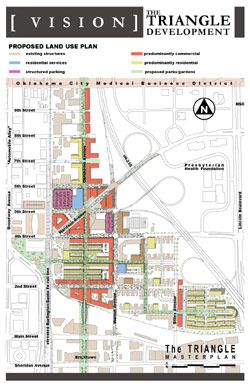
I'll make this my last one, and I think it's a big one. No matter how you slice it, The Triangle masterplan died. At a time when the possibilities for bubble-style downtown development appeared endless, the plan seemed fail-safe. A group of investors including Bert Belanger, Ron Bradshaw, among others, would team up to do a ton of development in a small area. However each one encountered difficulties selling units of their first project and then 2008 hit, and it became apparent that downtown development could not go forward purely driven by speculation on condo units. The group broke up, although they are still individually engaged in development in the "triangle" area, although hardly according to the original plan. And some new investors have popped up and added projects such as LEVEL and Aloft.

So, here you see a multitude of reasons. In every one of these cases, it is a shame that the development died, although this is not always the case--sometimes developments are bad and projects dying would be good. However, there HAS to be a way to meet over these kinds of things and compromise. Bad developments need input for improvement before they actually apply for the permit. Good developments need input to ensure their success. This goes both ways, the process shouldn't JUST be about putting pressure on bad projects. Furthermore, a lot of these reasons are preventable. Switching to a more sustainable economic model for real estate would have prevented a lot of the post-2008 development lethargy we were seeing until recently--the economy never stops, sometimes it contracts, and even that presents an opportunity (for more modest real estate deals). For instance, people still need housing when they can't afford a mortgage, which is why for-rent housing has thrived in the post-2008 economic climate. Capitalizing on that could have prevented a lot of these projects from collapsing. Also, a LOT of stuff is in limbo when we have these big-ticket items in limbo. Do you think somebody wants to build a mixed-use or housing investment when they aren't yet 100% certain where the streetcar route will go? Do you think somebody wants to invest in a huge hotel project without knowing where the new convention center and likewise, streetcar lines, will go? Of course not!

One thing that has been an absolute failure thus far is MAPS accounting for the spin-off development. It was one of the most persuasive reasons why we passed MAPS3. We wanted to buy into a vision for building a city, not just for building a single park or an isolated convention center. These things aren't being coordinated AT ALL. There is no single planning document that has more than one big-ticket public investment component in it. There are however millions of planning documents, district masterplans, streetcar route ideas, convention center proposals, and so on and so forth. Nobody is proposing that this stuff come together. Furthermore, a lot of the interests behind certain projects need to step down and realize that their project isn't the center of the universe. The end goal is spin-off development, not having a city built around a convention center. When you eat your most promising site for mixed-use development to put the convention center on it, you miss the mark. You can have your cake and eat it too. The convention center subcommittee needs to address the goals of downtown as a whole just as every other subcommittee needs to be concerned about it. Ignoring the big picture is setting us up for failure at a time that immense resources have opened up such an enormous opportunity.

Every MAPS3 subcommittee needs to be tasked with the exact goal, and it needs to be an overarching goal of what we as a city hope to create with this opportunity. Each subcommittee needs to be opening its meetings discussing this goal, whether it be attracting investment, or improving quality of life. There needs to be a singular vision shared by all. Right now what we have is a convention center subcommittee that has run amock with the process, stepping on other projects to make sure that at the very least the convention center gets done, and running completely contrary to the goal of MAPS.

These guys need to sit down and analyze universal MAPS goals. They need to ponder what they as a convention center subcommittee can do to improve quality of life and attract mixed-use development to downtown. I'll tell you one thing: You can do a LOT more to accomplish this than by eating the best real estate in the entire city for your convention center, which is going to happen anyway. That makes no sense whatsoever.

Tuesday, April 12, 2011

The Skirvin Proposal

I was currently in the midst of a large convention center post, with some thoughts on the progress so far from the MAPS 3 Convention Center Subcommittee. Well, evidently I was not about to have time to do such a blog post, if the Skirvin Partners would have anything to do with it. Do I think their proposal changes the game? Not in the slightest. But it becoming public does preclude anything else I might say, so perhaps it is best to just start with the now locally-famous Skirvin proposal.

I am going to cover this proposal in a completely unbiased way, since this is going to be controversial. I will give my strong opinion of this in a later post...

Background: OKC is building a new $280 million convention center. A centerpiece of the project that is not included in the budget will have to be a convention hotel, a hotel with minimum 700 rooms that can expand the convention center's ability to compete for vital larger conventions. The convention hotel, not being included in the budget, will have to be funded somehow. It will likely receive up to $60 million in city subsidies, money which will have to come from somewhere, but money which the city will likely get some ROI from (eg., it will probably be a loan).

Enter Skirvin:


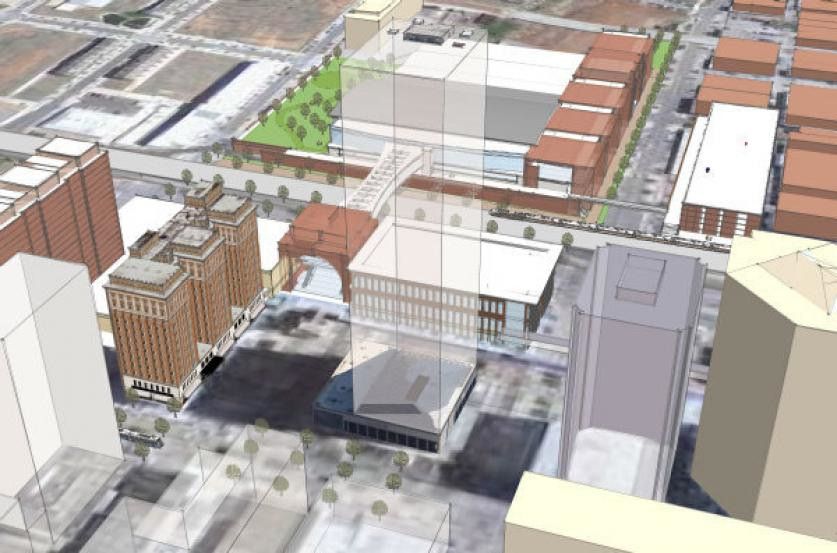
The Skirvin Partners propose that their hotel be repositioned to serve as the city's convention hotel. It is a proposal for siting the convention center between Bricktown's Main Street and Deep Deuce's 2nd Street. Essentially, across the street from the new Maywood Lofts on 2nd, and across the street from the Sherman Iron Works bldg in Bricktown.

The Skirvin currently has about 225 rooms. That's a far cry from a convention hotel, so they propose adding a second tower just to the north of their property (where there is currently a bank drive-thru) that will have 425 rooms. Then things get interesting with the razing of the Santa Fe Garage, which provides 1,518 parking spaces for downtown workers. Then to replace these parking spaces, it's proposed to build an 800-1260 space parking garage on 2nd Street, where the Sherman Iron Works bldg currently is (Main/Oklahoma in Bricktown), possibly incorporating the historic building into a parking structure.

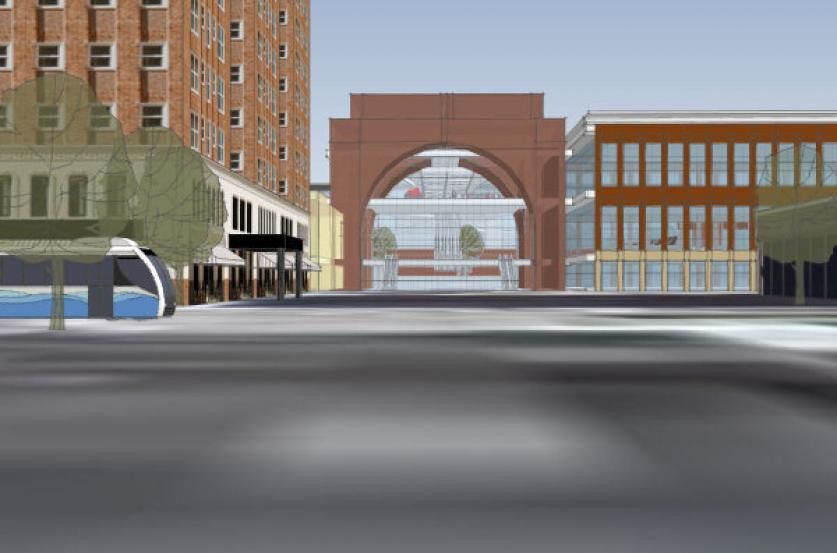
The Santa Fe Garage, which would be razed under this plan, would be replaced with a structure that features a large open "gateway," available office space that the Skirvin suggests could be ideal for the Chamber of Commerce, and more structured parking. This parking would accommodate between 575-895 spaces. Then it would ALL be incorporated with a large pedestrian bridge that crosses E.K. Gaylord and the BNSF tracks, connecting the new "Skirvin complex" and the convention center across the tracks.

One of the complexities happens to be that the site between Main and 2nd streets is currently a rail yard, one that is currently slated to become a high speed rail corridor. There is a proposed arc that cuts across the entire site (the non-utilized tracks currently veer to the north, but this would be a new arc that veers to the south merging with the BNSF tracks). The arc is important because ODOT's proposed high-speed rail corridor from OKC to Tulsa terminates where the Turner Turnpike terminates. So in order to get it further into downtown OKC, it has to come from the NE. So this will essentially be where the line changes from utilizing the BNSF track (that divides downtown and Bricktown) to where it veers to the NE toward the "Adventure District" and on to Tulsa.

While it is certainly true that high-speed rail is far from being funded at this point, especially given the current debt situation of the government, it is a salient fact to point out that there are still local plans to go forward with rail connections to the Adventure District and MWC/Tinker. These regions to the NE and E would be connected via this arc as well, with or without high-speed rail to Tulsa. Placing a convention center over this railyard could prove to be a fatal setback to rail connections to the NE. You could raise the convention center and allow the rail lines to pass underneath uninhibited, but doing so would likely put a convention center with the desired specifications well beyond the reach of $280 million.

Lastly, the Skirvin Partners have pointed to two factors that they feel make their proposal the best one for the city: 1, with the city having to come up with $60 million somewhere if they try and bring in a traditional convention hotel, they would be asking for "far less" of a subsidy. 2, they claim that Downtown OKC would not be able to absorb a new hotel with "more than 600 rooms" (ideally the convention center needs to have more than that) and they claim that using 225 existing rooms coupled with just 425 new rooms minimizes the risk of throwing off downtown's hotel room balance.

Some thoughts on this proposal coming up soon in a broader analysis of the convention center process so far...

Tuesday, February 15, 2011

Score some more for Deep Deuce

In today's Oklahoman, there's a Lackmeyer article about a housing project that OCURA hear in their meeting today. That's pretty routine business for OCURA, what makes this newsworthy is that the proposal is by Ron Bradshaw, who just finished a big project with the 2nd Street Lofts, and he's proposing all-rental now, and using one of the architects that's done a lot in Uptown Dallas. We know that this will be a 139-unit, $16M project. This project is at 4th and Oklahoma Ave--I suspect this is the site that will back up to the new Brownstones at Maywood Park, so it won't be a full block like LEVEL.

In the article, he admits that he and other developers put the cart before the horse in going full steam ahead with condo, which has proven to be a harder sell. Also interesting, aside from that we suspected Bradshaw would move on to another project soon, is that he proposed this so soon. He earlier said he would wait until selling out his project on 2nd Street, which makes me wonder if sales had picked up over there.

At any rate, it certainly looks like the economy is picking back up, and that downtown development is really taking off again. This project seeks to break ground this summer at 4th and Oklahoma Ave. It will be under construction simultaneously with the next phase of The Hill, the 7-story Aloft Hotel on Walnut, Richard McKown's full-block LEVEL development, as finishing touches are put on the Clark Bldg on 2nd Street, all in Deep Deuce alone. That will be a huge amount of construction in one area. Add it to the potential for some new mid-rises in St. Anthony, Dick Tanenbaum wanting to break ground as soon as he gets his hands on the old Mercy site, all the infill in SoSA, two proposed hotels in Bricktown, and some A-Alley renovations--there is a TON going on right now.

Downtown development is looking less and less dominated by Devon Tower and Project 180/MAPS3/Public and civic sector projects.

Wednesday, January 12, 2011

Upheaval in local grocery options

It looks like with Whole Foods coming to town, there is an upheaval underway already with the local grocery scene. Consider the number of local organic grocers within 1 mile of where Whole Foods ended up breaking ground. It looks like some of them may want to move downtown after all (especially after Crescent Market has been adamantly opposed to moving downtown for years until suddenly). And so now what we're seeing is downtown finally appearing as a viable retail alternative to the Chesapeake area...as long as your niche is going to be cannibalized by Whole Foods. And to be clear, this isn't saying Crescent Market, Forward Foods, or any other gourmet and organic grocers to name a few couldn't compete with Whole Foods which is often actually a benefit to the local gourmet and organic grocery options. Local options typically compete quite well against Whole Foods and Whole Foods brings more attention to the whole idea of gourmet and organic grocery shopping in cities it goes to. My belief is that Whole Foods may have gotten an agreement with Chesapeake that they'll raise the rent on Crescent Market and encourage them to leave the area, which is exactly what they're doing.

Crescent Market appears to be looking at areas with good access to Mesta Park and Heritage Hills, wanting to stay true to its base demographic. This means looking around Walker and around Broadway. Automobile Alley appears to be getting serious consideration, but the problem with A-Alley I see is that the current Crescent Market is well over 20,000 sf. Even if they utilize a more efficient floorplan I still don't see them downsizing their operations, meaning they'll need at least 10,000 sf on a ground floor in a well-renovated building, which may be hard to come by. Two other gourmet grocers that I won't name are also looking at downtown very seriously, and I understand there is a very strong possibility that the LEVEL Urban Apartments at 2nd/Walnut will sign a lease with an existing locally-known grocer that might not necessarily relocate a store but open a new one. Or it might relocate the store.


Is it possible that Chesapeake-area retailers moving downtown could stem the tide of movement further north? For the last 2-3 years it seems like the only option for retailers leaving 50 Penn Place or others coming to town was to go into the Classen Curve development, whereas they all could have very easily and successfully gone downtown. Full Circle, looking right at you..it's time to move downtown and get out of your building. Can anyone else imagine Crescent Market, other grocers, Full Circle, Hideaway, Shop Good, Rawhide, and others all in the same neighborhood? That would go many miles toward establishing the critical mass needed in terms of downtown retail to turn the tide and get the ball rolling.

On a sadder note, it appears that this Friday is the last day for Market C on NW 23rd. A great Uptown 23rd tenant for a long time, that added a lot to the really interesting and diverse mix that has blossomed there, it is a shame that it is going away. It will be replaced with more space for Cheever's catering.

Sunday, October 17, 2010

Brace for the 2nd wave of housing? (fingers crossed)

The first wave of new housing projects came shortly after the completion of the first MAPS package. We saw the completion of many projects, some that had been long in the works, others that were completed shortly after being envisioned. Some of these projects include the Legacy at Arts Central, the Montgomery, Park Harvey, the Seiber, the Harvey Lofts, Block 42, Central Avenue Villas, Maywood Park, the Centennial, and more. Then what's more important is that we saw more proposals coming out constantly so that it looked as if the second wave would come right after the first wave. All in all, I recall the total number of units being proposed between 2005 and 2008 being over 2,900.


The second wave included projects that almost unanimously fell apart at once. The Cotton Exchange. Overholser Green. Bricktown Gateway. The Flatiron. Bricktown Village. The Leslie. Maywood Hall. The Heights. And many more, and that's just residential. There was maybe ONE project from this entire wave that ever came to fruition, and that was The Lofts @ Maywood Park, which has been successful in selling smaller, reasonably-priced units to a younger demographic.

Then all of a sudden there was the silence and the frustration at the silence. Voters were asked to approve $777 million in public improvements on top of billions in the forms of other public improvements being made simultaneously downtown, and the rational is that it would spur the economy by resulting in private development. If that was so, then where's the private development? The first deal that looked like it could be a spin off was OCU moving its law school downtown--a deal which fell apart over the summer as a result of OCU's change in leadership.

Then things started to change. Was it one project? Probably not, because we are fairly certain that the owners of the land bounded by 2nd, 3rd, Oklahoma, and Walnut have been mulling over an urban project for a while. They were already past soils testing, which occurs toward the conclusion of the planning phase, when they were ready to publicly announce their plans. But the announcement of Jim Thompson's Aloft Hotel could have possibly resulted in things heating up and interested parties suddenly getting a lot more interested. The design of the Deep Deuce Aloft Hotel, which is very unique from all the other Alofts which are still very decent, turned heads. To say the least. Could the bold statement architecture of the proposed Aloft have a hand in moving McKown forward? Could it have had a part in persuading McKown to make his project as truly urban as possible?

Regardless, I find it very hard to say that a major investment like this would be unaffected by a game-changing addition such as the Aloft.


Then add a few more folks to the picture. Dick Tanenbaum is getting back involved downtown, who is competing for the attention of OCURA on the Overholser Green site, may have a viable proposal to build something where another successful developer, Chuck Wiggin couldn't. That's 250 apartment units that Tanenbaum says he can break ground on, in January 2011 (very soon) provided OCURA makes the right decision. Add that to McKown's 227. Mickey Clagg is finally about to resume the snail's pace renovation of Hadden Hall, which will bring 18 units onto the market, on top of the 20 or so they finished earlier this year north of Saint Anthony's. There are a few more smaller single home projects, such as 626 West Main, the Waters' residence in Deep Deuce, several homes u/c in SoSA, and a few around the medical district. Clagg says he'll begin 1212 Walker in the next few months, as well. 21 units there.

So add it all up, and there's at least 550 or so units that are about be underway once again, which actually does come close to the first wave in scope, which I think justifies this as the second wave, albeit a few years in waiting, and much smaller than expected. Still, hard not to take 550 units--especially in a cycle in which only conservative, pragmatic projects are getting off of the ground. I think Tulsa is still building more units, and if not more units, certainly at least twice as many individual projects seem quite possible (OKC's count is offset by two gargantuan-sized projects, 250 and 227 units). Do we count The Hill once again, now that it seems somewhat back on track? Hard to tell. One thing's apparent, is that downtown development is possible, even in OKC. Yes, "in this economy" (if that cliche phrase hasn't been banished yet). What I mean by that is that development proposals are still gaining traction, as long as you have the money to do it and aren't relying on speculation, and it's also a great time to get involved because construction costs have gone way down for urban development (although I think to agree this is regional, and depends on how desperate local contractors are for bids, which in Oklahoma isn't very desperate lately). I also think development is very cyclical, and I can see signs where the economy in the states is improving overall, and we've all been preaching about how well positioned OKC is to make some moves once the overall economy begins to rebound.

I think that this is a bona fide wave of residential projects, several that seem to be affecting each other, all the way across downtown from Midtown to Deep Deuce. Why I chose to write about this is simple: This means we could see some more very interesting proposals very soon, as well. Have we seen pent-up demand for downtown housing fully satisfied with the 550 or so new units from the 2010 downtown housing wave? Last I checked the downtown apartment occupancy rate was still 97%, so that would probably be a..no. Who's to say that there aren't more interested parties out there waiting for the right time, who no doubt have been encouraged by the Deep Deuce and Midtown projects that could all begin within the next 4 months.

Tuesday, September 7, 2010

Real infill coming soon

I think that phrase best explains the state of downtown development at the moment, which is actually significantly improved from last year when we were just losing major projects despite any anticipated boost from Devon Tower. Today we are better off in terms of knowing exactly what we've lost, how to come back from it, and the difference is we've come a long ways lately in gaining infill momentum. None of this is new news because you all have already seen it in the news and on the other blogs, just haven't gotten my take it due to my inactivity on here lately.


Think of Devon Tower, first and foremost. Hardly infill, when trying to analyze and assess the tower's impact on downtown, it will be equal or greater to the Ford Center or the Brick. I'm not even sure if we have a public works project downtown yet that is on that level. Maybe more on level of if Jerryworld were in downtown OKC, just call it Larryworld instead. What I can't impress enough is the importance of infill projects because they form the base of an urban environment. You can do without the major projects, you can't do without infill--right now we really do lack infill compared to the major projects in the works right now. To illustrate this problem, just think of the Deep Deuce area which is riddled with vacant lots with the downtown skyline towering overhead. It leaves an awkward impression of an urban desert (I don't know how else to say it). We have and without more infill will continue to have streets surrounded by mudpits and dried up dusty fields in the middle of our downtown, and clearly despite how wonderful that skyline is, the street-level is lacking.

There is a real need for a skyline, as it is a city's visual representation and I do believe it is important for a city's urban environment to form this representative image of that city. There is also a real need for facilities like convention centers and stadiums, because there aren't many other ways to pack that many people downtown at once--that traffic generated is much needed. However neglecting the infill projects, which are your less sexy, more practical, smaller buildings that form the surrounding neighborhoods--that's neglecting your meat and potatoes. OKC truly has a starved urban landscape if you look at it that way.

The reason I bring up Deep Deuce's vacant lots is to transition into what we've gained. Deep Deuce development is continuing to evolve continuously. Since the sky was falling downtown (last year), construction has picked back up at The Hill. Evidently they are just finishing up on the units on 3rd backing up to I-235, but they've also cleaned up the rest of the construction site which had weeds growing up everywhere. They will wait for the units to sell before starting on others, and amazingly, they have sold several more. I still think it's the worst bang for your buck downtown, but I sincerely wish them the best of luck for the sake of Deep Deuce, and hope that anyone looking for suburbia in downtown check them out.

Obviously the new Aloft Hotel, which I've already posted on a few times, will be major. It will compete directly with the Hampton Inn for business travelers looking for a very urban, chic hotel that they can use their corporate account on (which is where chains are good to have). The Aloft Hotel will have an advantage in competing for these travelers just because the brand image is more in line with this specific location, as opposed to the Hampton Inn which usually aren't that chic. The design is obviously going to be stunning and will create some real linkage between Deep Deuce and Bricktown.


The best project that's come onto the radar of late is a joint effort by Wade Scaramucci and Richard McKown, of Ideal Homes--an entire block bounded by Walnut, 2nd, 3rd, and Oklahoma--that will soon become 227 units with parking in the middle of the block and street level retail lining wide sidewalks. I think that the design could be anything and the product could be anything, there are just two things that are key here: This project, just like the Aloft, is financed and ready to break ground on an expedited construction schedule; and also, the project takes the last full vacant block in the Maywood Park area and turns it into the stuff cities are made of. Surrounding this contemporary apartment development on all sides will be the old Walnut Avenue Baptist Church, the Maywood Park Lofts, Maywood Park Brownstones, and the Aloft Hotel.

Deep Deuce's urban fabric resembles a horse shoe of development going around the edges that is finally being filled in, and it will be a continuous urban neighborhood from the BNSF tracks all the way to 235.

Elsewhere in Deep Deuce, Sage is also once again reinventing itself with the addition of a jazz club--returning the Deep Deuce neighborhood to its roots as a jazz hotbed. Good downtown development is not a lot of shiny new-urbanist projects sparsely scattered throughout greater downtown. When you create synergy from projects that relate to each other, bound each other, and create atmosphere is when you have good downtown development. Such as the perspective looking down 2nd Street at the new Maywood Park apartments and then the lofts fitting snugly with an equal setback, with the skyline rising over. That's the infill we need, focused where it most makes a difference right now.


And to bring it back in terms of Devon Tower, at what point with all of these major projects, do you have enough infill that there is balance? It may not even be possible. There are several billions of major projects in the works at the moment. Something like Scaramucci and McKown's apartment complex creates as much street-level density as Devon Tower despite being a miniscule fraction of the cost, possibly $10-15 million at the most probably, compared to $750 million. Maybe we don't deserve Devon Tower and perhaps it is "too enormous" a project for OKC, but we sure will take it and be glad to have it, but it does make you wonder what the right proportional amount of infill is that it should trigger?

Wednesday, June 16, 2010

Awesome hotel to go in Maywood Park

I am so glad to see someone with the cajones to do something. Here is to Jim Thompson, OSU arch grad who develops hotels and insists on designing every one of his own projects himself. Here is the article that Steve wrote, which will grace the business section of tomorrow's Oklahoman (been a while since the business section had GOOD news).

I recognize that major projects are happening, Devon, and the public initiatives. The resign that projects like this Aloft Hotel are SO VITAL is because this represents private buy-in. The ratio cities typically strive for in return on investment for public projects downtown is 5-1. I would argue that happened after MAPS 1 was finished but when we began the new wave of public investments the private investment did not keep up.

Infill is also vital for non economic reasons. It is important just because you want the building stock. A $750 million Devon Tower doesn't make a downtown nearly as much as $750 million in smaller infill projects spread out over a dozen blocks or so definitely could, and that's the truth. This adds vitality, it adds buildings that interact, it adds complimentary uses, it adds sense of place and definition of space over a broader area and not just in front of a landmark, and it adds architectural diversity. Just take a look yourself:


For more details, check out Steve's story in today's Oklahoman. You'll find out how expensive it will be, how tall it will be, how many rooms it will have, what use will occupy space on the street, what corner in Maywood Park it will be built on, where the project currently stands, how the project came about, and get some more background information on Jim Thompson who is new to the downtown area, but certainly not OKC development (with several NW Expressway projects). Congrats again to Jim Thompson, who is taking a risk and doing something in order to add this beautiful asset to our community. I am certain that Jim will be rewarded with success, it looks like a great project, and I certain we will be talking about him and his project for a while to come..considering that aside from Devon and other things that have been talked to death already, that's all that's goin on right now.

Sunday, February 21, 2010

OCURA: What a stellar track record

Gotta love gub'ment interference in downtown development, Oklahoma City Urban Renewal Authority (OCURA) especially, the folks who brought you Lower Bricktown, Bass Pro, The Hill at Bricktown, Overholser Green, and countless other downtown success stories. Pat yourself on the back, OCURA, because if not for you and your contributions toward expediting quality private development, OKC would still be a vibrant downtown. Wait, I meant a dead downtown.

So in this post we'll examine OCURA's stellar track record in advancing "quality" urban development in OKC.

I think we can all appreciate the corrupt bidding process in which we ended up with Bass Pro, over other potentially more urban projects that had been pitched. The good news is that Bass Pro is virtually the extent of retail in Bricktown, and the rest of downtown. It also added something Bricktown was in desperate need of: surface parking. So all in all, a win-win. Plus the adjacent Lower Bricktown development was absolutely fool-proof. Even though The Centennial is the only remotely urban component of Lower Bricktown, even it is loosing retail tenants. (LiT went out of business.) LB's other clothing retailer, Firefly Clothing, also closed recently. So one bright spot for Lower Bricktown, the fact that it did at least have leasing, is now just one of many sore spots for the much-maligned project. Add to the fact that LB has never been finished, and likely won't ever be finished until the Crosstown comes tumbling down and replaced by an at-grade boulevard behind Lower Bricktown. As it happens, developers Stonegate Hogan were given a TIMELINE on the project, and the TIMELINE has since lapsed. Will OCURA ever close on the remaining canal-front land and take it back, and try and get some other developers to bid on it? Nah, never. This is not about good development, the City of OKC, protecting a public investment like the canal, or ANYTHING like that. This is about the good ol' boy system and pushing the interests of the developer, Stonegate Hogan.

One of the few bright spots, if you're one of them out-of-touch urban advocates, is the Deep Deuce Apartments--but even Deep Deuce has one glaring downfall: it was NEVER completed, and won't EVER be completed as planned. So it's another example of where a developer proposes one thing, gets the bid, then does the ole switcharoo or doesn't even come close to finishing the development that they said they would do. Never mind the fact that the reason they were given the bid was to do the development they proposed, and nothing else. Integrity is not an important factor here, because OCURA doesn't actually care about "urban renewal."

Funny thing about the Overholser Green project is that I actually defended OCURA here. I supported the Overholser Green project because it was a good project, and at the time, I didn't realize how it was financially unfeasible. The high-end nature of the project, especially the condominium aspect. In contract to Marva Ellard's competing proposal, a mixed-use project with rental residential and financing in place. Well it's obvious that OCURA couldn't have picked that project, because it actually had a relatively good chance of success. That would just completely throw OCURA's track record all out of whack. Now where we are is (3/4 years or so after the bid was awarded) Chuck Wiggin has stalled on the project. In fact he scaled it way down so that it was a much less significant project, and he still couldn't get it off. So basically after he was awarded the contract, he pulled the old switcharoo as so many of them do, and instead of pulling the contract AS OCURA SHOULD HAVE DONE, OCURA approved it again because they already awarded the contract. At that point and thereafter Wiggin could have done whatever the hell he wants, or doesn't want; he could have put a 7/11 on that land for all OCURA cared. The story more or less has been marked by what he doesn't want to do, and that is develop the land which has absolutely sat there and won't be developed any time soon. Thanks to everyone's favorite gub'ment agency.

No downtown project exemplifies "FAILURE" like The Hill does, and that's bragging rights nobody can even come close to. This is the kind of project that OCURA really hangs its hat on, the bread and butter of what OCURA is all about as a corrupt government agency. I guess first you gotta begin with the corrupt bidding process, against two other more financially feasible projects, including a great mixed-use proposal from Anthony McDermid. Within the last 12 hours before the bid was awarded, Bill Canfield and Marva Ellard (developers of The Hill) notify OCURA that they're dropping their request for a TIF district as a part of the development. OCURA was legally required to notify McDermid and others of the change in the competing proposal, but failed to do so because it was late at night. McDermid later said that had he been notified, he also would have dropped his request for the TIF--but never got such a notice. Now that The Hill is what we're stuck with, as it's already under construction, it's become even more of a quagmire. The suburban design of the over-priced units have scared away any potential buyers, so the project has sold only 2 or 3 units, total. Without selling ANY units, Canfield couldn't pay contractors, so they stopped construction and probably hold liens on the project. The project can't even be closed on and reclaimed by OCURA at this point, because the few dozen townhomes that were built (out of 160 or so proposed) use up ALL of the street frontage that this project has. The only way thing that could be put on that site now is a big box retailer that needs highway visibility more than frontage (like BASS PRO, hint hint), or a commuter parking lot. That's it.

We got LUCKY with this project. Here's another one where a developer (Mike Henderson) gets awarded a bid, based on a great proposal with snazzy architectural elevations..then he pulls the old switcharoo and we get Plainville. This project in no way resembles the high-design development that was anticipated during the bidding process. But the bright side is this: the project actually is URBAN, it's not necessarily UGLY, and it works. It also has 300 or so upscale rental units, and that's GREAT for downtown. OCURA accidentally stumbled upon a success here..but they should have held Henderson to his original design proposal, especially considering he got TIF funding for this. That's a public investment that OCURA should have been looking out for.

I could go on. The funny thing, as you read through the annals of downtown history and come across a chapter on Sycamore Square, is how we have literally repeated the Sycamore Square fiasco over and over and over and over in the last 5 years. Yes, it's true that downtown development has been booming, very successfully, in the last 5 years. There is a HUGE exception to that however, and that is any time OCURA is involved. OCURA stands for Oklahoma City Urban Renewal Authority, but I would seriously question, based on their track record, what the hell their problem is. I think here is a great example of where a government agency with a long acronym no longer comes even close to representing what its acronym stands for. So next time someone asks, "What does OCURA stand for?" The answer of course must be, "OCURA stands for O-C-U-R-A," not anything relating to urban or downtown or the community or anything like that.

Sadly, I think I could raise some very critical questions of Downtown Design Review these days, as well.

Saturday, January 30, 2010

Cityshot XXXVII


Who says a single infill project can't lend tremendously towards sense of place, if surrounded by the right environs?

Thursday, January 7, 2010

Cityshot XXIX


I love it when buildings with contemporary design merits build off of each other. What is this, Rotterdam? No, it's Oklahoma City. This profiles the Central Avenue Lofts against the Block 42 condominiums.

Wednesday, January 6, 2010

Small-scale redevelopment on track

Many people may have noticed that the peach-brick 2 story building on 2nd Street across from the Lofts at Maywood Park has been having a ton of work done to it, and now recently, is being expanded with an additional level. Such extensive work to completely makeover a former warehouse into a mixed-use private abode was originally planned 3-4 years, long before Maywood Park began to surface. In fact owners Larry and Regina Waters didn't even realize that the area surrounding their building would ignite with new residential development when they were drafting plans years ago.

So why the delay? Originally the project architect was Bart Shedeck who drew up the designs before passing away, so then the Waters brought in a new architect, Bill Gumerson (who is also working on the Blue Door). Today construction is commencing "full speed."

The Clark Building, first built in 1922, has 10,475 sf on two floors, and the Waters are adding a 1,500 sf rooftop addition (they bought the building off the market for $350,000, although before that it had sold for as cheaply as $65,000, to Meg Salyer). The 2nd floor and rooftop areas will be turned into the Waters' new residence, 7,000 sf total. The first floor will be divided into a 4,000 sf retail space and a 1,500 sf apartment in the rear. Parking will be on the side where a drive drips down into the basement, which is being renovated into a garage. If anyone is interested in leasing the retail space or the apartment, here's a website to check out.

Some pictures I took yesterday when I was out and about..


The skyline backdrop is much more dramatic in person, because you have to realize that 2nd Street slopes down towards the tracks (Deep Deuce is generally a hilly area). Their rooftop patio and outdoor swimming pool area will have possibly one of the best urban views in all of Oklahoma.

Saturday, October 10, 2009

Beyond-depressing interview

This interview with Alison Oshel (the article doesn't say but I'm pretty sure she is the Chamber's new "retail specialist" whose job is to attract "center city retail") is pretty depressing. That's not to say that Steve Lackmeyer did a bad job, in fact I think he did a good job of exposing what a lackluster scenario the retail picture here is. And I think that in some part that falls on Oshel whose sole job is "center city retail." There is no such thing as "center city retail" and nothing has even begun to change on that front in the 2 or 3 years that Oshel has been in the position, begging the question what she does all day.

I don't mean to point the finger at one person and attack everything they've done in their job for a while, but I just think some questions need to be raised here, so I'm going to do the instigating on this matter, and I readily admit I could be wrong. Yeah I know there's a recession going on, but that isn't much of an excuse for having the nation's lowest unemployment rate and being the most "recession-proof major city" and having absolutely nothing going on with the retail front.

Let's examine what's actually happened with "center city retail": None of the large-scale mixed-use projects that could have happened have stuck. Bricktown Village was thwarted by the City, Grant Humphreys' Crown Heights project has fallen off the radar, his Waterfront project is stalled until he can make progress on the FlatIron, the FlatIron (which will need some retail and office tenants) has not made much progress, Gary Cotton's huge development on the canal faltered, MidTown Renaissance isn't moving forward, and I could just go on. We wanted a Whole Foods downtown and at one point in time we were confident it would come. What we HAVE seen are small projects. A couple opened up a gourmet market in Deep Deuce. Some restaurants moved into the Centennial. Some Bricktown restaurants went out of business and some took their place. Local billionaire Aubrey McClendon has a small 100,000 sf upscale development underway. McClendon may be able to attract Whole Foods to OKC himself, still. The complete shutdown of suburban development projects (Tuscana, Edmond projects, Oklahoma Premium Outlets, and more completely derailed) should have provided an opportunity for downtown to get some more retail development.

Now let's examine what we are hoping to get out of the future: a complete turnaround in downtown retail. We're looking for the kind of downtown that has more retail attractions than either Penn Square or Quail Springs Mall. C2S anticipates that a major retail development could line the new "boulevard" and neighborhood retail could fill the rest of C2S. Bricktown has added a few more "trophies" such as the School of Rock and the American Banjo Museum, so can it capitalize on that? Can Bricktown remain hot or will it begin to cool if nothing new comes in to keep it "fresh" in the minds of locals? Does anyone even realize how much empty retail space is just sitting all around Bricktown...it's a LOT. There's space in the Centennial, there's space where Uncommon Grounds was, there's space in the Santa Fe Train Depot, there's a TON of space along the Canal, and more. We need to fill that before we can attract the kind of star-studded retail we're looking to come downtown, and yeah, it is a chicken-and-egg scenario because we all know that downtown retail needs an anchor, and nobody in their right mind had better consider Bass Pro a "downtown retail anchor."

Now to bring it back to Oshel, which I hate to do to someone I don't even know. Here we have someone who is an upper-level Chamber of Commerce official whose sole job is "center city retail." Add to the fact that pretty much every district has a director. Bricktown has Jim Cowan who has been instrumental in keeping the momentum going there, and overall Downtown OKC has Jane Jenkins who has a proven track record in boosting downtown retail. Can you say too many cooks in the kitchen? These coordinators should all be able to help attract big-time national retailers as well as help locals set up business downtown, which we've been really lacking on.

The successes we have had have been ALL due to external factors. UCO has done a lot for downtown, with attracting the School of Rock and their boathouse. The Bricktown Association did good getting the Banjo Museum here. Government projects have made the OHC look like a potentially hot development area. Devon Tower guarantees a boom for the west side of downtown so thank God for Devon right now. MAPS 3 is also going to ensure a lot of possibility if it passes. Hopefully when the Thunder are back in play downtown will be a much better retail area.

I'm just curious what Oshel HAS been able to bring to the table. From here it looks like nothing. A coordinator in her position could have been instrumental in keeping politics from shunning Bricktown Village, or could have helped Humphreys with FlatIron in order to keep the rest of his projects on track, and so on. The Centennial sold out its residential units and had a long waitlist for units, then the same broker who handled that moved on to work with Gary Cotton's canal mid-rise, and couldn't get any of those names that were waitlisted to buy into the Cotton Exchange, which would have been a very cool project. That's another key example of poor coordination and something that should have been successful.

And now, turning to the interview, I'm not even sure they have the right focus.
"We’ve lost some national retailers — Linens ’N Things, Circuit City, Sportsman’s Warehouse — and we do have some big box space that wasn’t available or on the market about a year ago."
Wait, are we even talking about a "Big League City" and its aspirations any more? We're talking about Linens 'N things and Circuit City here, none of which were even in the "center city" so who cares, from a perspective of downtown retail. Why is that even something we're talking about.. I don't get it.

Thursday, August 6, 2009

A Night on the Town


Went to see The Producers at the Civic Center Music Hall tonight and had a blast. The Lyric's production was very good. I was pleasantly surprised what a cosmopolitan outing one could make any day of the week in Downtown. Dinner was at The Wedge, a new pizzeria that's been open for a few months on the edge of Deep Deuce, which has live music on the evenings.

At Intermission of the play we got drinks and walked out to the plaza in front of the Civic Center that faces the Downtown Skyline and I felt immersed by the city (and the smell of cigars and smokes right outside the door). It was the kind of warm, sultry, humid summer night that you just take in the sights and sounds. I could hear the great live jazz music carrying over from the rooftop of the art museum, the reflection of the skyline peering over lit-up City Hall, and the illuminated outline of the historic mid-rise rooftops of the Arts District. Not to mention my date wasn't bad herself.

It dawned on me that the Civic Center is always showing something, whether it's Ballet Oklahoma, the OKC Philharmonic, Lyric theater productions, traveling Broadway productions, or whatever else. The art museum has its Cocktails on the Skyline every Thursday evening except in Winter. Each night, you see carriages being pulled by Budweiser horses down Bricktown streets. You see people enjoying the Canal, and restaurants buzzing, most of them with their own live music. There are a half-dozen key nodes of activity that have truly turned Downtown OKC into the live/work/play community we've envisioned.

No need for congratulations this early on, but I just wanted to point out that everything we've been working towards has not gone for nothing. OKC has made a ton of progress, and it really is a very nice city that just has a lot of ways to keep going in order to it to fully meet its enormous potential. I'm going to keep advocating for OKC to keep progressing, but at the same time, I'm going to enjoy as much of OKC as I can before I have to go to my new home away from home.

P.S. Anyone reading this, go get yourself some tickets to see The Producers. It's worth it, and the Lyric is only doing it for one week. If you have a student I.D. the tickets are only $15 for best-available if you show up at 7.30. I ended up sitting in the side-box closest to the stage.. incredible seats, that normally go for $75 each.

Monday, August 3, 2009

Cityshot XIX

It's a billboard for a ranch house beside the Walnut St bridge

Tuesday, July 14, 2009

Monday, April 13, 2009

Cityshot XII


Progress at Sage Gourmet Market -- this will be a GREAT addition to Deep Deuce

Wednesday, March 25, 2009

Cityshot XI

It's going to be hard for any urban aficionado to not absolutely love Oklahoma City in the near future. When I came back home for Spring Break I could definitely begin to see the beginning formation of a great urban environment.