It seems odd that the proper way to develop a downtown is through intangibles rather than concretes. What I mean by this, is in response to a recent thought-provoking post of
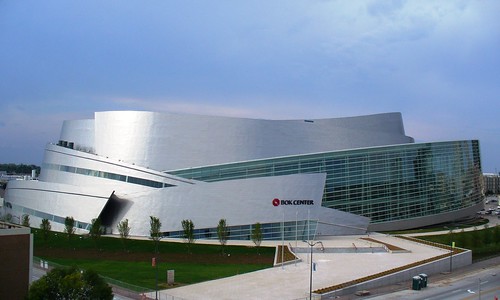
Michael Bates' where he visited Des Moines to look at how a downtown arena there has 'transformed' their downtown area. In fact, it has not. The Iowa Events Center is a top-notch facility (though considerably smaller than the Ford Center or BOK) that hosts major concerts, some sports games, and some conventions. In a way, it serves the exact same purpose for Des Moines that the Ford Center had served OKC until the NBA came to town. The argument is that in one prime example cited as a reason we need the BOK Center (Des Moines), their arena has done little to pump life into the part of downtown in which it was built:
"The nearby area was as dead as can be -- parking ramps, parking lots, office buildings. The arena sits near the river, but turns its back to it."
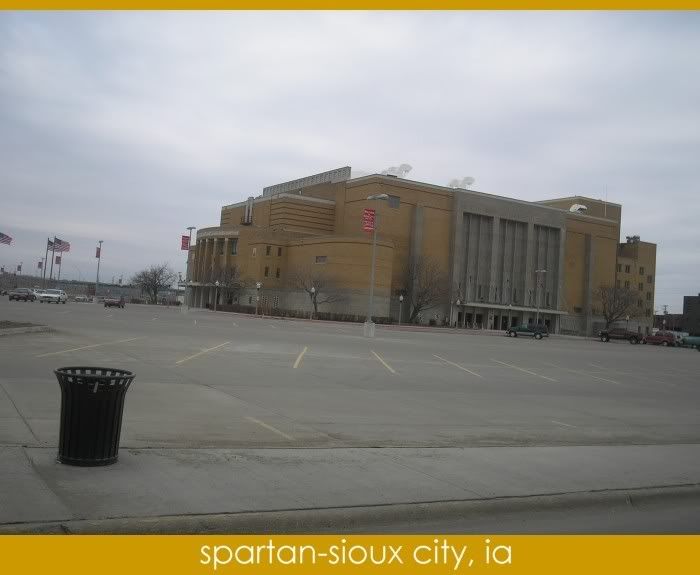
This isn't just something that has happened in Des Moines. One of my favorite all-time small towns is Sioux City, IA, with a population around 85,000. It's a very well-educated, yet somewhat gritty and urban small town nestled in the steep bluffs along the Missouri River, which creates a lot of interesting urban environments. Imagine the hills of San Francisco covered by a quaint Midwestern city. One of Sioux City's most impressive qualities is the amenities it has for a city of 85,000--such as an Art-Deco downtown arena
almost as big as the Iowa Events Center. Here is a photo I took of it a few winters ago when I was spending the Holidays with family:

As you can see, the area surrounding it is also dead. And if you've ever been to the Qwest Center in Omaha, you also have the same problem--an arena envisioned to pump life into an area, but cut off from that area. Here in Sioux City, the arena is surrounded by parking on 3 sides. The back of it is what faces downtown, but that's irrelevant because it's cut off by railroad tracks. On the west and north sides it faces a bend in I-29 which essentially cuts Sioux City off from their significant civic investments along the Missouri River riverfront. As your driving down I-29, there is the arena and downtown beyond that on the right, and to the left is the Mighty Mo lined with a Casino and trails and parks that go all the way through the city, even up into South Dakota. If Sioux City were to find an alternative to the sea of parking on that site, you could almost have a development firm come in and redevelop around the arena similarly to the Ballpark Village in St Louis or the Power & Light District in KC.

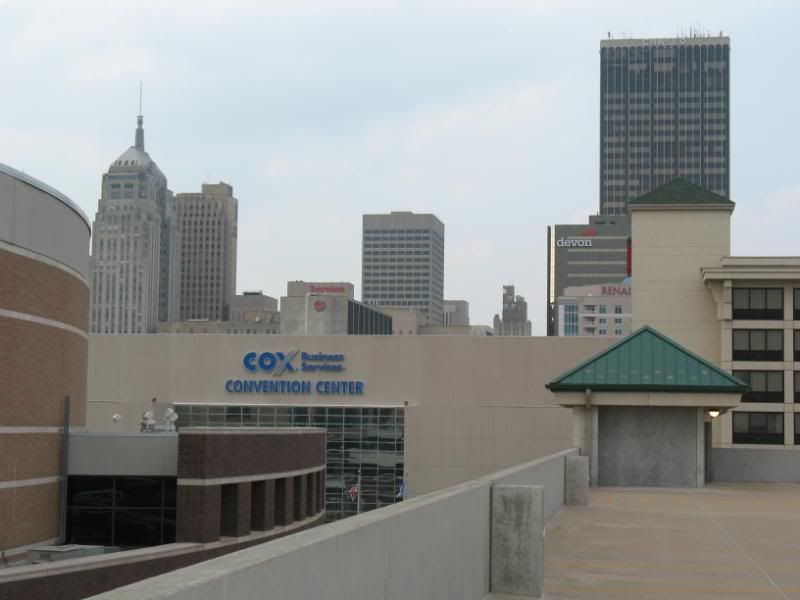
But do OKC and Tulsa face these problems? I would argue not. While the Ford Center is not in Bricktown, which everyone will tell you is where people go after an event at the Ford Center, it is still smack dab in the heart of downtown. It is not cut off by a river, or a highway, or ground railroad tracks (notice how I specified that). The Ford Center did in fact propel Bricktown past being a fledgling restaurant row on the edge of downtown, into what is definitely an attraction in its own right. Today development in Bricktown is booming because of the demand for the Bricktown scene. It's a district where people badly want to live, work, play, and shop/dine. This is because someone can easily walk from the main Concourse in the Ford Center to a restaurant in Bricktown in less than 4 minutes without risking their life.
Will Tulsa follow the steps of OKC or Des Moines? I also think not. A key difference in what happened in OKC and those other cities is that in OKC there was no pre-established hotspot in downtown. Bricktown became the hotspot of Downtown OKC after the Ford Center was built, whereas before the Iowa Events Center, the Hy-Vee Center in Sioux City, or the Qwest Arena, these cities already had a "Bricktown." Omaha-Old Market, Des Moines-Court Street, Sioux City-4th Street. Downtown Tulsa's building stock is far more mature than Downtown OKC's, but it is still ALL undergoing revitalization--there is no pre-established hotspot in Downtown Tulsa, while there are many fledgling neighborhoods that are beginning to see good growth. The BOK Center is coming just in time to affect the growth of downtown, and not be left out, because downtown is a blank slate that could go in any direction. It could see nothing but growth in Blue Dome and Brady, or it could see new developments on the old City Hall site, or it could continue its growth in a N/S linear fashion and see infill in the TCC (and churches) parking empire that splits downtown and Uptown.
There are already a small handful of businesses on the west side of downtown that are opening up just for the arena buzz. This is how we build momentum, which is the main reason we built the BOK Center. Face it, Tulsa is not without event centers--the Maybee Center has done just fine for concerts and stuff, and everybody loves South Tulsa more than downtown. The goal of the BOK Center was to get people back to looking at downtown, and bring in crowds so that businesses can thrive in the heart of the city. Doesn't that sound like an important civic goal?