It's a billboard for a ranch house beside the Walnut St bridge
Monday, August 3, 2009


Sunday, August 2, 2009
Could DT Austin become the best Texas skyline..in 2030?
Interesting thought. I don't necessarily condone this idea, but it's an interesting one worth considering. Anything is possible. Seeeeee intoooooo the Fuuuuuuuuture. Austin's skyline has shown incredible growth in the last 3-4 years, but it is not as if Houston and Dallas aren't adding onto their downtown skylines, plus rapidly growing Uptown Houston is probably a safe 3rd best in Texas for at least another 10 years.
 2006
2006
 2009
2009
2030..??
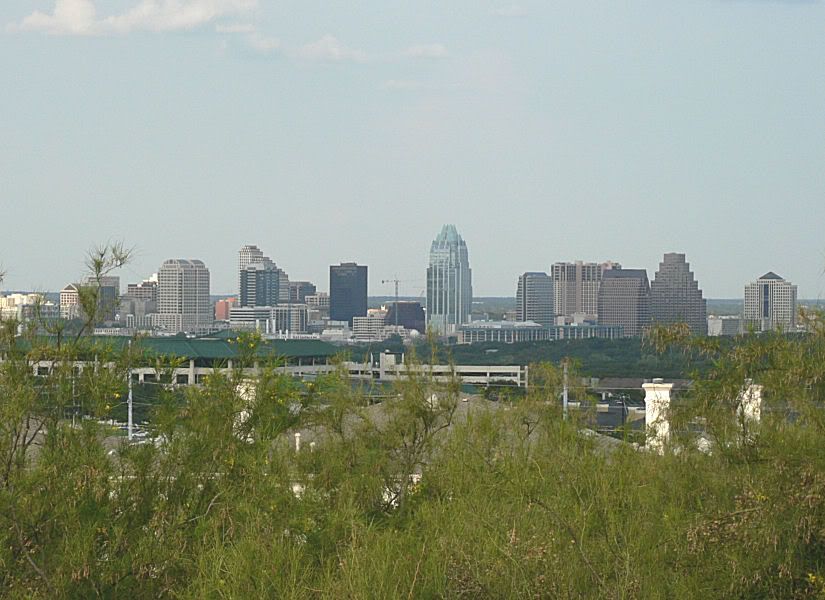 2006
2006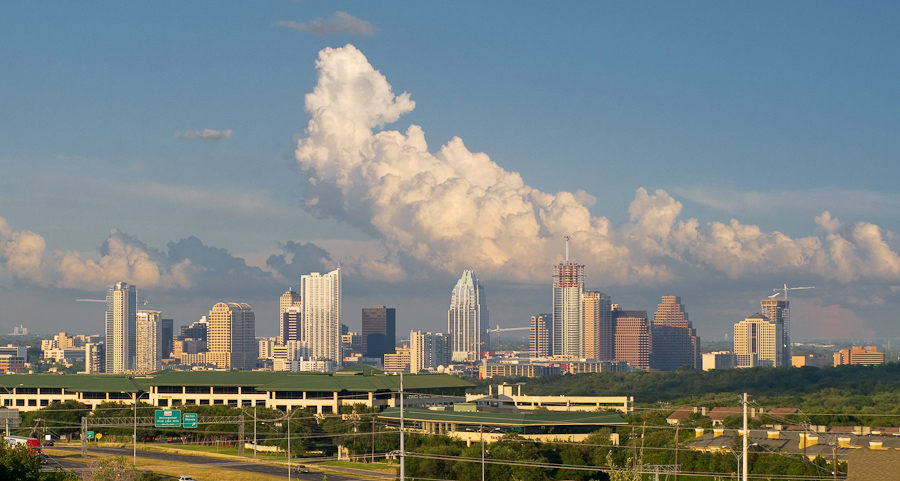 2009
20092030..??
Saturday, August 1, 2009
If I could live anywhere...
Writing my "Downtown OKC 2020" column for Steve Lackmeyer had me thinking.. what would a list of my top choices to live look like? There are so many great places, all of them with unique advantages. I think I've been blessed to be exposed to a lot of great cities..growing up in Houston, then moving to OKC, and then transfering from OU to Calgary.. not to mention vacations in Colorado, New Orleans, NYC, D.C., and the list goes on and on, for places I've been lucky enough to see. I think if I wrote a list of the top places I'd consider (excluding places I would not consider) it would be one of the most unique such lists, for sure. Pittsburgh?!? D.C.?!? Plus I know the order is kind of weird..how dare I not put NYC and Chicago first, but it is what it is. I just have infinitely more interest in living in Houston than Chicago, or Portland rather than Seattle, and so on.
Without much further ado:
1 Houston
2 New Orleans
3 Pittsburgh
4 D.C.
5 Dallas
6 Calgary
7 Denver
8 Austin
9 Vancouver
10 Portland
11 Atlanta
12 New York City
13 Savannah
14 Boston
15 Oklahoma City
16 Nashville
17 Minneapolis
18 Richmond
19 Memphis
20 Charleston
21 Raleigh
22 Tulsa
23 Cleveland
24 Toronto
25 Buffalo
26 Birmingham
27 Kansas City
28 San Antonio
29 Seattle
30 Chicago
31 San Diego
32 St. Louis
33 Baltimore
34 Cincinnati
35 Des Moines
36 Charlotte
Question, if you were to make such a list for yourself, how would it look? I would encourage folks to leave comments with such a list, and it can be short..just a top 5 or a top 10 perhaps. Just be honest about where you stick OKC. You're already going to rank it a lot higher than most people because you know how great this city is, but for most of us, OKC is not honestly our #1 choice..but it is probably up there. I personally think I've ranked OKC too low, but I did that somewhat on purpose.
Without much further ado:
1 Houston
2 New Orleans
3 Pittsburgh
4 D.C.
5 Dallas
6 Calgary
7 Denver
8 Austin
9 Vancouver
10 Portland
11 Atlanta
12 New York City
13 Savannah
14 Boston
15 Oklahoma City
16 Nashville
17 Minneapolis
18 Richmond
19 Memphis
20 Charleston
21 Raleigh
22 Tulsa
23 Cleveland
24 Toronto
25 Buffalo
26 Birmingham
27 Kansas City
28 San Antonio
29 Seattle
30 Chicago
31 San Diego
32 St. Louis
33 Baltimore
34 Cincinnati
35 Des Moines
36 Charlotte
Question, if you were to make such a list for yourself, how would it look? I would encourage folks to leave comments with such a list, and it can be short..just a top 5 or a top 10 perhaps. Just be honest about where you stick OKC. You're already going to rank it a lot higher than most people because you know how great this city is, but for most of us, OKC is not honestly our #1 choice..but it is probably up there. I personally think I've ranked OKC too low, but I did that somewhat on purpose.
Friday, July 31, 2009

Wednesday, July 29, 2009
Medical District progress
I was driving around with my camera taking pictures of mixed-use developments under progress across the metro, which is a dauntingly huge task that I can only hope to have finished by the time I leave to go back up to Calgary, but as I was coming the metro, I came across the Medical District and realized that these major developments in this inner city district deserve some attention. Tonight I will be posting these, hot off my phone camera, because it is so much easier to take pictures of development in a small district, than to track major mixed-use development in a metro as sprawled as OKC. I haven't even gotten a fifth of those pics yet, but in the meantime, feast your eyes on these.
I think it suffices well enough to say that the Medical District is coming along very well. I wish I could have taken a few pictures of the towers and hospital complexes already in this area, including some really amazing contemporary architecture I just kept driving past simply because it's already been completed for at least 5 years (the OU Physician's Bldg, namely). And starting closest to I-235:
 Oklahoma Blood Institute HQ on NE 8th Street, between Lincoln and I-235, 3 story frame is going up. No renderings online, but I believe it will just be a plain white 3-story office bldg.
 This is something on NE 10th, across Phillips from the OU Cancer Institute..and I have no idea what it is, but the rendering shows a fairly low-rise structure.

 OU College of Allied Health on Stonewall Avenue, nearly complete. I think it turned out beautifully.

 The OU Cancer Research Institute on NE 10th Street, the structure went up really fast, but the annex is still yet to go, and then comes the tedious stuff.

 Dean McGee Eye Institute on Lincoln Blvd, pretty close to completion.

 OU Children's Hospital on NE 13th Street, as you can see nearly finished, but the lobby and parking lot are still to be finished.


 OMRF Research Tower on NE 15th, broken ground, sign in the ground on NE 13th.
I think it's really impressive all of the construction going on here in the Medical District, when you consider how it mostly goes unnoticed and without any praise. We're all far too busy bickering and making accusations over MAPS 3 and Core to Shore to take notice of what's going on northeast of the core. I think that's detrimental to our city's direction, though. We're really lucky to have this burgeoning medical district located so close to downtown, instead of miles away like most cities that have similar medical districts, or bigger (like Houston). The truth is that not very many cities have entire medical districts complete with some of the most advanced hospitals in the world, and considering that this is what is being built without anyone taking notice here in OKC, is just truly incredible to me.
Oh and I just realized I left out the Medical District Embassy Suites (an 8-story full-service hotel) being built at Phillips and 8th. I didn't notice much work being done on it from 10th or it would have caught my eye, but I do recall last year that the site was surrounded by a construction fence.

I think it suffices well enough to say that the Medical District is coming along very well. I wish I could have taken a few pictures of the towers and hospital complexes already in this area, including some really amazing contemporary architecture I just kept driving past simply because it's already been completed for at least 5 years (the OU Physician's Bldg, namely). And starting closest to I-235:
 Oklahoma Blood Institute HQ on NE 8th Street, between Lincoln and I-235, 3 story frame is going up. No renderings online, but I believe it will just be a plain white 3-story office bldg.
 This is something on NE 10th, across Phillips from the OU Cancer Institute..and I have no idea what it is, but the rendering shows a fairly low-rise structure.
 OU College of Allied Health on Stonewall Avenue, nearly complete. I think it turned out beautifully.
 The OU Cancer Research Institute on NE 10th Street, the structure went up really fast, but the annex is still yet to go, and then comes the tedious stuff.
 Dean McGee Eye Institute on Lincoln Blvd, pretty close to completion.
 OU Children's Hospital on NE 13th Street, as you can see nearly finished, but the lobby and parking lot are still to be finished.

 OMRF Research Tower on NE 15th, broken ground, sign in the ground on NE 13th.
I think it's really impressive all of the construction going on here in the Medical District, when you consider how it mostly goes unnoticed and without any praise. We're all far too busy bickering and making accusations over MAPS 3 and Core to Shore to take notice of what's going on northeast of the core. I think that's detrimental to our city's direction, though. We're really lucky to have this burgeoning medical district located so close to downtown, instead of miles away like most cities that have similar medical districts, or bigger (like Houston). The truth is that not very many cities have entire medical districts complete with some of the most advanced hospitals in the world, and considering that this is what is being built without anyone taking notice here in OKC, is just truly incredible to me.
Oh and I just realized I left out the Medical District Embassy Suites (an 8-story full-service hotel) being built at Phillips and 8th. I didn't notice much work being done on it from 10th or it would have caught my eye, but I do recall last year that the site was surrounded by a construction fence.

Malls, malls, malls.."galore"
I was doing a post on Crossroads Mall, which most people know I hate, and I was thinking of a lot of different things. I was thinking of how evil indoor shopping malls are. The advent of Crossroads Mall in the 1970s as the 8th largest shopping mall in the U.S. at the time was the death of the inner south side. Another thought was, God it will be great when Crossroads bites the dust, as it'll free up some retail demand for the inner south side. You see growth all over the metro, everywhere, except the inner south side. You especially see it in NW OKC and the Cleveland County area, however in order for the "urban revival" fad to spread to the inner south side, it will require some kind of impetus to get the ball rolling in a positive way.
I think the good thing about new urbanism is that it takes into account the full lifespan of a mall, including its decline. With these indoor mega shopping malls, once they go into decline, it's difficult to find any useful purpose for them to serve. Shepherd Mall got converted into an office building, but that only works if you have a large office tenant lined up and ready to go, such as AOL in the case of Shepherd Mall. Northpark Mall just shifted its focus to older, upscale demographics and filled its stores with high-end local boutiques, which is kind of cool for a mall, but they would have a better location lining a pedestrian-friendly avenue. Penn Square has managed to stay on top of the game by being close to OKC's wealthiest areas. Sooner Fashion Mall has stayed pretty nice by being the only place to shop in the midst of rapidly-growing Cleveland County.
Crossroads Mall has gone the way of the dodo by being close to OKC's worst areas, not keeping its best long-time tenants, and the sheer inability and unfeasability of converting it to any other meaningful use. There is no way to make good use of Crossroads Mall. The mall is too horribly designed, the site plan kills the idea of any other use, and it's literally located between a ghetto and a towering landfill. AND the site connects to nothing except freeway onramps at I-240 and I-35, so the name Crossroads Mall itself is even somewhat deceiving. Whoever's idea it was to build this mall needs to be shipped and Mexico where hopefully they won't ever again have any say in American city planning.
This brings me to Quail Springs Mall, which is obviously a vibrant mall today, but in the future..it will be the next Crossroads Mall. Things it has going for it.. one: it, like Sooner Fashion Mall, is surrounded by an extremely high-growth area of the metro that will economically buoy it for a long time; two: the site does actually connect to much more than just freeway onramps, and Memorial Road itself is lined with so many office complexes, developments, and so forth, that it's hard to imagine this corridor will give way to suburban blight. Things is has going against it.. one: the Quail Springs area will likely always be a pretty nice area, but that doesn't mean that the main focus area for retail may not shift to OK 74 or some other road if Memorial Road isn't any longer a short 15 minute drive for these people; two: Quail Springs Mall will soon be facing competition from more exciting new urbanist developments, one of which will be directly adjacent to the mall's north side, where Dillard's is. The Quail Springs area will also be facing increasing competition from Edmond, which will probably become the new urbanist mecca for Central Oklahoma. It's hard to say that Quail Springs Mall will stand up to more exciting developments along the far north edge of the metro for very long.
The moral of this story: When you plan a development, consider its full lifespan (its vitality, its middle-aged period, its decline, and its reuse). Indoor shopping malls are always a bad idea.
I think the good thing about new urbanism is that it takes into account the full lifespan of a mall, including its decline. With these indoor mega shopping malls, once they go into decline, it's difficult to find any useful purpose for them to serve. Shepherd Mall got converted into an office building, but that only works if you have a large office tenant lined up and ready to go, such as AOL in the case of Shepherd Mall. Northpark Mall just shifted its focus to older, upscale demographics and filled its stores with high-end local boutiques, which is kind of cool for a mall, but they would have a better location lining a pedestrian-friendly avenue. Penn Square has managed to stay on top of the game by being close to OKC's wealthiest areas. Sooner Fashion Mall has stayed pretty nice by being the only place to shop in the midst of rapidly-growing Cleveland County.
Crossroads Mall has gone the way of the dodo by being close to OKC's worst areas, not keeping its best long-time tenants, and the sheer inability and unfeasability of converting it to any other meaningful use. There is no way to make good use of Crossroads Mall. The mall is too horribly designed, the site plan kills the idea of any other use, and it's literally located between a ghetto and a towering landfill. AND the site connects to nothing except freeway onramps at I-240 and I-35, so the name Crossroads Mall itself is even somewhat deceiving. Whoever's idea it was to build this mall needs to be shipped and Mexico where hopefully they won't ever again have any say in American city planning.
This brings me to Quail Springs Mall, which is obviously a vibrant mall today, but in the future..it will be the next Crossroads Mall. Things it has going for it.. one: it, like Sooner Fashion Mall, is surrounded by an extremely high-growth area of the metro that will economically buoy it for a long time; two: the site does actually connect to much more than just freeway onramps, and Memorial Road itself is lined with so many office complexes, developments, and so forth, that it's hard to imagine this corridor will give way to suburban blight. Things is has going against it.. one: the Quail Springs area will likely always be a pretty nice area, but that doesn't mean that the main focus area for retail may not shift to OK 74 or some other road if Memorial Road isn't any longer a short 15 minute drive for these people; two: Quail Springs Mall will soon be facing competition from more exciting new urbanist developments, one of which will be directly adjacent to the mall's north side, where Dillard's is. The Quail Springs area will also be facing increasing competition from Edmond, which will probably become the new urbanist mecca for Central Oklahoma. It's hard to say that Quail Springs Mall will stand up to more exciting developments along the far north edge of the metro for very long.
The moral of this story: When you plan a development, consider its full lifespan (its vitality, its middle-aged period, its decline, and its reuse). Indoor shopping malls are always a bad idea.
Friday, July 24, 2009
A Crossroads update
 The mall that just won't die. That is Crossroads Mall. It's like a huge flying cockroach that you keep trying to kill by stepping on it, but just won't die because its damn carcass is too squish-proof. Crossroads Mall has lost every long-time anchor: Ward's, Foley/Macy's, J.C. Penney's, and Dillard's. It even lost Steve & Barry's Crappy College XXL Megastore.
Thank goodness though for that southside ingenuity, that rugged hard-headedness that won't take defeat as the last word..instead of having a completely blank sign fronting I-35, they've filled up the spots maintaining the appearance of a mall, somewhat. It announces to a hundred thousand commuters a day on I-35 that its major anchors are Bath&Body Works, Waldenbooks, and Chick fil-A, and that there is an AMC movie theater on I-240 in front of the mall. That's what I call "maintaining appearances" through hard times.
And thank goodness that ODOT did not go through with an overhaul of the I-35/I-240 intersection just because it would have blocked off the main I-240 exit to this oasis of cosmopolitan shopping that is Crossroads Mall. Nevermind that there are deadly car accidents every day here, and the constant traffic tangle during the day, because if Crossroads Mall had died, the southside would have been without its crown jewel, Crossroads Mall.
Thursday, July 23, 2009
Top 40 largest cities in 1900
This here trivia game is pretty cool, and it's easy to play. Just click Ready and enter in the names of cities. You have 6 minutes to guess as many of the Top 40 largest cities in 1900. It's a really cool interactive way to learn our nation's urban history.
I got 35. If anyone beats me, I'd like to hear about it!
I got 35. If anyone beats me, I'd like to hear about it!
Monday, July 20, 2009
A canal extension that works
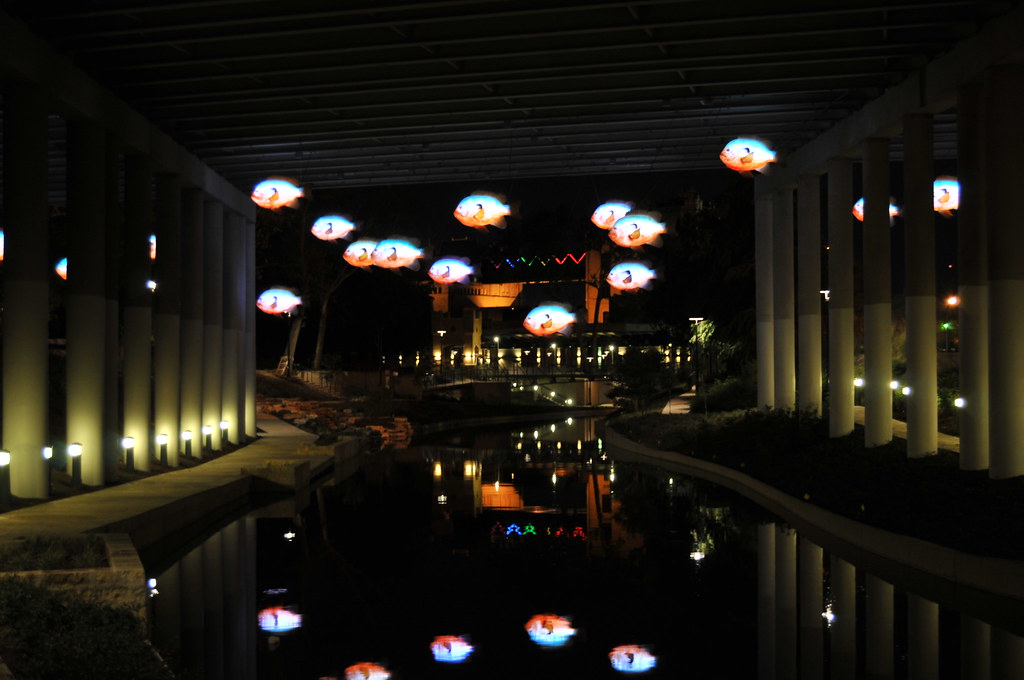
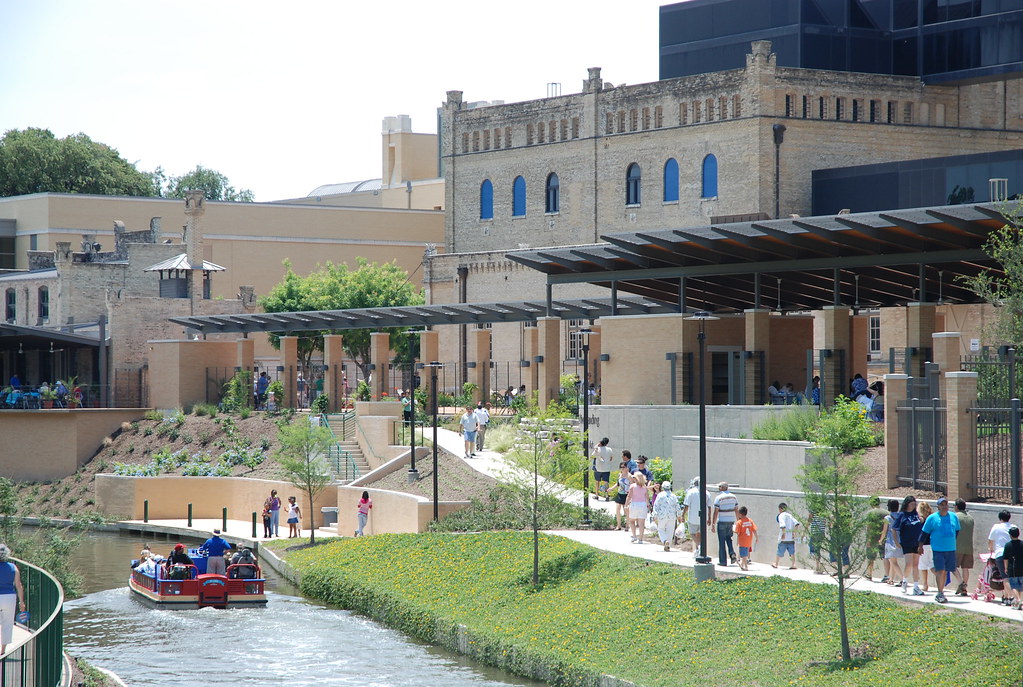
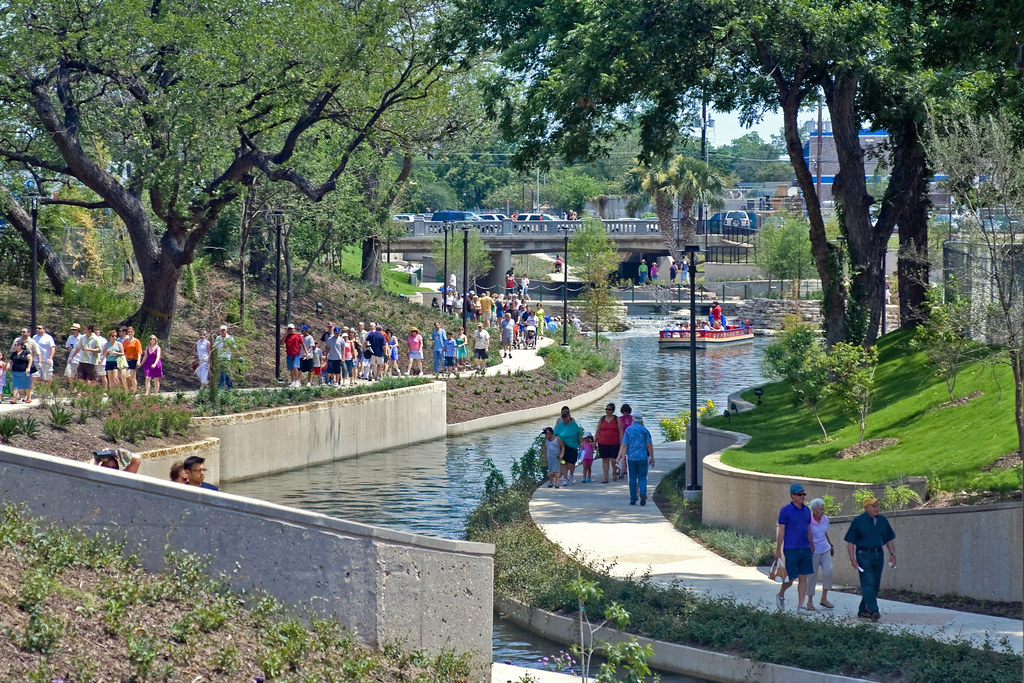
Well, it's not really a canal extension..but rather a Riverwalk extension. San Antonio's recently-finished 1 and 1/3rd-mile extension of the Riverwalk, extends north out of Downtown San Antonio and cuts through a dense area lined with some mixed-use development and the San Antonio Museum of Art. The entire new extension of the Riverwalk is a work of art though, in how underpasses that posed a risk as a potential eyesore were brightened up with public art. A few highlights are.. adorning the Lexington Street underpass are shimmering tiles that catch the light and sort of flitter, colored metal panels under another underpass, a new landscaped landing abutting the San Antonio Museum of Art, and under the I-35 bridge are hanging fish to take away the marr of a highway bridge, and a "grotto" theme at the Camden/Newell intersection. The entire 1.33 mile extension is heavily landscaped, which goes without saying. You can learn a lot more about the Museum Reach segment by checking out this interactive map on the San Antonio Express-News' website.
Here are some pictures taken by popnfresh on SkyscraperCity:


Why was this project a success: The reason that the Museum Reach urban segment of the Riverwalk is such a success is that the right-of-way already existed. The urban fabric already developed around the San Antonio River, and the City of San Antonio is just coming in and giving major aesthetic upgrades to an existing riverfront. The design is innovative and does two things: it incorporates existing "landmarks" along the path, such as the art museum and the Pearl Brewery, which has become a large mixed-use redevelopment project, AND the second reason is that it is innovative in covering up eyesores, such as bridges, and brightening up these dull spaces.
Why copying this would fail in OKC: OKC does not have an existing river that flows through the heart of downtown. There is no neighborhood or even single city block that matured framing a water right of way. The Bricktown Canal is an absolutely brilliant conversion of an alley way into a canal. Where dumpsters, vagrants, and utility lines once were is now an area lined with upscale restaurants, clubs, and the Bricktown haunted house. This is why future planning involving the Bricktown Canal MUST be taken from an "opposite-of-San Antonio" perspective in order to be successful. We have to look for existing right-of-ways that we can easily adapt to become a thin sliver of waterway, and truthfully it isn't a good idea to delve into Core to Shore with the Canal and expect to create a space that matures framing an urban canal. It won't work.
Here are some pictures taken by popnfresh on SkyscraperCity:
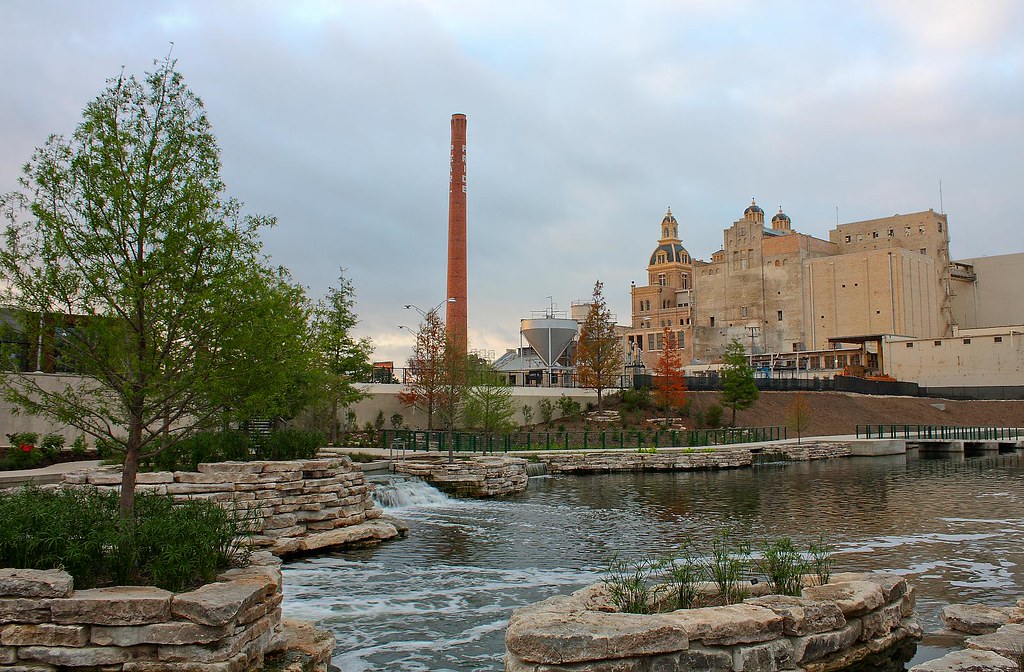

Why was this project a success: The reason that the Museum Reach urban segment of the Riverwalk is such a success is that the right-of-way already existed. The urban fabric already developed around the San Antonio River, and the City of San Antonio is just coming in and giving major aesthetic upgrades to an existing riverfront. The design is innovative and does two things: it incorporates existing "landmarks" along the path, such as the art museum and the Pearl Brewery, which has become a large mixed-use redevelopment project, AND the second reason is that it is innovative in covering up eyesores, such as bridges, and brightening up these dull spaces.
Why copying this would fail in OKC: OKC does not have an existing river that flows through the heart of downtown. There is no neighborhood or even single city block that matured framing a water right of way. The Bricktown Canal is an absolutely brilliant conversion of an alley way into a canal. Where dumpsters, vagrants, and utility lines once were is now an area lined with upscale restaurants, clubs, and the Bricktown haunted house. This is why future planning involving the Bricktown Canal MUST be taken from an "opposite-of-San Antonio" perspective in order to be successful. We have to look for existing right-of-ways that we can easily adapt to become a thin sliver of waterway, and truthfully it isn't a good idea to delve into Core to Shore with the Canal and expect to create a space that matures framing an urban canal. It won't work.

Saturday, July 18, 2009
25+ comments over at Steve's blog
As many of you know, there are a few other blogs I regularly check..including much more reputable ones than mine. While I'm not nearly as idiotic as some people tend to think I am (lol), I would have to say there are more educated opinions than those of an architecture student who has only been able to drink legally for a few months. That's why it's an honor to see much more respectable folks such as Steve Lackmeyer of the Daily Oklahoman mention me on his blog, and most notably, my recent push against Core to Shore. His post where he linked my C2S alternative impelled 25+ comments..which I think is awesome..and I can see where it pays to go with eye-catching, attention-grabbing headlines like "Core to Shore sucks."
I don't really believe Core to Shore sucks, I just believe it is dangerously flawed. I don't know how someone can just go forward thinking this is the best thing since sliced cheese with all of the new considerations that have come up from reputable sources--sources who aren't against Core to Shore because they hate downtown, but because they love downtown and want to see what's really best for it. That's what's so surprising about the direction that the debate over C2S has turned, that the opposition isn't coming from the southside folks who oppose "MAPS for Millionaires" at all costs--but from the biggest fans of downtown. Consider that.
Even though it's not my blog, I thought I might address a few of the comments that were illicited by Steve's post. This is what I call a fun Saturday night..
That said, I just wanted to point out that it wasn't city council leaders that created the plan we deem as pedestrian-God-awful. It was actually an ensemble of local architects, Hans Butzer and Anthony McDermid (great guys..and I had Butzer for a class even), City Planner Russel Claus, and Sara MacLennon. MacLennon was the leader of a planning firm brought in (and paid about $100,000) to help design C2S. The firm was not even from within 1,000 miles of Oklahoma..I believe they had some planners from Denver and Omaha that I met at the public meetings in the Cox Convention Center. I have to question why people with no clue about Oklahoma City were brought in as the professionals behind the C2S project, when there are plenty of planning firms here in Oklahoma. Of course, there is a separate C2S Steering Committee, which does include city council, as well as dozens of community leaders.
Dennis, I don't see the problem in having a bungalow neighborhod adjacent to I-35/I-40. The reality is that there is still a wide right-of-way separating the neighborhood from the freeway interchange that the intrusion is minimal, and the reality is that in cities all across America that are neighborhoods that back up to freeways. Crown Heights backs up to I-235 (and what will return to being a construction zone, at that) and the separation would be equal. Jefferson Park is right up against I-235. There are upscale neighborhoods off of I-35 in Edmond, and freeways all over the metro pass through close proximity to residential neighborhoods. A dense single-family unit neighborhood is the best use for that land, or else it will just go as dead space in the middle of the city.
The main reason I moved the convention center wasn't because it wasn't close enough to Bricktown, but because it was too close to the existing Coc Center and the Ford Center, and the park. I feel like it's imperitive to break up these super-block structures or else we will be stuck with a huge vacuum of 24/7 activity in the middle of C2S. In order for the park impact to be fully realized on development, the park edge needs to be lined with as much development as possible, and as few super-block structures as possible. It happens to be a huge benefit that the alternative site is across the street from Bricktown. As for the boulevard in my alternative being huge and inhibiting access, I would say that's wrong, and that's actually one of the main points to my alternative. My alternative boulevard is mirrored after Commonwealth Avenue in Boston, and is the complete opposite of the Okie Champs Elysees that the C2S planners have envisioned.
I don't really believe Core to Shore sucks, I just believe it is dangerously flawed. I don't know how someone can just go forward thinking this is the best thing since sliced cheese with all of the new considerations that have come up from reputable sources--sources who aren't against Core to Shore because they hate downtown, but because they love downtown and want to see what's really best for it. That's what's so surprising about the direction that the debate over C2S has turned, that the opposition isn't coming from the southside folks who oppose "MAPS for Millionaires" at all costs--but from the biggest fans of downtown. Consider that.
Even though it's not my blog, I thought I might address a few of the comments that were illicited by Steve's post. This is what I call a fun Saturday night..
"Our city council leaders seem very ignorant concerning the principles of pedestrian-friendliness. I’m worried this is going to be a disaster…" - Kris BryantKris, the city council has been surprisingly silent on the matter of Core to Shore. While we have to assume that they will support MAPS 3, obviously, I almost feel like the city council isn't even very involved in the process. Ultimately they will be the deciders, but I don't know how many original thoughts they have. I can't judge for myself, because there is no known, 100% reliable way to determine the original thoughts of a largely silent group of people, with the exception of the Supreme Couty.
That said, I just wanted to point out that it wasn't city council leaders that created the plan we deem as pedestrian-God-awful. It was actually an ensemble of local architects, Hans Butzer and Anthony McDermid (great guys..and I had Butzer for a class even), City Planner Russel Claus, and Sara MacLennon. MacLennon was the leader of a planning firm brought in (and paid about $100,000) to help design C2S. The firm was not even from within 1,000 miles of Oklahoma..I believe they had some planners from Denver and Omaha that I met at the public meetings in the Cox Convention Center. I have to question why people with no clue about Oklahoma City were brought in as the professionals behind the C2S project, when there are plenty of planning firms here in Oklahoma. Of course, there is a separate C2S Steering Committee, which does include city council, as well as dozens of community leaders.
The main reason I moved the convention center wasn't because it wasn't close enough to Bricktown, but because it was too close to the existing Coc Center and the Ford Center, and the park. I feel like it's imperitive to break up these super-block structures or else we will be stuck with a huge vacuum of 24/7 activity in the middle of C2S. In order for the park impact to be fully realized on development, the park edge needs to be lined with as much development as possible, and as few super-block structures as possible. It happens to be a huge benefit that the alternative site is across the street from Bricktown. As for the boulevard in my alternative being huge and inhibiting access, I would say that's wrong, and that's actually one of the main points to my alternative. My alternative boulevard is mirrored after Commonwealth Avenue in Boston, and is the complete opposite of the Okie Champs Elysees that the C2S planners have envisioned.
"Here is a suggestion: It doesn’t take an artist to draw a city plan…let’s have a Core to Shore-off! Everybody draws their ideas, we post them here, and let the comments ensue." -Andrew (Cuatro deMayo?)This is a great idea. We don't need a charrette, we just need for concerned citizens to show what they can do. I think that those of us that live and breath in OKC can design a far-better masterplan for Core to Shore than anyone that has to be paid in the ballpark of a hundred grand to come to Oklahoma. Seriously. We're not talking about designing a real estate project; we're talking about designing the center city of a community that is filled to the brim with talented, creative citizens.
Norman's University Town Center..renderings
I was cleaning out my hard drive and came across these, some renderings that I had for the Town Center that will eventually get built as a part of University North Park/University Town Center. It's such a shame, how many excellent projects OKC had in the works that got momentarily derailed by the national economy. It's fortunate that most of these developments haven't been canceled, just pushed back until there is some recovery and loosening up in the national retail market.


So in the meantime feast your eyes on these:


Friday, July 17, 2009
WNBA to Tulsa
 Looks like Tulsa will probably be welcoming a WNBA team to the BOK Center. In fact, according to the Tulsa Whirled's "unnamed sources" the BOK Center has already been in negotiations for a while. There will be a press conference Wednesday where a group of investors from OKC will announce their venture, which WNBA president Donna Orender will be in Tulsa for. One of ESPN's main women's bball analysts, Nancy Lieberman, said of the deal, “Oklahoma is passionate about sports, they are avid sports fans. I think it would be a great partnership."
This is nothing new however, as almost exactly a year ago the Tulsa Metro Chamber was putting out feelers for landing a possible WNBA team, influenced by the NBA coming to Oklahoma.
Considering Tulsa's desire to fill the BOK Center with some meaningful sports franchise, the WNBA makes perfect sense considering that the NBA is already in the Ford Center and the NHL would probably prefer to wait till after the recession to start even considering making a move somewhere else. Plus, the NHL just did did an expansion phase, so it would have to be a team relocation, and Kansas City is already all over that scene.
There are other sports that Oklahoma could play host to, such as Major League Soccer--which purportedly had a high level of interest in Tulsa which suddenly dropped off the radar a few years ago. The National Lacrosse League has even wants to expand into OKC, so perhaps they'd give Tulsa a shot, which is probably a more favorable city to Lacrosse anyway. Lacrosse is actually kind of cool, and I've been to a few NLL games in DC and Calgary..that I was literally already in the neighborhood for.
There are a lot of possible ways for Tulsa to get its foot in the door of major league sports. An NLL or WNBA franchise is definitely a step up from minor league basketball and arena football, and a good stepping stone toward landing either an NHL or MLS team, or perhaps even an NFL team should Tulsa ever build a stadium. The WNBA only has 13 teams at the moment, all of them in locations that would be "good company" for Oklahoma: Atlanta, Chicago, Connecticut, Detroit, Indianapolis, New York, DC, LA, Minneapolis, Phoenix, Sacrament, San Antonio, and Seattle (for some reason the Houston Comics recently died, despite winning 4 back-to-back championships). All of these teams play in NBA arenas with the exception of Connecticut's. Nancy Lieberman is right, this would be a win-win for Oklahoma and the WNBA.
P.S. Wow, it's been a long time since I wrote about Tulsa, especially considering I used to be pretty good at dividing my posts equally in the beginning..

C2S vision revised

Revised my C2S vision.
It occurred to me that while the Chesapeake Boathouse is on the west side of the Lincoln/Byers bridge, the Boathouse Row is actually going in across the bridge, on the east side, where I erroneously planned mixed-use development. It's for the better though because I knew that would be the one area of dead space anyway. There just isn't any great way for me to be inclusive with that area and have it develop in a way that doesn't feel disjointed with the rest of C2S. Developing a dense, historically-inspired single-family bungalow community is probably just the best use for that land, and of course, I made certain the inclusion of Boathouse row for real this time.
Another change I made was shortening the streetcar route. The only reason for this is just keeping it on one side of the highway, and that it probably made more sense to combine it with where the park is bisected by the Crosstown, to cut down on heavy-traffic crossings through the park. I wanted to include mixed-use development along the path of the streetcar route, especially when it cuts through the park, and I figured that made more sense on the north side of the Crosstown.
Another change I made, and this isn't really a change but just being clearer on the map, is redoing Shields Boulevard. Bringing it down and making it identical to the C2S boulevard. It should follow the recommendations that Speck had for Gaylord, making it pedestrian-friendly, rather than pedestrian-brutal.
I also went ahead and included the Skydance Bridge, which is already funded. It's just the green strip that crosses the Crosstown and streetcar path. That's about it. All in all a more perfect plan I think.
Trying to understand how highways are funded..(key word: trying)
Forenote: This post is an educational process for me as much as it is for the reader, and the only "fact" one can be certain of reading the following post is that the process is very convoluted and opportunities for corruption abound. I am not expert on state transportation funding, so it won't hurt my feelings if I get corrected, in fact it's probably for the best, so don't just feel free, but feel obligated to do so!
On my post regarding ODOT's formal request for rail funding, Steve and I began debating the merits of including rail in what ODOT does, and so on. I was about to respond to his last comment when I realized it should probably illicit its own post..trying to understand how the Turnpike Authority and ODOT function, how they get funding, what they use it for, and so on. His comment was as follows:
As for the Oklahoma Turnpike Authority, far from being a non-profit was created in the 1950s, predating the Federal Highway System and even ODOT, which wasn't even created until 1976. OTA's sole purpose today is collecting tolls to supplement maintenance that we give the State Legislature tax dollars to do anyway. Their slogan on their website is, "PIKEPASS - Your life just got easier." But the irony is that if you're trying to understand why they exist, who funds them, and what they do.. then your life just got harder. OTA does not determine what projects need to be done, they are directed to act based on appropriations from the State Legislature that first go through ODOT. Studies are done by ODOT, whose responsibility it is to make sure projects are included in long-range transportation plans. The one and only way in which it is an independent arm of ODOT is that it's authorized to issue bonds to fund Turnpike projects, which aren't considered part of the State's debt. Tolls are collected to pay down on the bonds, which in 2005, tolls brought in $192 million. That year there was a $90 million debt payment, $60 million in operating expenses, and the remaining balance went to fund an $80 million Capital Plan. ODOT on the other hand has a $1.2 billion operating budget.
If you read OTA's website, they have an explanation of their funding that looks ridiculously incriminating of the powers that be in the State Capitol. ODOT gets around 5% of total appropriations, and according to the Federal Highway Administration, Oklahoma ranks 2nd in how much federal money we divert to non-transportation uses. In fact, we divert about one quarter of our total Motor Fuel Tax money that we receive from Washington to non-transportation uses. Supposedly, Kansas invests three times as much as Oklahoma does into transportation, making it a crying shame how transportation is funded in Oklahoma AND anyone whose driven all the way up to KC knows that their tolls are higher than ours.
There is no easy way to tell what "non-transportation" uses our Motor Fuel Tax money go towards. I'll keep digging and see what I can find.
On my post regarding ODOT's formal request for rail funding, Steve and I began debating the merits of including rail in what ODOT does, and so on. I was about to respond to his last comment when I realized it should probably illicit its own post..trying to understand how the Turnpike Authority and ODOT function, how they get funding, what they use it for, and so on. His comment was as follows:
"Auto transit is a great topic, but that turnpike you refer to is under a turnpike authority ... not directly a government program if I understand it correctly - more like a non-profit?I agree with Steve that auto transit is a great topic, and it's definitely one that is a lot more complex than it should be. The general idea of how the system is supposed to work makes perfect sense, but becomes a tangled web of contradictions, corruption, and incompetency when we're talking about reality. The formula for transit funding that ODOT uses goes like this: Federal $ + ODOT $ = Total budget; ODOT $ = maintenance expenses, Federal $ = new road construction. First of all, I think this formula speaks volumes to the massive maintenance cost of roads, second of all, the "formula" hardly describes how roads actually get funded. Oftentimes ODOT doesn't even have enough money to cover the costs of maintenance, and we must wait until a federal appropriation in order for a road to be repaired, and sometimes a federal appropriation doesn't quite cover the expense of a new road, and the Stimulus Package just further complicates the picture with additional overlaps in responsibility. With as many overlaps in responsibility for transit funding as there are, the finger of blame can be pointed at pretty much everyone. The feds, the State Legislature, ODOT, the corrupt bidding process, metropolitan coalitions like ACOG and INCOG that get ODOT funding, and so on.
And I've always thought roads and the military are the best things for government to be involved in. And as conservative as I am, I'll defend government/authorities and their relationship with roads in Oklahoma. We have lots of land that need roads, but generally a small population to pay for it. If we want to have people travel through our great state (which is smack dab in the middle of the country) then 44, 35, and 40 need to be well maintained. Remember when the bridge at Weber Falls was destroyed by a wayward river boat?! The quickness that was repaired goes to show how important it is to keep our roads in tip-top shape."
As for the Oklahoma Turnpike Authority, far from being a non-profit was created in the 1950s, predating the Federal Highway System and even ODOT, which wasn't even created until 1976. OTA's sole purpose today is collecting tolls to supplement maintenance that we give the State Legislature tax dollars to do anyway. Their slogan on their website is, "PIKEPASS - Your life just got easier." But the irony is that if you're trying to understand why they exist, who funds them, and what they do.. then your life just got harder. OTA does not determine what projects need to be done, they are directed to act based on appropriations from the State Legislature that first go through ODOT. Studies are done by ODOT, whose responsibility it is to make sure projects are included in long-range transportation plans. The one and only way in which it is an independent arm of ODOT is that it's authorized to issue bonds to fund Turnpike projects, which aren't considered part of the State's debt. Tolls are collected to pay down on the bonds, which in 2005, tolls brought in $192 million. That year there was a $90 million debt payment, $60 million in operating expenses, and the remaining balance went to fund an $80 million Capital Plan. ODOT on the other hand has a $1.2 billion operating budget.
If you read OTA's website, they have an explanation of their funding that looks ridiculously incriminating of the powers that be in the State Capitol. ODOT gets around 5% of total appropriations, and according to the Federal Highway Administration, Oklahoma ranks 2nd in how much federal money we divert to non-transportation uses. In fact, we divert about one quarter of our total Motor Fuel Tax money that we receive from Washington to non-transportation uses. Supposedly, Kansas invests three times as much as Oklahoma does into transportation, making it a crying shame how transportation is funded in Oklahoma AND anyone whose driven all the way up to KC knows that their tolls are higher than ours.
There is no easy way to tell what "non-transportation" uses our Motor Fuel Tax money go towards. I'll keep digging and see what I can find.
Thursday, July 16, 2009
MAPS for Convics (a hastily-written post)
Oklahoma County politicians have begun lobbying for more than $390 million to build a new jail, or $436 million to renovate the existing jail. This, at a time when the City of OKC is anticipating a campaign to make the next step toward becoming a World-class City. The $390 million would build a new 3,376-unit jail on a 50-acre site that would require the additional hire of 400 employees. The reason for a new jail is that the current one, built as recently as 1991, is inherently flawed, which has led to numerous escapes, suicides, and so on.
Fuzzy math: 3,376 units would make the Oklahoma County Jail three times the size of "Big Mac", the State Pen in McAlister. Just to clarify, there are 706,617 residents in Oklahoma County, and 3,617,316 residents in all of Oklahoma, in case anyone was suddenly confused about which was bigger. Just up the turnpike, the Tulsa County Jail is a much less bloated facility, with 1,440, built in 2000 at a cost of $70 million. It also has a maximum capacity of 3,000--how'd they do that (Tulsa County has 591,982 residents..100,000 less than Oklahoma County). You know what, why the $#@% does Oklahoma County need a jail facility that is three times the size of Big Mac? This is insane.
Here's an idea..why don't we hire ten more "Gladiators"? You know, someone instructed to snap fingers, break arms, smash faces, and crush skulls! Or not..
What's more outraging: Oklahoma County politicans want this to be the next MAPS. Nevermind streetcar, a convention center, a central park, the Oklahoma River, or research improvements, or anything that actually improves Oklahoma. A streetcar system would revolutionize development in downtown by creating a huge development impetus, a central park would create a landmark space that Oklahomans can treasure for as long as it's there in the heart of our city, a convention center would bring in business from around the world, Oklahoma River projects would make an even bigger splash on the river, and investing in research incentives would help OKC become a bigger part of the new economy. What would a $390 million county jail do for us? When we don't even want to spend near that much on a new convention center, why should we even consider throwing more than $100 million into a jail, AT THE MOST? This is why the crooks at Oklahoma County need to be just gotten rid of and merged with the city government of OKC. County home rule, check it out..
Fuzzy math: 3,376 units would make the Oklahoma County Jail three times the size of "Big Mac", the State Pen in McAlister. Just to clarify, there are 706,617 residents in Oklahoma County, and 3,617,316 residents in all of Oklahoma, in case anyone was suddenly confused about which was bigger. Just up the turnpike, the Tulsa County Jail is a much less bloated facility, with 1,440, built in 2000 at a cost of $70 million. It also has a maximum capacity of 3,000--how'd they do that (Tulsa County has 591,982 residents..100,000 less than Oklahoma County). You know what, why the $#@% does Oklahoma County need a jail facility that is three times the size of Big Mac? This is insane.
"But the push for major upgrades grew after the U.S. Justice Department issued a scathing report on the facility last year. The report, which cited lax supervision, inmate violence and excessive force by guards, threatened a federal lawsuit if a resolution wasn’t reached."I'm not denying that what's going on at the OK County Jail is bad, which it is. The only problem is what does a major expansion and $390 million do to correct inmate violence? What does it do to change lax supervision? Can a $390 million building supervise 2,000 inmates that desperately want out? Here's an idea...hiring better guards? More guards?
Here's an idea..why don't we hire ten more "Gladiators"? You know, someone instructed to snap fingers, break arms, smash faces, and crush skulls! Or not..
What's more outraging: Oklahoma County politicans want this to be the next MAPS. Nevermind streetcar, a convention center, a central park, the Oklahoma River, or research improvements, or anything that actually improves Oklahoma. A streetcar system would revolutionize development in downtown by creating a huge development impetus, a central park would create a landmark space that Oklahomans can treasure for as long as it's there in the heart of our city, a convention center would bring in business from around the world, Oklahoma River projects would make an even bigger splash on the river, and investing in research incentives would help OKC become a bigger part of the new economy. What would a $390 million county jail do for us? When we don't even want to spend near that much on a new convention center, why should we even consider throwing more than $100 million into a jail, AT THE MOST? This is why the crooks at Oklahoma County need to be just gotten rid of and merged with the city government of OKC. County home rule, check it out..
Sad and pathetic
 I was on OKC Talk where I was corrected in suggesting that the main boulevard be named after Ralph Ellison, which I still think is in order. But I was not aware that there was already an Ellison Avenue! This caught me by surprise. I'd heard of the streets that surround it before..Douglas, Klein, and then Western, but the Ellison Avenue that already exists was new to me.
Ralph Ellison was a great man, probably Oklahoma's best author, who wrote the most famous work of literature to come out of Oklahoma (and no, it wasn't called the Grapes of Wrath). The man has gone down in history as one of the greatest American authors, and he was an important African American of that period. In my opinion he was more pivotal to OKC's anti-discrimination movement than even Clara Luper, a local legend who is known for her fight for equality, and has statues, NE 23rd, and more named after her memory. Ralph Ellison however has nothing besides this crappy street, and I believe there is also a branch library named for him. Look at it..would you want that street named after you?? How can we treat the legacy of a famous Oklahoman like this! On OKC Talk (no surprise) one poster did not even know who Ralph Ellison was. Unbelievable, and yet, 11th graders across the nation read Invisible Man..maybe everywhere except OKC, apparently.
Wednesday, July 15, 2009

In France.."Those who ask, eat." ODOT finally asks (for rail funding).
When I was on my senior trip a few years ago, me and my parents went to France, which is a country I like to joke about a lot. That aside, they have some really great sayings there. One of the biggest culture shocks is that in Paris people are NOT clamoring to provide a million expensive services to you, in fact, they make it a pain in the ass. When you sit down in restaurants, a waiter will not automatically greet you and all that good stuff, but you have to ASK to eat and literally hail a waiter. "Those who ask..eat." I actually like that because it is very similar to life, where the only way usually to get what you want is to ask for it, something most Americans do not understand.
For years we've all been complaining about the state of public transit in Oklahoma, and the simple fact that we need to invest way more than we currently are, into the system. This goes true for the city level, state level, and the federal level, which oddly enough for most municipalities that do things right, federal money is the key ingredient. Well, no more (hopefully). ODOT made the first step towards, for the first time ever, formally requesting federal funding for a bona fide Oklahoma high-speed rail link. Not only will it extend the Heartland Flyer up to Tulsa, but it will also include massive upgrades for the existing Heartland Flyer at least down to the Red River, if not all the way to Fort Worth, enabling the entire system to be high-speed.
Top speeds between OKC and Fort Worth would reach 90 mph and an average of over 60 mph (currently the top speed is 79 with an average of 50), while top speeds between OKC and Tulsa would reach 150 mph and an average speed of over 110 mph. This is the future. No longer will Amtrak service for Oklahoma only go to Fort Worth, and no longer will Tulsa be the largest city in the nation not served by Amtrak.
ODOT's cost estimates for the project come in just under $2 billion, a fraction of the $13 billion in federal funds Obama has identified in order to get the ball rolling on high-speed rail. If approved (which in all likelihood, it will be approved for funding, it's just a matter of it covering half of the cost or more, or all..even though the application does NOT require a state match) work could begin in 2010 and riders could be on the system by 2016, which IMO is a pretty aggressive timetable--the kind of thing I like to see for long-overdue projects such as this. Helping the likelihood funding will be secured, is that the ODOT proposal follows exactly what the Obama administration laid out for the South-Central Corridor.
I'd also like to remind folks that we would already have light rail in OKC if a certain former (local!) Congressman had not blocked federal funding that we surely would have gotten to supplement Maps 1. To that extent, it's nice to see that state agencies are once again being proactive in attempting to secure federal funds that as we can see with the Stimulus (not to mention all the other cities that got fed $$ for rail), are just there for the taking.
For years we've all been complaining about the state of public transit in Oklahoma, and the simple fact that we need to invest way more than we currently are, into the system. This goes true for the city level, state level, and the federal level, which oddly enough for most municipalities that do things right, federal money is the key ingredient. Well, no more (hopefully). ODOT made the first step towards, for the first time ever, formally requesting federal funding for a bona fide Oklahoma high-speed rail link. Not only will it extend the Heartland Flyer up to Tulsa, but it will also include massive upgrades for the existing Heartland Flyer at least down to the Red River, if not all the way to Fort Worth, enabling the entire system to be high-speed.
Top speeds between OKC and Fort Worth would reach 90 mph and an average of over 60 mph (currently the top speed is 79 with an average of 50), while top speeds between OKC and Tulsa would reach 150 mph and an average speed of over 110 mph. This is the future. No longer will Amtrak service for Oklahoma only go to Fort Worth, and no longer will Tulsa be the largest city in the nation not served by Amtrak.
ODOT's cost estimates for the project come in just under $2 billion, a fraction of the $13 billion in federal funds Obama has identified in order to get the ball rolling on high-speed rail. If approved (which in all likelihood, it will be approved for funding, it's just a matter of it covering half of the cost or more, or all..even though the application does NOT require a state match) work could begin in 2010 and riders could be on the system by 2016, which IMO is a pretty aggressive timetable--the kind of thing I like to see for long-overdue projects such as this. Helping the likelihood funding will be secured, is that the ODOT proposal follows exactly what the Obama administration laid out for the South-Central Corridor.
I'd also like to remind folks that we would already have light rail in OKC if a certain former (local!) Congressman had not blocked federal funding that we surely would have gotten to supplement Maps 1. To that extent, it's nice to see that state agencies are once again being proactive in attempting to secure federal funds that as we can see with the Stimulus (not to mention all the other cities that got fed $$ for rail), are just there for the taking.
Subscribe to:
Posts (Atom)