Thursday, December 17, 2009
MidTown progress
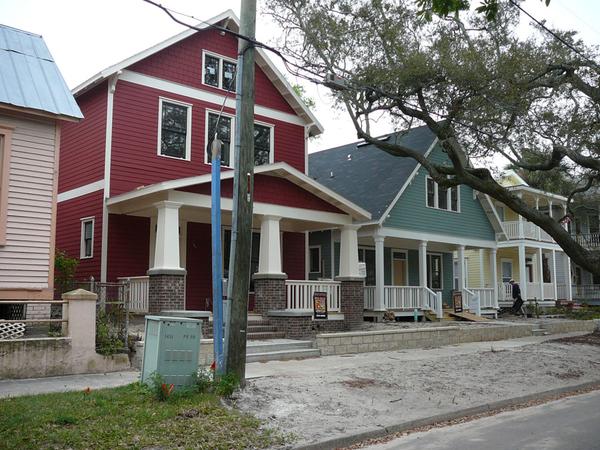
Here's some pictures of construction progress underway throughout the MidTown area. Most of the big former-Banta projects, like 1101 N Broadway, the Packard, Traveler's, Heritage, etc have made progress, even if it's just more gutting on the inside and new windows. A wooden frame is going up for some new senior assisted living at NW 12th and Hudson, and across from that they're putting in more parking for Plaza Court. Another building renovation at 1236 Shartel is wrapping up that I didn't see on my first drive-around. Otherwise, that's the neighborhood..


Wednesday, December 16, 2009
The problem with an overwise excellent SandRidge proposal
I appreciate the term that Steve brought up in an archived post about SandRidge's plans, "Streetwall." A streetwall is something that SandRidge is going to break up for the purpose of a pretty plaza on the west side of their campus. To non technical lovers of urbanism, a "streetwall" is better known as a skyscraper canyon (excellent examples of which are Park Ave especially, Robinson, and Main), but it doesn't have to be buildings of fleeting height. It can be a row of any buildings that go together that line a street.
A streetwall is usually the result of successful planning, and this is what usually defines the public realm in downtown areas. By having the buildings all frame the street with a uniform distance between the building and the curb, public space is defined by the streetwall. When you break up the streetwall or you just don't have that continuity you don't have as well-defined of a public space. Definition is good, especially for space.
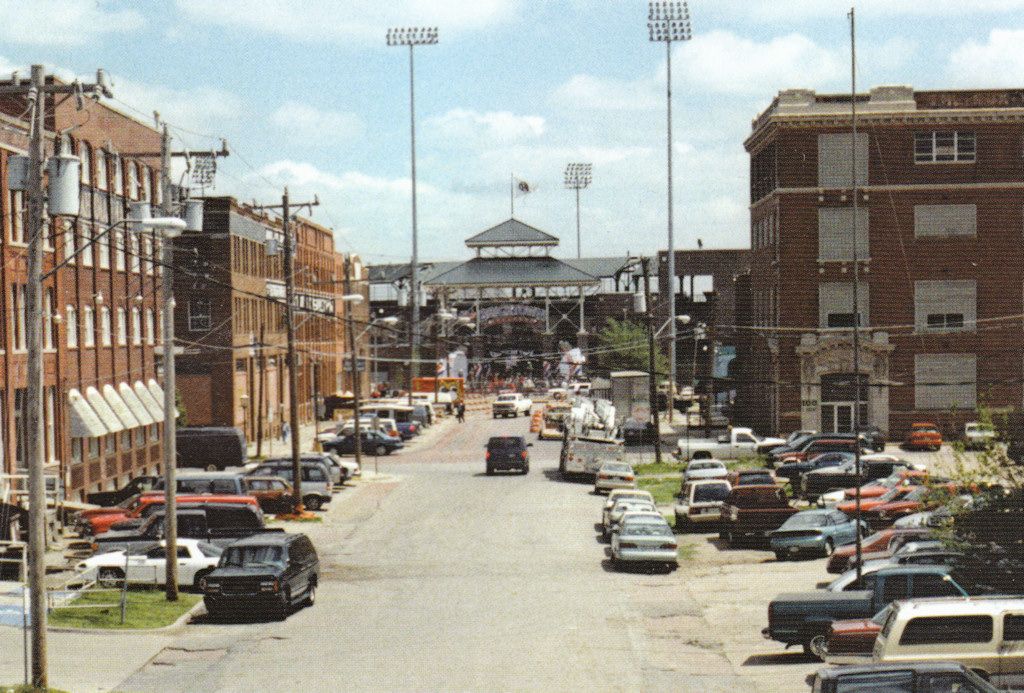
This is a good streetwall. It's not healthy, but it has the potential to be. The block in the immediate foreground of this picture is owned by SandRidge, and it lines up well with the block in the background and beyond creating a well-defined public realm. Imagine the possibilities of these buildings were renovated, with street-level retail (a very real possibility), and the streets were brought back to life with an enhanced streetscape (which is going to happen, Robinson I believe is in the first phase of Project 180).
We brought Jeff Speck in, an accomplished planner, and he told us some truths about our downtown and our current way of thinking. Were we laughing at him? Is there someone in our community that thinks they know more than him? If not, then why did we bring him in, and now why are we racing to shirk his recommendations on as many different and unique counts as possible? It literally never ends: no we want the ridiculously wide downtown boulevard, let's line our downtown streets with a million bollards to make them "safe" for everything but the eye, let's break up every streetwall we have an go full-throttle on replacing buildings with open plazas, and so on, it never ends.
Now SandRidge Energy, as a part of their sweeping campus redevelopment plans, intends to invest at least $100 million into several construction projects proposed to spruce up the corporate campus. I think that's fantastic and I congratulate SandRidge on wanting to go so far to bring their campus back to life. The north side of downtown really needs it, where urban renewal-ravaged blocks at the convergence of the CBD, Automobile Alley, and MidTown, lie completely dead and underutilized. The lack of vitality in this part of downtown is what detaches MidTown from everything else, makes A-Alley merely a linear stretch down North Broadway rather than a neighborhood, and reinforces that a large part of downtown still doesn't feel like it's been touched too much by MAPS progress. The area around the SandRidge campus truly is..dead.
What SandRidge is doing/plans to do: Currently they're finishing up an overhaul of the main skyscraper, which was in desperate need of a renovation when they bought the former Kerr McGee Tower from Houston-based Anadarko Energy. It felt like taking a space ride through the 1970s when you walked through the revolving front entrance. Today it's been modernized, and they're finishing up the top floors as I type away on my laptop. Now they're shifting their focus to the campus surrounding the tower, which for something that contributed so much to the current state of north downtown that I boldly described as dead, actually represents a lot of potential, in my opinion. As dead as the area is, it has a lot of potential to be a cool area, and it will get there. This part of downtown, in my opinion, doesn't represent nearly the preservation challenges that some more difficult buildings might, with the obvious exception of the historic India Temple which nobody seems willing to invest the time and energy in bringing back to life (despite being a former state capital). And so we have the SandRidge proposal, 1970s urban renewal all over again: tear some buildings down, put something more modern in its place.
That's a quick fix. That's not a sustainable solution. That's not "future-proof." That's not good planning. Then we get into the material of what they're replacing with the buildings that they want to tear down, which is where we run into more problems, or just one really big problem in particular: the old KerMac Building.
The old KerMac Building, the historic gray and beige brick mid rise building pictured at the end of the SandRidge block, should not be torn down..especially for an open plaza. This building can be given a facelift and brought back to life, it can house offices, OR loft apartments on its upper floors, and retail on the street floor. In fact it was part of a redevelopment project that failed, despite developers being ready to proceed, due to the KMG/Anadarko merger. Now Anthony McDermid, principal of TAP Architecture and former preservationist behind that very redevelopment project, is a member on the Downtown Design Review committee -- the very committee that will eventually have to approve these plans. He knows KerMac can be saved. We all know that KerMac can be saved.

The only building on the SandRidge campus that may or may not truly be beyond saving is the old India Temple. Despite that it is possible to remove an EIFS facade and uncover the incredibly ornate and beautiful facade underneath, it has to go. Because regardless the facade would be "damaged." Here's a lost concept: You restore the facade. Why can't it be built back? It doesn't have to be the original as-is facade from the 100 year old building, and there are modern remedies to the problem. In Europe these kinds of renovation projects take decades, but they have no qualms with having artisans painstakingly build back old decrepit facades that are worth saving.
In Moscow they are currently in the midst of restoring the grand Bolshoi Theatre, one of the world's largest theatres, and possibly the grandest. Originally built in 1825, this theatre was the site of the premiers of some of Russia's most famous symphonies and operas, a true cultural gem. Here is where Tchaikovsky and Rachmaninoff performed in the flesh, and if one is a big enough music buff, they could probably imagine the notes reverberating through the hall at the premier of Tchaikovsky's 1812 Overture or Mazeppa. This is why Russians are going to extraordinary lengths to preserve such an important place, including a painstaking $730 million restoration begun in 2005 that won't be finished until 2013, paid for by a public-private partnership.
The India Temple is our Bolshoi, despite that it is a much smaller scale project. We should restore this once-great landmark, and if the private market won't naturally do it, the State Government should do it, or solicit donors in a way similarly to how the Capitol Dome was finished. Few people may know, but this building was our State Capitol between 1913 and 1917 when the state seal was sneaked out of Guthrie in the cover of the night and moved to Oklahoma City. This is where the state seal was while the current Capitol was in the planning and construction phases. Now ask yourselves this: Are we really going to tear down a former State Capitol? I don't blame SandRidge if they do, it would be a high-commitment project no doubt. Moscow didn't make one corporation renovate the Bolshoi, instead the community took it on. I believe that the OKC community needs to be given the chance to take on restoring the India Temple, which played an important role in Oklahoma City becoming the State Capitol, the single-most important economic development move that Oklahoma City has ever made.
So, the two facets of this project I have a major disagreement with are the demolition of the KerMac Building, the original headquarters of Kerr McGee that could easily be salvaged and renovated into anything really, and the old India Temple, which as unrecognizable as it may be from its glory days, is a building with an endearing legacy that calls for it to be saved. If the India Temple, even with its original facade, did not have the legacy it carries with it, I would have no problem in letting it go. Restoring the India Temple and taking off the urban renewal mask is only worth it in my opinion because of its legacy as the first State Capitol in OKC. We can not tear this building down because it would be negating the existential question of post urban renewal downtown: are we ready to learn from the mistakes of urban renewal? If we restore this building, reclaim its heritage, reclaim our historic downtown's heritage, we have made a complete 180. If we tear this building down, we are saying we have no learned from the mistakes of urban renewal, and we are going to go down in history, in the year 2010, as a continuance of the 1970s assault on our downtown and all of the progress we have made with MAPS and everything else is for naught! Think about it.
After having derailed these plans as much as I have, I really do like the rest of SandRidge's proposal, which I recognize as a huge investment in bringing vitality back to this part of downtown. Making the mistakes I argued against above would only serve to cancel out the good intent of this project, and the positive impact that the other projects would indeed have on downtown. They are: demolishing the high-rise parking garage and replacing it with a multi-story building with restaurants and retail and a fitness center, auditorium, and rooftop basketball courts above. The new building would open up to a new park, that will be contiguous when SandRidge and Chesapeake combine efforts to renovate Couch Park and Kerr Park, connect the two, and close Couch Drive to vehicular traffic. The only vehicular traffic that ever utilizes that stretch of road anyway are utility vehicles and creepy stalker vans. I'm not sure what SandRidge will do with the site that the old YWCA, but it doesn't really matter..the YWCA, like the high-rise parking garage, is a brutally ugly structure that can go. Neither serve any real functional purpose and are pretty devoid of any life. If they would just execute the former Braniff Towers redevelopment plan that McDermid had in the works, they would tear the YWCA down and build a more modern garage with street retail, and put apartments in the Braniff Tower and KerMac Building and leave it at that.
The simple laundry list of steps we need to follow to resurrect this part of downtown are as follows:
1. Resurrect the old Braniff Towers proposal, see if McDermid is willing to take it on again, or SandRidge can just handle it by themselves if they're going to be doing development on their campus anyway.
2. Restore the India Temple as a landmark structure for OKC's history.
3. Do something about the Broadway/E.K. Gaylord intersection.
4. Have the Chamber chose a more urban site plan. The configuration they went with was actually not even their first choice, but it was reached after they concluded the Broadway/Gaylord intersection was a lost cause.
5. Go through with the Project 180 streetscape projects, which will hurt at first, but make a world of difference to the street level.
6. Hope that The Carnegie project (renovation of the old downtown library) which was supposed to have begun a long time ago, does indeed get done one of these days.
The north end of downtown is long gone, but it can be easily brought back. It has the advantage of being attached to much more vibrant neighborhoods and a corporate tenant with big pockets that is willing to help fund some improvements. This part of downtown will be back to life within the next 5 minutes as long as these improvements don't backfire and other plans go through as planned. Let's see to it. Tomorrow morning at 9.30 am in the Council Chambers, the Downtown Design Review Committee is meeting. They aren't going to be considering this proposal, but it will still be a good opportunity to get to speak and make the urbanist perspective on this project known. It is a good project, but certain aspects of it have the potential to do more harm than good. The demolitions of the KerMac and India Temple buildings needs to be opposed. The matter will likely be before the DDR in January or February, but I won't be here then..I will be at tomorrow morning's meeting though. If anyone wants to join me, that would be cool, if not, I hope you can make it in Jan or Feb.
A streetwall is usually the result of successful planning, and this is what usually defines the public realm in downtown areas. By having the buildings all frame the street with a uniform distance between the building and the curb, public space is defined by the streetwall. When you break up the streetwall or you just don't have that continuity you don't have as well-defined of a public space. Definition is good, especially for space.
This is a good streetwall. It's not healthy, but it has the potential to be. The block in the immediate foreground of this picture is owned by SandRidge, and it lines up well with the block in the background and beyond creating a well-defined public realm. Imagine the possibilities of these buildings were renovated, with street-level retail (a very real possibility), and the streets were brought back to life with an enhanced streetscape (which is going to happen, Robinson I believe is in the first phase of Project 180). We brought Jeff Speck in, an accomplished planner, and he told us some truths about our downtown and our current way of thinking. Were we laughing at him? Is there someone in our community that thinks they know more than him? If not, then why did we bring him in, and now why are we racing to shirk his recommendations on as many different and unique counts as possible? It literally never ends: no we want the ridiculously wide downtown boulevard, let's line our downtown streets with a million bollards to make them "safe" for everything but the eye, let's break up every streetwall we have an go full-throttle on replacing buildings with open plazas, and so on, it never ends.
Now SandRidge Energy, as a part of their sweeping campus redevelopment plans, intends to invest at least $100 million into several construction projects proposed to spruce up the corporate campus. I think that's fantastic and I congratulate SandRidge on wanting to go so far to bring their campus back to life. The north side of downtown really needs it, where urban renewal-ravaged blocks at the convergence of the CBD, Automobile Alley, and MidTown, lie completely dead and underutilized. The lack of vitality in this part of downtown is what detaches MidTown from everything else, makes A-Alley merely a linear stretch down North Broadway rather than a neighborhood, and reinforces that a large part of downtown still doesn't feel like it's been touched too much by MAPS progress. The area around the SandRidge campus truly is..dead.
What SandRidge is doing/plans to do: Currently they're finishing up an overhaul of the main skyscraper, which was in desperate need of a renovation when they bought the former Kerr McGee Tower from Houston-based Anadarko Energy. It felt like taking a space ride through the 1970s when you walked through the revolving front entrance. Today it's been modernized, and they're finishing up the top floors as I type away on my laptop. Now they're shifting their focus to the campus surrounding the tower, which for something that contributed so much to the current state of north downtown that I boldly described as dead, actually represents a lot of potential, in my opinion. As dead as the area is, it has a lot of potential to be a cool area, and it will get there. This part of downtown, in my opinion, doesn't represent nearly the preservation challenges that some more difficult buildings might, with the obvious exception of the historic India Temple which nobody seems willing to invest the time and energy in bringing back to life (despite being a former state capital). And so we have the SandRidge proposal, 1970s urban renewal all over again: tear some buildings down, put something more modern in its place.
That's a quick fix. That's not a sustainable solution. That's not "future-proof." That's not good planning. Then we get into the material of what they're replacing with the buildings that they want to tear down, which is where we run into more problems, or just one really big problem in particular: the old KerMac Building.
The old KerMac Building, the historic gray and beige brick mid rise building pictured at the end of the SandRidge block, should not be torn down..especially for an open plaza. This building can be given a facelift and brought back to life, it can house offices, OR loft apartments on its upper floors, and retail on the street floor. In fact it was part of a redevelopment project that failed, despite developers being ready to proceed, due to the KMG/Anadarko merger. Now Anthony McDermid, principal of TAP Architecture and former preservationist behind that very redevelopment project, is a member on the Downtown Design Review committee -- the very committee that will eventually have to approve these plans. He knows KerMac can be saved. We all know that KerMac can be saved.
The only building on the SandRidge campus that may or may not truly be beyond saving is the old India Temple. Despite that it is possible to remove an EIFS facade and uncover the incredibly ornate and beautiful facade underneath, it has to go. Because regardless the facade would be "damaged." Here's a lost concept: You restore the facade. Why can't it be built back? It doesn't have to be the original as-is facade from the 100 year old building, and there are modern remedies to the problem. In Europe these kinds of renovation projects take decades, but they have no qualms with having artisans painstakingly build back old decrepit facades that are worth saving.
The India Temple is our Bolshoi, despite that it is a much smaller scale project. We should restore this once-great landmark, and if the private market won't naturally do it, the State Government should do it, or solicit donors in a way similarly to how the Capitol Dome was finished. Few people may know, but this building was our State Capitol between 1913 and 1917 when the state seal was sneaked out of Guthrie in the cover of the night and moved to Oklahoma City. This is where the state seal was while the current Capitol was in the planning and construction phases. Now ask yourselves this: Are we really going to tear down a former State Capitol? I don't blame SandRidge if they do, it would be a high-commitment project no doubt. Moscow didn't make one corporation renovate the Bolshoi, instead the community took it on. I believe that the OKC community needs to be given the chance to take on restoring the India Temple, which played an important role in Oklahoma City becoming the State Capitol, the single-most important economic development move that Oklahoma City has ever made.
So, the two facets of this project I have a major disagreement with are the demolition of the KerMac Building, the original headquarters of Kerr McGee that could easily be salvaged and renovated into anything really, and the old India Temple, which as unrecognizable as it may be from its glory days, is a building with an endearing legacy that calls for it to be saved. If the India Temple, even with its original facade, did not have the legacy it carries with it, I would have no problem in letting it go. Restoring the India Temple and taking off the urban renewal mask is only worth it in my opinion because of its legacy as the first State Capitol in OKC. We can not tear this building down because it would be negating the existential question of post urban renewal downtown: are we ready to learn from the mistakes of urban renewal? If we restore this building, reclaim its heritage, reclaim our historic downtown's heritage, we have made a complete 180. If we tear this building down, we are saying we have no learned from the mistakes of urban renewal, and we are going to go down in history, in the year 2010, as a continuance of the 1970s assault on our downtown and all of the progress we have made with MAPS and everything else is for naught! Think about it.
After having derailed these plans as much as I have, I really do like the rest of SandRidge's proposal, which I recognize as a huge investment in bringing vitality back to this part of downtown. Making the mistakes I argued against above would only serve to cancel out the good intent of this project, and the positive impact that the other projects would indeed have on downtown. They are: demolishing the high-rise parking garage and replacing it with a multi-story building with restaurants and retail and a fitness center, auditorium, and rooftop basketball courts above. The new building would open up to a new park, that will be contiguous when SandRidge and Chesapeake combine efforts to renovate Couch Park and Kerr Park, connect the two, and close Couch Drive to vehicular traffic. The only vehicular traffic that ever utilizes that stretch of road anyway are utility vehicles and creepy stalker vans. I'm not sure what SandRidge will do with the site that the old YWCA, but it doesn't really matter..the YWCA, like the high-rise parking garage, is a brutally ugly structure that can go. Neither serve any real functional purpose and are pretty devoid of any life. If they would just execute the former Braniff Towers redevelopment plan that McDermid had in the works, they would tear the YWCA down and build a more modern garage with street retail, and put apartments in the Braniff Tower and KerMac Building and leave it at that.
The simple laundry list of steps we need to follow to resurrect this part of downtown are as follows:
1. Resurrect the old Braniff Towers proposal, see if McDermid is willing to take it on again, or SandRidge can just handle it by themselves if they're going to be doing development on their campus anyway.
2. Restore the India Temple as a landmark structure for OKC's history.
3. Do something about the Broadway/E.K. Gaylord intersection.
4. Have the Chamber chose a more urban site plan. The configuration they went with was actually not even their first choice, but it was reached after they concluded the Broadway/Gaylord intersection was a lost cause.
5. Go through with the Project 180 streetscape projects, which will hurt at first, but make a world of difference to the street level.
6. Hope that The Carnegie project (renovation of the old downtown library) which was supposed to have begun a long time ago, does indeed get done one of these days.
The north end of downtown is long gone, but it can be easily brought back. It has the advantage of being attached to much more vibrant neighborhoods and a corporate tenant with big pockets that is willing to help fund some improvements. This part of downtown will be back to life within the next 5 minutes as long as these improvements don't backfire and other plans go through as planned. Let's see to it. Tomorrow morning at 9.30 am in the Council Chambers, the Downtown Design Review Committee is meeting. They aren't going to be considering this proposal, but it will still be a good opportunity to get to speak and make the urbanist perspective on this project known. It is a good project, but certain aspects of it have the potential to do more harm than good. The demolitions of the KerMac and India Temple buildings needs to be opposed. The matter will likely be before the DDR in January or February, but I won't be here then..I will be at tomorrow morning's meeting though. If anyone wants to join me, that would be cool, if not, I hope you can make it in Jan or Feb.
Labels:
Downtown OKC,
Kerr McGee,
SandRidge,
urban design,
urban renewal
Jacksonville?
Jacksonville, FL: City pop -- 807,815. Metro pop -- 1,313,228.

Ever wonder about Jacksonville? Well, they wondered about us.. a really spiffy Jacksonville blog wrote a glowing review of OKC's urban rebirth, focusing on MAPS and the passage of MAPS 3. They made some key comparisons to OKC, comparing things like sprawl, density, convention center, infill obstacles, walkability, etc. They even mentioned two blog posts of mine, so that's kind of cool.
I hope that Jacksonville can take a few positives out of our book and put them to good use. And I hate to say this after the glowing review that a Jacksonville blogger wrote of OKC's progress, but I think that Jacksonville presents a really good case example of what not to do for OKC. I think that the two are incredibly similar cities, just that one is moving in the right direction, the other not so much.
As OKC continues to sell out Thunder games, Jacksonville is losing the Jaguars.. they will probably fill LA's new football stadium once it is finished in 2-3 years. Jacksonville is also highly sprawled, and probably getting worse--with the advent of flashy new urbanist town centers and a development boom along Jacksonville Beach, well east of the city core, distractions from downtown abound. If OKC had not passed MAPS this is exactly where we as a community would be. Granted, the Jacksonville economy is better than ours was in 1993, and they are growing at a faster pace than us -- typical for cities in Florida, which Jax is easily one of the more traditional cities in Florida (not as flashy and fake as Orlando, Miami, and Tampa).
Jacksonville's convention center is even more inadequate than ours. Their downtown transit is a joke, because not only do they have Oklahoma Spirit Trolley lookalikes roaming the streets empty, they've also got monorail. Monorail is a funny concept because at first blush I can get over my initial skepticism over monorail and understand why a city like Jacksonville would go with that. Being a city divided by the St. John's River, it makes sense to bridge the urban area with elevated monorail. Where things go wrong is with the implementation on the street level though. Little Rock, another town that bridges a river with rail transit, chose streetcar instead and has gotten far more positive results. Compare the two:


Look at all of those people on the sidewalks of Little Rock trying to board the streetcar! That just screams success from an urban planning standpoint. Pat yourself on the back, Little Rock.. I pretty much do nothing but praise thee on this blog. Jacksonville, on the other hand, not so good to say the least. Transportation officials predicted that the Little Rock system would have 1,000 riders a week (found on a website with an incredible anti-rail bias), it ended up having over 3,500 passengers a week according to that source, and 2,900 passengers a day according to this source. Jacksonville has 1,700 riders a day but even if it did or didn't have more riders than the Little Rock system, you wouldn't know it because none of it is at the street level. A monorail system is the same as our Underground, in that it gets pedestrians from point a to point b across downtown and keeps them OFF the streets while doing it. A horrible idea. For Jacksonville, it's been a failure, because they could have done a streetcar instead.

Downtown revitalization wise, Jacksonville has one really cool area called Springfield, north of their downtown area, which you can read about on the same blog. This area is really unlike any of the downtown OKC neighborhoods, in that this is more single family housing. I would say it's really comparable to perhaps The Paseo/Jefferson Park area of OKC (except that it's not as hip as The Paseo) or more closely resembles a smaller-scale version of The Heights in Houston. The problem with it is that non-walkable arterial streets cut it off from the adjacent downtown area, so there is no flow and downtown Jax doesn't feel the progress. Downtown Jax itself is full of grit and wear, very few restaurants and lofts and stuff of the sort compared to OKC, although 60,000 people do work there during the day (more than OKC, which is around 50,000). So much potential exists in some of their downtown neighborhoods, such as La Villa, for downtown loft conversions, much like we've done in Deep Deuce and Automobile Alley in OKC.
I think that eventually cities that have the potential to be great urban gems find ways to get there. Jacksonville will find a way to take advantage of its historic inner city, it just needs a new coat of varnish and a few bells and whistles. Cities like Jacksonville that are still growing can always begin to do things right, any time they chose. It's not like Cleveland or Buffalo where your resources are highly limited and you can literally only do so much. Cities like Jacksonville, Little Rock, and OKC have limitless potential because they are still growing and economically strong, BUT they aren't the vapid sprawl cesspools that places like the rest of Florida, Arizona, LA, etc have become.. All Jacksonville needs to do is get people to fall in love with downtown again, as people in OKC already have.
Ever wonder about Jacksonville? Well, they wondered about us.. a really spiffy Jacksonville blog wrote a glowing review of OKC's urban rebirth, focusing on MAPS and the passage of MAPS 3. They made some key comparisons to OKC, comparing things like sprawl, density, convention center, infill obstacles, walkability, etc. They even mentioned two blog posts of mine, so that's kind of cool.
I hope that Jacksonville can take a few positives out of our book and put them to good use. And I hate to say this after the glowing review that a Jacksonville blogger wrote of OKC's progress, but I think that Jacksonville presents a really good case example of what not to do for OKC. I think that the two are incredibly similar cities, just that one is moving in the right direction, the other not so much.
As OKC continues to sell out Thunder games, Jacksonville is losing the Jaguars.. they will probably fill LA's new football stadium once it is finished in 2-3 years. Jacksonville is also highly sprawled, and probably getting worse--with the advent of flashy new urbanist town centers and a development boom along Jacksonville Beach, well east of the city core, distractions from downtown abound. If OKC had not passed MAPS this is exactly where we as a community would be. Granted, the Jacksonville economy is better than ours was in 1993, and they are growing at a faster pace than us -- typical for cities in Florida, which Jax is easily one of the more traditional cities in Florida (not as flashy and fake as Orlando, Miami, and Tampa).
Jacksonville's convention center is even more inadequate than ours. Their downtown transit is a joke, because not only do they have Oklahoma Spirit Trolley lookalikes roaming the streets empty, they've also got monorail. Monorail is a funny concept because at first blush I can get over my initial skepticism over monorail and understand why a city like Jacksonville would go with that. Being a city divided by the St. John's River, it makes sense to bridge the urban area with elevated monorail. Where things go wrong is with the implementation on the street level though. Little Rock, another town that bridges a river with rail transit, chose streetcar instead and has gotten far more positive results. Compare the two:
Look at all of those people on the sidewalks of Little Rock trying to board the streetcar! That just screams success from an urban planning standpoint. Pat yourself on the back, Little Rock.. I pretty much do nothing but praise thee on this blog. Jacksonville, on the other hand, not so good to say the least. Transportation officials predicted that the Little Rock system would have 1,000 riders a week (found on a website with an incredible anti-rail bias), it ended up having over 3,500 passengers a week according to that source, and 2,900 passengers a day according to this source. Jacksonville has 1,700 riders a day but even if it did or didn't have more riders than the Little Rock system, you wouldn't know it because none of it is at the street level. A monorail system is the same as our Underground, in that it gets pedestrians from point a to point b across downtown and keeps them OFF the streets while doing it. A horrible idea. For Jacksonville, it's been a failure, because they could have done a streetcar instead.
Downtown revitalization wise, Jacksonville has one really cool area called Springfield, north of their downtown area, which you can read about on the same blog. This area is really unlike any of the downtown OKC neighborhoods, in that this is more single family housing. I would say it's really comparable to perhaps The Paseo/Jefferson Park area of OKC (except that it's not as hip as The Paseo) or more closely resembles a smaller-scale version of The Heights in Houston. The problem with it is that non-walkable arterial streets cut it off from the adjacent downtown area, so there is no flow and downtown Jax doesn't feel the progress. Downtown Jax itself is full of grit and wear, very few restaurants and lofts and stuff of the sort compared to OKC, although 60,000 people do work there during the day (more than OKC, which is around 50,000). So much potential exists in some of their downtown neighborhoods, such as La Villa, for downtown loft conversions, much like we've done in Deep Deuce and Automobile Alley in OKC.
I think that eventually cities that have the potential to be great urban gems find ways to get there. Jacksonville will find a way to take advantage of its historic inner city, it just needs a new coat of varnish and a few bells and whistles. Cities like Jacksonville that are still growing can always begin to do things right, any time they chose. It's not like Cleveland or Buffalo where your resources are highly limited and you can literally only do so much. Cities like Jacksonville, Little Rock, and OKC have limitless potential because they are still growing and economically strong, BUT they aren't the vapid sprawl cesspools that places like the rest of Florida, Arizona, LA, etc have become.. All Jacksonville needs to do is get people to fall in love with downtown again, as people in OKC already have.
Labels:
comparing cities,
Jacksonville,
light rail,
monorail,
public transit,
streetcar
Tuesday, December 15, 2009
Conceptual food for thought
For those of you that actually enjoy when I start going into planning jargon, or who can at least follow it a little bit, here's some food for thought. I was thinking about what makes great city centers and how you build such a neighborhood and other typical chicken-or-egg kinds of questions. Well really, you need both the chicken or egg simultaneously, but ironically if you chose one, someone accuses you of not doing enough to be proactive, if you chose the other, you're accused of putting the cart before the horse. That's true with a lot of things, especially planning and the transit debate where streetcar came out victorious, despite detractors saying OKC isn't dense enough and blah blah (streetcar builds density).
But here's the food for thought, what I want to hear thoughts and opinions on: Do people live where they work, or do people live where they play? Think about it. Now in context, look at the people moving downtown. We've been surprised by all of the studies that have actually shown most of them to not work in downtown, despite downtown having the metro's highest concentration of workers. But then again, we expect downtown workers to live downtown. So which is it, do people tend to live where they play, or do people tend to live where they work?
First I would argue that OKC itself is a horrible example to use to figure this out because we don't have a healthy, full-blown alternative to suburban markets of all price points. But imagine we did, unless you spend a lot of time in a different city that does have viable alternatives at each price point. If the downtown residential market was viable, would people live there because they play in downtown or because they work in downtown... of course you could say both, but that's a cop-out!
But here's the food for thought, what I want to hear thoughts and opinions on: Do people live where they work, or do people live where they play? Think about it. Now in context, look at the people moving downtown. We've been surprised by all of the studies that have actually shown most of them to not work in downtown, despite downtown having the metro's highest concentration of workers. But then again, we expect downtown workers to live downtown. So which is it, do people tend to live where they play, or do people tend to live where they work?
First I would argue that OKC itself is a horrible example to use to figure this out because we don't have a healthy, full-blown alternative to suburban markets of all price points. But imagine we did, unless you spend a lot of time in a different city that does have viable alternatives at each price point. If the downtown residential market was viable, would people live there because they play in downtown or because they work in downtown... of course you could say both, but that's a cop-out!
Convention center search: Reality

Before we continue with the convention center search, I wanted to pause to impress upon you readers the realities of the convention industry and the fierce competition within this particular industry. There's a lot of misunderstanding out there about what makes convention centers competitive over others. We like to assume that "bells and whistles" and certain special above-and-beyond features are what makes convention centers competitive. I've heard several suggestions for everything from having a massive food court in the new OKC convention center, to something like having a dedicated streetcar stop smack in the middle of the convention center and the streetcar tracks going right through the thing.
First of all I would argue vehemently against those suggestions for reasons entirely separate of this post. They just go against rational urbanism and they would hurt the project. The idea with a convention center is that it's like any other typical superblock structure, which means it usually subtracts rather than adds from the surrounding neighborhood. Think about the sides of the Cox Center that front Robinson and E.K. Gaylord .. pitiful. Huge expanses of dead space. I like to think of urbanism from this perspective: You can tell everything about a block from what happens on the sidewalk. There is absolutely no reason to be on the sidewalk in front of most convention centers, so in that way, convention centers and the usual superblock structures detract from the neighborhood. They also create a vacuum in the neighborhood, since usually the site is several city blocks that serve no real purpose unless there's a big convention in town, and the worst is when typically they create barriers because of their huge size.
It's possible that the Cox Center contributed more to the "dead end" on the south side of downtown than the Crosstown Expressway did, and yet that's what we've focused all of our attention on moving. Look at all of the superblock structures we have clumped together at the south end of downtown -- the Cox Center, Ford Center, and the Myriad Gardens, so it's no wonder that there's nothing south of there. In fact, usually a park can be creatively used to have the complete opposite effect that I just described with superblock structures -- however when you clump it together with other superblock structures then the possibility of that goes away. Because we put the park next to the convention center, instead of an urban park, we just got two side-by-side superblock structures that form a vacuum of activity. So instead of learning from the mistakes we made in the past, we're very very gung-ho to make these mistakes again. Do we do it because we think it's exciting and get a rush out of screwing up our downtown? No! We do it because we don't know any better and nobody else has mentioned this except myself and fellow urbanist bloggers (Blair Humphreys namely)!
[/endC2Srant]
The specific reasons I would argue against a massive all-encompassing food court or restaurant section inside the convention center is because it eliminates a key reason to venture outside the convention center. By including everything the convention goer could possibly want, we create a convention fortress. Fortresses are bad for urban planning. In fact, the fortress basically WAS urban planning back in the Medieval Ages, so in honor of Hamlet and Old England and Renaissance Faires (which mistakenly label Medieval culture as "Renaissance" culture) by all means, let's bring back cutting edge urban planning from the Medieval Ages, because surely it's better than the collective wisdom we've gained since then. If you disagree with this, maybe you are sane after all. After all, it's called a convention "center" and not a convention "CITY". But so often people make the mistake of creating a convention city instead of just a simple convention center because they think it's going to lead to more conventions. Wrong.
Same goes with the streetcar. By putting the streetcar through the convention center and having it stop right in front of someone's meeting, not only have we bended to an incredibly powerful special interest, but we've also eliminated another key reason to venture outside the front door and down those venerable steps to the yellow brick road (the sidewalk). The sidewalk in front of a convention center could indeed be an incredibly lively scene if we lined it with food vendors, eliminated dead plaza space that looks pretty in photographs, and put a streetcar stop just outside the front entrance. The convention goer wouldn't have to walk far at all, but he/she would experience that part of OKC nonetheless, even if only for a few hundred feet. Also, a streetcar cutting through the convention center would pose a nightmare from a structural standpoint. It would be expensive to find a solution to providing ingress and egress into the convention center for the streetcar lines while maintaining a decent level of heat and air control inside the massive facility. MAPS projects don't need expensive useless bells and whistles because that's just the thing that harms public trust.
The reality is that none of these things bring more conventions. Meeting planners (which there are thousands of, an ever-evolving career sector that's one of those new age jobs that didn't really exist a decade ago) have very specific criteria that they judge a city on. They are:
1. The convention center. Yes, they take into account the individual convention centers, but they don't actually weigh individual features. The convention center is more likely to get up or down consideration, either good or bad, no shades of gray. Meeting planners are not architects or engineers, or even urban planners, and they could care less how much money went into some preposterous feature like a state-of-the-art streetcar route cutting right through the center.
2. The city. They're also very likely to weigh in the city, so this is where you can win points for good urbanism over bad urbanism. I think it's a great point to mention that here is where these ridiculously unneeded bells and whistles can actually do more harm than good if you believe in my diatribe over how they can detract from the surrounding environs. However I'll admit myself that the consideration given to the individual city itself has less to do with what the city is like and how nice it is as it does over the strategic advantages of a particular city. For example, the best thing NW Arkansas has going for it from a convention standpoint is that everyone wants to get face time with Wal-Mart, so you go to their backyard..that's very strategic. Good locations, lots of involvement with a particular industry, a history of supporting conventions, etc..all pose strategic benefits. Oklahoma Dept of Commerce is always trying to spin its location in the middle of nowhere as a strategic plus saying that we're "in the middle of it all, on I-35 between Mexico and Canada, and within close proximity to the Midwest and Texas."
3. The proposal. The truth about the convention industry is that these huge meetings are so coveted that it's almost as if the conventions don't come to cities, instead, cities come to conventions. That's the truth. It's actually the city's CVB that in most cases has to apply for a convention, and submit an RFP (in the economic development world, this means "request for proposals") by a certain deadline for consideration. The OKC CVB pays to have access to a database that lists all of the RFPs that are currently open, and the OKC CVB is particularly competent at putting together competitive RFPs for conventions that are small enough for us to host. The RFP says it all. How much will they have to pay for rooms, to use the space, how much is AV equipment rental going to cost them, what taxes will apply to them, and so on.
To most meeting planners having some of these ridiculous bells and whistles are kind of like when Billy Mays would offer a 2nd free bottle of Oxiclean or whatever in the hell he was hawking, or a free Shamwow if you call in the next 20 minutes, or something like that. Don't forget that Billy Mays sold crap, not convention centers. In the hyper-competitive convention industry, the reason cities that people generally do not "like" such as Cleveland and Phoenix (although I love Cleveland, and Phoenix is making serious progress with its recently-finished LRT) can be just as competitive as cities that people generally "love" such as Minneapolis (as long as it's not winter) and San Francisco is how simple the competitive process is. In fact even Detroit could be a convention hit if only the Cobo Center weren't a pit, which is the first thing I would change if I were mayor of Motown (that and getting rid of public officials' free cell phones..which have caused them quite a bit of trouble). And just look at the two biggest convention cities in the nation: Orlando and Las Vegas. It's proof that even the crappiest, most horribly planned cities in the nation can become convention hotspots. It's all about what YOU will do for the convention. That's the bottom line.
And even if everything I just said is untrue and I was lying to you readers, what does OKC have to gain by selling itself out to gain a little bit more favorability in competing for conventions? The result we really want is not for more people to be forced to go to OKC for more conventions, but instead, we want more people to enjoy OKC when they do get to come here for conventions. That's what it's all about.
Monday, December 14, 2009
What MAPS tells us about north v. south
Let's pause our search at convention centers to take a real quick flashback at the MAPS 3 election results. If you previously didn't believe in a north/south dichotomy, take a look at this. It couldn't be clearer, and I think this is evidence that the rift between North OKC and South OKC is getting worse. Typically the MAPS results follow socioeconomic lines, but there are some lower-income wards in NE OKC that went pro-MAPS and some high-income wards in SW OKC that went anti-MAPS. That suggests that the north/south rift is so strong that it even bridges socioeconomic rifts.
The north side with its museums, coffee shops, art galleries, locally-owned restaurants, night clubs, locally-owned bookstores, universities, and so on.. and the southside with none of that. Consider that the southside, a huge region with hundreds of thousands of people, has ONE Starbucks (the only coffee option besides 7/11). Edmond alone had 8. North OKC has quite a collection, too. There is also not a single bookstore in South OKC, and going south from downtown, you won't reach a bookstore until you get to the southwest side of Norman.


And lastly, in honor of MAPS 3 passing, here's some music to go with it. The song is "Maps" by the Yeah Yeah Yeahs. Last week OKC said "Yeah Yeah Yeah" to MAPS 3.
The north side with its museums, coffee shops, art galleries, locally-owned restaurants, night clubs, locally-owned bookstores, universities, and so on.. and the southside with none of that. Consider that the southside, a huge region with hundreds of thousands of people, has ONE Starbucks (the only coffee option besides 7/11). Edmond alone had 8. North OKC has quite a collection, too. There is also not a single bookstore in South OKC, and going south from downtown, you won't reach a bookstore until you get to the southwest side of Norman.


And lastly, in honor of MAPS 3 passing, here's some music to go with it. The song is "Maps" by the Yeah Yeah Yeahs. Last week OKC said "Yeah Yeah Yeah" to MAPS 3.
Sunday, December 13, 2009
Convention center search: Cox Convention Center
Since the Cox was renovated, OKC's convention business has shot up. One study that came out a year ago announced that OKC saw the largest % increase in convention business over a 5-year span. The #2 city was Omaha, which we'll discuss in the future. Now the Cox's limited convention space is holding back OKC's ability to compete for larger conventions. The largest conventions that we do have, which is usually Pre-Paid Legal's annual meeting, have the Cox bursting at the seams. To put OKC's convention industry growth in perspective, just single out a single month last year, March of 2008: We had 15,000 people here for the Pre-Paid Legal meeting, 5,000 in town for the American Choral Society convention, about 10,000 for a high school FFA convention, and dozens and dozens of thousands came for the Big 12 basketball tourney..all in the span of the shortest month of year. That's HUGE economic development. According to a OKC CVB report, the hotel bookings for March were 28,000 rooms above the previous March.

A recent study commissioned by the Chamber of Commerce indicated that OKC needs at least 200,000 sf of total exhibition space. The Cox can not be expanded because there is no room to expand it, being in the core of downtown, and its footprint isn't conducive to another expansion anyway. The MAPS 3 convention center would have about 550,000 sf of space total, with 200,000 devoted to exhibition space. So even though it's about half the size of the Cox, it would have double the real convention space. By keeping the Cox that gives us about 300,000 sf of exhibition space in downtown.
Saturday, December 12, 2009
Convention center search: The best and the worst
As I am currently working on a huge post comparing OKC's convention center project to what a countless number (dozens and dozens) of other cities have done, I figured it might be appropriate to break it up into smaller segments and start with the best and the worst, since that's really what these posts are about: learning from what other cities did right, and taking into account what other cities did wrong.
The best and worst have one thing in common, aside from the fact that they are both large convention centers. That is that they both interact with the surrounding street level in extraordinary ways, let's put it at that. One of them is a colossal failure from a new urbanist perspective, whereas the other is a highly innovative success.
Columbus, OH - city pop 711,470; metro pop 1,773,120. Convention Center: Greater Columbus Convention Center.


Columbus' center is probably one of the most innovative designs I've come across. It might not be LEED-certified and it doesn't come with the bells and whistles that other centers feature, but it is extremely practical, it's big enough for a growing city like Columbus to grow into, and it actually ADDS to the surrounding environs. The design, which is a result of a 1989 design competition (this project broke ground in 1993 and was expanded in 2001), creates a unique streetwall effect that minimizes the impact of having a super block structure. By mimicking the other side of the street, which features historic buildings and infill development, the convention center flows well with the neighborhood -- something most convention centers, no matter how glamorous, fail to do. Usually they end up becoming the bookend for a downtown area.
The center has 1.7 million total sf, 426,000 of which is devoted to exhibition purposes .. and it was built on a shoestring budget, which is what we're looking for with MAPS projects. The 2001 addition, which added 300,000 sf, cost a mere $81 million (which even when you adjust for inflation and building costs, is still a heck of a deal). That's comparable to what we ended up spending on renovating the Cox Center which is 100,000 sf -- total (ridiculously small for a city our size). The Columbus center also features a dedicated convention specialty hotel that is attached, via a skyway across railroad tracks. The convention hotel also interacts well with the street level that is on, in a completely detached part of downtown Columbus. Columbus is an example OKC can learn a lot from because of its innovative layout approach, the design originating from a design competition (which would likely turn up even newer, more innovative ideas for OKC that I can't even think of), the low cost of the project (given its huge size), the attached convention hotel, and the size that adequately gives Columbus room to grow into.
___________________________________________
Daytona Beach, FL -- city pop 64,421; metro pop 496,575. Convention Center: Ocean Center.

I don't know where to begin with how much I hate this project. Instead I'll start with just the stats. Built in 1985 and expanded in 2009, the expansion which doubled its size cost $76 million. The convention center features 205,000 sf of exhibit space, not sure about the total.. so it's about half the size of the Columbus center. It also has an attached arena that seats 8,632 for basketball games. Now to begin with how much I hate this project. First of all it's in Florida, which is where good urban concepts go to die.
Typically cities in Florida make me dislike palm trees, because of how garish they look, and the fact that the only cities I've ever seen tastefully use palm trees are Houston, LA, and New Orleans. The design is obviously hideous, and the fact that they tried to hide it behind a jungle of unorganized palm trees makes it even worse. Who knows, it might actually be an attractive project without the palms. The effect reminds me a lot of the striking architecture of the Carpenter Square Theater today known as the Stage Center (which I contend is awesome architecture) that OKC has hidden behind some scrubby trees to lessen the BAM! effect of the edgy design. The result doesn't go over too well.
The bulk of why I dislike this project so much is how it really has zero interaction with the street level. There is no activity going on with that street, and I just don't see myself wanting to be there. The design of the actual convention center has the effect of a people repellent. Imagine with those beautiful Florida sunsets, when the sun shimmers against that silver balloon-looking building, the effect it would on you as a pedestrian to make you want to walk the other way. As far as wanting to wrap a nice little plaza around it, that's an understandable mistake that a lot of urban planners make. Architects love plazas because they're like decorative picture frames for their work (the smartest architects let crowd scenes form the "picture frame"). But if you're going to make the mistake of doing a plaza, at least design one that is attractive. Not one that looks more like a putt putt course in the middle of a downtown environment.
I would say that the hideous, garish design that the MAPS 3 people promoted for our convention center is VERY comparable to the Daytona center (and yes, I know it's one of many preliminary convention renderings that just act as placeholders until we are closer to breaking ground on this in 6-7 years). Let's get a head start on not making the mistakes that Daytona Beach made, because it would extremely costly for us. And if we go with such a hideous, garish design, look at the effect it will have on the park: I don't care how wonderful the park is and how well-designed it is, if you put it in front of a ghastly colorful object, it will look silly. That's why the convention center needs to be removed from the park and why we have no business with ghastly colorful designs in the first place. No wonder the convention center was the least popular MAPS 3 project -- I guarantee if they had just stuck with the C2S preliminary rendering (the "Rose Rock Center") that the convention center wouldn't have cost as many votes. Now, how it interacts with the surrounding environs, that's a whole different issue.
The best and worst have one thing in common, aside from the fact that they are both large convention centers. That is that they both interact with the surrounding street level in extraordinary ways, let's put it at that. One of them is a colossal failure from a new urbanist perspective, whereas the other is a highly innovative success.
Columbus, OH - city pop 711,470; metro pop 1,773,120. Convention Center: Greater Columbus Convention Center.
Columbus' center is probably one of the most innovative designs I've come across. It might not be LEED-certified and it doesn't come with the bells and whistles that other centers feature, but it is extremely practical, it's big enough for a growing city like Columbus to grow into, and it actually ADDS to the surrounding environs. The design, which is a result of a 1989 design competition (this project broke ground in 1993 and was expanded in 2001), creates a unique streetwall effect that minimizes the impact of having a super block structure. By mimicking the other side of the street, which features historic buildings and infill development, the convention center flows well with the neighborhood -- something most convention centers, no matter how glamorous, fail to do. Usually they end up becoming the bookend for a downtown area.
___________________________________________
Daytona Beach, FL -- city pop 64,421; metro pop 496,575. Convention Center: Ocean Center.
I don't know where to begin with how much I hate this project. Instead I'll start with just the stats. Built in 1985 and expanded in 2009, the expansion which doubled its size cost $76 million. The convention center features 205,000 sf of exhibit space, not sure about the total.. so it's about half the size of the Columbus center. It also has an attached arena that seats 8,632 for basketball games. Now to begin with how much I hate this project. First of all it's in Florida, which is where good urban concepts go to die.
Typically cities in Florida make me dislike palm trees, because of how garish they look, and the fact that the only cities I've ever seen tastefully use palm trees are Houston, LA, and New Orleans. The design is obviously hideous, and the fact that they tried to hide it behind a jungle of unorganized palm trees makes it even worse. Who knows, it might actually be an attractive project without the palms. The effect reminds me a lot of the striking architecture of the Carpenter Square Theater today known as the Stage Center (which I contend is awesome architecture) that OKC has hidden behind some scrubby trees to lessen the BAM! effect of the edgy design. The result doesn't go over too well.
The bulk of why I dislike this project so much is how it really has zero interaction with the street level. There is no activity going on with that street, and I just don't see myself wanting to be there. The design of the actual convention center has the effect of a people repellent. Imagine with those beautiful Florida sunsets, when the sun shimmers against that silver balloon-looking building, the effect it would on you as a pedestrian to make you want to walk the other way. As far as wanting to wrap a nice little plaza around it, that's an understandable mistake that a lot of urban planners make. Architects love plazas because they're like decorative picture frames for their work (the smartest architects let crowd scenes form the "picture frame"). But if you're going to make the mistake of doing a plaza, at least design one that is attractive. Not one that looks more like a putt putt course in the middle of a downtown environment.
I would say that the hideous, garish design that the MAPS 3 people promoted for our convention center is VERY comparable to the Daytona center (and yes, I know it's one of many preliminary convention renderings that just act as placeholders until we are closer to breaking ground on this in 6-7 years). Let's get a head start on not making the mistakes that Daytona Beach made, because it would extremely costly for us. And if we go with such a hideous, garish design, look at the effect it will have on the park: I don't care how wonderful the park is and how well-designed it is, if you put it in front of a ghastly colorful object, it will look silly. That's why the convention center needs to be removed from the park and why we have no business with ghastly colorful designs in the first place. No wonder the convention center was the least popular MAPS 3 project -- I guarantee if they had just stuck with the C2S preliminary rendering (the "Rose Rock Center") that the convention center wouldn't have cost as many votes. Now, how it interacts with the surrounding environs, that's a whole different issue.
Labels:
C2S,
Columbus,
comparing cities,
convention center,
Daytona Beach,
Downtown OKC,
MAPS,
OKC,
urban design
Wednesday, December 9, 2009
A post-MAPS OKC
A picture is worth a thousand words. A video however, is worth a whole Downtown OKC 2020 column.
Post-MAPS home video
YES for MAPS | MySpace Video
Post-MAPS home video
YES for MAPS | MySpace Video
NW 9th Street revitalization
Obviously we're all ecstatic that MAPS 3 passed. I feel like I've already said what would happen if we approve MAPS, and given a large scale vision for what could happen, and now it will happen. Instead today I want to focus on the revitalization of NW 9th Street, where Steve Mason has been quietly focusing on one building at a time, doing high quality work. Things like MAPS 3 are like throwing huge boulders into a stream, and they make huge ripples. Things like NW 9th, SoSA, and Plaza District and are like throwing pebbles into a stream, and they make smaller ripples, but with enough of them, the impact is just as great.
A few weeks ago I wrote about the transformation underway in SoSA, one of the many small areas of OKC that have been transformed. This post is about NW 9th and Steve Mason, who has been redeveloping properties on the north end of Automobile Alley for two years now. The original reason that Mason purchased the 1000 block of N. Broadway was for the offices of his company, Cardinal Engineering. He didn't think it would be difficult to find tenants to occupy the street level either. After he set about renovating the building and finding tenants, he came across his fair share of difficulties but persevered through the historic preservation and ended up with a great project. He found Bicycle Alley and Coffee Slingers, and I'm pretty sure he even loaned Coffee Slingers the money it needed to start up. He repainted the building a fresh coat of red paint.
After what a gutsy success the 1000 block was for Mason, you have to figure he was in the mood for some more adventure. So he crossed the other side of North Broadway and bought up several buildings along NW 9th, between Broadway and the tracks. The original plan was to renovate one building for a restaurant and tear down the rest so that the restaurant would have parking. So the restaurant, Iguana Mexican Grill (formerly on N. Western), opened up and has since been a huge hit -- known across the downtown community for its Tuesday drink specials.

Mason had a different idea with the rest of the block though. He thought he could save the boarded up old houses and put businesses in them, and just have parking along the street. After working to save one boarded up house that had sustained fire and flood damage, a desert shop, Sara Sara Cupcakes, has opened up in one of them.
Another building now houses a home decor store, BD Home. BD Home is owned by downtown dwellers Adam and Brittany Branscum, who live across I-235 in the OHC area. Adam Branscum was the contractor Mason hired for restoring the Sara Sara Cupcakes house, and ironically, Branscum initially urged Mason to just tear the building down (due to the extensive structural damage). Branscum still says that the building should have been torn down, but appreciates Mason's greater vision for the neighborhood. Now a portrait studio, Stella Photography, is opening above Sara Sara Cupcakes, and across from BD Home a new sushi restaurant is going in.
Eric Smith, the chef at the desert shop, is also working with Mason to open a new Asian fusion restaurant named Pachinko Sushi. Smith is one of many Okie expats (Chicago, in his case) who have moved back to OKC to get in on the urban scene that has cropped up, and despite deliberately moving back for the downtown scene, the last place Smith would have expected to wind up on is this particular stretch of NW 9th, between Broadway and the tracks.
Aside from Smith's new restaurants, several other projects are currently in the works. Mason is already in talks with another furniture store, restaurant, and a bar for other buildings on the block. For him, vision keeps rolling, as he says, "If we come back here one year from now it's going to look just as much different as it did a year and a half ago." While 9th Street is such a work in progress, with so much progress already visible, it's beginning to form another one of downtown's many smaller communities. It just goes to show that the overall city is moving forward, picking up steam, and all of that is manifested in people like Steve Mason being able to turn an abandoned, derelict block of gutted out buildings into a vibrant community with a half dozen new businesses in the span of a year. So yes it's exciting that MAPS 3 passed, and this is why -- for what it means to entrepreneurs who are taking risks on downtown neighborhoods everyday. When we went to the polls and answered the call, we were really just affirming what has already motivated these people to put so much effort into downtown; that is that anything is possible in OKC.
Mason had a different idea with the rest of the block though. He thought he could save the boarded up old houses and put businesses in them, and just have parking along the street. After working to save one boarded up house that had sustained fire and flood damage, a desert shop, Sara Sara Cupcakes, has opened up in one of them.
Aside from Smith's new restaurants, several other projects are currently in the works. Mason is already in talks with another furniture store, restaurant, and a bar for other buildings on the block. For him, vision keeps rolling, as he says, "If we come back here one year from now it's going to look just as much different as it did a year and a half ago." While 9th Street is such a work in progress, with so much progress already visible, it's beginning to form another one of downtown's many smaller communities. It just goes to show that the overall city is moving forward, picking up steam, and all of that is manifested in people like Steve Mason being able to turn an abandoned, derelict block of gutted out buildings into a vibrant community with a half dozen new businesses in the span of a year. So yes it's exciting that MAPS 3 passed, and this is why -- for what it means to entrepreneurs who are taking risks on downtown neighborhoods everyday. When we went to the polls and answered the call, we were really just affirming what has already motivated these people to put so much effort into downtown; that is that anything is possible in OKC.
Labels:
9th Street,
Automobile Alley,
Downtown OKC,
Iguana Mexican Grill,
OKC,
Steve Mason
Tuesday, December 8, 2009
We WIN!
6 of 271 precincts reporting, with 2,794 votes YES and 1,832 votes NO. However the Oklahoman puts the percentage at 51.6% to 48.4%. My math says the percentage is actually 60.4% to 39.6%.
edit: The Jokelahoman isn't the best source to follow here.. FOX's Andrew Speno has a twitter page that's well-updated. And he can do simple math.
MAPS 3: 30 of 271 Precincts Reporting. Yes: 5694 No: 4377
MAPS 3: 83 of 271 Precincts Reporting. Yes: 12711 No: 9682
MAPS 3: 126 of 271 Precincts Reporting. Yes: 19039 No: 14442
MAPS 3: 157/271 precincts. Yes: 23,738 // No: 17,896
MAPS 3: 177/271 precincts. Yes: 26,738 // No: 20,992
MAPS 3: 219/271 precincts. Yes: 34,588 // No: 27,866
MAPS 3: 241/271 precincts. Yes: 37,929 // No: 31,510
MAPS 3: 271/271 precincts reporting! Yes: 40,956 // No: 34,465
edit: The Jokelahoman isn't the best source to follow here.. FOX's Andrew Speno has a twitter page that's well-updated. And he can do simple math.
MAPS 3: 30 of 271 Precincts Reporting. Yes: 5694 No: 4377
MAPS 3: 83 of 271 Precincts Reporting. Yes: 12711 No: 9682
MAPS 3: 126 of 271 Precincts Reporting. Yes: 19039 No: 14442
MAPS 3: 157/271 precincts. Yes: 23,738 // No: 17,896
MAPS 3: 177/271 precincts. Yes: 26,738 // No: 20,992
MAPS 3: 219/271 precincts. Yes: 34,588 // No: 27,866
MAPS 3: 241/271 precincts. Yes: 37,929 // No: 31,510
MAPS 3: 271/271 precincts reporting! Yes: 40,956 // No: 34,465
Monday, December 7, 2009
The last MAPS post: Lucky #7?
Tomorrow is the big day, the day we've all been waiting on. The day that will affirm or negate the momentum that OKC has built up through the last 10 years. It comes down to a hastily-organized election over a 7-year extension to generate $777 million for 7 projects (not counting sidewalks). So will the number 7 be lucky for Oklahoma City, or will antagonistic union subterfuge harm progress? It's very possible that MAPS is in the closest dogfight it's ever been in and there is no telling which side will be victorious. That's why everybody in OKC who reads this blog needs to turn out to vote.
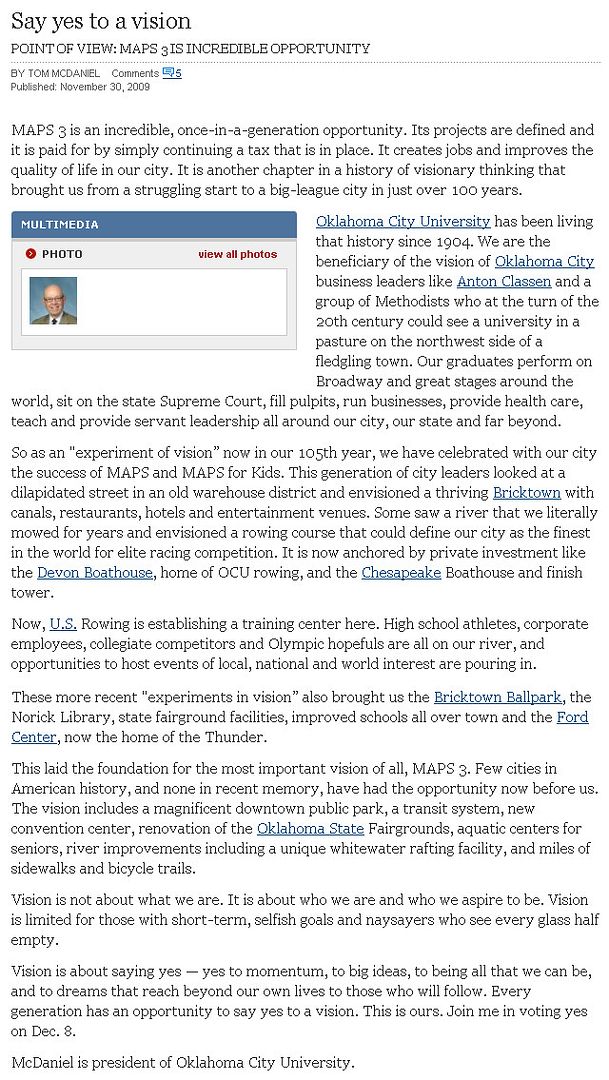
The best editorial on this comes from Oklahoma City University President Tom McDaniel. Tom wrote:
This will be an initiative that lives in infamy. Throughout the 60s and 70s we wrecked our downtown with the incomplete I.M. Pei masterplan to just root out the old and stick in the new. That was not a plan geared toward people and toward vitality. MAPS 3 is. We're putting amenities in downtown, and nothing more. We are letting the free market do its thing with development. We provide the community gems, our developers provide the community. Look at the city that's emerged. Look at the potential we have.
With MAPS 3, we've taken the best that bigger and better cities have done since we did MAPS and we applied the MAPS formula to it. Houston and Chicago have done ground-breaking things with downtown parks. Portland has done ground-breaking things with streetcar. Just pick a city..Pittsburgh/Houston/Denver/Dallas..have done ground-breaking things with a convention center. Charlotte has done ground-breaking things with an artificial white water rapids. Little Rock has done ground-breaking things with senior centers. There is one project where we've been the one doing the ground-breaking stuff in the past, and that's the river for rowing. We're going to attempt to redefine the success of these projects, including our own rowing, and offer them to the citizens of OKC. We're taking elements that have gone over big in other cities and applying them to our own city. We expect equally positive effects at the worst.
MAPS 3 is not about staying up with the curve, though. It's about moving beyond the curve. It's about redefining success, creating a unique city, adding landmarks to OKC, and providing infrastructure that will serve OKC well for decades to come because it will be sustainable and long-lasting. MAPS 3 is about doing more than just night clubs and restaurants in Bricktown. It's about creating a bona fide live/work/play community. It's about attracting more college graduates to OKC, and keeping our OU/OSU/OCU grads here. It's about a more active lifestyle, so that OKC is no longer the most fast food binging, most chronically obese MSA in the nation. It's about fanning the effects of MAPS 3 around the entire city, so that it isn't just downtown that moves forward; the entire city will feel the effects of MAPS 3, whether you want to argue about that for MAPS 1 or not.
The entire city will enjoy the system of hiking and bicycle trails. Each section of the city that gets a senior city will benefit from that. Businesses on the west side of town will benefit from more expo shows at the Fairgrounds and the entire city will benefit from more sales tax from the expo center and the convention center. The south side, particularly Capitol Hill, will benefit from the stadium seats to be placed on the south side of the river. The whole center city will benefit from 5-6 miles of streetcar track. This could connect C2S, Bricktown, the Medical District/OHC area, Capitol area, Uptown, Heritage Hills, MidTown, Downtown/Arts District, and back to C2S. And the entire center city, anything between I-44 and I-240, will benefit from a downtown renaissance. Before MAPS, how fashionable was it to live in neighborhoods like Heritage Hills, Mesta Park, Gatewood, Jefferson Park, The Paseo, et all? The answer is not very en vogue. Because of MAPS, the entire city is en vogue. You can't put a pricetag on that. If we go back to a day and age where we as a community are too stubborn to invest in ourselves, we might not hit rock bottom again. We may even continue to make some progress, but it won't be a whole lot of progress. We will not even come close to realizing our full potential right now.
We are currently a fairly prosperous city at a time that everyone else is licking their wounds and cutting back. Now is that most advantageous time ever for us to make our move to become the next Dallas. It might not seem like so on an icy December day, that's frigid and nobody wants to stand in lines to go vote in a bitterly contested election that could go either way. But it is the biggest election OKC has had in 15 years, since the original MAPS. On December 8th, tomorrow, your vote will be more important than ever. Get out the vote and keep OKC in its pole position in the race.
The best editorial on this comes from Oklahoma City University President Tom McDaniel. Tom wrote:
"Vision is not about what we are. It is about who we are and who we aspire to be. Vision is limited for those with short-term, selfish goals and naysayers who see every glass half empty.
Vision is about saying yes - yes to momentum, to big ideas, to being all that we can be, and to dreams that reach beyond our own lives to those who will follow. Every generation has an opportunity to say yes to a vision. This is ours. Join me in voting yes on Dec. 8th."
This will be an initiative that lives in infamy. Throughout the 60s and 70s we wrecked our downtown with the incomplete I.M. Pei masterplan to just root out the old and stick in the new. That was not a plan geared toward people and toward vitality. MAPS 3 is. We're putting amenities in downtown, and nothing more. We are letting the free market do its thing with development. We provide the community gems, our developers provide the community. Look at the city that's emerged. Look at the potential we have.
With MAPS 3, we've taken the best that bigger and better cities have done since we did MAPS and we applied the MAPS formula to it. Houston and Chicago have done ground-breaking things with downtown parks. Portland has done ground-breaking things with streetcar. Just pick a city..Pittsburgh/Houston/Denver/Dallas..have done ground-breaking things with a convention center. Charlotte has done ground-breaking things with an artificial white water rapids. Little Rock has done ground-breaking things with senior centers. There is one project where we've been the one doing the ground-breaking stuff in the past, and that's the river for rowing. We're going to attempt to redefine the success of these projects, including our own rowing, and offer them to the citizens of OKC. We're taking elements that have gone over big in other cities and applying them to our own city. We expect equally positive effects at the worst.
MAPS 3 is not about staying up with the curve, though. It's about moving beyond the curve. It's about redefining success, creating a unique city, adding landmarks to OKC, and providing infrastructure that will serve OKC well for decades to come because it will be sustainable and long-lasting. MAPS 3 is about doing more than just night clubs and restaurants in Bricktown. It's about creating a bona fide live/work/play community. It's about attracting more college graduates to OKC, and keeping our OU/OSU/OCU grads here. It's about a more active lifestyle, so that OKC is no longer the most fast food binging, most chronically obese MSA in the nation. It's about fanning the effects of MAPS 3 around the entire city, so that it isn't just downtown that moves forward; the entire city will feel the effects of MAPS 3, whether you want to argue about that for MAPS 1 or not.
The entire city will enjoy the system of hiking and bicycle trails. Each section of the city that gets a senior city will benefit from that. Businesses on the west side of town will benefit from more expo shows at the Fairgrounds and the entire city will benefit from more sales tax from the expo center and the convention center. The south side, particularly Capitol Hill, will benefit from the stadium seats to be placed on the south side of the river. The whole center city will benefit from 5-6 miles of streetcar track. This could connect C2S, Bricktown, the Medical District/OHC area, Capitol area, Uptown, Heritage Hills, MidTown, Downtown/Arts District, and back to C2S. And the entire center city, anything between I-44 and I-240, will benefit from a downtown renaissance. Before MAPS, how fashionable was it to live in neighborhoods like Heritage Hills, Mesta Park, Gatewood, Jefferson Park, The Paseo, et all? The answer is not very en vogue. Because of MAPS, the entire city is en vogue. You can't put a pricetag on that. If we go back to a day and age where we as a community are too stubborn to invest in ourselves, we might not hit rock bottom again. We may even continue to make some progress, but it won't be a whole lot of progress. We will not even come close to realizing our full potential right now.
We are currently a fairly prosperous city at a time that everyone else is licking their wounds and cutting back. Now is that most advantageous time ever for us to make our move to become the next Dallas. It might not seem like so on an icy December day, that's frigid and nobody wants to stand in lines to go vote in a bitterly contested election that could go either way. But it is the biggest election OKC has had in 15 years, since the original MAPS. On December 8th, tomorrow, your vote will be more important than ever. Get out the vote and keep OKC in its pole position in the race.
Sunday, December 6, 2009
Cityshot XXIV
A scene that warms the heart: TAP's window display, made of MAPS fliers. Impressive, huh? Image sent to me via email from a reader.
Labels:
City Hall,
Cityshot,
Downtown OKC,
MAPS,
OKC,
photography,
politics
Saturday, December 5, 2009
The snow falls in Houston
Big, fluffy snowflakes fall in Houston. I thought we'd take a nice break from heavy MAPS 3 rants. Photos from the Houston Chronicle.
The City That MAPS Built
(credit Doug Loudenback for pics)
Just look at the difference between 1997/98 and 2003/04; the difference that about 5 years made in Bricktown. In the top picture, you see no canal, and just absolute blight, yet the Bricktown Ballpark is under construction at the end of the ally, which does provide some sort of time stamp on the picture. In the 2nd pic obviously the Canal is finished and the area has opened up with new businesses. It's like an episode of Queer Eye for cities, and I can just here a lisp saying, "from drab to fab!" Sorry, I just had to go there in reference to OKC's gay community leaders recently endorsing MAPS.
1993: OKC's economy is sinking, things are getting worse. The entire center city was in shambles from urban blight. In order to improve OKC's situation, OKC leaders decide to lure employers with wads of cash to come to OKC, but not even that would work.. they just flat-out did not want to come to OKC. In one of these failed deals, the city offered major incentives to United Airlines to put their maintenance center here, and UA turned it down and took a less impressive offer from Indianapolis because, "nobody would want to live in a place like OKC." (That was a news headline.)
2009: The rankings speak for themselves.
#3 on BusinessWeek's Forty Strongest U.S. Metro Economies
#1 on Fortune Magazine's list of best places to start a business
Top 20% of all metro's in GDP growth, U.S. Dept of Commerce
28 of the nation's 500 fastest-growing companies
Top Ten in BusinessWeek's Strongest Housing Markets in the U.S.
#1 on fastest-growing per capita income for a large MSA, U.S. Dept of Commerce
#2 for volunteer hours, #7 for overall volunteerism among major U.S. metros.
#4 Best Undervalued Place to Live, U.S. News & World Report
#8 for Indeed's Best Cities to Look for a Job
#2 on the Brooking's Institution's list of best-performing cities during the recession
#4 in ArtBistro's Top 25 Cities for Artists and Designers
#4 for WomenCo.com's Best Cities for Your Career
#1 on FDI's (Foreign Direct Investment) on list of most cost-effective large cities
#1 on BusinessWeek's most affordable major metros
Top Ten, Mat Hoffman Action Sports Park on National Geographic's Ten Best Things for Families
#37 on The Sporting News' Best Sports Cities (Toronto is #36, Austin is #38)
#28 on the Today Show's Best Places to Raise a Family
#7 on Forbes' Top Ten Cleanest Cities
#4 on Forbes' Best Cities for Commuters
#1 on Forbes' Most Recession-Proof Cities
#4 on BizJournal's 10 Least Stressful Metros
That's not to say that the work is finished. The momentum is still strong, there's still progress to be made, there's still room for improvement. The new frontier for downtown will be along the Oklahoma River, an area that has also seen a drastic facelift over the last decade. Will the progress during the 2000s be the end of the road for the Oklahoma River, or will development of the area along the river be a headliner going into the 2010s? Only time can tell. By Tuesday, we'll have a clearer idea of whether OKC's going to continue at the current rate (or slow down), or if we build onto the momentum.
Images, credit OKC: 2nd Time Around by Steve
Economists agree MAPS 3 timing is perfect
Don't just take it from ME, some of Oklahoma's top experts on the economy are speaking out about the strong economic benefit of MAPS. It turns out, according to their calculations, that not only is the current bad economy not an issue, but it will also end up meaning that MAPS returns more on our investment this time.
Bob Dauffenbach, director of the Center for Economic and Management Research at the University of Oklahoma; Russell Evans, director of the Center for Applied Economic Research at Oklahoma State University; and Larkin Warner, professor emeritus at Oklahoma State University, all speak out for MAPS 3 in this press release.
The benefit of this timing, as opposed to waiting for a better economy, is this:
And obviously it should go without saying that doing MAPS 3 will position OKC for the strongest rebound when the economic climate goes back up. Communities that don't invest in economic development typically don't have as much economic growth. That's not a no-brainer.
Bob Dauffenbach, director of the Center for Economic and Management Research at the University of Oklahoma; Russell Evans, director of the Center for Applied Economic Research at Oklahoma State University; and Larkin Warner, professor emeritus at Oklahoma State University, all speak out for MAPS 3 in this press release.
The benefit of this timing, as opposed to waiting for a better economy, is this:
“The timing of MAPS is perfect,” said Evans. “We’ll get the projects done at a lower cost, and the return on economic activity in the city will be maximized because of the timing, not in spite of the timing. If the construction industry was highly active right now and we put more activity into it, we would end up with less quantity and higher prices. At this point in time, we will get more return on our investment of economic activity per dollar spent and at better prices.”
And obviously it should go without saying that doing MAPS 3 will position OKC for the strongest rebound when the economic climate goes back up. Communities that don't invest in economic development typically don't have as much economic growth. That's not a no-brainer.
Thursday, December 3, 2009
Wayne Coyne: YES on Dec. 8th
Wayne writes, "If you've done anything downtown or consider the things it has to offer -- if you like these things and think they are cool -- these all have connections back to the first MAPS vision. Please urge everyone you know to vote 'yes' in Tuesday's election. Urge them also to seek out the truth and not be misguided by any bad hype."
In his editorial, he looks back on what downtown used to -- back when it was desolate, abandoned, and left in dire shape. A friend of his found a human skull once. Cops always used to stop him when he was performing at sketchy clubs (back in the '80s when the Flaming Lips began), just asking why he was in the area. When your downtown is so dire that cops are stopping people just trying to find out why they're in the area, that's when it's bad. And you think that improving downtown might have helped public safety out? (Well, that's a different matter.)
I think it's also cool that you have, basically, everyone with a brain in OKC coming out supporting this. A lot of these people don't even agree on most anything, for example, do you think Wayne Coyne and Larry Nichols have ever voted the same way in a presidential election? Or even a state election? So you have to ask yourself, why are there nothing but "Not this MAPS" signs all over OKC? Go figure. Here in OKC, city matters are meant to be nonpartisan. By doing that, the idea is to get rid of the divisiveness in politics. But some people will always cling to that divisiveness for their side of any issue.
Labels:
City Hall,
Downtown OKC,
MAPS,
OKC,
politics,
The Flaming Lips,
Wayne Coyne
Wednesday, December 2, 2009
Public support for MAPS3
Here is the hard data comparing public support and opposition for MAPS3, in a survey conducted over the phone by News9 and the Oklahoma Gazette, from a pool of over a thousand residents, 917 of which are likely OKC voters.
Mayor Mick Cornett's job rating
49% "strongly" approve
28.5% approve
--- 77.5% COMBINED approve
10.3% disapprove
3.7% "strongly" disapprove
--- 14% COMBINED disapprove
8.5% unsure/no opinion
Support the original MAPS program
65.9% "strongly" approve
21.6% approve
--- 87.5% COMBINED approve
6.2% disapprove
4.2% "strongly" disapprove
--- 10.4% COMBINED disapprove
2.1% unsure/no opinion
Support MAPS for Kids
48.2% "strongly" approve
29.5% approve
--- 77.7% COMBINED approve
12.4% disapprove
5.6 "strongly" disapprove
--- 18% COMBINED disapprove
4.4% unsure/no opinion
Support the Big League City Tax
56.5% approve
39.6% disapprove
3.8% unsure/no opinion
MAPS 3 downtown streetcar project
49.9% approve
33.5% disapprove
16.6% unsure/no opinion
MAPS 3 Parks, trails, outdoor projects, street beautification, amphitheaters
53.8% approve
30.4% disapprove
15.9% unsure/no opinion
MAPS 3 downtown convention center
26.8% approve
57.1% disapprove
16.1% unsure/no opinion
MAPS 3 Core to Shore park
36.4% approve
45.2% disapprove
18.4% unsure/no opinion
Extending the MAPS penny sales tax
51.6% approve
37.5% disapprove
10.9% unsure/no opinion
Prior voting
10.8% MAPS for Kids
22.3% Big League City
42.8% Both
42.1% Neither
Mayor Mick Cornett's job rating
49% "strongly" approve
28.5% approve
--- 77.5% COMBINED approve
10.3% disapprove
3.7% "strongly" disapprove
--- 14% COMBINED disapprove
8.5% unsure/no opinion
Support the original MAPS program
65.9% "strongly" approve
21.6% approve
--- 87.5% COMBINED approve
6.2% disapprove
4.2% "strongly" disapprove
--- 10.4% COMBINED disapprove
2.1% unsure/no opinion
Support MAPS for Kids
48.2% "strongly" approve
29.5% approve
--- 77.7% COMBINED approve
12.4% disapprove
5.6 "strongly" disapprove
--- 18% COMBINED disapprove
4.4% unsure/no opinion
Support the Big League City Tax
56.5% approve
39.6% disapprove
3.8% unsure/no opinion
MAPS 3 downtown streetcar project
49.9% approve
33.5% disapprove
16.6% unsure/no opinion
MAPS 3 Parks, trails, outdoor projects, street beautification, amphitheaters
53.8% approve
30.4% disapprove
15.9% unsure/no opinion
MAPS 3 downtown convention center
26.8% approve
57.1% disapprove
16.1% unsure/no opinion
MAPS 3 Core to Shore park
36.4% approve
45.2% disapprove
18.4% unsure/no opinion
Extending the MAPS penny sales tax
51.6% approve
37.5% disapprove
10.9% unsure/no opinion
Prior voting
10.8% MAPS for Kids
22.3% Big League City
42.8% Both
42.1% Neither
Tuesday, December 1, 2009
Steve Lackmeyer is a terrorist
No, I'm not trying to get people to switch to reading my blog more often. It's true -- Homeland Security has deemed his new book, "Skirvin," to be a threat to freedom so they put the kibosh on his book signing event this Wednesday (tomorrow). Good news though, it will still be going on..next week. The books, which were temporarily quarantined by the people keeping America safe, will be released soon after a detailed inspection and Steve's book debut will go on as planned.
Overtime posting
In case you all haven't noticed, I've been working on overtime posting, creating content designed to educate people about MAPS 3 and most importantly persuade people who may be on the edge to vote YES on Dec. 8th. I'll continue this "overtime posting" mode until MAPS 3 results come in, but in the meantime, I would really really appreciate it if readers of mine passed this stuff on to any friends you might know in OKC who are interested in knowing more about MAPS 3. I think there's a feature where you can share a post with a friend, but if not, just send the link or something. We all need to do our part to make sure that MAPS 3 emerges from this dogfight victorious.
Subscribe to:
Posts (Atom)