Thursday, August 2, 2012

Clerical stuff

Hey guys! I had two quick clerical things to get out of the way, in terms of running the blog..

#1 - Some of you may have heard I got a job and I'm moving to Cleveland, OH to start a new life and also to make my start in the urban design profession. I'm excited, but I've also been asked by many what that means for this blog, and I'm not sure. Sure, I've been away before, but that was different because I always knew exactly when I will be back. I have come to the conclusion that this blog needs co-authors, so if any readers are interested in helping me keep this going, the more the merrier. Email me at moore.energizer@yahoo.com. Of course, I'll still contribute as much as I can, but I want this blog moving forward, not backward.

#2 - Some of you have noticed that I got lazy and stopped tagging my blog posts a long time ago. I can go back and tag some of them if it makes it easier for you guys to reference, but I won't do it unless more people tell me they'd like me to. Yes, I'm that lazy. Just make a comment (super easy, you can even do it as anonymous) letting me know that you need those posts tagged.

Thanks!

Tuesday, July 31, 2012

Do we make the news?

Well, I feel like Council went quite well today. Watch for us on the news! I know I myself may end up on News9 and KOCO, as I was interviewed by one of their lovely reporters as I was leaving council chambers. NewsOK's Michael Kimball was tweeting live, and he'll have a full wrap-up. No sign of KFOR - no offense to their viewing audience, but they're probably the least likely to cover something downtown.

edit: Here is the Kimball write-up, which was indeed quite favorable to the better boulevard. It's important that the factual record stress that the earthen ramp will hinder development, which we can all agree we need more of if we're ever going to keep up with demand for housing, etc.

edit2: News9 has their coverage of today up online, and it looks very good, congrats to News9 on a well-produced story. I was pretty surprised that I made the cut personally, as there's nothing quite like seeing yourself in high definition on the evening news. I think Wenger's bit is the most important, because it really shows the engineers coming around and beginning to think with more emphasis on planning's concerns, like walkability. Could we all be singing Kumbaya down on the Boulevard?

"The people in Oklahoma City have ideas themselves, and it's important for ideas to come from all kinds of diverse backgrounds," Nick Roberts said. 
Nick Roberts with Friends for a Better Boulevard says repeating mistakes from the past will keep younger generations and growth from OKC. 
"We've also seen this boulevard get designed in a way that's going to decimate the southwest side, we believe," Roberts said.
News9.com - Oklahoma City, OK - News, Weather, Video and Sports |

(Please forgive any self-congratulating on my part, I just hate public speaking, and I'm not used to actually sounding coherent on these news reels and at City Hall.) :P

edit3: We made KFOR too (including a snippet of me up at the podium), and I heard that we made KOCO as well. I'll stop here. But it was a good one-day media blitz for sure!

Monday, July 30, 2012

Opening Arguments


With tomorrow being the day for official Opening Arguments on the ODOT Boulevard fiasco, in which ODOT wants to build an $80 million boulevard, the reason for the exorbitant cost being a large earthen ramp section of elevated freeway that will carry the boulevard over Reno, Classen, and Western avenues on the western edge of downtown. The mission of urbanists and government watchdogs is simple: To prevent this misuse of funds and redirect it instead to something that improves downtown, rather than damages it.

Downtown is important - it is where the majority of Oklahoma City's GDP is generated, it is the cultural and entertainment center of our metropolitan area, it is where young professionals moving to our city want to live, and it is the basis for the overwhelming majority of OKC's positive appearances in the national media. For fear of redundancy, allow me to stress that ODOT's earthen-ramp suburban freeways are not the basis for OKC's positive appearances in national media. Before I move on to the next point, here it is only fitting to conclude that ODOT must treat downtown uniquely from how it treats every other roadway in our state, which is shameful enough. This means that downtown, we do not need a new freeway where one was just removed, and those at-grade roadways need to be conducive to pedestrians, bicyclists, school children, Thunder/concert crowds, and just life in general. 

People live well downtown, and it shows - when you see people on a leisurely morning bike ride, or running an errand on the new OKC Spokies bike share system, walking their dog through Bricktown, or the throngs of people enjoying evening drinks on rooftops scattered across downtown. Whether or not these folks have a downtown address yet, these people are living their lives downtown - and that has been a very good thing for improving OKC's reputation over the last decade. These people do not need their lives disrupted by a new elevated, earthen-ramp freeway. Downtown's growth potential does not need to take a hit so that ODOT can move more cars than ever, faster than ever, during peak periods while the road sits empty all other times. Or more likely, downtown's future development does not need to be stunted just so that someone with ODOT ties can get a payoff as is common with their road projects. OKC's national reputation does not need to take a hit from building a misguided freeway downtown. All ODOT is doing is inducing traffic, rather than solving it, with their "our way or the highway" mentality of forcing highways on cities and refusing to even listen to other disciplines that have had considerably more success in combating traffic problems. 

This is why it is so important for a, urban planner, even if it's just one planner up against a cartel of public engineers, to have at least a say in major projects that will shape downtown for decades to come. That has not happened here. Not a single urban planner, or for that matter anyone not a public engineer, has been involved in this process.

Hello, this is ODOT, and we're going to build this highway
It all started back in 1998, when I was still a kid growing up in OKC, when City leaders first learned of ODOT's plans and tried to abate them then. Anyone wanting to know more about the timeline of how this came about, Steve Lackmeyer wrote an excellent context piece here complete with a flashback write-up that he did after ODOT chose the route in 1998, concluding with a tidbit on then-ODOT chief Neal McCaleb's disdain that the press would show up when he selected the route. McCaleb tried kicking Lackmeyer and his colleague, Jack Money, out of the meeting to no avail, and ended up settling for biting comments for public transparency. This is ironic because ODOT has predicated their insistence on the already-chosen route and proposal on "fulfilling a promise" (more like a threat) to OKC leaders back in the 90s. Even if their mumbojumbo was accurate about "fulfilling a promise," that still seeks to exclude all of downtown's growth, all of OKC's new residents, and all of OKC's <30 young professionals. When new residents and young professionals are so excluded from the public process, they are significantly likelier to move somewhere that they feel more appreciated. This is a fact backed up by studies. Yes, we should have known the boulevard would happen like this, however, we had a mayor who also lied to us when he told us the whole thing would be at-grade and conveniently excluded that Western/Classen/Reno intersections would not be. However this isn't about egos or getting the record right; This is about getting the finished product right.

Then there was the EIS. For those who don't understand public engineer jargon, the EIS is the environmental impact statement, which is required as a part of the FTA grant process (getting road projects funded federally). The EIS is supposed to outline the project scope and its impact on the surroundings, and is supposed to be finalized before the project may commence. Below is the text of the I-40 Crosstown Relocation EIS; Sections 3&5 are relevant to the Boulevard project:

3.0 ALTERNATIVES CONSIDERED"This chapter describes the alternatives and summarizes the evaluation process."3.4.1 Tier One Evaluation3.4.2 Short List of Build Alternatives RefinementAlternative D"A six-lane at-grade boulevard would be constructed in the existing I-40 right-of-way from east of the Union Pacific tracks at the I-235 interchange to west of Walker Avenue; however, from west of Walker Avenue to Western Avenue, the existing I-40 bridge structure would be rehabilitated. From Western to Agnew Avenues, the existing I-40 facility would be converted to a divided boulevard."3.4.6 Tier Two EvaluationProject Construction Time and Implementation Difficulty"Alternative D’s Phase I construction would achieve the full traffic flow benefits projected for Alternative D because only the boulevard construction would remain for Phase II."Access to Downtown"The proposed boulevard from I-235 to Agnew Avenue will provide improved access to Bricktown and the downtown area from eastbound and westbound traffic."3.5 Preferred Alternative"As a result of the Tier-Two evaluation, the ODOT selected Alternative D as the locally preferred alternative because this alternative provides a ten-lane facility approximately 2,200 feet south of the existing I-40 alignment and involves converting the existing I-40 facility to a downtown business route. This business route would maintain the current at-grade freeway from Agnew to Western Avenues and bridge structure from Western Avenue to west of Walker Avenue and reconstruct the existing I-40 facility from west of Walker to I-235 as an at-grade six-lane boulevard with at-grade intersections at the downtown cross streets."5.0 ENVIRONMENTAL CONSEQUENCES"This chapter presents potential beneficial and adverse social, economic, and environmental effects for the proposed relocation and construction of the I-40 Crosstown Expressway..."5.2 NOISE IMPACTS AND VIBRATION ANALYSIS5.2.a Traffic Noise"The FHWA has established the Noise Abatement Criteria (NAC) for various land use activity areas that are used as one of two means to determine when a traffic noise impact will occur.""When a traffic noise impact occurs, noise abatement measures must be considered. A noise measure is any positive action taken to reduce an activity area’s traffic noise impact""Alternative D’s boulevard alignment was modeled at 45 mph from Robinson Avenue to Classen Boulevard and at 60 mph from Classen Boulevard to Agnew Avenue.""As shown in Table 5-5, the projected noise levels with Alternative D would approach, equal, or exceed the receptor activity categories B and C’s NAC; therefore, this alternative would result in traffic noise impacts and mitigation measures must be considered in accordance with the 1996 ODOT Policy Directive, “Highway Noise Abatement.” This policy states that mitigation will not be considered for commercial or industrial areas or for those areas that are trending to commercial or industrial land use."5.2c Vibration Impact Analysis"There are no federal or state standards or regulations regarding traffic-induced vibration."5.3 LAND USE IMPACTS"The existing I-40 facility between the I-235/I-35 interchange and the Agnew/Villa interchange would be replaced under Alternative D with a boulevard. The current at-grade freeway would be converted to a boulevard from Agnew to Western Avenues. From Western Avenue to west of Walker Avenue, the existing I-40 bridge structure would be rehabilitated. From west of Walker Avenue to I-235, the boulevard would be a divided, multi-lane, grade-level facility with at-grade intersections with major cross streets and this is where land use impacts would occur.""The boulevard's north side for the first two blocks west of the Burlington Northern and Santa Fe railroad would front the new indoor sports arena. The first block on the south side fronts an Oklahoma Gas and Electric facility and that use is not expected to change. The remainder of the boulevard corridor frontage will consist of over six linear blocks of vacant land and approximately seven blocks of commercial, industrial, and some institutional development on either side of the facility, including parking lots. Of the vacant land, most is zoned industrial, but one block is zoned residential, and another is currently unzoned since it falls entirely within the existing ROW. Transforming the existing facility to a grade-level boulevard with at-grade access to cross streets, would provide the incentive for commercial development on vacant land and, commercial redevelopment of existing industrial properties along the boulevard would increase. The least impact would be no change in existing land use and, no requests for rezoning if market demand were to be stagnant. The greatest impact would be commercial development or mixed commercial and industrial development on all vacant lands and possible commercial redevelopment of existing industrial properties. This would require rezoning currently zoned residential and industrial properties. The current commercial zoning along the north side of the proposed boulevard between the sports arena site and Hudson Avenue is consistent with the ULI’s “Downtown Oklahoma City” plan. Those two blocks are within the plan’s designated downtown entertainment district. Similar development along the south side of the boulevard would also be consistent with the plan, given the area’s designation as a “flex” district, which is designed to capture expanded downtown development. North of the boulevard and west of Hudson Avenue, the ULI plan designates residential, loft apartment redevelopment of appropriate commercial warehouse structures. The land fronting the boulevard in this area includes vacant lots and is zoned for industrial uses. Market incentives and planning and development policies could guide new area development and redevelopment, rather than the expected commercial development. The overall effects of converting existing I-40 to a boulevard could have positive land use impacts on the downtown area."5.5 HISTORIC AND ARCHAEOLOGICAL PRESERVATION IMPACTS"Developing a grade-level boulevard serving the downtown area along the current I-40 alignment would change the SW 3rd Street Industrial District's visual setting. The change may bring the district closer to the original historic context, which included grade-level city streets. Therefore, this is anticipated to be a beneficial impact. Impacts to other historic resources would not be likely."5.14 JOINT DEVELOPMENT"ODOT recognizes the strategies identified in the City of Oklahoma City's land use and mitigation plan for implementing Alternative D. Alternative D would provide access to Bricktown's south end and downtown. Also, the urban boulevard would provide additional access to potential development sites between Walker and Western Avenues."5.15 CONSTRUCTION IMPACTS"For Alternative D, improving the existing alignment to a boulevard is scheduled after the new facility is completed. Vehicles crossing I-40 along this section would experience occasional delays or be directed to alternate crossings."5.18 VISUAL IMPACTS"Adding a street-level boulevard along the existing raised facility would also shorten the visual distance between the Riverside neighborhood and the downtown."5.19 PEDESTRIANS AND BICYCLISTS"The boulevards associated with Alternatives B-3 and D offer the opportunity for east-west bicycle and pedestrian travel, as well.""Alternative D would include converting the existing alignment to a landscaped boulevard. This proposed facility was analyzed for its impacts to non-motorist activities. Crossings, which would merit attention as possible bicycle routes, include the same facilities as for Alternative B-3 (Agnew, Pennsylvania, Western, Walker, and Robinson Avenues and Shields Boulevard), with the addition of Reno and Classen. The facility would cross the Bricktown Canal Trail, but would present no greater impact than the existing I-40 facility. Using the I-40 ROW as a boulevard would have slight or no impact upon non-motorist access to nearby public schools. The current alignment is a boundary feature for Capitol Hill, Wilson, and Shidler Elementary School feeder areas, which means that students attending these schools should not have to cross the boulevard. The boulevard alignment is a prominent feature in the Mark Twain Elementary School feeder area. Although changing existing I-40 to a boulevard would result in a less imposing physical barrier for non-motorists, a boulevard would present greater opportunities for non-motorist conflicts with motorists than the present limited-access configuration. These conflicts could be minimized by using signalized crosswalks to allow non-motorist crossings without vehicular turning movements. Other possible safety measures include bicycle lanes, intersection design with places for pedestrians to stand at street corners and on the median, all-way red lights for pedestrian crossings, and raised crosswalks where larger pedestrian crossing numbers are anticipated. Because other existing pedestrian and bicycle activity centers, including downtown, the Myriad Center, and the Bricktown District, are concentrated north of the existing I-40 alignment, using the present I-40 alignment as a boulevard would divert vehicular traffic away from these non-motorist activities and result in improved safety. The bicycle/pedestrian impacts of the proposed boulevard along the present I-40 alignment would likewise depend upon the ultimate facility design. While a boulevard potentially would represent more opportunities for non-motorist conflicts with vehicles than a controlled-access highway, abutting boulevard land uses and facility design would also be important considerations. Facilities that attract special-event, tourist, shopping, and cultural activities, would necessitate slower speeds and painted and signalized crosswalks. Additionally, where warranted by the pedestrian traffic levels, elevated crosswalks should be considered. Through traffic will be encouraged to use the new I-40 alignment."5.23c Economic Impacts"The property tax base in the affected study area could be enhanced by potential commercial development and redevelopment in available areas along the proposed boulevard under Alternative D."5.24 ADDITIONAL MITIGATION"Downtown access concerns have been addressed by identifying three boulevard options associated with Alternative D. These options included maintaining the existing I-40 facility; constructing the six-lane at-grade boulevard from I-235, east to Agnew Avenue; and providing a modified boulevard combining the other two options. The preferred option is the modified boulevard that provides a downtown business route. This option involves retaining the current at-grade freeway from Agnew to Western Avenues and bridge structure from Western to west of Walker Avenues and reconstructing the existing I-40 facility from west of Walker to I-235 as an at-grade six-lane boulevard with at-grade intersections at the downtown cross streets." USDOT - RECORD OF DECISION"The decision is to select the preferred alternative, Alternative D, as described in the FEIS.""The selected alternative will provide a six-lane at-grade boulevard in the existing I-40 right-of-way from east of the Union Pacific tracks at the I-235 interchange to west of Walker Avenue. From west of Walker Avenue to Western Avenue, the existing I-40 bridge structure will be rehabilitated. From Western Avenue, west to Agnew Avenue, the existing facility will be converted to a divided boulevard."
In case anyone is confused by all of this jargon, I highlighted the parts of the EIS that are incorrect and in need of updating. Why is this relevant? Why does any of this matter? Because ODOT is claiming that they can not do an at-grade boulevard all the way to Western because they have to fulfill their obligations in the EIS, not that this has ever mattered before for ODOT (they broke the hell out of the EIS for I-235 in their quest to demolish downtown's black community, Deep Deuce, in its entirety). So not only is the moral of the story that ODOT lies, but also that ODOT expects us to not read this stuff, to just go away eventually, and let them get back to their work. The most glaring omission is the fact that the old Crosstown viaduct no longer exists, and therefor it is not possible to "rehabilitate the existing bridge structure." The EIS needs to be redone anyway, and this is hardly an impediment specifically to changing the plans to make them more urban. If the EIS has to be redone, causing delays on the project that will be justified to get it right, it will not be because OKC demanded a Better Boulavard, but instead because the Feds decided to reign in ODOT which has a long, storied history of breaking these documents. But it's okay ODOT, Mick Cornett and Eric Wenger also have a habit of telling lies.

Furthermore, they conclude that the boulevard has little impact on schools because it is nowhere near any schools. This is inaccurate as well due to the construction that will begin next year on the new Downtown Elementary which will back-up to none other than the BOULEVARD. Nowhere near any schools, right.

Opportunity squashed
Due to the new I-40's only downtown exits being at either Shields/Robinson or a full exit at Western Avenue, where the majority of people entering from SW or NW OKC come into downtown, Western Avenue is now the front door to downtown. It is our less-than-grand entrance to downtown. Blighted for blocks, congested and jammed like no other city street at 5 o'clock, Western has traffic counts to make development happen - all of those downtown workers taking Western to get on the highway heading home will stare at whatever properties line the ROW, so they might as well stare at redevelopment.


The group, Friends for a Better Boulevard, of which I am certainly informally a part of, has envisioned a grand entrance to downtown where people currently sit in traffic along Western. They are proposing the Market Circle, along the Boulevard at the Reno/Classen/Western intersections, and the Thunder Circle, along the Boulevard in between the Chesapeake Arena and new MAPS3 Downtown Park. In the Market Circle the pro-bono architects have envisioned an arch way that gives OKC the opportunity to realize a turn-of-the-century plan by legendary architect Solomon Layton (State Capitol, Colcord, Skirvin, et al.) to have a Veterans Memorial Arch in the middle of Lincoln Boulevard. Those plans, along with the Capitol dome (a bad idea) were never realized. However, often the best new plans incorporate good old ideas, that came about for a reason. This traffic circle proposal will catalyze a boom of dense development west of downtown and generate significant economic development for OKC. Here is an excerpt from a recent article by Lackmeyer on Film Row and west downtown's development boom (this quote is Film Row redeveloper Chip Fudge talking about several building projects and predicting that south of Film Row will be a hot spot):


With all this activity, and Devon Energy Center in the foreground, friends are no longer mocking Fudge for plowing his money into “skid row.”
“Life is good,” Fudge said. “My friends who thought I was nuts for doing this initially now think I'm brilliant. Really, I'm just lucky. We're continuing to buy property in the area. And if the boulevard (planned along the alignment of the old Interstate 40) goes in at ground level as I expect, I think the area south of here will be the next hot spot.”

Read more here.


There is also the matter of the Farmer's Market, which is what lies south of Film Row, and concurrently the city and a group of citizens are trying to revitalize. Currently it has been repurposed as an events center taking advantage of its beautiful mission-style architecture, but there may be plans in the future to bring back a permanent outdoor market and engage historic redevelopment in this area. The Farmer's Market is an extremely historic center of commerce for OKC, and my own grandfather used to work there long ago. In fact, back then, the entire clan worked there selling produce which was not a bad living back before WWII. The Farmer's Market was a magnet of middle class life in Oklahoma City back then, just as the once-beautifully landscaped Canadian River waterfront was with Wheeler Park and Delmar Gardens. This market-area masterplan seeks to bring back both the tranquility and the commerce:


Unfortunately for ODOT, all of these are things we are not willing to sacrifice just so that ODOT can pay somebody off and move on more easily to the next project. All of these visions, especially the hope for a grand entrance into downtown, and also the hope to revitalize the areas south of downtown such as the market area and the riverside, are all endangered by this elevated freeway plan. This is also a plan that was most recently articulated by highway engineers who weren't aware that the streetcar would run on rails in the Boulevard. How do you get through to these people, as oblivious as they are, aside from political means? At the state level it is time to pursue correcting and reforming ODOT, but in the interim, at the civic level, we have to engage to protect our city and any other plans ODOT simply isn't aware of.

Those seem to include the Downtown Elementary, the Downtown Streetcar, Farmer's Market revitalization, Core2Shore revitalization, Film Row/Arts District redevelopment, and the very idea of downtown development on the whole. All of these ODOT is either ignorant or hostile to, and all of these kinds of projects have proven to be the essential ingredients in the recipe for an OKC reborn. What does OKC reborn mean and why is it important? Because too many of us remember a river that had to be mowed, too many of us remember wrestling and minor-league arena football being the main attraction in town, too many of us remember Wal-mart being the only place to shop, and too many of us remember an OKC that was essentially no more than an extended truck stop between LA and Chicago. Today those are merely insulting reminders of how far OKC has come in its quest to justify itself as a "big league city" and even cast itself in similar fashion to truly "world-class cities."

The ODOT earthen ramp is not world-class, hell, it's not even bush-league. It is embarrassing. ODOT has pushed OKC around too much for the last two decades, and it's time for OKC to take a stand. They bulldozed all of Deep Deuce, the downtown black community, and built a suburban depressed freeway (I-235) where there used to be a dense, urban neighborhood. They forced the I-40 Crosstown Relocation against the city's will. Then, they decimated the railyard behind Union Station which will add billions in cost when we get around to building the commuter rail that is planned, which the city idly watched them do, while a few enraged citizens went away kicking and screaming (Tom Elmore). Now they are taking our best site for urban redevelopment and giving us a highway mound of dirt and grass that will have to be mowed while it isn't dead and brown, like grass all over Oklahoma.

This isn't the revenge of Tom Elmore. This is the culmination of ODOT's years-long recent legacy in Downtown OKC, and a decision that needs to be made whether we want to hear only ideas that come from highway engineers or if urban planners should also be brought into the fold. Urban planners and design specialists, being the folks who gave us entertainment in Bricktown and large-scale gentrification in what was left standing of Deep Deuce, Automobile Alley, and Mid-town. Today these areas are surprisingly decent and growing better with each new development, despite the unfortunate past these areas have endured until now. The choice seems pretty simple.

Sunday, July 29, 2012

Tuesday Morning Showdown

I believe that ODOT's presentation to City Council, where the Mayor will control the floor and not anyone with ODOT, will be the single most important opportunity to make a difference vis a vis the boulevard catastrophe that is about to occur. If anyone is interesting in joining the motley crowd that will be there to protest ODOT's proposed suburban highway in the middle of downtown, be there by at least 9:00 a.m. probably (City Council begins at 8:30 am but goes through the consent docket first).

An opportunity for the public to be heard will be given after ODOT and City Council have a chat and before any council action could be taken (unsure of what official action could be taken aside from "receiving" the report, but the focus of the lens on this issue this week is still there). I know many will be in attendance. I also believe this will be my last hoorah for a long time in OKC.

Let's hope we can make a difference and contribute something to the public discourse that future civic leaders will thank us for.

Wednesday, July 25, 2012

Paging any planners

One thing had me wondering about the proposed Boulevard plans. Has there been a SINGLE individual with a degree in urban planning, regional planning, urban design, environmental design, etc. (ie., anything BUT civil engineering) who has said that the boulevard should be elevated? Can anyone name someone? Anyone? Just one person??

(Of course that's a rhetorical question, because we're referring to a boulevard that has only come about through sparse cooperation with ODOT and OKC Public Works.)

How can we make such a major decision in our city planning without input from a SINGLE individual who actually has a degree in anything planning or design-related. The thought of the elevated boulevard is repulsive. The thought of such major decisions, not just failing to include, but actively patronizing those who do have planning or design expertise - that goes beyond this boulevard, and is a much more serious issue.

Something is rotten in OKC right now. Very rotten.

Friday, July 20, 2012

Roundabout reservations

Many readers and folks beyond know that I've become one of many side advocates of Friends for a Better Boulevard, and I support almost everything that has been said by Bob Kemper and others that have gotten very entrenched in that fight for a better boulevard for OKC. That said, I concede that I was erroneously espousing the term traffic circle when what has really been envisioned is a roundabout, and there is apparently a very major difference between the two.

To paraphrase, a roundabout is a perfect circle where entering traffic yields to everything else and exits right to leave the circle. A roundabout is more of an orbital intersection, less of a perfect circle usually, where the lanes flow out and staying in the roundabout requires left turns. Roundabouts can efficiently handle a large volume of traffic but can not safely accommodate pedestrians, whereas traffic circles are the opposite.

Here is a chart created by WashU and distributed by Friends for a Better Boulevard (click to enlarge):


This looks fine and dandy, but I think it raises questions as to which of these we really want. I agree that this intersection will have to handle large volumes of traffic, but I am uncomfortable with it doing that unless major design concessions are made to promote walkability in and out of the circle as well. Why would we put an arch and a park in the middle of this, just to improve the view that motorists have, esp if people can't get to it?? I'm wondering if there is a way to engineer a hybrid roundabout and traffic circle.

Let me make one thing clear before I even open up this can of worms, and before anyone accuses me of straying from the reservation: I support whatever the consensus alternative is to anything above-grade. I just also agree that this debate needs to play out. For instance, while I love the amazing renderings produced by Andrew Stewart, who has also been helping the group, the bone I have to pick there is that Western Avenue does not flow into the circle. For me, Western Avenue and its high traffic counts, high prominence, high blight factor, and huge rent gap potential for development, is one of the main reasons to do this intersection RIGHT. I want to be on the record supporting the movement in its entirety and I support whatever a public process would yield, that said, I am looking to see Western Avenue flow directly into a circular roadway that can also accommodate pedestrians. A circle of some sort that does not accommodate Western OR pedestrians is only half as sweet.

Having made my unconditional support clear, I keep going back to the name "better boulevard." To me, a better boulevard means something other than the strict and narrow purview of what is better for motorists. I am looking for what is better for pedestrians, for bicycles, for transit, for quality of life, for the environment, for economic development, and the entire city as a whole. While there is no doubt that a roundabout is far superior to those ends than an earthen ramp or anything above-grade, I would also suggest that an old-fashioned traffic circle may be even better. IF there is a way to make a traffic circle work for high traffic counts.

Friday, July 6, 2012

Deep Deuce update

Here are some old construction pics from a month or two ago that I am just now getting around to posting. Sorry for the delay:


Sunday, June 24, 2012

Now for good news!

Yes, this is a post about a parking garage. How on EARTH could a post reflecting a more positive shift on this blog (after the last several posts, all challenging leaders to embrace the community's passion for downtown, for a change) be based on a parking garage? Well, it's simple - the people behind this parking garage are going to take advantage of an excellent development opportunity. Those people are Cathy O'Conner (The Alliance) and Anthony McDermid (TAP).

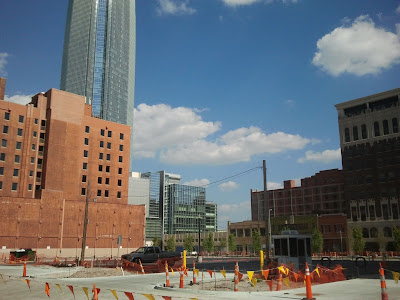
Lackmeyer's recent article outlines the project parameters, needing 700 spaces on 7 stories, for $20 million. Then there's the idea to build housing on top of it, possibly around 5 floors, and I understand street-level retail/cafe/whatever they can lease will also be in the picture. In the article, McDermid says he is committed to fitting the historic context of the site (pictured below) - however considering McDermid's excellent architectural track record, I would still anticipate something fairly modern. I'm convinced that modern can quite often nicely compliment historic - such was the case with David Bardwell's 18th Street Studios near Classen SAS, which can possibly provide inspiration on how to fit a modern structure into a historic setting.
Cathy O'Conner also talks about unique opportunities for night-time demand, including for the OKCMOA and Downtown Library - but the main problem is that they over-booked COTPA's parking garages, particularly the Santa Fe Garage, with the addition of Enogex and Continental Resources to downtown. This presents an even bigger conundrum as the Alliance is looking to lure new companies downtown to fill Devon's vacated Chase Tower space, but can't provide parking due to downtown's growth.


However, the even bigger opportunity, bigger even than the parking conundrum in attracting new companies, is the development opportunity that this site presents. It is absolutely imperative to get this site right, and I think that the Alliance and COTPA will.

Saturday, June 23, 2012

Even if we had brought the NBA championship home...

There was a reason that I did the two Thunder polls for the last month. You guys overwhelmingly stated that Thunder Alley should have continued. It should have. Not only was it a great success until it spilled over into Bricktown, which has a motley horde every weekend night anyway at bars like ROK Bar and Coyote Ugly that I'd honestly like to see shut down, but it was also promised to voters. That's right, the arena penny tax extension stipulated the inclusion of video boards to be used during the Playoffs.

Why does the City not feel an absolute responsibility to deliver capital tax projects as promised? Why is the City so quick to accept shorting the public, so often?

Nonetheless, Thunder Alley aside, this got me wondering: Even if we had won it all, would a Thunder Championship Parade even have been worth attending? Before anyone mistakes my motives, I was there on Friday, at the airport, to welcome the team back home and show my support for all they've done for our city. However, when the city gets involved in public events now, let's just say I have lost my confidence in their ability to throw a public event worth my attendance. Especially with how they let the gangs (and heat-packing Laker fans) win with Thunder Alley, over the community's overwhelming desire to see Thunder Alley remain..

I went down to City Hall the week after that happened and I was pleasantly surprised to see three members of the public actually stay till the end and speak their mind on how disappointed they were over Thunder Alley. Keep in mind, City Council is held Tuesday mornings, you must sign up at 8:30 a.m., then wait several hours (no way to tell how long) until everyone else is done until you can have your 2 minute say, and if you go over, Mick will send you home. It's an absolute affront to the public how this City conducts business, and if someone cares enough to even show up and try to be involved, that shows serious dedication. I'm not convinced Thunder Alley and not delivering the video boards as promised, won't leave a bad taste with voters. I myself consider it a scandal if my taxes go toward building something for the public, and then instead of featuring ANY meaningful programming for the public, it only features ads. That is an insult, and at the very least, they should lose the right to show ads if they are violating the other public stipulations behind the arena tax that paid for this.

That said, in my mind I envision a huge, raucous, joyous championship rally going along Sheridan, from the new Devon complex, into Bricktown. Families could set up lounge chairs in the park and watch the team go by, they could re-screen Space Jam or old Finals games on the park's great lawn, Generation Y would feel welcome to line the street in Bricktown where they could hang out before and after, and there would be something for everyone and the community could reacquaint itself with Sheridan after it has been closed through so many major changes. For those who forgot, Sheridan is one of the best cross-sections of downtown, in my opinion at least.

But just as none of it happened as the team dropped 4-straight, none of it would have happened with a City paranoid about anytime thousands of basketball fans (gasp) get together on the streets. Lame. Bush league, not Big League.

P.S. I voted Westbrook, I've always loved Russ' spunk and athleticism. But I was also fascinated by the broad support for Harden, who may get traded. I seriously hope not. I think Sam Presti's first priority should (and probably will) be to keep everyone in tact, especially Harden and Brooks. Well, except maybe Perkins...sigh

Thursday, June 21, 2012

Western Avenue gridlock

Stuck in traffic for a good 20 minutes on that half-mile stretch of Western Avenue between Sheridan and the new I-40, I made a mental note to myself to revisit a post that I made a while ago. Western is routinely gridlocked during this half-mile stretch, and I myself was surprised that the new I-40 project's completion has actually finally given OKC the "big league city" rush hour that we all craved. Ok, or not..

However I think that this is an opportunity, not a problem (although trying a different synchronization pattern with the lights along Western may be a good idea to ease traffic circulation). It's an opportunity because these kinds of traffic counts don't exist anywhere else downtown, and even though Western is definitely the blighted back entrance to downtown, at least with this kind of bumper-to-bumper congestion and the corridor's newfound prominence, that lends a majority opportunity for the Market Circle proposal to take advantage of.

I happen to believe (call me crazy) that development should follow traffic counts, rather than try to magically manufacture them. Western must be redeveloped, the gridlocked rush hour traffic that only exists here is screaming for it. Imagine the exposure that a business would get if somebody is stuck sitting in their car for 5 minutes just in front of that business alone. Then gets to crawl up another hundred yards after a few lights turn green, and gets stuck for another 5 minutes staring at a different business. I think this is the kind of traffic that could actually make downtown destination retail (ie., another subject we've talked to death on here and around town) very viable, although as far as that goes I am still bullish on North Broadway and the A-Alley area, especially if they can get a public parking solution.

Here's the photo from NewsOK that shows you what Western becomes every single weekday between 4:30 and 6.


I think at a certain point, you have to stop basing your planning on how you understood downtown in 1990. Downtown has changed and evolved since then; downtown is dynamic. The new reality in 2012 is this. Take advantage of that new reality.

Tuesday, June 19, 2012

Market Circle renderings are IN!

Without saying a lot (I'll let the renderings, just completed by OKC Talk's CuatrodeMayo aka young architect Andrew Stewart, do the talking), I will just say that I think this marks the evolution of Friends for a Better Boulevard as one of the most dynamic local movements in recent history, perhaps second to only the Modern Transit Project. Could Andrew be the traffic circle's Jeff Bezdek? I doubt he wants that kind of commitment, I know I would be freaked out, but I also know that Andrew is very committed to seeing OKC evolve into the kind of community he and his young family can prosper in.

Please, click on these renderings to enlarge to full-screen, they're worth it:


Thank you, Aubrey

I'm going to get something off my shoulders, that will probably ruffle some feathers among my base of civic, urbanist, and progressive activists - I grieve each time I read a news article about Aubrey K. McClendon, former CEO and Chairman of Chesapeake Energy Corp. Now he is no longer Chairman, and it's expected that his replacement in that capacity will be named this week. Breaking news: It was announced Thursday 6/21 it will be Archie Dunham, formerly CEO of ConocoPhillips. 

I understand that CHK is a publicly traded company, so the shareholders have a right to go on a mutiny against the company's leadership if they so chose to be that destructive, but that doesn't mean it's in the best interest of the company. Nobody understands natural gas like Aubrey does, and sure he had some excesses and needed to be reigned in, but I like what T. Boone said that if you're betting against Aubrey, you're betting against a winner. CHK needs Aubrey; he was their secret weapon against the competition. In this grotesquely-fascinating Reuters special on "the lavish and leveraged lifestyle," it gets one major point right - he is obsessed.

"He's also a micro-manager -- not necessarily meddlesome, employees and business associates say, but obsessed. No aspect of a project is too granular. He helped pick the kind of peanuts served at a restaurant he owns. He inserts commas into press releases and measures the distance between Redbud trees near his office."

It's pretty obvious to all of us that this level of obsession is not personally healthy, and for Aubrey's own good, he probably should have learned the power of delegation. However, here's a common sense Oklahoma guy who isn't going to sit around and notice something that's not right and say, "Well, I pay people to do this, so they need to do it," when he can just as easily make a decision himself or fix something himself. I will agree with others that it is very untrue that he has this "rags to riches" story of working his tail off while he was young - he was an heir to the enormous Kerr fortune, the K in AKM stands for Kerr, afterall. However, to say he didn't work his tail off despite everything he inherited, is blatantly wrong. And why would somebody work their tail off after they have already inherited so much? Almost every second-party source that even Reuters used in the scathing expose confirms that he is obsessed with competition, and in a capitalist society, who better to lead? Aubrey is NOT part of the downtown good ole boy club - here is a person who strove to be different from the rest, better than the rest, and more innovative than the rest. Hardly an outsider, hardly an insider. He's just different than the others.

So now, having addressed Aubrey's latest trouble in terms of his corporation that he founded, I want to move on to looking at this in a civic light. Aubrey is a Hometown Hero in my book, and this WSJ piece examining his role in OKC even says as much. Or, if you're more of a picture reader, here are some illustrations from the Journal Record. The point is that if you are looking for one individual to credit the entire turned fortune of OKC in the last decade, I would truly suggest looking no further than Aubrey K. McClendon, more than any political leader, more than any other business leader, and so on.

OntheRange readers are sharks for veracity, and want concrete specifics before they'll believe something. So, to get you to love Aubrey and defend him however your capacity may allow, here are just 5 simple, concrete things (I could come up with several others, too) that Aubrey arguably deserves all the credit for:

1. The OKC Thunder, NBA championship or not (it's looking more and more like the latter, sadly), are arguably the centerpiece of OKC's renaissance. The young guns are electrifying, and one thing that the sorry officials (heat of the moment, my apologies) can't take away is that America loves them and they have electrified a community's civic pride. However, the Thunder is often credited as a political success of Mayor Mick Cornett - proper credit does seem to have been taken away from where it belongs in this case. How much money did Mick put up for the Sonics franchise? In case you didn't know, McClendon is the lead investor in that group, despite that Clay Bennett is the spokesman (Bennett has significant NBA experience as an owner of the Spurs).

2. Oklahoma River. Mike Knopp just hoped he could get funding for a log cabin boathouse along the river - the potential donor he courted, however, had some different ideas: Chesapeake Boathose, CHK Finish Line Tower, countless other facilities, not to mention having Aubrey's personal architect (Rand Elliott) design it all. Nobody should get more credit for the Oklahoma River, and recognizing potential greatness along a river that used to be mowed twice a year, than Aubrey. It's often said that some of these wildcatters' innate sense of where oil and gas is located displays great visionary capacity, however, finding this diamond in the rough that was here all along, perhaps that is on another level altogether.

3. Whole Foods. Oklahoma City was trying to get Whole Foods to come here forever, at the annual retail convention in Las Vegas, the Chamber delegation always spent significant time pestering the upscale grocer. I simply can not fathom why they routinely passed us up for markets like Omaha, Tulsa, Richmond, Birmingham ALABAMA, and so on, but they did. Now they can't even explain it, as the OKC location has out-performed projections in a huge way and now Whole Foods is looking at a second OKC store already despite scaling down their national expansion footprint. It's not just that Aubrey lured Whole Foods by personally offering incentives to locate in Classen Curve, arguing (correctly) to his board that these kinds of amenities are necessary for CHK to attract the best and brightest. The addition of Whole Foods to OKC completely revolutionized the OKC grocery market in just two years, completely turning it on its head. Crest sensed the move, and also sensed a major market gap in South OKC, and invested in a grand location at SW 104th and May. Then the metro-based  Buy For Less invested in the incredible "Uptown Grocers" in Edmond. Sunflower Farmer's Market, a business very similar to Whole Foods, added a location in OKC. There are other such new grocers, and Aubrey/CHK is adding another in Nichols Hills Plaza which is under major renovations right now. Walmart used to have a 40% market share on the OKC grocery market, which didn't just eliminate our local options, but it prevented new options from taking a risk on OKC. Now that market share has plummeted and OKC's grocery market is robust and healthy, including several competitive local options, and this is all because Aubrey ponied up the cash to get Whole Foods to stop writing OKC off.


4. Western Avenue. This is another one of those quiet urban transformations, because many of you have not noticed all of the new businesses along Western in the last ten years - probably because Western has been a cool restaurant row for a long time, and was never really blighted. However, it is now cooler than ever, busier than ever, and less blighted than ever, all because of Aubrey. In addition to new businesses as well as the Classen Curve and Whole Foods projects, Aubrey is building a grand new Oncue called "The Peake" at 50th and Western (pictured) and has been instrumental in getting the city to spring for a major streetscape project all the way from 63rd down to 36th (unfortunately this stops just north of the mile stretch that IS blighted and desperately needs a streetscape). This streetscape includes roundabouts, such as the one proposed at Western and Grand. The convergence of these Aubrey projects, city investment, an entrepreneurs getting in on the area's prosperity, has led to a resurgence of Western Avenue like no other - a seriously underreported story.

5. 5,000 jobs and a ton of cool modern, and traditional architecture. I think that the presence of CHK Energy Corp. speaks for itself. In case anyone thought Devon was OKC's largest private employer, that is incorrect (they just have the more productive facility) - CHK is actually quite a bit larger. They also employ more interns from OU and especially OSU than anyone else. While I think the campus format is less conducive to productivity than having everyone in one tower, you can't deny that OKC goes as CHK goes, and if CHK leaves town or goes bankrupt, OKC is back in instant depression, not just recession. It's also not just the thousands of jobs, and growing - it's the millions of volunteer hours, it's the local advertising that Aubrey takes out for each of his new hires, and that brings me to the biggest point - CHK and Devon are together the sole reason that young people are staying in OKC. It has nothing to do with anything that the Chamber or City Hall have came up with. The overwhelming majority of CHK's new hires (and Devon's too) are young college graduates FROM Oklahoma. That's not to say they aren't drawing a ton of other state's college grads. But that is to say that they have single-handedly stemmed the brain drain that used to be such a prominent funnel on Oklahoma's economy.

These are all 5 things that Aubrey has worked harder than anyone to achieve for OKC, and these are all major ingredients in OKC's turnaround. The going has gotten rough for him, and I personally hope he can bounce back and get redemption with CHK and continue doing what he is so good at - competing and cornering the natural gas industry. However, if things don't work out with CHK, and I'm honestly just not sure what continued leadership role is left for him after these scandals, I really think he needs to follow his real passion and go into local politics if he can't rescue his role at CHK. Maybe become a developer and live that second life he's always wanted to be able to focus on OKC as his monopoly board. However, I think in addition to that, he ought to consider getting into local politics. I would NOT suggest running for Senate like his uncle, Robert S. Kerr did (Aubrey is brilliant, just not his politics LOL) - I would suggest that he take his unique visionary and innovative abilities to City Hall where they are so desperately needed right now. City Hall is grid locked and is going to take OKC down the cliff if we can't get a new bold, enigmatic leader to force this city to embrace innovation and new ideas. Kick the engineers running the show to the curb. An example of how long it takes the City to make the wrong decision, Wenger was recently quoted in the Gazette saying that making some changes to the Boulevard plan would add 6 months or so and they will need several more months to decide if they want to do that. Aubrey makes decisions in nano-seconds, and as he says, he usually gets them right 90% of the time. That's the guy I want running this city.

So give it some thought Aubrey, run for mayor. OKC needs you. And if you like sports, food, jobs, urban planning, architecture, the river, Western Avenue, and living somewhere that is finally considered cool - I think you guys owe AKM a collective thank you.

Sunday, June 17, 2012

Northwest Expressway & May dysfunction

This is an interchange I was never particularly fond of, even when I knew nothing about urban planning and that highways and byways were just cool. Even in terms of accomplishing every traffic engineer's wet dream of getting CAR from Point A to Point B as fast as possible, I think it falls short. First of all, you can't go northbound on May from eastbound on the NW Expressway. Second of all, cloverleaf ramps are dangerous, especially with next to zero merging room.

Throwing the traffic engineer hat in the garbage where it belongs, and looking at this from an urban planning perspective, this intersection is just horrendous. Oh my, the wasted space. There's actually quite a bit of dense development around here. Oh my, the wasted opportunities. It's almost as if the planners of this interchange were attempting to prevent connectivity at all costs. (You can click on the image above to see the lay of the land close-up.)

Why does this even matter? Because now May & NWX is seeing a ton of development. First it was the new Super Target. Then, it was the new Dave & Buster's and other adjoining cluster of businesses across May. Now, further west just behind the new D&B, the Tiffany Apartments are getting a total makeover. New glass cladding will give a butt ugly, aging residential high-rise that was fast falling on tenement status a new lease on its own life. The $32 million redevelopment project will revitalize this complex and bring back high-rent capacity.


What if we could get a do-over and have this intersection at-grade, complete with a streetscape project, pedestrian crossings, etc. Right now, THERE'S NOT EVEN A SIDEWALK ON THE NORTHWEST EXPRESSWAY (Voice of Zeus)!!! Every time I drive down the Expressway I see several sad souls drudging it out on the grass beside the ROW, some of them even waiting for the bus to come, despite NO sidewalk. It's insane.

I'd say the Northwest Expressway could easily have been our Peachtree Boulevard. But instead, we just had to let engineers near the plans for it. Peachtree Boulevard in Atlanta: