I have been searching for an email address for Rob Rogers that I can send him my suggestions for how to improve the SandRidge Commons proposal. Can't find ANYTHING on the web, not even on the Rogers Marvel Architects website. If anyone knows the email address, please let me know. You can leave a comment on here or email me as many readers do at moore.energizer@yahoo.com.
Thanks, and save the India Temple!
Showing posts with label Kerr McGee. Show all posts
Showing posts with label Kerr McGee. Show all posts
Friday, June 4, 2010


Wednesday, May 19, 2010
SandRidge appeal tomorrow
Tomorrow is the day of the SandRidge appeal before the Board of Adjustment. The appeal was filed by Preservation Oklahoma and has recently gotten a letter of support from the National Trust for Historic Preservation.
The meeting is tomorrow in the City Council chambers, at 1:30. I will be taking off from work to attend the meeting. The way I see it, I already saved these buildings once from demolition..against the odds, time to do it again.
I don't really take ANY credit for saving the buildings initially, the real credit goes to Scottye Montgomery who read my letter to the City Council and other citizens who actually were able to show up on that day. The Downtown Design Review Commission obviously saw that citizens were concerned and responded by deferring it to a special meeting at which we eventually lost.
I still don't feel very confident about the appeal, but we have to make a good showing nonetheless on the off chance that we can make a difference. I also wrote a letter to Kathe Casula, who works for the Board of Adjustment. Her email is: kathe.casula@okc.gov
My letter is as follows:
Dear Ms. Casula,
My name is Nick Roberts and I run a popular local urbanism blog at downtownontherange.blogspot.com--recently I did a poll of my readers on the SandRidge demolition permit and determined that 42 of them actually opposed the $100 million SandRidge Commons project simply on the grounds of the demolitions. 20 readers approve of the project, but I wonder how many of them are just "glass half full" people who still wish SandRidge would do more to preserve a few buildings rather than tearing them down.
I like the SandRidge Commons proposal--in concept, but the incompetent, horrible, uneducated architects and planners who put it together need to be banned from ever doing any Oklahoma City projects again. If they really knew OKC, they would know how sour we still are over the I.M. Pei legacy. He ruined our city, basically--and they want to continue his urban renewal schemes. Basically we oppose two of the demolitions and support the other elements of the project, but with hesitation.
The India Temple, as I am sure everyone in downtown is aware now, is the oldest remaining building (built in 1902) and also served as the home of the Oklahoma State Legislature for years. It is an incredibly relevent historical site and SandRidge wants to tear it down and replace it with...nothing. A windswept corporate plaza will replace it. The person who put the false facade over it says it can be removed, although SandRidge says it can't. The building poses challenges but should be given a chance. Asbestos abatement will have to be done before it can be demolished anyway.
SandRidge wants to tear down the KerMac building to increase the visibility of the main tower. This is not only a bad proposition, but also sets a dangerous precedent for other companies thinking they can move downtown and establish a "corporate campus" area by demolishing density that leads up their tower. This building has no structural issues and on the outside appears to have a lot of really cool historic detailing--it should be saved even if the India Temple can't be. There is just no reason for it to not be saved, and in the past, there have been numerous (not just one) development groups interested in redeveloping this building and the adjacent Braniff building (as well as the India Temple). These buildings should be restored, not by SandRidge if they don't want to do it (but by someone), and not torn down and replaced with nothing but dead plaza space. We also need to preserve the streetwall along Robinson, one of the few in-tact streetwalls that remain from downtown's urban days. The effect of these streetwalls is defined space, which is becoming a rarity in downtown of all places.
The rest of the plan doesn't threaten the existence of downtown, but that doesn't make it wonderful. There is a really great cubist modern building proposed on Robert S. Kerr, but it's proposed in the middle of the Commons area and doesn't have any frontage on Robinson or Broadway. It makes no sense to have this building where it is proposed and it should be moved to be along Robinson or Broadway--preferably Broadway, where it can help reinforce an area with poorly defined space. This also would extend the Commons area up against a straight edge, which would support the commons and give it more definition as well.
By saving the India Temple and KerMac and allowing redevelopers to buy the buildings from them, moving the new building to Broadway near the India Temple, and extending the Commons to a straight edge--SandRidge Commons goes from being a horrible assault on downtown's urbanity and becomes a fantastic addition that will surely be praised in architectural journals as being a well-planned downtown asset. At any rate, we need to go back to the drawing board with this proposal--the public needs to be heard and the community's concerns for downtown's density and urbanity need to be taken into account. By taking into account these concerns, not only does SandRidge get a truly fantastic proposal at the end, but also would deserve praise for valuing the public process. How about it?
Thanks for reading, and I hope that you will pass my concerns along to anyone who might be concerned.
Have a great day!
Nick Roberts
-address removed-
OKC, OK 73170
(Walters' ward)
______________
In hindsight, I forgot to mention another important point: This should technically be against city code. City code for downtown development states that setbacks aren't allowed for downtown development and new buildings should be built right up to the sidewalk--so why is SandRidge being allowed to demolish buildings that DO come right up to the sidewalk in favor of nothing, for the sake of a plaza setback for their main tower. The city code states no setbacks for new development, but we're still allowed to have development that is basically just one huge setback??
The meeting is tomorrow in the City Council chambers, at 1:30. I will be taking off from work to attend the meeting. The way I see it, I already saved these buildings once from demolition..against the odds, time to do it again.
I don't really take ANY credit for saving the buildings initially, the real credit goes to Scottye Montgomery who read my letter to the City Council and other citizens who actually were able to show up on that day. The Downtown Design Review Commission obviously saw that citizens were concerned and responded by deferring it to a special meeting at which we eventually lost.
I still don't feel very confident about the appeal, but we have to make a good showing nonetheless on the off chance that we can make a difference. I also wrote a letter to Kathe Casula, who works for the Board of Adjustment. Her email is: kathe.casula@okc.gov
My letter is as follows:
Dear Ms. Casula,
My name is Nick Roberts and I run a popular local urbanism blog at downtownontherange.blogspot.com--recently I did a poll of my readers on the SandRidge demolition permit and determined that 42 of them actually opposed the $100 million SandRidge Commons project simply on the grounds of the demolitions. 20 readers approve of the project, but I wonder how many of them are just "glass half full" people who still wish SandRidge would do more to preserve a few buildings rather than tearing them down.
I like the SandRidge Commons proposal--in concept, but the incompetent, horrible, uneducated architects and planners who put it together need to be banned from ever doing any Oklahoma City projects again. If they really knew OKC, they would know how sour we still are over the I.M. Pei legacy. He ruined our city, basically--and they want to continue his urban renewal schemes. Basically we oppose two of the demolitions and support the other elements of the project, but with hesitation.
The India Temple, as I am sure everyone in downtown is aware now, is the oldest remaining building (built in 1902) and also served as the home of the Oklahoma State Legislature for years. It is an incredibly relevent historical site and SandRidge wants to tear it down and replace it with...nothing. A windswept corporate plaza will replace it. The person who put the false facade over it says it can be removed, although SandRidge says it can't. The building poses challenges but should be given a chance. Asbestos abatement will have to be done before it can be demolished anyway.
SandRidge wants to tear down the KerMac building to increase the visibility of the main tower. This is not only a bad proposition, but also sets a dangerous precedent for other companies thinking they can move downtown and establish a "corporate campus" area by demolishing density that leads up their tower. This building has no structural issues and on the outside appears to have a lot of really cool historic detailing--it should be saved even if the India Temple can't be. There is just no reason for it to not be saved, and in the past, there have been numerous (not just one) development groups interested in redeveloping this building and the adjacent Braniff building (as well as the India Temple). These buildings should be restored, not by SandRidge if they don't want to do it (but by someone), and not torn down and replaced with nothing but dead plaza space. We also need to preserve the streetwall along Robinson, one of the few in-tact streetwalls that remain from downtown's urban days. The effect of these streetwalls is defined space, which is becoming a rarity in downtown of all places.
The rest of the plan doesn't threaten the existence of downtown, but that doesn't make it wonderful. There is a really great cubist modern building proposed on Robert S. Kerr, but it's proposed in the middle of the Commons area and doesn't have any frontage on Robinson or Broadway. It makes no sense to have this building where it is proposed and it should be moved to be along Robinson or Broadway--preferably Broadway, where it can help reinforce an area with poorly defined space. This also would extend the Commons area up against a straight edge, which would support the commons and give it more definition as well.
By saving the India Temple and KerMac and allowing redevelopers to buy the buildings from them, moving the new building to Broadway near the India Temple, and extending the Commons to a straight edge--SandRidge Commons goes from being a horrible assault on downtown's urbanity and becomes a fantastic addition that will surely be praised in architectural journals as being a well-planned downtown asset. At any rate, we need to go back to the drawing board with this proposal--the public needs to be heard and the community's concerns for downtown's density and urbanity need to be taken into account. By taking into account these concerns, not only does SandRidge get a truly fantastic proposal at the end, but also would deserve praise for valuing the public process. How about it?
Thanks for reading, and I hope that you will pass my concerns along to anyone who might be concerned.
Have a great day!
Nick Roberts
-address removed-
OKC, OK 73170
(Walters' ward)
______________
In hindsight, I forgot to mention another important point: This should technically be against city code. City code for downtown development states that setbacks aren't allowed for downtown development and new buildings should be built right up to the sidewalk--so why is SandRidge being allowed to demolish buildings that DO come right up to the sidewalk in favor of nothing, for the sake of a plaza setback for their main tower. The city code states no setbacks for new development, but we're still allowed to have development that is basically just one huge setback??
Tuesday, March 16, 2010
Thursday means History, Streetwall, and Corporate Campus

March 18th will be the showdown at City Hall over whether SandRidge can turn OKC history into rubble and debris as a part of their newfangled makeover of the SandRidge corporate campus.
So before I make my last post before the vote, let's examine this concept..corporate campus. I think that first we have to identify the nature of SandRidge's project. Is it fair to label it as a corporate campus, and if not, what else could it be? I would argue that if it's not a corporate campus, it should be a dynamic and urban-friendly addition to downtown.
A few more questions are, if the project falls under the category of corporate campus, is that good for downtown? What are the ramifications of that?
Here's a better question, is it fair to look at this in the context of what the ideal development of this site would entail (comparatively opposed to the proposal at hand), or should we be bending over backwards just happy as a peach that someone was willing to occupy KMG Tower immediately after it was vacated?
Needless to say, this will be an objective post. For the most part.
 This is an ideal corporate campus. It is that of Chesapeake Energy, who has gobbled up land around NW 63rd and Western Ave to build the corporate campus of Aubrey McClendon's dreams. AMC, the only OKC resident on Forbes' list of billionaires, is quoted in the Gazette saying, "I want to turn 63rd and Western into the second major focal point of this community." The Chesapeake campus continues to grow by leaps and bounds as the company expands, and currently they employ 3,500 people at their OKC headquarters that currently has just under 1 million square feet. The funny thing is that the plan keeps changing and evolving, in the masterplan shown here you see "Chopt Square" or the older, uglier office buildings at the heart of the campus--as I posted earlier, those were recently demolished for a recreational green for CHK employees. The plan has also grown to include a large mixed-use village component across Western. In the mind of AMC, his corporate campus would be completely constructed now if it weren't for the pesky recession (talk about a man with vision).
But at the end of the day, the Chesapeake Energy development is a corporate campus. That is to say the epitome of "dead after 5," and it could just as well go around any major intersection in the metro, whether it be NW 63rd, the NW Expwy, Memorial Rd, May Ave, Edmond, Hefner Rd, Broadway Extn, I-240, SW 119th, Norman, or..well you get the point. You can do a corporate campus anywhere, it's a development genre that is more suited to a suburban corridor than it is a downtown, so therefor it is in essence a type of suburban development.
The strategy behind it is to have a fabulous setting to showcase a corporation's image that dominates the entire environment it is projected onto. Downtowns boost their corporate image in the form of a skyline, and that is it (for the successful downtowns at least), whereas with a corporate campus you can have wide, rangy plazas, useless green spaces, and other elements that act like a picture frame around your corporate headquarters. All of these plaza and landscaping elements don't get in the way of pedestrians or any street life or functional purpose, because it's a corporate campus, and it's functional purpose IS to make the corporation look mighty.
There is nothing wrong with corporate campuses, and the really nifty ones like Chesapeake are planning to add the detached urban village across the street from the corporate confines. They just aren't suitable for a downtown environment in most successful downtowns.
On the other hand, the whole "dead after 5" problem that people talk about with our downtown stems from the fact that from the 60s until recently, the goal was apparently to turn downtown into one large corporate campus. I would actually suggest, aside from the point I'm getting at, that today downtown has degenerated into an executive fantasy land, where on the west side of the tracks you've got the wonderful suburban office park, and on the east side of the tracks you've got the wonderful upscale gated community--all it lacks is the gate with a sign that says, "Maywood Park." And Lower Bricktown, of course, is the suburban strip mall de jour.
Obviously we in OKC are not serious about building a downtown that is designed for people, diversity, density, and PEOPLE! If we were, then we'd be boosting downtown's density, not tearing down buildings. We would be attempting to attract residential development at all different price points, and not doing everything we can to prevent development at reasonable price points (OCURA!!). And most importantly, if we were serious of course about this whole urban thang, our focus would be on the street, and framing the street--not on corporate office towers, and framing them.
For those not familiar, Tom Ward was a co-founder of Chesapeake Energy with AMC--he left on amicable terms, and now AMC is in lone charge of CHK. However, I would use this as proof to venture that Tom Ward is a suburbs man. He's a corporate campus man. He understands the potential impact that Devon Tower will have in terms of projecting Devon's corporate image on downtown, and he knows he has to keep up in terms of the community relations race (it's not enough to have commercials everywhere there's a Devon commercial, billboards everywhere there's a Devon billboard). And believe me, that 850 ft tall tower will be visible everywhere from Edmond to Norman. From Tom Ward's perspective, he's going to go with the suburban model because that's whats most familiar to him--and the whole Devon thing means that it's time to step it up. Keep in retrospect through all of this that Tom Ward didn't go downtown for reasons that he just always liked downtown..it was financially a real deal for him to move into KMG.
_________________________________________
Or is SandRidge Commons a suitable downtown development? Does it contribute to the livability, or 24/7 vitality of downtown? Does it add life downtown, or just more of the same unfortunate sameness of corporate plazas and useless parks? You be the judge.

"Oh, but this will be different. This will be nice pavement and grass." That's what they always say..
Of course, even if you are convinced of how horrible this development will be for downtown, it is still worth considering that SandRidge still has an argument. I don't think that my argument is 100% infallible, I'm not that big-headed. There are still the arguments of property rights, and whether SandRidge should have to take marching orders from the public. That said, I don't think it's too much to ask for quality developments at least in downtown. Also I think there's something to be said for how thankful we are that SandRidge is growing, here in OKC, and that they took over KMG Tower. Should we be bending over backward and let them lay waste to our downtown since they helped us with KMG Tower?
I think it's pretty obvious that this is about developing a corporate campus. This is about taking the hollowed out area of downtown around the old Kerr McGee campus and expanding it all the way to Robinson Ave, hence how SandRidge has boasted that demolishing the KerMac will "improve the sight lines of the tower." Translation: It will inflict the corporate image of SandRidge Tower, once hidden from sight on Robinson by the streetwall.
Streetwall, which I once again brought up earlier, brings me to my last point. I agree, everyone around here has been talking about streetwall lately, and I'm no different, and it's a tired argument. Except for the point that it's true. Great cities and great downtowns are made up out of well-defined space, and private property that comes together and frames the public realm, and also adds its own flavor to it. That indeed does exclude windswept plazas which contribute nothing, but actually detract in terms of possibility cost, as well as lack of definition for the public realm. What we ought to be doing with all of these plazas is start fashioning them into the surface of the moon (how about a plaza made out of cheese?), because that's about how urban they are.
But Thursday's not about streetwall. It's not about history either, even though yes, we do stand to lose significant parts of OKC History when the India Temple and KerMac are turned to rubble. It's not about urban renewal, either. It's about corporate campus, and a combination of all of those things. On Thursday, Downtown Design Review has the opportunity to say "NO" to tearing down OKC history, urban renewal in the year 2010, removing one of OKC's last streetwalls, preventing historic loft conversions, and last and not least, hollowing out more of downtown for a suburban corporate campus.
_____________________________________________
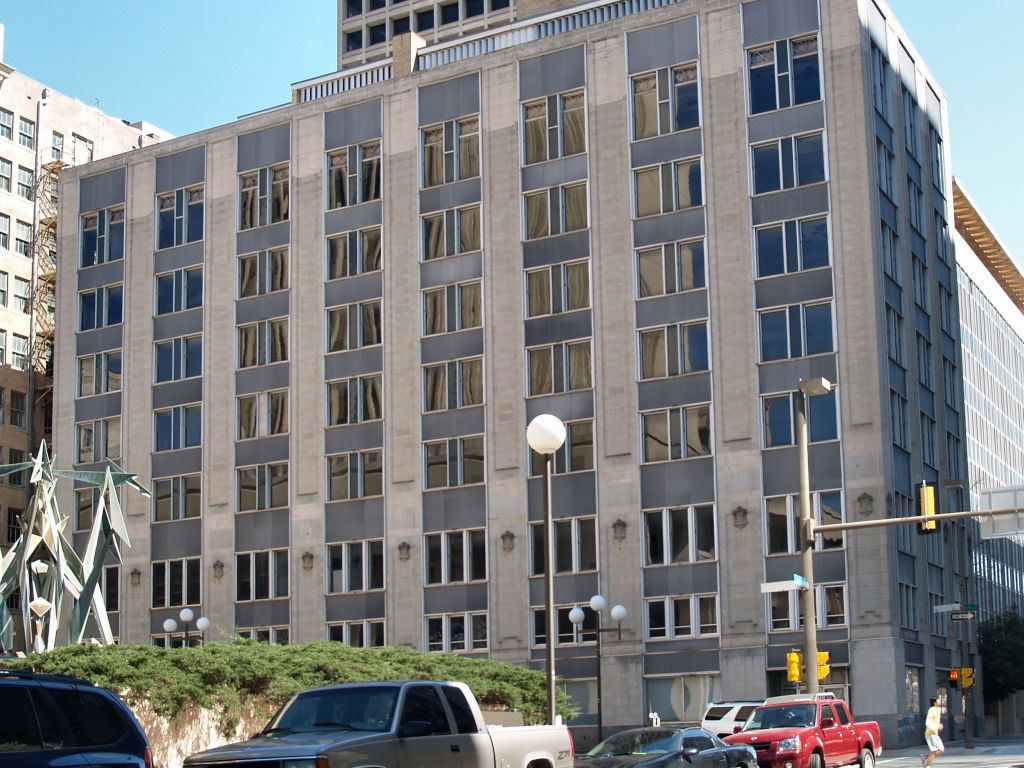 I recently discovered a REALLY COOL set of KerMac interior pics on Steve Lackmeyer's okchistory.com website. Apparently the inside of that old building is just full of old murals and paintings commemorating Kerr McGee's storied history in Oklahoma, afterall, the shabby old KerMac building IS the original headquarters for old KMG. If we have to lose the building that temporarily housed the Oklahoma Legislature for 4 years because the building is beyond saving, that's sad but so be it, but let's at least not lose the old KerMac Building that we know investors would like to convert to historic lofts. Imagine it: Kerr McGee Lofts, or better yet, Oiler Lofts.
If you're interested in a cumulative read, and have lots of time, consider reviewing the long series of posts I've written on the SandRidge demolition proposal:
Save the KerMac!
It's baaaaaaack... (Urban Renewal)
Hard to argue
Building demolition rampant
The problem with an otherwise excellent SandRidge proposal
As well as as these Cityshots:
Cityshot XVII
Cityshot XXXVI
Wednesday, March 3, 2010
Save the KerMac!

As we all know, the KerMac Building, the original headquarters of longtime Oklahoma energy giant Kerr McGee, is slated to be demolished. After they get approval from the Downtown Design Review committee and get the permit from the city, there will be no stopping this particular component of an otherwise excellent and laudable sweeping campus redevelopment scheme being proposed by SandRidge Energy.
So before that happens, let me just pose the question: Was Kerr McGee important to Oklahoma? I would love to hear the explanation from anyone who can say KMG was NOT incredibly important to Oklahoma. The fact is that throughout much of the 50s, 60s, 70s, and especially the 80s, and on until 2005 when KMG was no more--that this was a very important corporation. Look at the people who have come from this corporation, the extremely powerful U.S. Senator Robert S. Kerr; and the godfather of Downtown OKC during Urban Renewal, Dean McGee (they now give out the Dean A. McGee Award to the biggest downtown players in his honor). These two people had an incredibly lasting affect on Oklahoma City, worthy of commemorating alone. These men's dreams to form an energy giant came together in the building SandRidge now wants to tear down.
The impact of Kerr McGee, as a corporation, is also widespread and huge. For a long time, KMG was OKC's largest energy company--up until the recent breakneck ascent of Devon and Chesapeake. It employed thousands and thousands of hard-working Oklahomans and powered the OKC economy. That's the good history. There's also bad history we must not forget, such as the affair with an activist employee at their nuclear facility in Crescent, OK--Karen Silkwood.
SandRidge is new to Oklahoma. I don't want to second-guess their commitment to the community, as it turns out SandRidge's founder, Mitchell Malone, is an OSU alum who recently donated $29 million to OSU. So there's no doubting their commitment to Oklahoma, and that's great. But SandRidge, formerly known as Riata Energy, is not from OKC--it relocated here from Amarillo. They are likely familiar with the Kerr McGee story as anyone in the energy industry probably is, but preserving that history is undoubtedly not a priority for them like it should be for people who are from OKC.
Furthermore, who's to say SandRidge isn't out-right trying to root out the KMG legacy around their headquarters and replace it with SandRidge footprints? I can even see a reasonable debate for and against that, because it's certainly understandable that SandRidge DID thankfully purchase and occupy the tower when KMG left us high and dry. However on the other side, the argument that KMG history is NOT Luke Corbett history has to win at the end of the day. KMG history is OKC history, and it's about the history of the thousands of people that worked for it, people from hard working oil drillers, to people like Karen Silkwood. It's the history of Oklahoma, in a microcosm. SandRidge needs to be respectful of that, and there is no reason for them to mow down the original headquarters of Kerr McGee and replace it with nothing more than a windswept plaza to inflict SandRidge's corporate image on Robinson Avenue.
The old KerMac building also needs to be placed on the National Register of Historic Places, and this is something that SandRidge can do. If SandRidge doesn't want to do it, then a historical group in OKC can start the nomination process themselves. If the National Park Service finds that the original headquarters of Kerr McGee is significant to the legacy of this former energy giant that shaped much of Oklahoma history, then it will be placed on the Register of Historic Places. This will be a boon for the property, with a plaque out front detailing the building's importance, as well as avenues for special preservation grants that can be used to rehabilitate the building. Many of the grants would not prevent it from being rehabilitated and put back on the market as offices or apartments. There's no reason that a building with its historical importance being rooted in business function can't be commemorated by being functional once again.
Wednesday, February 17, 2010
It's baaaaaack...
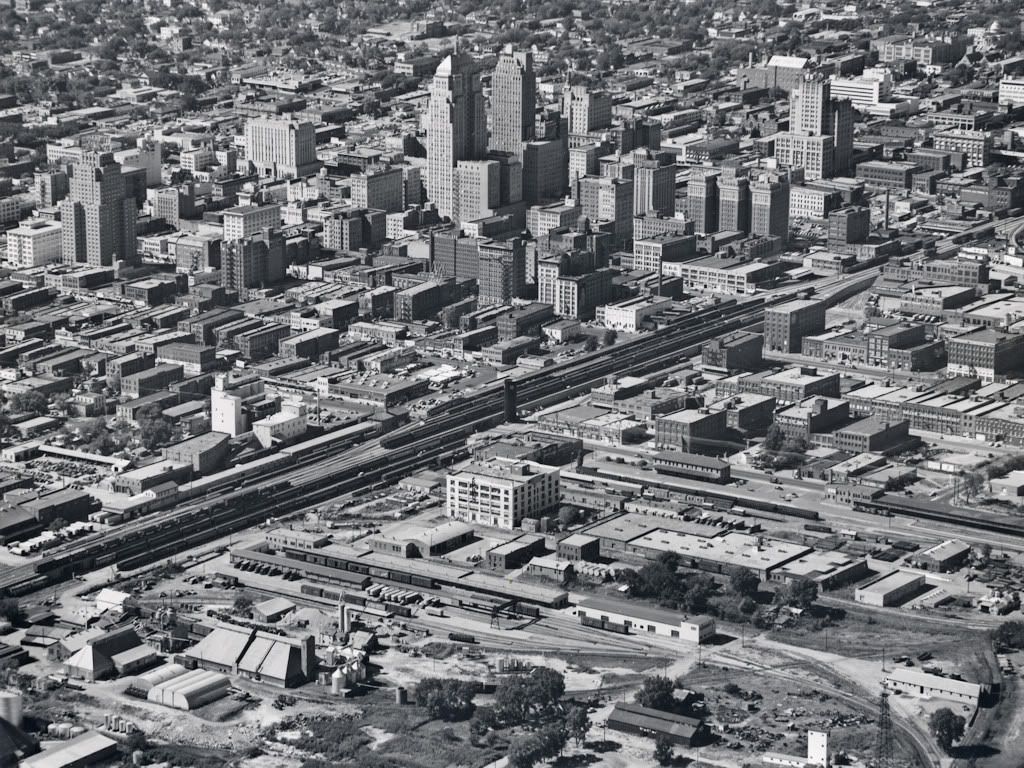
Urban renewal. It's back, and it's in full force. Examine the "main" blunders that OKC made during urban renewal:
-Reconfiguration of the city grid. By removing several streets, making way for superblocks (city blocks that are made up of combined blocks, such as the Cox Center site), and filling them up with single structures we accomplished one thing: We cut off flow from the north side of downtown to the south side of downtown, and as a result, the south side withered away. We cut out large swaths of city and replaced it with dull superblock structures like a convention center, an arena, etc.. and what's even worse, we put them all together. If they were spread around, the edge of the Myriad Gardens would have vitality, the convention center wouldn't be so bad, the Ford Center would be surrounded by retail and restaurants, etc.
-Demolition of existing urban fabric. Here's a shocking concept to most people: A dense city is something that happens naturally, believe it or not. So at the end of the day, after all of these crappy incentives and urban renewal projects, what have we really accomplished? You get more of a downtown that's suited for events and special occasions than for any kind of lifestyle at all, and that's detrimental. Now the incentives are needed because it was unnatural forces that killed most downtowns in the first place (i.e., government subsidizing freeways, roads, cars, white school districts, etc). But when you remove that urban fabric, not only do you remove something that was built specifically for a city to grow into it, but you've severely diminished your ability to bounce back economically.
-Wiping out the architectural and cultural jewels of our city. What's probably the #1 thing that downtown used to be full of that no longer exists in any comparable form or fashion? MOVIES. Vaudeville. Film houses. The only performing arts that exists in downtown anymore are that at the Civic Center Music Hall, which has become a major league performing arts center. The Stage Center hosts a theatrical production once in a blue moon, too, but that's it. There were literally dozens of cultural jewels we have lost. We also lost a lot of our downtown's architectural significance. The result, once you lose all of those things that add intrinsic value to the built environment, is an environment that is not worth caring about to most people.
-Loss of defined space. Believe it or not, well-defined space is another absolutely essential aspect of city development. When people think of the great cities they don't think of one building, but usually it's a street lined with special buildings that build off each other. When people think of these great cities they think of entire environments, not isolated buildings. Defined space, such as a street lined with uniform buildings, also creates natural safety. There is clear definition of the space intended for pedestrians, and you see pedestrians and news stands and more there; there is clear definition of the space intended for cars, and you see cars and bicycles there. When you lose definition you get a downtown environment that behaves more like a stretch of the Northwest Expressway, where there is space for cars, and then the buildings randomly placed, and that's it. You also lose the natural ability to navigate a downtown without a map, which would be possible with a downtown grid that makes SENSE. Today's downtown resembles a space rover trekking through Mars, past unnatural developments like the Century Center and the parking garages along E.K. Gaylord, one-way streets, blocked off streets, streets that dead-end such as Broadway and Harvey and every other street, and so on. It's a nightmare to get around Downtown OKC if you aren't from there!! It just doesn't make sense, there is no defined space, it has not been allowed to develop naturally, and we still don't get that.
-Loss of traditional community uses. Believe it or not the traditional community use of a downtown is not 95% office. Downtowns of olden days were dominated by retail, the thing that is most absent from downtown today! They also had abundant residential units, civic amenities, recreational space, and then there was also a lot of offices. It used to be the beating heart of the city. When we took out the retail districts of downtown, and expected it to relocate to new space that was yet-to-be-built (the planned "Downtown Galleria") we were expecting something unnatural and heavily subsidized to work just as well as the naturally-developing retail district had for decades. That didn't cut it. The result from that blunder was that downtown lost all personal relevance and for a small handful of people that have lived in OKC for a long time, they're still skeptical of going downtown after 5.
So I have gone over some reasons why, specifically, urban renewal was bad. However it obviously doesn't take a rocket scientist or complex explanations for the average pedestrian to tell that urban renewal is bad, all you have to do is experience Downtown OKC today for yourself and you can tell it was not good.
Well looks like we're at it again! And because we have not learned from our own history, we are absolutely doomed to keep repeating the mistakes over and over. Let's go over the main blunders I outlined above, again..

-Reconfiguration of the city grid? Yup, we're definitely at it again. Just look at Core to Shore, particularly the enormous cluster of superblocks beginning at the Cox Center and Myriad Gardens and going all the way down to the new Crosstown. That is a TON of wasted frontage that could be taken up instead by cafes, townhomes, retail storefronts, and other delightful things a downtown SHOULD have. And if the vitality of a city is in the movement of life from one block to another, what is this? There are no blocks here. The Myriad Gardens is an underutilized park surrounded by no significant development that takes advantage of the park front real estate. Likewise, the new Core to Shore park is doomed to the exact same fate, minimized to the point of serving as nothing more than a pretty front yard for the convention center. Instead, why don't we immerse the convention center in the city and surround it on all sides by neighborhoods? It would seem to me that would ensure the success of the park more than anything else!
-Demolition of existing urban fabric? Yeah, we've got tons of that, too! As I wrote the other month in "The problem with an otherwise excellent SandRidge proposal," and in "Building demolition rampant," and countless other posts from before the recent SandRidge proposal, there is a very disturbing trend of tearing down buildings that has come up over the last 5 years. It started with the Brewers who weaseled a demolition proposal through downtown design review mechanisms without anyone ever getting notice of it. Then one day people on their way to work noticed that there was no longer a building standing on East Sheridan, across from the new Hampton Inn. People scratched their heads and wondered, "Wow, how did that happen?" The bottom line is that downtown design review mechanisms have lost any of their effectiveness. The Brewers and others are getting everything from demolition proposals to inflatable dragons in, against "the rules," without ever getting approval from the design review mechanisms intended to prevent that very thing. Sometimes it's because the person filing the permit at City Hall doesn't realize that a signature is missing, other times it's sheer corruption, other times it's sheer incompetence, but most of the time it's a lethal combination of all three things. Today we are witnessing an era in downtown OKC where demolition is championed as "substantial development." How did we get this low?
 -Wiping out the architectural and cultural jewels of our city? Yessir, we've got plenty of that going on as well. Just look at the grand historic KerMac building, a solid building with developers clamoring to renovate it into apartments, with unique architectural detail. It's going to be replaced with a windswept plaza, similar to what already exists all the way around the periphery of the SandRidge Tower. We're also looking at buildings disappearing from Bricktown and MidTown and Automobile Alley. We're also fixing to tear down the India Temple, a building covered by a hideous bland EIFS facade, underneath which is a beautifully detailed and intricate structure. In fact the India Temple was also once home to the State Government during the period after the State Government fled Guthrie and was waiting on the new Capitol Building to be built. That's something we're about to recklessly tear down.
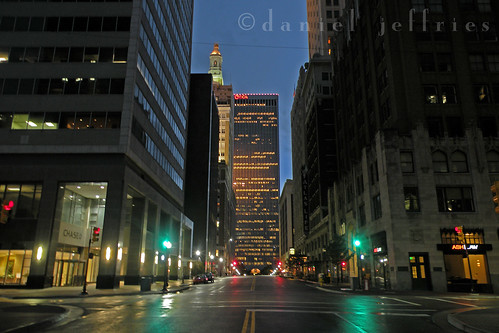 -Loss of defined space? Oh yeah. This is perhaps the most troubling aspect of the "New Urban Renewal" that OKC has set out on, particularly with tearing down one of the last remaining streetwalls in Oklahoma. Out with the old, in with the new, as they say. Downtowns used to be lined uniformly with complimentary buildings. Now all Tulsa has left is Boston Avenue and Main Street. Tulsa's Boston Avenue is by far Oklahoma's greatest street, lined with complimentary highly detailed high-rises as it is, bounded on one end by Oklahoma's tallest skyscraper (for now) and on the other by one of the world's tallest cathedrals, the towering Art-Deco symbol of Tulsa (The Boston Avenue Methodist Church), you could literally drop the unknowing off on Boston Avenue and convince them they are in New York City. OKC really only has three such streetwalls remaining from its once-great downtown: Park Avenue, Harvey Avenue, and Robinson Avenue. Broadway would count too, if its buildings weren't all surrounded by plazas. It is however Robinson Avenue, the least-intact corridor that still resembles some kind of streetwall, that is most endanger due to its proximity to energy giant SandRidge.
Which of these do you like better? Which of the below pictures shows a more defined, urban space? Yeah, tearing down the KerMac bldg will be GREAT for making SandRidge Tower perfectly visible all across downtown--but is that a good thing? Should we be able to look from one block and see straight through to other blocks, and should we HAVE to look at SandRidge Tower everywhere we go in downtown? Those are things worth considering. That's what this is about, is tearing down parts of downtown to make their building more visible. At what cost to the rest of us is that worth it?

-Loss of traditional community uses? Well, you be the judge of that. For what it's worth, we still haven't hardly gotten any meaningful retail going on anywhere in downtown. And all the restaurants are in MidTown or Bricktown. So I would have to say that not only have traditional community uses failed to materialize throughout this "renaissance" of downtown, but in the end we are actually getting ourselves further and further from that ever being realized downtown.
So after all, let me be the first to welcome you to the year 1975. Our mayor is Mick Cornett, our cause is Core to Shore, this message was brought to you by SandRidge Energy, and everywhere else it is the year 2010.
Thursday, January 28, 2010
Hard to argue
Well, I guess it's going to be an uphill battle for any of us now that SandRidge has brought in the glowing CNBC national spotlight to their plans. Obviously the plans are interesting, and mostly good. I am still very, very concerned over the loss of the KerMac building. Time will tell if it is able to be saved.
Wednesday, December 16, 2009
The problem with an overwise excellent SandRidge proposal
I appreciate the term that Steve brought up in an archived post about SandRidge's plans, "Streetwall." A streetwall is something that SandRidge is going to break up for the purpose of a pretty plaza on the west side of their campus. To non technical lovers of urbanism, a "streetwall" is better known as a skyscraper canyon (excellent examples of which are Park Ave especially, Robinson, and Main), but it doesn't have to be buildings of fleeting height. It can be a row of any buildings that go together that line a street.
A streetwall is usually the result of successful planning, and this is what usually defines the public realm in downtown areas. By having the buildings all frame the street with a uniform distance between the building and the curb, public space is defined by the streetwall. When you break up the streetwall or you just don't have that continuity you don't have as well-defined of a public space. Definition is good, especially for space.
This is a good streetwall. It's not healthy, but it has the potential to be. The block in the immediate foreground of this picture is owned by SandRidge, and it lines up well with the block in the background and beyond creating a well-defined public realm. Imagine the possibilities of these buildings were renovated, with street-level retail (a very real possibility), and the streets were brought back to life with an enhanced streetscape (which is going to happen, Robinson I believe is in the first phase of Project 180).
We brought Jeff Speck in, an accomplished planner, and he told us some truths about our downtown and our current way of thinking. Were we laughing at him? Is there someone in our community that thinks they know more than him? If not, then why did we bring him in, and now why are we racing to shirk his recommendations on as many different and unique counts as possible? It literally never ends: no we want the ridiculously wide downtown boulevard, let's line our downtown streets with a million bollards to make them "safe" for everything but the eye, let's break up every streetwall we have an go full-throttle on replacing buildings with open plazas, and so on, it never ends.
Now SandRidge Energy, as a part of their sweeping campus redevelopment plans, intends to invest at least $100 million into several construction projects proposed to spruce up the corporate campus. I think that's fantastic and I congratulate SandRidge on wanting to go so far to bring their campus back to life. The north side of downtown really needs it, where urban renewal-ravaged blocks at the convergence of the CBD, Automobile Alley, and MidTown, lie completely dead and underutilized. The lack of vitality in this part of downtown is what detaches MidTown from everything else, makes A-Alley merely a linear stretch down North Broadway rather than a neighborhood, and reinforces that a large part of downtown still doesn't feel like it's been touched too much by MAPS progress. The area around the SandRidge campus truly is..dead.
What SandRidge is doing/plans to do: Currently they're finishing up an overhaul of the main skyscraper, which was in desperate need of a renovation when they bought the former Kerr McGee Tower from Houston-based Anadarko Energy. It felt like taking a space ride through the 1970s when you walked through the revolving front entrance. Today it's been modernized, and they're finishing up the top floors as I type away on my laptop. Now they're shifting their focus to the campus surrounding the tower, which for something that contributed so much to the current state of north downtown that I boldly described as dead, actually represents a lot of potential, in my opinion. As dead as the area is, it has a lot of potential to be a cool area, and it will get there. This part of downtown, in my opinion, doesn't represent nearly the preservation challenges that some more difficult buildings might, with the obvious exception of the historic India Temple which nobody seems willing to invest the time and energy in bringing back to life (despite being a former state capital). And so we have the SandRidge proposal, 1970s urban renewal all over again: tear some buildings down, put something more modern in its place.
That's a quick fix. That's not a sustainable solution. That's not "future-proof." That's not good planning. Then we get into the material of what they're replacing with the buildings that they want to tear down, which is where we run into more problems, or just one really big problem in particular: the old KerMac Building.
The old KerMac Building, the historic gray and beige brick mid rise building pictured at the end of the SandRidge block, should not be torn down..especially for an open plaza. This building can be given a facelift and brought back to life, it can house offices, OR loft apartments on its upper floors, and retail on the street floor. In fact it was part of a redevelopment project that failed, despite developers being ready to proceed, due to the KMG/Anadarko merger. Now Anthony McDermid, principal of TAP Architecture and former preservationist behind that very redevelopment project, is a member on the Downtown Design Review committee -- the very committee that will eventually have to approve these plans. He knows KerMac can be saved. We all know that KerMac can be saved.

The only building on the SandRidge campus that may or may not truly be beyond saving is the old India Temple. Despite that it is possible to remove an EIFS facade and uncover the incredibly ornate and beautiful facade underneath, it has to go. Because regardless the facade would be "damaged." Here's a lost concept: You restore the facade. Why can't it be built back? It doesn't have to be the original as-is facade from the 100 year old building, and there are modern remedies to the problem. In Europe these kinds of renovation projects take decades, but they have no qualms with having artisans painstakingly build back old decrepit facades that are worth saving.
 In Moscow they are currently in the midst of restoring the grand Bolshoi Theatre, one of the world's largest theatres, and possibly the grandest. Originally built in 1825, this theatre was the site of the premiers of some of Russia's most famous symphonies and operas, a true cultural gem. Here is where Tchaikovsky and Rachmaninoff performed in the flesh, and if one is a big enough music buff, they could probably imagine the notes reverberating through the hall at the premier of Tchaikovsky's 1812 Overture or Mazeppa. This is why Russians are going to extraordinary lengths to preserve such an important place, including a painstaking $730 million restoration begun in 2005 that won't be finished until 2013, paid for by a public-private partnership.
The India Temple is our Bolshoi, despite that it is a much smaller scale project. We should restore this once-great landmark, and if the private market won't naturally do it, the State Government should do it, or solicit donors in a way similarly to how the Capitol Dome was finished. Few people may know, but this building was our State Capitol between 1913 and 1917 when the state seal was sneaked out of Guthrie in the cover of the night and moved to Oklahoma City. This is where the state seal was while the current Capitol was in the planning and construction phases. Now ask yourselves this: Are we really going to tear down a former State Capitol? I don't blame SandRidge if they do, it would be a high-commitment project no doubt. Moscow didn't make one corporation renovate the Bolshoi, instead the community took it on. I believe that the OKC community needs to be given the chance to take on restoring the India Temple, which played an important role in Oklahoma City becoming the State Capitol, the single-most important economic development move that Oklahoma City has ever made.
So, the two facets of this project I have a major disagreement with are the demolition of the KerMac Building, the original headquarters of Kerr McGee that could easily be salvaged and renovated into anything really, and the old India Temple, which as unrecognizable as it may be from its glory days, is a building with an endearing legacy that calls for it to be saved. If the India Temple, even with its original facade, did not have the legacy it carries with it, I would have no problem in letting it go. Restoring the India Temple and taking off the urban renewal mask is only worth it in my opinion because of its legacy as the first State Capitol in OKC. We can not tear this building down because it would be negating the existential question of post urban renewal downtown: are we ready to learn from the mistakes of urban renewal? If we restore this building, reclaim its heritage, reclaim our historic downtown's heritage, we have made a complete 180. If we tear this building down, we are saying we have no learned from the mistakes of urban renewal, and we are going to go down in history, in the year 2010, as a continuance of the 1970s assault on our downtown and all of the progress we have made with MAPS and everything else is for naught! Think about it.
After having derailed these plans as much as I have, I really do like the rest of SandRidge's proposal, which I recognize as a huge investment in bringing vitality back to this part of downtown. Making the mistakes I argued against above would only serve to cancel out the good intent of this project, and the positive impact that the other projects would indeed have on downtown. They are: demolishing the high-rise parking garage and replacing it with a multi-story building with restaurants and retail and a fitness center, auditorium, and rooftop basketball courts above. The new building would open up to a new park, that will be contiguous when SandRidge and Chesapeake combine efforts to renovate Couch Park and Kerr Park, connect the two, and close Couch Drive to vehicular traffic. The only vehicular traffic that ever utilizes that stretch of road anyway are utility vehicles and creepy stalker vans. I'm not sure what SandRidge will do with the site that the old YWCA, but it doesn't really matter..the YWCA, like the high-rise parking garage, is a brutally ugly structure that can go. Neither serve any real functional purpose and are pretty devoid of any life. If they would just execute the former Braniff Towers redevelopment plan that McDermid had in the works, they would tear the YWCA down and build a more modern garage with street retail, and put apartments in the Braniff Tower and KerMac Building and leave it at that.
The simple laundry list of steps we need to follow to resurrect this part of downtown are as follows:
1. Resurrect the old Braniff Towers proposal, see if McDermid is willing to take it on again, or SandRidge can just handle it by themselves if they're going to be doing development on their campus anyway.
2. Restore the India Temple as a landmark structure for OKC's history.
3. Do something about the Broadway/E.K. Gaylord intersection.
4. Have the Chamber chose a more urban site plan. The configuration they went with was actually not even their first choice, but it was reached after they concluded the Broadway/Gaylord intersection was a lost cause.
5. Go through with the Project 180 streetscape projects, which will hurt at first, but make a world of difference to the street level.
6. Hope that The Carnegie project (renovation of the old downtown library) which was supposed to have begun a long time ago, does indeed get done one of these days.
The north end of downtown is long gone, but it can be easily brought back. It has the advantage of being attached to much more vibrant neighborhoods and a corporate tenant with big pockets that is willing to help fund some improvements. This part of downtown will be back to life within the next 5 minutes as long as these improvements don't backfire and other plans go through as planned. Let's see to it. Tomorrow morning at 9.30 am in the Council Chambers, the Downtown Design Review Committee is meeting. They aren't going to be considering this proposal, but it will still be a good opportunity to get to speak and make the urbanist perspective on this project known. It is a good project, but certain aspects of it have the potential to do more harm than good. The demolitions of the KerMac and India Temple buildings needs to be opposed. The matter will likely be before the DDR in January or February, but I won't be here then..I will be at tomorrow morning's meeting though. If anyone wants to join me, that would be cool, if not, I hope you can make it in Jan or Feb.
A streetwall is usually the result of successful planning, and this is what usually defines the public realm in downtown areas. By having the buildings all frame the street with a uniform distance between the building and the curb, public space is defined by the streetwall. When you break up the streetwall or you just don't have that continuity you don't have as well-defined of a public space. Definition is good, especially for space.
 This is a good streetwall. It's not healthy, but it has the potential to be. The block in the immediate foreground of this picture is owned by SandRidge, and it lines up well with the block in the background and beyond creating a well-defined public realm. Imagine the possibilities of these buildings were renovated, with street-level retail (a very real possibility), and the streets were brought back to life with an enhanced streetscape (which is going to happen, Robinson I believe is in the first phase of Project 180).
 We brought Jeff Speck in, an accomplished planner, and he told us some truths about our downtown and our current way of thinking. Were we laughing at him? Is there someone in our community that thinks they know more than him? If not, then why did we bring him in, and now why are we racing to shirk his recommendations on as many different and unique counts as possible? It literally never ends: no we want the ridiculously wide downtown boulevard, let's line our downtown streets with a million bollards to make them "safe" for everything but the eye, let's break up every streetwall we have an go full-throttle on replacing buildings with open plazas, and so on, it never ends.
Now SandRidge Energy, as a part of their sweeping campus redevelopment plans, intends to invest at least $100 million into several construction projects proposed to spruce up the corporate campus. I think that's fantastic and I congratulate SandRidge on wanting to go so far to bring their campus back to life. The north side of downtown really needs it, where urban renewal-ravaged blocks at the convergence of the CBD, Automobile Alley, and MidTown, lie completely dead and underutilized. The lack of vitality in this part of downtown is what detaches MidTown from everything else, makes A-Alley merely a linear stretch down North Broadway rather than a neighborhood, and reinforces that a large part of downtown still doesn't feel like it's been touched too much by MAPS progress. The area around the SandRidge campus truly is..dead.
What SandRidge is doing/plans to do: Currently they're finishing up an overhaul of the main skyscraper, which was in desperate need of a renovation when they bought the former Kerr McGee Tower from Houston-based Anadarko Energy. It felt like taking a space ride through the 1970s when you walked through the revolving front entrance. Today it's been modernized, and they're finishing up the top floors as I type away on my laptop. Now they're shifting their focus to the campus surrounding the tower, which for something that contributed so much to the current state of north downtown that I boldly described as dead, actually represents a lot of potential, in my opinion. As dead as the area is, it has a lot of potential to be a cool area, and it will get there. This part of downtown, in my opinion, doesn't represent nearly the preservation challenges that some more difficult buildings might, with the obvious exception of the historic India Temple which nobody seems willing to invest the time and energy in bringing back to life (despite being a former state capital). And so we have the SandRidge proposal, 1970s urban renewal all over again: tear some buildings down, put something more modern in its place.
That's a quick fix. That's not a sustainable solution. That's not "future-proof." That's not good planning. Then we get into the material of what they're replacing with the buildings that they want to tear down, which is where we run into more problems, or just one really big problem in particular: the old KerMac Building.
The old KerMac Building, the historic gray and beige brick mid rise building pictured at the end of the SandRidge block, should not be torn down..especially for an open plaza. This building can be given a facelift and brought back to life, it can house offices, OR loft apartments on its upper floors, and retail on the street floor. In fact it was part of a redevelopment project that failed, despite developers being ready to proceed, due to the KMG/Anadarko merger. Now Anthony McDermid, principal of TAP Architecture and former preservationist behind that very redevelopment project, is a member on the Downtown Design Review committee -- the very committee that will eventually have to approve these plans. He knows KerMac can be saved. We all know that KerMac can be saved.
The only building on the SandRidge campus that may or may not truly be beyond saving is the old India Temple. Despite that it is possible to remove an EIFS facade and uncover the incredibly ornate and beautiful facade underneath, it has to go. Because regardless the facade would be "damaged." Here's a lost concept: You restore the facade. Why can't it be built back? It doesn't have to be the original as-is facade from the 100 year old building, and there are modern remedies to the problem. In Europe these kinds of renovation projects take decades, but they have no qualms with having artisans painstakingly build back old decrepit facades that are worth saving.
In Moscow they are currently in the midst of restoring the grand Bolshoi Theatre, one of the world's largest theatres, and possibly the grandest. Originally built in 1825, this theatre was the site of the premiers of some of Russia's most famous symphonies and operas, a true cultural gem. Here is where Tchaikovsky and Rachmaninoff performed in the flesh, and if one is a big enough music buff, they could probably imagine the notes reverberating through the hall at the premier of Tchaikovsky's 1812 Overture or Mazeppa. This is why Russians are going to extraordinary lengths to preserve such an important place, including a painstaking $730 million restoration begun in 2005 that won't be finished until 2013, paid for by a public-private partnership.The India Temple is our Bolshoi, despite that it is a much smaller scale project. We should restore this once-great landmark, and if the private market won't naturally do it, the State Government should do it, or solicit donors in a way similarly to how the Capitol Dome was finished. Few people may know, but this building was our State Capitol between 1913 and 1917 when the state seal was sneaked out of Guthrie in the cover of the night and moved to Oklahoma City. This is where the state seal was while the current Capitol was in the planning and construction phases. Now ask yourselves this: Are we really going to tear down a former State Capitol? I don't blame SandRidge if they do, it would be a high-commitment project no doubt. Moscow didn't make one corporation renovate the Bolshoi, instead the community took it on. I believe that the OKC community needs to be given the chance to take on restoring the India Temple, which played an important role in Oklahoma City becoming the State Capitol, the single-most important economic development move that Oklahoma City has ever made.
So, the two facets of this project I have a major disagreement with are the demolition of the KerMac Building, the original headquarters of Kerr McGee that could easily be salvaged and renovated into anything really, and the old India Temple, which as unrecognizable as it may be from its glory days, is a building with an endearing legacy that calls for it to be saved. If the India Temple, even with its original facade, did not have the legacy it carries with it, I would have no problem in letting it go. Restoring the India Temple and taking off the urban renewal mask is only worth it in my opinion because of its legacy as the first State Capitol in OKC. We can not tear this building down because it would be negating the existential question of post urban renewal downtown: are we ready to learn from the mistakes of urban renewal? If we restore this building, reclaim its heritage, reclaim our historic downtown's heritage, we have made a complete 180. If we tear this building down, we are saying we have no learned from the mistakes of urban renewal, and we are going to go down in history, in the year 2010, as a continuance of the 1970s assault on our downtown and all of the progress we have made with MAPS and everything else is for naught! Think about it.
After having derailed these plans as much as I have, I really do like the rest of SandRidge's proposal, which I recognize as a huge investment in bringing vitality back to this part of downtown. Making the mistakes I argued against above would only serve to cancel out the good intent of this project, and the positive impact that the other projects would indeed have on downtown. They are: demolishing the high-rise parking garage and replacing it with a multi-story building with restaurants and retail and a fitness center, auditorium, and rooftop basketball courts above. The new building would open up to a new park, that will be contiguous when SandRidge and Chesapeake combine efforts to renovate Couch Park and Kerr Park, connect the two, and close Couch Drive to vehicular traffic. The only vehicular traffic that ever utilizes that stretch of road anyway are utility vehicles and creepy stalker vans. I'm not sure what SandRidge will do with the site that the old YWCA, but it doesn't really matter..the YWCA, like the high-rise parking garage, is a brutally ugly structure that can go. Neither serve any real functional purpose and are pretty devoid of any life. If they would just execute the former Braniff Towers redevelopment plan that McDermid had in the works, they would tear the YWCA down and build a more modern garage with street retail, and put apartments in the Braniff Tower and KerMac Building and leave it at that.
The simple laundry list of steps we need to follow to resurrect this part of downtown are as follows:
1. Resurrect the old Braniff Towers proposal, see if McDermid is willing to take it on again, or SandRidge can just handle it by themselves if they're going to be doing development on their campus anyway.
2. Restore the India Temple as a landmark structure for OKC's history.
3. Do something about the Broadway/E.K. Gaylord intersection.
4. Have the Chamber chose a more urban site plan. The configuration they went with was actually not even their first choice, but it was reached after they concluded the Broadway/Gaylord intersection was a lost cause.
5. Go through with the Project 180 streetscape projects, which will hurt at first, but make a world of difference to the street level.
6. Hope that The Carnegie project (renovation of the old downtown library) which was supposed to have begun a long time ago, does indeed get done one of these days.
The north end of downtown is long gone, but it can be easily brought back. It has the advantage of being attached to much more vibrant neighborhoods and a corporate tenant with big pockets that is willing to help fund some improvements. This part of downtown will be back to life within the next 5 minutes as long as these improvements don't backfire and other plans go through as planned. Let's see to it. Tomorrow morning at 9.30 am in the Council Chambers, the Downtown Design Review Committee is meeting. They aren't going to be considering this proposal, but it will still be a good opportunity to get to speak and make the urbanist perspective on this project known. It is a good project, but certain aspects of it have the potential to do more harm than good. The demolitions of the KerMac and India Temple buildings needs to be opposed. The matter will likely be before the DDR in January or February, but I won't be here then..I will be at tomorrow morning's meeting though. If anyone wants to join me, that would be cool, if not, I hope you can make it in Jan or Feb.
Subscribe to:
Posts (Atom)