Showing posts with label Bricktown. Show all posts
Showing posts with label Bricktown. Show all posts
Thursday, April 5, 2012
Re-re-name change
Apparently it will now be the Chickasaw Bricktown Ballpark instead, which is a major improvement obviously, not to mention a major PR disaster for the city and Bricktown..averted! This would have not happened without the outcry from the public, particularly being engaged through social media.


Tuesday, April 3, 2012
Sunday, January 1, 2012
Cityshot(s): Merry belated Christmas
For those of you who have visited the blog lately and only seen a way-too-early New Years post and no mention of Christmas, yes we do in fact celebrate Christmas at this blog. I have just been inexcusably late at getting around to it because of getting busy with family and other stuff I do while I'm home for the holidays.
That said, what better (late) Christmas gift than downtown Christmas pics? Let's remain cognizant of what a great downtown Christmas scene we used to have, but to tell the truth, I don't think downtown has ever looked better during the holidays than now. Not even in the hey day was it as spectacular and unique as today, and that's largely in part due to the lights along Automobile Alley.


And of course, Bricktown was all decked out also:


Tuesday, December 27, 2011
Coffee and snacks @ Nonna's

For all the negativity I may have expressed regarding Avis Scaramucci, which I believe was rightly deserved for the current Bricktown doldrums, I also believe in giving credit where credit is due. Just the other day I had some time to kill, so I and a friend visited the Purple Bar to catch up--I had some coffee and a few delicious orange madelines (hard to describe, but I highly recommend) and took in the incredible view from above Nonna's.
Bricktown may have run out of steam under Avis' watch, but that doesn't mean that the entire Nonna's compound, retail, bar, restaurant, and all (including the heart-warming story of an Italian emigre family from Krebs) is an OKC classic. Avis truly does things right with Nonna's, and perhaps that alone is justification to run the show.
So let me pose a question to readers, and feel free to comment and share your opinion, although I know many of you are lurkers. Is it better to "lead by example" or lead with your votes? One could argue that Scaramucci has been rather lenient on the Bricktown Suburban Design Commission. One could also argue that Nonna's, from an urban design standpoint, is the standard-bearer for Bricktown in terms of development, maybe even restaurant quality (although too many good restaurants for that one to be clear-cut).
So which is more important?
Monday, December 19, 2011
Scara-development
I wasn't really planning on extrapolating on my previous criticism of Avis Scaramucci and her leadership in Bricktown, but after seeing Steve's reference to my blog last week, now I suppose I am compelled to keep it going. Instead of going as far out there to say something wildly critical of Avis, let's just pretend that I did. "There, I said it."
But in all seriousness, maybe Avis is the leader of the Bricktown Association (or emeritus?) and Bricktown Suburban Design Commission because nobody else wants these positions? That would be sad, because here you have a district that is in dire need of leadership. There is such a multitude of issues that they could be addressing, or could have already addressed. But as it stands, Bricktown stays still. For its entire life, the Bricktown Association's response to the Bricktown parking problem has been to promote the rationalization that there isn't really a parking problem. Weak on leadership.
The Suburban Design Commission, which is tasked with maintaining urban design standards for the district, could have taken proactive action on targeting abandoned buildings, attracting new developments, assisting proposed developments, and so on. Instead of proactively making a difference in building a better Bricktown, they have been consistently contributing to the wrong direction for the district. The House of Bedlam vote was just the icing on the cake. Let's talk about building demolitions, giant inflatable dragons, and more.
So, the problem isn't anything personal I have against Avis. It's that I am disappointed that this district has had bad leadership. I don't know what it's like behind the scenes in Bricktown. I don't know if there's a power struggle. I don't know if nobody wants to lead. Maybe everyone is real chummy and pleased with Avis' leadership and sees no problem with the district's stunted progress (I'd put my money on that). Either way, it doesn't matter. What matters are the results. And they just aren't there.
So make a list of Bricktown goals. You won't get to cross very many of them off, and probably not for a while, either (all the while surrounding districts are crossing off goals like they're on sale). Then make a list of Bricktown's known problems. Parking crunch. Too many surface parking lots for pay. Losing density. Slow day-time traffic. Slum lords who sit on buildings waiting for values to rise. Lack of mixed-use. And so on.
All of those problem, except lack of mixed-use (her one development really was as outstanding as it gets, to give credit where credit IS due), Avis Scaramucci has directly (through her business interests) or indirectly (through her votes) contributed to. It turns out that she exemplifies one of them. If she's not a slumlord, then I'm not a blogger.
They have no plans to renovate the Rock Island Plow Building. In fact, as Steve informed us last week, they are boarding up even more windows THIS WEEK as I am typing this out. Furthermore, they have no plans to sell--essentially they make no bones about the fact that they're waiting for "the right time to sell," as they say. This is the ultimate indictment in my opinion.
How important is this building to Bricktown? Well, how important is wood to a woodchuck? Talk about a "Bricktown Gateway" in terms of the entrance on Reno. Furthermore, this is one of the most prominent buildings that OKC Arena crowds see as they're walking between the arena and the accompanying entertainment district that is aggressively promoted to those event crowds. When we have bball tourneys, fanbases will have a HQ bar in Bricktown. And with the planned transit hub, this location is set to become even more high-profile.
Something needs to be done. But it's not going to be done any time soon. Just accept it. What can people do? Well, I hear complaining doesn't hurt. According to my poll, almost 2/3rds of observers disapprove, most vehemently, of the B(s)UDC. This is even after absorbing a flurry of pro-Bricktown votes lately, I assume a small group of people heard about this discussion on the blogs. But what else can you do?
Not a lot. This is because when the bad interests get involved in the decision-making process, effectively preempting urban planning in a district that is little more than a massive public interest (WE built that canal, not Lower Bricktown developers, not Avis Scaramucci, not the Brewers, and NOT Chris Johnson, that is OUR canal god dammit), then the system is rigged. A rigged system is a broken system.
So one thing you can NOT count on is a rigged, broken system producing solutions that will get Bricktown back on track for where it needs to be in terms of its urban development.
Saturday, November 19, 2011
Here's a new culprit for you

Here's the thing that frustrated me about Bricktown: The amount of taxpayer dollars we have pumped into this tiny little district and the miniscule ROI that we have seen following that.
Basically it follows the exact same narrative of other public economic incentives that never work. Hey developers, we're going to throw an insane amount of cash your way by investing in this district so that your land values rise. Oh, but then we're not going to come in and direct development in ANY meaningful way at all. Corporate welfare + deregulation.
Nevermind that the PUBLIC made Bricktown, and now it has totally lost control over how that district develops. Quality standards have spiraled down hill. The Bricktown Suburban Design committee is a laughing stock. We can't even use the argument of "protecting the public investment (ie: the canal)" any long at this point. Bricktown developers and parking lords are out of control.
So there you have it, the concept of Bricktown as a failed Reaganomic dream. But why would we expect anything else? That's what the people of this city believe in. Furthermore, the woman that we put in charge of the Bricktown Suburban Design Committee is in the Bricktown parking business herself! She's also in the Bricktown land values squatting business herself.
This is the Rock Island Plow Building, at the corner of Reno and Oklahoma Avenue, overlooking the canal as well. This building, owned by Bricktown Suburban Design Committee Chairwoman Avis Scaramucci, is falling down on itself and is one of Bricktown's largest eyesores. Years have passed since Scaramucci bought this building. At the time we all hoped that she would renovate it, but I think we gave Avis too much credit at the time, and in reality she's probably just waiting to get a pay day from another interested buyer.
Does a single successful restaurant make someone the "Queen of Bricktown?" So far Avis has done nothing to prove that she wasn't one and done in terms of Bricktown development, and how did this get to be the person chairing the Bricktown Suburban Design Committee?
The problem with Bricktown is that we (the public, the city, MAPS, etc) probably invested TOO much in the district all at once. Districts don't develop instantly, yet Bricktown's land values skyrocketed as much as 300%--instantly. The development could never have kept up with that kind of a spike in land values. Therefor the people who benefited the most weren't developers that couldn't keep up, but rather property owners who could sit on properties--especially if they had enough in the bank that they could absorb the cost of long-term ownership, which sometimes included doing bare minimum improvements just to keep these buildings standing. Sometimes the bare minimum improvements actually do more harm than good in the long run, structurally and especially aesthetically.
Avis Scaramucci has embodied these problems and more, all the while getting credit as the "Queen of Bricktown" as though her leadership is all that's keeping the district together or something. Another common complaint with the district is that it is too bogged down with restaurants. Score another for Avis. Perhaps the biggest indictment is all this chumminess and lack of accountability. Maybe that's what there should be, after all.
Thursday, November 10, 2011
Worse than West End, more like off the deep end
Watch my years. Ten years from now, Bricktown will be nothing more than the redneck hub of downtown OKC. Mickey Mantle's and very few other upscale eateries will survive, yet they will be outposts of culture in a district dominated by metal green roofs, Bass Pro fishin shops, Toby Keith's crappy restaurant, more chains galore, House of Bedlam, and a BUNCH of highly-lucrative parking lots. The parking lots will unfortunately remain lucrative because rednecks will still be fooled into thinking Bricktown is somehow "classy" but nobody else will be fooled. The crowd at Mickey Mantle's will remain the "old days" when Bricktown was still only marginally tacky (ie., now).
The only good things that will give it a glimmer of hope (to transform into a real urban district) going forward is its proximity to Deep Deuce and the ACM. Did ACM make a bad decision in choosing Bricktown over Film Row or other downtown districts? How do they and other people TRYING to improve Bricktown feel about the grip of the parking mafia?
I think in a decade we'll see a Bricktown that, while not much different from today, is remarkably different in that it has chosen its path--that ambiguity of the district that led to constant debate/questions/hope about its future (what will it be? where will it go? etc) will be gone. It will be officially the red-headed step child of downtown OKC, but I hardly doubt it will matter. Why would OKCers miss the opportunity we HAD there when I envision Deep Deuce, Midtown, Film Row, and others will all outperform our wildest expectations.
Oh and hey, at least there might be hope for a real C2S district as well, after all.
BUDC votes in favor of aspiring parking overlord Chris Johnson
The Bricktown Suburban Design Committee is absolutely pathetic. Not a whole lot that's new there, but it is what it is. The bar is now officially set so low it's even lower than Lower Bricktown.
We now have a parking "garage" (basically one elevated level of parking) overlooking people and canal taxis as they pass the canal. A surface parking lot would be better. This "garage" will essentially be a surface parking lot raised above the canal.
Does anyone even take pride in this city even more? This spot of land possibly had more potential than any other plot in downtown. Since when did we just start passing sub-par suburban developments in BRICKTOWN, surface parking and all? Pathetic.
Bob Bright is a joke. Someone who has to ask whether Wanda Jackson Way is an alley or a road is a joke, especially if they were somehow appointed to serve on the committee overseeing urban design in BRICKTOWN. The others who approved this development (ALL except Tom Wilson) are also just as pathetic as this development, except also spineless.
Stay tuned and I'll tell you how I really feel at a later date.
Avis Scaramucci and Phil Miller, where were you guys, why didn't you vote? Do you all care to prevent what is happening to Bricktown, or is urban design (the name of the committee you sit on) not important after all for an "urban" district?
Sunday, May 22, 2011
How good developments go bad
This will be a post dedicated specifically to how developments get proposed, or rumors about, and then the developments halt and get to the point where they're dead on arrival. Since it's just a blog post, I'll make it short, and just focus on the primary reasons I've seen since I've been giving up my life to track OKC developments (kidding--well, mostly). The main reasons are unaccounted economic changes, incompetent development teams, what I like to call "strict 2009 adherence to 2007 ideas," and another big one is the limbo caused by big-ticket public projects, many of which are still up in the air.
 I will also try and relate this back today, with the implications of post-MAPS3 passage Oklahoma City. Remember: We were supposed to see all of this amazing amount of spin-off development.
 This is the Flatiron project, on Harrison Avenue, just north of Deep Deuce--proposed by Grant Humphreys who has been a successful, innovative urban developer. So what could have gone wrong (because this project is definitely been dead for a while, in spite of past efforts to revive it)? Humphreys was somewhat over-extending himself, especially at a time when he was still heavily leveraged in the Block 42 project which he finished a few years ago and has recently still been selling off the last units in that project. Block 42 was an innovative project for OKC because it combined townhomes and flats in a building with a striking urban design, so price points were high. It was also competing with several other projects within the immediate 3-block vicinity. The Flatiron project also called for a lot of mixed-use space, and I imagine it was difficult to find high-end commercial tenants to sign-up for an outpost location at a time when even Bricktown was losing retailers. It's a shame because it would have been an awesome project, but Humphreys will be back downtown, and is currently working on Carlton Landing at Lake Eufala.
 The Cotton Exchange is an especially interesting project because it's up there with the old "Factory" proposal as the projects I most wish could have happened. I won't get into the details of how much I love this project, but it would have been a great one. It offered prime commercial space right on the canal as well as with frontage on Mickey Mantle, and it also offered a good amount of residential which Bricktown badly needs. The Centennial was a huge success, so it begs the question why OKC can't support this kind of quality mixed-use development, even though we surely haven't seen much of it. The developer, Gary Cotton, was in trouble though. He didn't have the resources to pull the project off--he had a little bit of equity from the sale of the Bricktown "Mercantile" building. He needed other investors but didn't want to listen to other ideas, from what I've heard. It's still a shame that this didn't go forward because he was using the brokerage team that The Centennial used (which sold out, and still had many interested clients), and because other experienced Bricktown businessmen were offering lots of advice. He also benefited from not just lots of Oklahoman and blogosphere coverage, but even got TV news coverage, which downtown development rarely gets.
 Many people got very excited when Tom McDaniel announced that OCU wanted to move its law school to the gargantuan Fred Jones auto factory, which is an awesome historic building. The deal died when Tom McDaniel stepped down as president of OCU and a new guy came in, who didn't like the idea so much. But it's hard not to note the sequence of events: Chamber officials promise there will spin-off MAPS development, Tom McDaniel announces OCU will develop law school downtown if MAPS passes, MAPS passes, Tom McDaniel becomes chair of MAPS Citizens Oversight Board, downtown law school plans are nixed. I would chalk this one up to political problems, if the new leader of OCU doesn't like the idea, then I don't see how anyone is going to "force" him to follow through.
 For years, the Union Bus Station was a magnet for vagrants, which caused problems for the developers on both sides of the facility who wanted it gone. First, Dick Tanenbaum, redeveloper of The Montgomery on Walker, wanted to buy the bus station and close it down, and put a jazz club inside of it. It would have been a win-win, downtown didn't need the Greyhound station anymore, it was a blight, it attracted vagrants, he could have renovated it and turned it into a historic gem and just put a jazz club inside of it, which would have turned a problem for the neighborhood into an asset for the neighborhood. That's what you call making lemonade out of lemons. Obviously Tanenbaum, a veteran Central Oklahoma developer, had the resources to make it happen. One problem: The owner was pesky and had no intentions of moving, and was difficult to deal with. So Tanenbaum gave up and turned his files over to Nick Preftakes who was on his way to acquiring the whole block anyway. Preftakes also found the owner to be pesky, but by using his properties positioned all around the station, he was able to make it difficult for the bus station to remain there, and forced its closure that way. One problem now: The owner still doesn't want to sell to Preftakes, and harbors a grudge, seemingly. Well let's be honest, when Preftakes put up a property fence just to make it difficult for buses to make wide turns, that wasn't very nice. So I'm not sure Preftakes is going to get to include this parcel in his block in the end, anyway. I just hope the building gets restored somehow, and not leveled.
 How could I not bring this one up? haha.. The Braniff Lofts proposal, from 2006 and 2007, would have been a really vital piece toward preventing a controversy (and a tragedy) that would soon follow. A group of investors local of investors ("Corporate Redevelopment LLC"), many with significant Downtown OKC experience and have been mentioned often on this blog, were negotiating with Kerr McGee to acquire these abandoned buildings surrounding their headquarters for redevelopment purposes. The plan was to, at the very least, use the Braniff building AND the KerMac building and convert the two into lofts--the developers at the time were convinced they had a winner, and many onlookers are still convinced the proposal could have been a winner. The deal fell apart because KMG was acquired by Anadarko Energy who refused to honor the deal between the investors and KMG. SandRidge acquired the block and demolished the buildings to make way for a corporate plaza. These buildings, except for the Braniff Building which was lucky enough to already be on the historic register, are goners and lofts or mixed-use of any kind on this block will never have an opportunity to happen. I would chalk this one up to corruption at many junctions.
 It appeared to be one of the turning points of downtown development when the Downtown Ford announced it was closing and was demolished. The land owners, Fred Hall and Bob Howard announced potentially ambitious plans to redevelop the large site into a huge mixed-use development. The Jones-Hall family has been involved in other deals, and was involved in the OCU deal that fell through, and Howard has been engaged in redevelopment of of Mid-town lately, so there is no doubt that the development wherewithal and resources were in place. The site could have possibly been the largest mixed-use downtown development to date. "It's no surprise, and it fits our long-term plans to develop that site into commercial retail and housing," remarked Hall, at the time. It was lauded as a success of MAPS spin-off. Why did the deal fell through? Because it got gobbled up by a MAPS subcommittee that insisted the convention center needed to go on THE most promising piece of real estate in all of OKC.
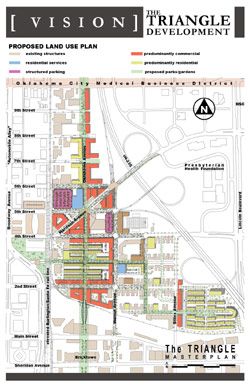 I'll make this my last one, and I think it's a big one. No matter how you slice it, The Triangle masterplan died. At a time when the possibilities for bubble-style downtown development appeared endless, the plan seemed fail-safe. A group of investors including Bert Belanger, Ron Bradshaw, among others, would team up to do a ton of development in a small area. However each one encountered difficulties selling units of their first project and then 2008 hit, and it became apparent that downtown development could not go forward purely driven by speculation on condo units. The group broke up, although they are still individually engaged in development in the "triangle" area, although hardly according to the original plan. And some new investors have popped up and added projects such as LEVEL and Aloft.
So, here you see a multitude of reasons. In every one of these cases, it is a shame that the development died, although this is not always the case--sometimes developments are bad and projects dying would be good. However, there HAS to be a way to meet over these kinds of things and compromise. Bad developments need input for improvement before they actually apply for the permit. Good developments need input to ensure their success. This goes both ways, the process shouldn't JUST be about putting pressure on bad projects. Furthermore, a lot of these reasons are preventable. Switching to a more sustainable economic model for real estate would have prevented a lot of the post-2008 development lethargy we were seeing until recently--the economy never stops, sometimes it contracts, and even that presents an opportunity (for more modest real estate deals). For instance, people still need housing when they can't afford a mortgage, which is why for-rent housing has thrived in the post-2008 economic climate. Capitalizing on that could have prevented a lot of these projects from collapsing. Also, a LOT of stuff is in limbo when we have these big-ticket items in limbo. Do you think somebody wants to build a mixed-use or housing investment when they aren't yet 100% certain where the streetcar route will go? Do you think somebody wants to invest in a huge hotel project without knowing where the new convention center and likewise, streetcar lines, will go? Of course not!
One thing that has been an absolute failure thus far is MAPS accounting for the spin-off development. It was one of the most persuasive reasons why we passed MAPS3. We wanted to buy into a vision for building a city, not just for building a single park or an isolated convention center. These things aren't being coordinated AT ALL. There is no single planning document that has more than one big-ticket public investment component in it. There are however millions of planning documents, district masterplans, streetcar route ideas, convention center proposals, and so on and so forth. Nobody is proposing that this stuff come together. Furthermore, a lot of the interests behind certain projects need to step down and realize that their project isn't the center of the universe. The end goal is spin-off development, not having a city built around a convention center. When you eat your most promising site for mixed-use development to put the convention center on it, you miss the mark. You can have your cake and eat it too. The convention center subcommittee needs to address the goals of downtown as a whole just as every other subcommittee needs to be concerned about it. Ignoring the big picture is setting us up for failure at a time that immense resources have opened up such an enormous opportunity.
Every MAPS3 subcommittee needs to be tasked with the exact goal, and it needs to be an overarching goal of what we as a city hope to create with this opportunity. Each subcommittee needs to be opening its meetings discussing this goal, whether it be attracting investment, or improving quality of life. There needs to be a singular vision shared by all. Right now what we have is a convention center subcommittee that has run amock with the process, stepping on other projects to make sure that at the very least the convention center gets done, and running completely contrary to the goal of MAPS.
These guys need to sit down and analyze universal MAPS goals. They need to ponder what they as a convention center subcommittee can do to improve quality of life and attract mixed-use development to downtown. I'll tell you one thing: You can do a LOT more to accomplish this than by eating the best real estate in the entire city for your convention center, which is going to happen anyway. That makes no sense whatsoever.
I will also try and relate this back today, with the implications of post-MAPS3 passage Oklahoma City. Remember: We were supposed to see all of this amazing amount of spin-off development.I'll make this my last one, and I think it's a big one. No matter how you slice it, The Triangle masterplan died. At a time when the possibilities for bubble-style downtown development appeared endless, the plan seemed fail-safe. A group of investors including Bert Belanger, Ron Bradshaw, among others, would team up to do a ton of development in a small area. However each one encountered difficulties selling units of their first project and then 2008 hit, and it became apparent that downtown development could not go forward purely driven by speculation on condo units. The group broke up, although they are still individually engaged in development in the "triangle" area, although hardly according to the original plan. And some new investors have popped up and added projects such as LEVEL and Aloft.So, here you see a multitude of reasons. In every one of these cases, it is a shame that the development died, although this is not always the case--sometimes developments are bad and projects dying would be good. However, there HAS to be a way to meet over these kinds of things and compromise. Bad developments need input for improvement before they actually apply for the permit. Good developments need input to ensure their success. This goes both ways, the process shouldn't JUST be about putting pressure on bad projects. Furthermore, a lot of these reasons are preventable. Switching to a more sustainable economic model for real estate would have prevented a lot of the post-2008 development lethargy we were seeing until recently--the economy never stops, sometimes it contracts, and even that presents an opportunity (for more modest real estate deals). For instance, people still need housing when they can't afford a mortgage, which is why for-rent housing has thrived in the post-2008 economic climate. Capitalizing on that could have prevented a lot of these projects from collapsing. Also, a LOT of stuff is in limbo when we have these big-ticket items in limbo. Do you think somebody wants to build a mixed-use or housing investment when they aren't yet 100% certain where the streetcar route will go? Do you think somebody wants to invest in a huge hotel project without knowing where the new convention center and likewise, streetcar lines, will go? Of course not!
One thing that has been an absolute failure thus far is MAPS accounting for the spin-off development. It was one of the most persuasive reasons why we passed MAPS3. We wanted to buy into a vision for building a city, not just for building a single park or an isolated convention center. These things aren't being coordinated AT ALL. There is no single planning document that has more than one big-ticket public investment component in it. There are however millions of planning documents, district masterplans, streetcar route ideas, convention center proposals, and so on and so forth. Nobody is proposing that this stuff come together. Furthermore, a lot of the interests behind certain projects need to step down and realize that their project isn't the center of the universe. The end goal is spin-off development, not having a city built around a convention center. When you eat your most promising site for mixed-use development to put the convention center on it, you miss the mark. You can have your cake and eat it too. The convention center subcommittee needs to address the goals of downtown as a whole just as every other subcommittee needs to be concerned about it. Ignoring the big picture is setting us up for failure at a time that immense resources have opened up such an enormous opportunity.
Every MAPS3 subcommittee needs to be tasked with the exact goal, and it needs to be an overarching goal of what we as a city hope to create with this opportunity. Each subcommittee needs to be opening its meetings discussing this goal, whether it be attracting investment, or improving quality of life. There needs to be a singular vision shared by all. Right now what we have is a convention center subcommittee that has run amock with the process, stepping on other projects to make sure that at the very least the convention center gets done, and running completely contrary to the goal of MAPS.
These guys need to sit down and analyze universal MAPS goals. They need to ponder what they as a convention center subcommittee can do to improve quality of life and attract mixed-use development to downtown. I'll tell you one thing: You can do a LOT more to accomplish this than by eating the best real estate in the entire city for your convention center, which is going to happen anyway. That makes no sense whatsoever.
Tuesday, April 12, 2011
The Skirvin Proposal
I was currently in the midst of a large convention center post, with some thoughts on the progress so far from the MAPS 3 Convention Center Subcommittee. Well, evidently I was not about to have time to do such a blog post, if the Skirvin Partners would have anything to do with it. Do I think their proposal changes the game? Not in the slightest. But it becoming public does preclude anything else I might say, so perhaps it is best to just start with the now locally-famous Skirvin proposal.
I am going to cover this proposal in a completely unbiased way, since this is going to be controversial. I will give my strong opinion of this in a later post...
Background: OKC is building a new $280 million convention center. A centerpiece of the project that is not included in the budget will have to be a convention hotel, a hotel with minimum 700 rooms that can expand the convention center's ability to compete for vital larger conventions. The convention hotel, not being included in the budget, will have to be funded somehow. It will likely receive up to $60 million in city subsidies, money which will have to come from somewhere, but money which the city will likely get some ROI from (eg., it will probably be a loan).
Enter Skirvin:
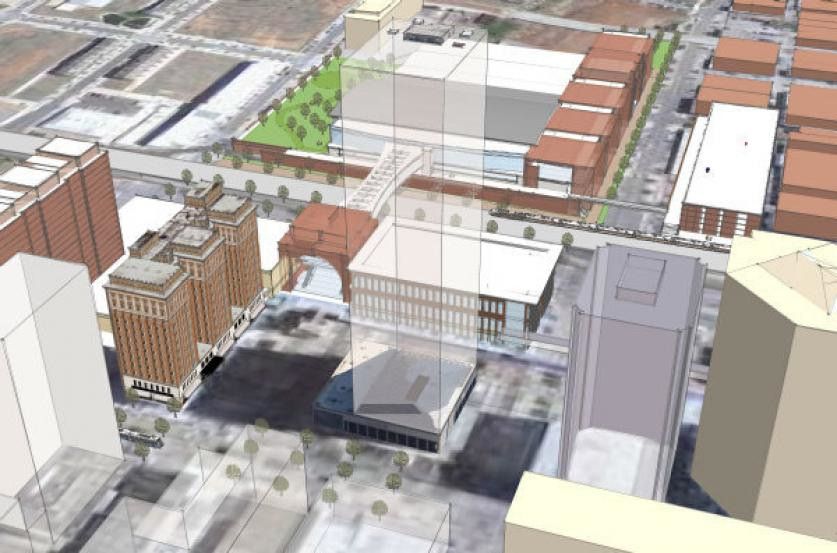
The Skirvin Partners propose that their hotel be repositioned to serve as the city's convention hotel. It is a proposal for siting the convention center between Bricktown's Main Street and Deep Deuce's 2nd Street. Essentially, across the street from the new Maywood Lofts on 2nd, and across the street from the Sherman Iron Works bldg in Bricktown.
The Skirvin currently has about 225 rooms. That's a far cry from a convention hotel, so they propose adding a second tower just to the north of their property (where there is currently a bank drive-thru) that will have 425 rooms. Then things get interesting with the razing of the Santa Fe Garage, which provides 1,518 parking spaces for downtown workers. Then to replace these parking spaces, it's proposed to build an 800-1260 space parking garage on 2nd Street, where the Sherman Iron Works bldg currently is (Main/Oklahoma in Bricktown), possibly incorporating the historic building into a parking structure.
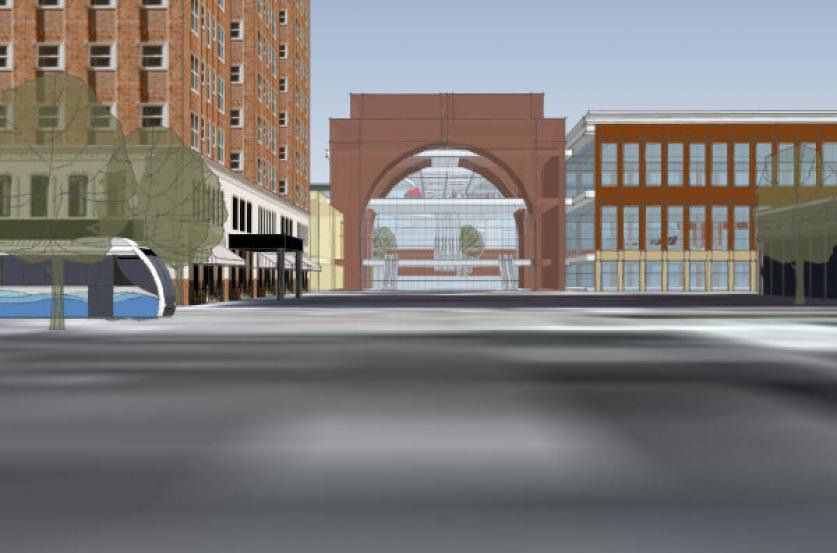
The Santa Fe Garage, which would be razed under this plan, would be replaced with a structure that features a large open "gateway," available office space that the Skirvin suggests could be ideal for the Chamber of Commerce, and more structured parking. This parking would accommodate between 575-895 spaces. Then it would ALL be incorporated with a large pedestrian bridge that crosses E.K. Gaylord and the BNSF tracks, connecting the new "Skirvin complex" and the convention center across the tracks.
One of the complexities happens to be that the site between Main and 2nd streets is currently a rail yard, one that is currently slated to become a high speed rail corridor. There is a proposed arc that cuts across the entire site (the non-utilized tracks currently veer to the north, but this would be a new arc that veers to the south merging with the BNSF tracks). The arc is important because ODOT's proposed high-speed rail corridor from OKC to Tulsa terminates where the Turner Turnpike terminates. So in order to get it further into downtown OKC, it has to come from the NE. So this will essentially be where the line changes from utilizing the BNSF track (that divides downtown and Bricktown) to where it veers to the NE toward the "Adventure District" and on to Tulsa.
While it is certainly true that high-speed rail is far from being funded at this point, especially given the current debt situation of the government, it is a salient fact to point out that there are still local plans to go forward with rail connections to the Adventure District and MWC/Tinker. These regions to the NE and E would be connected via this arc as well, with or without high-speed rail to Tulsa. Placing a convention center over this railyard could prove to be a fatal setback to rail connections to the NE. You could raise the convention center and allow the rail lines to pass underneath uninhibited, but doing so would likely put a convention center with the desired specifications well beyond the reach of $280 million.
Lastly, the Skirvin Partners have pointed to two factors that they feel make their proposal the best one for the city: 1, with the city having to come up with $60 million somewhere if they try and bring in a traditional convention hotel, they would be asking for "far less" of a subsidy. 2, they claim that Downtown OKC would not be able to absorb a new hotel with "more than 600 rooms" (ideally the convention center needs to have more than that) and they claim that using 225 existing rooms coupled with just 425 new rooms minimizes the risk of throwing off downtown's hotel room balance.
Some thoughts on this proposal coming up soon in a broader analysis of the convention center process so far...
I am going to cover this proposal in a completely unbiased way, since this is going to be controversial. I will give my strong opinion of this in a later post...
Background: OKC is building a new $280 million convention center. A centerpiece of the project that is not included in the budget will have to be a convention hotel, a hotel with minimum 700 rooms that can expand the convention center's ability to compete for vital larger conventions. The convention hotel, not being included in the budget, will have to be funded somehow. It will likely receive up to $60 million in city subsidies, money which will have to come from somewhere, but money which the city will likely get some ROI from (eg., it will probably be a loan).
Enter Skirvin:
The Skirvin Partners propose that their hotel be repositioned to serve as the city's convention hotel. It is a proposal for siting the convention center between Bricktown's Main Street and Deep Deuce's 2nd Street. Essentially, across the street from the new Maywood Lofts on 2nd, and across the street from the Sherman Iron Works bldg in Bricktown.
The Skirvin currently has about 225 rooms. That's a far cry from a convention hotel, so they propose adding a second tower just to the north of their property (where there is currently a bank drive-thru) that will have 425 rooms. Then things get interesting with the razing of the Santa Fe Garage, which provides 1,518 parking spaces for downtown workers. Then to replace these parking spaces, it's proposed to build an 800-1260 space parking garage on 2nd Street, where the Sherman Iron Works bldg currently is (Main/Oklahoma in Bricktown), possibly incorporating the historic building into a parking structure.
The Santa Fe Garage, which would be razed under this plan, would be replaced with a structure that features a large open "gateway," available office space that the Skirvin suggests could be ideal for the Chamber of Commerce, and more structured parking. This parking would accommodate between 575-895 spaces. Then it would ALL be incorporated with a large pedestrian bridge that crosses E.K. Gaylord and the BNSF tracks, connecting the new "Skirvin complex" and the convention center across the tracks.
One of the complexities happens to be that the site between Main and 2nd streets is currently a rail yard, one that is currently slated to become a high speed rail corridor. There is a proposed arc that cuts across the entire site (the non-utilized tracks currently veer to the north, but this would be a new arc that veers to the south merging with the BNSF tracks). The arc is important because ODOT's proposed high-speed rail corridor from OKC to Tulsa terminates where the Turner Turnpike terminates. So in order to get it further into downtown OKC, it has to come from the NE. So this will essentially be where the line changes from utilizing the BNSF track (that divides downtown and Bricktown) to where it veers to the NE toward the "Adventure District" and on to Tulsa.
While it is certainly true that high-speed rail is far from being funded at this point, especially given the current debt situation of the government, it is a salient fact to point out that there are still local plans to go forward with rail connections to the Adventure District and MWC/Tinker. These regions to the NE and E would be connected via this arc as well, with or without high-speed rail to Tulsa. Placing a convention center over this railyard could prove to be a fatal setback to rail connections to the NE. You could raise the convention center and allow the rail lines to pass underneath uninhibited, but doing so would likely put a convention center with the desired specifications well beyond the reach of $280 million.
Lastly, the Skirvin Partners have pointed to two factors that they feel make their proposal the best one for the city: 1, with the city having to come up with $60 million somewhere if they try and bring in a traditional convention hotel, they would be asking for "far less" of a subsidy. 2, they claim that Downtown OKC would not be able to absorb a new hotel with "more than 600 rooms" (ideally the convention center needs to have more than that) and they claim that using 225 existing rooms coupled with just 425 new rooms minimizes the risk of throwing off downtown's hotel room balance.
Some thoughts on this proposal coming up soon in a broader analysis of the convention center process so far...
Saturday, December 25, 2010
Christmas Wishlist 2010
As today happens to be Christmas Day, I thought I would take some time to lay out my ideal wishlist for OKC. It could be a lot longer obviously, as virtually everything could be done differently, more efficiently, and better. But I'll stick to the main points:
 1. One thing I wish for is a serious Plan OKC process. In the coming weeks I am going to be trying to get together an urbanist group to do a Plan OKC "Meeting in a Box" over one evening. I would actually like to see OKC implement some innovative ideas (maybe even some that would make city planning conspiracy theorists' eyes bulge) that could legitimately curb sprawl. I'd like to see us creating fewer places devoid of real lasting value (thus creating future SLUMS) and like to see us move some more of our growth into the kind of development that will still be nice 30 years from now, and even still standing 100 years from now. I'm tired of cheap and low-quality being Oklahoma City's best selling-point. Even if that means prices are going to rise, we have to find a way to start building quality communities and to stop building slightly better than crappy communities. A friend once told me that OKC's motto is, "Better than crappy makes us happy." It's true, and how said is that?
 2. When it comes to one of OKC's latest greatest projects with a 7-digit price tag, I'm not even going to say I hope for any kind of abstract, feel-good process with the convention center like an open or transparent process. I could care less about that at this point, because the bottom line is that if the convention center is right next to the park with no separation, it will ruin the park environment. If they think putting commie block apartments in the convention center facade is going to work, they must be kidding themselves. A convention hotel is not a mixed-use from a convention center, either. They need to either put the convention center somewhere else or if they insist on the mysterious OG+E payments, then they need to utilize my creative solution to set it back an entire block and bring Broadway back, allowing for a slender 1x4-block district to develop in between the two. The ULI panel noted that the convention center is being put on 40% more land than it needs, even if it's going to be expanded. Furthermore, I'm tired of the suburban thinking behind Core2Shore. There are block sizes and human scales that actually matter downtown. I get it that they don't understand or care about this, but you can't just recreate a site identical to what you'd do in the suburbs and put it downtown. In the suburbs you wouldn't notice an area (similar to what would end up running all the way from Park Avenue to Oklahoma River) that consists of over 100 normal sized city blocks consolidated into about 15 huge superblocks. Right now we have a large cluster of superblocks that has killed downtown, and ALL Core2Shore looks like it will do at this point is extend that huge miserable cluster further south. Has anyone noticed how the Myriad Convention Center and the Myriad Gardens interact with eachother?? "Oh, but it will be different this time.." If anyone buys that the nature of superblocks have changed, or that they can do the exact same thing and get a better result, they need to be locked up in the mental ward. Or shipped to Tulsa.
3. Come on Nick, tell us what you're planning. I mean Nick Preftakes, not myself. Years later I am still dying to find out what Nick Preftakes is planning to do with the entire block he bought up in the Arts District. I've been telling people it's going to be a game changer, especially with Devon Tower+park+retail+auditorium and the emergence of the Film Row area (which is coming along very nicely), the Arts District could potentially be unrecognizable if Preftakes announces a major development there. It will be absolutely essential that he maintains the historic integrity of the very-historic block, but there are some boarded up buildings there with some really amazing potential. It would be so worth it, especially when you look at the new lease on life the old Montgomery Ward building across the street got. The unfolding of these plans could potentially affect other things like the streetcar route. I've been telling people that I think the Arts District could potentially be a much bigger deal than it is now.
 4. I want to see development in Bricktown get back to where it could be. I wish for Bricktown to come closer to being "completed" because once other districts get hot, it may never be able to attract more development. The big problem is that in my opinion Bricktown has gotten stale and has failed to reinvent itself in a long time, and in today's world, that can be fatal. Bricktown could suffer the same death that the West End did for a period if it fails to reinvent itself and stay fresh. It's not just for the sake of locals who have started to focus more on districts that are hotter right now, but for developers who are comparing cheaper asking prices somewhere like 10th Street or Broadway to astronomical ridiculously inflated asking prices in Bricktown, and the choice to pass on Bricktown becomes an easy one. I think Bricktown is relying too much on the streetcar spurring development along Sheridan to bother pursuing other ideas. The city absolutely is to blame, not the Bricktown merchants that put their money where their mouths are. Just because the ballpark and canal are in Bricktown doesn't mean that it's reached some invisible limit for how much city assistance a neighborhood can receive. Has the city turned its back on Bricktown?
5. The Bricktown point is a great segway into parking. Simply put, two things need to happen: It needs to be expressly codified into the city statutes that new surface parking downtown will not be tolerated, especially in lieu of previously standing buildings no matter the condition of said building, and parking lot moguls in areas like Bricktown need to be shut down and put out of business. Tell them to take their business to Tulsa or some city that will tolerate that, but we won't here in OKC, because a few of us are actually serious about building downtown up. How do you shut down the Bricktown parking lot lords? Public parking, and that can be done extremely easy. Watch closely a project that is underway with Automobile Alley to re-stripe North Broadway and take away a lane, add a turning lane, and change parallel parking to angled parking which will allow them to squeeze in hundreds more parking spaces. If they went with angled parking along every Bricktown street that is free or metered, they could easily shut down the Bricktown parking lots because more than enough parking would be available for free on the street. This should also be pursued in other districts if the results in A-Alley are as positive as it could very well turn out.
6. Oklahoma City has failed to grow downtown housing to the extent that we had hoped we would have by now. This is a simple fact in spite of the other fact that downtown housing is slowly on its way to becoming viable, with several hundred downtown residents moving in and taking up urban lifestyles. It could be more, it should have been more. The 2005 Downtown Housing Study said there was 5-year demand for thousands more units than we ended up getting built between 2005-10. Another downtown study that came out right around there recommended taking several steps to incentivize downtown development. Virtually none of those steps, except for rezoning, were actually followed through with. I assume the copies of it at the Planning Dept got filed in the big file cabinet full of other ignored downtown studies and surveys and reports and commissions. But it may be time to develop a REAL program designed to result in a boom in smaller infill projects. This needs to happen now, so that we can fix the problem with demand, before streetcar comes on line and results in a huge boom in infill and therefor makes the appearance of a problem go away. If we get the streetcar finished without an infill program, the results aren't going to be as positive as it would be if we got the streetcar in and an infill program. We need to evaluate our goals from 5 years ago, and the results we got, consider why it ended up that way (and be open-minded to reasons other than the popular excuse, "It's the economy, stupid"), and get back on track to recover lost projected units.
7. I want to see Full Circle move downtown. They could locate smack in between Heritage Hills and the booming downtown residential market. Downtown residential markets tend to be filled with creative types with disposable income WHO READ. If they went into a beautiful old building like The Packard at 10th/Robinson they'd have the potential to be one of the absolute coolest locally-owned bookstores in America. They already are, the only thing holding them back is their location in crappy (and rapidly-emptying) 50 Penn Place. Enough said.
Well that's the Top 6 at least. Quick summary: 1, Plan OKC; 2, convention center location; 3, Nick Preftakes development; 4, Bricktown development; 5, angled parking; 6, small infill program; 7, Full Circle.
I am thankful for all the really good things going on in OKC, for being included in a number of processes unfolding around downtown right now, and it's also good to be back in town. If anyone's interested in meeting for coffee or lunch, feel free to let me know, I'm always excited to meet with fellow urbanists. I know this blog doesn't get a lot of comments by the nature of the things it talks about, but I do appreciate the people who read this and hear me out on the ideas I have. Merry Christmas to all!
2. When it comes to one of OKC's latest greatest projects with a 7-digit price tag, I'm not even going to say I hope for any kind of abstract, feel-good process with the convention center like an open or transparent process. I could care less about that at this point, because the bottom line is that if the convention center is right next to the park with no separation, it will ruin the park environment. If they think putting commie block apartments in the convention center facade is going to work, they must be kidding themselves. A convention hotel is not a mixed-use from a convention center, either. They need to either put the convention center somewhere else or if they insist on the mysterious OG+E payments, then they need to utilize my creative solution to set it back an entire block and bring Broadway back, allowing for a slender 1x4-block district to develop in between the two. The ULI panel noted that the convention center is being put on 40% more land than it needs, even if it's going to be expanded. Furthermore, I'm tired of the suburban thinking behind Core2Shore. There are block sizes and human scales that actually matter downtown. I get it that they don't understand or care about this, but you can't just recreate a site identical to what you'd do in the suburbs and put it downtown. In the suburbs you wouldn't notice an area (similar to what would end up running all the way from Park Avenue to Oklahoma River) that consists of over 100 normal sized city blocks consolidated into about 15 huge superblocks. Right now we have a large cluster of superblocks that has killed downtown, and ALL Core2Shore looks like it will do at this point is extend that huge miserable cluster further south. Has anyone noticed how the Myriad Convention Center and the Myriad Gardens interact with eachother?? "Oh, but it will be different this time.." If anyone buys that the nature of superblocks have changed, or that they can do the exact same thing and get a better result, they need to be locked up in the mental ward. Or shipped to Tulsa.3. Come on Nick, tell us what you're planning. I mean Nick Preftakes, not myself. Years later I am still dying to find out what Nick Preftakes is planning to do with the entire block he bought up in the Arts District. I've been telling people it's going to be a game changer, especially with Devon Tower+park+retail+auditorium and the emergence of the Film Row area (which is coming along very nicely), the Arts District could potentially be unrecognizable if Preftakes announces a major development there. It will be absolutely essential that he maintains the historic integrity of the very-historic block, but there are some boarded up buildings there with some really amazing potential. It would be so worth it, especially when you look at the new lease on life the old Montgomery Ward building across the street got. The unfolding of these plans could potentially affect other things like the streetcar route. I've been telling people that I think the Arts District could potentially be a much bigger deal than it is now.
5. The Bricktown point is a great segway into parking. Simply put, two things need to happen: It needs to be expressly codified into the city statutes that new surface parking downtown will not be tolerated, especially in lieu of previously standing buildings no matter the condition of said building, and parking lot moguls in areas like Bricktown need to be shut down and put out of business. Tell them to take their business to Tulsa or some city that will tolerate that, but we won't here in OKC, because a few of us are actually serious about building downtown up. How do you shut down the Bricktown parking lot lords? Public parking, and that can be done extremely easy. Watch closely a project that is underway with Automobile Alley to re-stripe North Broadway and take away a lane, add a turning lane, and change parallel parking to angled parking which will allow them to squeeze in hundreds more parking spaces. If they went with angled parking along every Bricktown street that is free or metered, they could easily shut down the Bricktown parking lots because more than enough parking would be available for free on the street. This should also be pursued in other districts if the results in A-Alley are as positive as it could very well turn out.
6. Oklahoma City has failed to grow downtown housing to the extent that we had hoped we would have by now. This is a simple fact in spite of the other fact that downtown housing is slowly on its way to becoming viable, with several hundred downtown residents moving in and taking up urban lifestyles. It could be more, it should have been more. The 2005 Downtown Housing Study said there was 5-year demand for thousands more units than we ended up getting built between 2005-10. Another downtown study that came out right around there recommended taking several steps to incentivize downtown development. Virtually none of those steps, except for rezoning, were actually followed through with. I assume the copies of it at the Planning Dept got filed in the big file cabinet full of other ignored downtown studies and surveys and reports and commissions. But it may be time to develop a REAL program designed to result in a boom in smaller infill projects. This needs to happen now, so that we can fix the problem with demand, before streetcar comes on line and results in a huge boom in infill and therefor makes the appearance of a problem go away. If we get the streetcar finished without an infill program, the results aren't going to be as positive as it would be if we got the streetcar in and an infill program. We need to evaluate our goals from 5 years ago, and the results we got, consider why it ended up that way (and be open-minded to reasons other than the popular excuse, "It's the economy, stupid"), and get back on track to recover lost projected units.
7. I want to see Full Circle move downtown. They could locate smack in between Heritage Hills and the booming downtown residential market. Downtown residential markets tend to be filled with creative types with disposable income WHO READ. If they went into a beautiful old building like The Packard at 10th/Robinson they'd have the potential to be one of the absolute coolest locally-owned bookstores in America. They already are, the only thing holding them back is their location in crappy (and rapidly-emptying) 50 Penn Place. Enough said.
Well that's the Top 6 at least. Quick summary: 1, Plan OKC; 2, convention center location; 3, Nick Preftakes development; 4, Bricktown development; 5, angled parking; 6, small infill program; 7, Full Circle.
I am thankful for all the really good things going on in OKC, for being included in a number of processes unfolding around downtown right now, and it's also good to be back in town. If anyone's interested in meeting for coffee or lunch, feel free to let me know, I'm always excited to meet with fellow urbanists. I know this blog doesn't get a lot of comments by the nature of the things it talks about, but I do appreciate the people who read this and hear me out on the ideas I have. Merry Christmas to all!
Tuesday, June 8, 2010

Friday, June 4, 2010
Cityshot LIII

Some little bambinos hanging out on the Walnut Street bridge on a Friday night in Bricktown.
One of those pictures that are worth a thousand words, I think.
Wednesday, June 2, 2010

Monday, May 24, 2010
Meetup photos: Bricktown
I'll slowly post a few highlights of my photos from the OKC Talk downtown photog meetup, which went very well--I think everyone who participated is looking forward to future meetups, and I hope more people in the future will join us. In general, I think it's good for people to get out there, meet each other in person, and do away with Internet communication barriers whenever possible--and hopefully it will foster more involvement by encouraging people to take their passion for downtown urbanism out to the real world.
Without further ado, here's my faves out of the Bricktown pics I took:


Notice anything wrong with Bricktown in any of these pics? I don't--and that's coming from someone who's admittedly quick to point out anything wrong with this city. I couldn't imagine a more perfect evening..Bricktown is doing WELL, despite all of the criticism and controversy it frequently attracts. Make no mistake, that goes to say a lot about Jim Cowan.
Without further ado, here's my faves out of the Bricktown pics I took:
Notice anything wrong with Bricktown in any of these pics? I don't--and that's coming from someone who's admittedly quick to point out anything wrong with this city. I couldn't imagine a more perfect evening..Bricktown is doing WELL, despite all of the criticism and controversy it frequently attracts. Make no mistake, that goes to say a lot about Jim Cowan.
Friday, May 21, 2010

Monday, May 3, 2010
A thousand questions
So many questions, so little time. In lieu of a full post (currently working on an exhaustive retail post), I think for this week I'll just post some questions that are burning in my mind. If anyone would venture some answers, feel free.
I am afraid that if it's questionable, in "this current economy" (I disagree with that..) and in the current malaise that is private development in downtown OKC, you have to assume the worst..that each of these possible projects are negligible. I want to be wrong. Or here's a much more optimistic possibility: Maybe everyone is waiting to see what's going to happen with MAPS 3 before they put any more investment into downtown? Too much up in the air right now. There is an amazing amount of change going on, but it's virtually all public sector and instead of invigorating the private sector, the private sector seems to have taken a breather.
So here goes, no particular order:
1 Is OKC still doing anything to attract more retail? Did the ULI panel give the city some ideas? Is the city willing to subsidize a "Core to Shore boulevard" retail development?
2 Has anyone besides myself realized the demolition spree that this city is on? Multiple buildings on 10th Street, the SandRidge proposal, Bricktown Steffen Creamery bldg, and more. Now it looks like the next may be a row of shops at Classen and NW 30th. Oh and the site Bradshaw cleared at Broadway/12th. The more I think, the more examples I come up with.
3 How has first-floor leasing been going? Legacy and Park Harvey were huge successes in that regard. What about the Maywood Lofts? Chuck Ainsworth's Candy Factory project? I'm sure there's some I'm forgetting. I know there is no first-floor retail yet in the Candy Factory "Lofts" or in Maywood Lofts' spaces..
4 I'm curious what Steve Mason's been up to. He's always up to something cool.
5 The Maywood Brownstones have changed hands. So does that free Ron Bradshaw up to do some more projects? Hopefully something more economically feasible. And what does this mean for Maywood Park? Will the brownstones be finished out as originally planned? (dozens more were originally planned)
6 When I was last in Bricktown I saw a ton of site work going on around the Steel Yards project. Is that going forward, or is something else entirely going on?
7 Did the ULI knock some sense into the city, or is Mayor Mick still intent on building the convention center adjacent to the Core to Shore park? It might make or break MAPS 3. Not really, but still--why be intent on making the worst out of the top-dollar ticket item?
8 What is the deal with Chesapeake? I realize we will never find out, but it's worth speculating. So much construction equipment between Classen and the tracks, on top of several blocks that I'm guessing they cleared. They've also been clearing a half dozen apartment buildings off of Grand Blvd between Western and 63rd. There was an apartment building on 63rd in front of Nichols Hills Plaza they also just razed. No announcement from Chesapeake as usual. What is going on? We already know Whole Foods is going in where they tore down the funeral home earlier this year.
9 Ron Bradshaw (I think it was him) bulldozed that site at like.. NW 12th and Broadway. What will come of that? Another site that was bulldozed just to sit for decades? We all thought we'd see development of that site by now, no surprise--no development. Maybe something is still planned, or is he no longer developing?
10 What is going on at Saint Anthony's Hospital? I'm hearing a lot about two possible new mid-rise buildings at the hospital, including a new emergency ward--and in addition to that, I'm hearing about a group of doctors interested in building a new doctor's office building (significant midrise as opposed to lowrise from what I hear).
11 What's the deal with some of these downtown developments that you hear nothing about? Like The Carnegie. The First National Building renovations? The CityPlace Lofts (in the upper floors)? Will Lower Bricktown ever be finished (is Randy Hogan going to be 'let off' or will OCURA ever take the land back)?
12 Our friend Nicholas Preftakes... 'nuff said.
13 Are some property owners actually trying to make sure that the downtown streetcar does not go in front of their property? Words can not describe how misdirected I think such a move would be. Streetcar = good. Usually the argument against it is "I'm too cheap to pay for it," and not.. "It better stay off of my lawn!"
14 Would a downtown grocer even be successful? Crescent Market closed. The deli is still open, thankfully. People really do a lot of talking about what downtown needs and yada yada--when someone comes in are they supporting them? It's a valid question I've heard raised by many. I've asked people what businesses they think are in need of support, nobody wants to specifically name a business that's doing badly, but maybe we really do need a downtown endangered list..if it would help.
Not to be all negative, unexpected answers that have come up..
1 Is Bricktown EVER going to have some decent retail? Apparently, yes--in June. The people behind the Red Dirt Emporium are opening a "public market" type space in June that will feature a collection of local vendors with different kinds of booths. It will also hopefully act as an incubator for new retail in Bricktown, where people who make shirts or food or whatever--can start out with a booth here and then get their own store as they expand. The market will be located on the canal level of the Jackson Building in upper Bricktown--the interior will be very avant garde, very Bricktown. Can't wait to see it.
2 Will SandRidge be opposed? Yes, big-time. An awesome group has formed with the mission to "Keep Downtown Urban." Preservation Oklahoma has filed a public appeal against SandRidge Energy's plans to raze north downtown leaving only SandRidge Tower standing. Today during lunch they held a "Building Hug" ceremony downtown, gathering about 40 participants, as well as spectators and news reporters. They gave out free "Keep Downtown Urban" t-shirts as well.
3 Can development happen during this economy? Yes. Look at Paseo, look at the Plaza District--not only is there significant redevelopment going on, but these are also by far some of the highest-risk (as far as lender's are concerned) development areas of the city. Low risk development: Bricktown, or Memorial Road. High risk: Plaza District (because there aren't active precedent indicators that a project will be successful). Look at the transformation the Plaza has undergone during a bad economy, and look at the local retail tenants that have miraculously popped up. Plaza has a truly awesome retail scene in my opinion. Maybe the low expectations lent themselves to a surprisingly successful district? Maybe the ridiculously high expectations are what's problematic in Bricktown.
Think about it, OKC.
Saturday, March 20, 2010
Development potential
Sometimes you hear a site proclaimed as having the most development potential in downtown. There was even a survey back in 2005 that identified the intersection that would be the most important development site in the growth of downtown. This 2005 survey, way ahead of its time, predicted that Midtown would become a resurgent hotspot area, and recognized the fantastic building stock still standing along North Broadway in A-Alley.
That site, identified as the most important piece of the puzzle for downtown redevelopment, was the intersection of NW 10th and Broadway. Imagine the potential it had; it could have been anything..a corporate headquarters, a large mixed-use development, a condo mid-rise, an NBA practice facility, and so on. What ended up going on that site, the OKC Community Foundation, while underwhelming from a development standpoint, ended up being as good as we could have hoped for. The community foundation, a respected community institution dedicated toward helping the inner city poor, is a great thing to have there..it's a shame they have to bulldoze adjacent buildings for extra parking. The EIFS entrance is tastefully done, so we can surely forgive the dreaded "fake stucco," and I think their facility fits in well with the surrounding environment, even if it isn't the pinnacle that North Broadway could have hoped for.
So since there is no condo mid-rise at NW 10th and Broadway, in the interest of jinxing another site to be underutilized, let's ponder the NEXT best development potential. And it's worth considering that things such as potential change each year as downtown continues to evolve and revitalize. I think that the progress since 2005 makes NW 10th and Broadway even more vital, especially as we anticipate that 1101 and 1100 N Broadway get restored soon.
But the progress since 2005 also makes other sites pop up on our radar. Those sites will be around the Devon Tower site, sites that connect downtown and "Core 2 Shore" taskforce lands, key sites in Bricktown and Deep Deuce, as well as the city initiative to develop a particular site in Midtown.

I like the potential of the NW 10th and Harvey-to-Hudson block to be a "perfect" development, although I don't think it's the "most vital" to the city's continued evolution. I think it is important however for Midtown, in fact, it's not hard to imagine the site's development being a prerequisite for the further development of Midtown, which is currently a collection of separate hotspots, mainly the Walker Circle area. There is also the area around the Sieber, Beatnix, Packard, Church Row, etc etc.. The one site that will connect it all, to lay the path for Midtown to evolve into the next Bricktown, will be this site that the city is taking action on. The ideal development is not anything that might be much larger than the scale of surrounding buildings, but it's important to realize that anything that doesn't completely fill the site out would be underutilization. Something very similar to Marva Ellard's former Mercy Park proposal would be ideal. Something around 4/5 stories max, but more than 2/3, and try and package as many different uses as possible. The key with residential, in order to be assured success, is to appeal to the pent-up rental demand downtown and not buy into the utter fallacy that we need more high-end for-sale units. We all fell for that one..and most of us regret it today.

The site with the most importance, by far, for the city's continued development, given the current Devon Tower development underway--is the city block owned by Nicholas Preftakes to the west of Devon. It is safe to assume Preftakes has plans because of his history as a downtown developer, being involved in many, many past downtown projects, and now given his acquisition of this entire city block at such a convenient time. The important thing to realize here, in order for this city block to realize its full potential, is that every building must remain standing. This block already comes with an exciting stock of buildings that have a ton of potential, not to mention many unique architectural features, ranging from Art Deco to Brownstone. It's a very urban, diverse, and colorful block, not to mention a sadly underutilized block. The potential uses for these buildings, once redeveloped, should take an arts-based focus. The site is surrounded by the Myriad Gardens, Devon World Headquarters, Stage Center, the Civic Center Music Hall, the OKC Museum of Art, City Hall, and Trattoria il Centro. The uses here should reflect truly being in the center of it all. Here, an art gallery could thrive, as well as upscale restaurants, law offices, perhaps a bodega, a winebar, etc etc..
The potential for new development, even large-scale new development, is going to exist across the street between the Arts District and the planned boulevard. (I would be dismayed to see large-scale infill, any time soon, proposed on the south side of the boulevard.)
Many people have their own eye on sites in Deep Deuce and Bricktown. Because of the inorganic way in which Bricktown developed, you see vastly important sites just sitting there in the middle of Bricktown. Many of these include the festival site/parking lot across from the Brewery at Sheridan and Oklahoma, the surface parking next to Tapwerks at Sheridan and Mickey Mantle, and especially the canal-front sites along Mickey Mantle. And I could go on and on about the canal. Nevermind development sites along the east periphery of Bricktown, such as Candlewood Suites and The SteelYards, there is so much work left to be done at Bricktown's core. I know that people behind the scenes are still working diligently to attract the development Bricktown will need to be successful, and there are several deals in the works. Let's hope some of them are successful! What Bricktown needs, at this point, are rental units. It needs "rooftops" in order to pave the way for more retail, and also to take some of the seasonality out of its business cycle (which has been difficult for some "pro retailers" to grasp).
Sunday, February 21, 2010
OCURA: What a stellar track record
Gotta love gub'ment interference in downtown development, Oklahoma City Urban Renewal Authority (OCURA) especially, the folks who brought you Lower Bricktown, Bass Pro, The Hill at Bricktown, Overholser Green, and countless other downtown success stories. Pat yourself on the back, OCURA, because if not for you and your contributions toward expediting quality private development, OKC would still be a vibrant downtown. Wait, I meant a dead downtown.
So in this post we'll examine OCURA's stellar track record in advancing "quality" urban development in OKC.
 I think we can all appreciate the corrupt bidding process in which we ended up with Bass Pro, over other potentially more urban projects that had been pitched. The good news is that Bass Pro is virtually the extent of retail in Bricktown, and the rest of downtown. It also added something Bricktown was in desperate need of: surface parking. So all in all, a win-win. Plus the adjacent Lower Bricktown development was absolutely fool-proof. Even though The Centennial is the only remotely urban component of Lower Bricktown, even it is loosing retail tenants. (LiT went out of business.) LB's other clothing retailer, Firefly Clothing, also closed recently. So one bright spot for Lower Bricktown, the fact that it did at least have leasing, is now just one of many sore spots for the much-maligned project. Add to the fact that LB has never been finished, and likely won't ever be finished until the Crosstown comes tumbling down and replaced by an at-grade boulevard behind Lower Bricktown. As it happens, developers Stonegate Hogan were given a TIMELINE on the project, and the TIMELINE has since lapsed. Will OCURA ever close on the remaining canal-front land and take it back, and try and get some other developers to bid on it? Nah, never. This is not about good development, the City of OKC, protecting a public investment like the canal, or ANYTHING like that. This is about the good ol' boy system and pushing the interests of the developer, Stonegate Hogan.
 One of the few bright spots, if you're one of them out-of-touch urban advocates, is the Deep Deuce Apartments--but even Deep Deuce has one glaring downfall: it was NEVER completed, and won't EVER be completed as planned. So it's another example of where a developer proposes one thing, gets the bid, then does the ole switcharoo or doesn't even come close to finishing the development that they said they would do. Never mind the fact that the reason they were given the bid was to do the development they proposed, and nothing else. Integrity is not an important factor here, because OCURA doesn't actually care about "urban renewal."
 Funny thing about the Overholser Green project is that I actually defended OCURA here. I supported the Overholser Green project because it was a good project, and at the time, I didn't realize how it was financially unfeasible. The high-end nature of the project, especially the condominium aspect. In contract to Marva Ellard's competing proposal, a mixed-use project with rental residential and financing in place. Well it's obvious that OCURA couldn't have picked that project, because it actually had a relatively good chance of success. That would just completely throw OCURA's track record all out of whack. Now where we are is (3/4 years or so after the bid was awarded) Chuck Wiggin has stalled on the project. In fact he scaled it way down so that it was a much less significant project, and he still couldn't get it off. So basically after he was awarded the contract, he pulled the old switcharoo as so many of them do, and instead of pulling the contract AS OCURA SHOULD HAVE DONE, OCURA approved it again because they already awarded the contract. At that point and thereafter Wiggin could have done whatever the hell he wants, or doesn't want; he could have put a 7/11 on that land for all OCURA cared. The story more or less has been marked by what he doesn't want to do, and that is develop the land which has absolutely sat there and won't be developed any time soon. Thanks to everyone's favorite gub'ment agency.
 No downtown project exemplifies "FAILURE" like The Hill does, and that's bragging rights nobody can even come close to. This is the kind of project that OCURA really hangs its hat on, the bread and butter of what OCURA is all about as a corrupt government agency. I guess first you gotta begin with the corrupt bidding process, against two other more financially feasible projects, including a great mixed-use proposal from Anthony McDermid. Within the last 12 hours before the bid was awarded, Bill Canfield and Marva Ellard (developers of The Hill) notify OCURA that they're dropping their request for a TIF district as a part of the development. OCURA was legally required to notify McDermid and others of the change in the competing proposal, but failed to do so because it was late at night. McDermid later said that had he been notified, he also would have dropped his request for the TIF--but never got such a notice. Now that The Hill is what we're stuck with, as it's already under construction, it's become even more of a quagmire. The suburban design of the over-priced units have scared away any potential buyers, so the project has sold only 2 or 3 units, total. Without selling ANY units, Canfield couldn't pay contractors, so they stopped construction and probably hold liens on the project. The project can't even be closed on and reclaimed by OCURA at this point, because the few dozen townhomes that were built (out of 160 or so proposed) use up ALL of the street frontage that this project has. The only way thing that could be put on that site now is a big box retailer that needs highway visibility more than frontage (like BASS PRO, hint hint), or a commuter parking lot. That's it.
 We got LUCKY with this project. Here's another one where a developer (Mike Henderson) gets awarded a bid, based on a great proposal with snazzy architectural elevations..then he pulls the old switcharoo and we get Plainville. This project in no way resembles the high-design development that was anticipated during the bidding process. But the bright side is this: the project actually is URBAN, it's not necessarily UGLY, and it works. It also has 300 or so upscale rental units, and that's GREAT for downtown. OCURA accidentally stumbled upon a success here..but they should have held Henderson to his original design proposal, especially considering he got TIF funding for this. That's a public investment that OCURA should have been looking out for.
I could go on. The funny thing, as you read through the annals of downtown history and come across a chapter on Sycamore Square, is how we have literally repeated the Sycamore Square fiasco over and over and over and over in the last 5 years. Yes, it's true that downtown development has been booming, very successfully, in the last 5 years. There is a HUGE exception to that however, and that is any time OCURA is involved. OCURA stands for Oklahoma City Urban Renewal Authority, but I would seriously question, based on their track record, what the hell their problem is. I think here is a great example of where a government agency with a long acronym no longer comes even close to representing what its acronym stands for. So next time someone asks, "What does OCURA stand for?" The answer of course must be, "OCURA stands for O-C-U-R-A," not anything relating to urban or downtown or the community or anything like that.
Sadly, I think I could raise some very critical questions of Downtown Design Review these days, as well.
So in this post we'll examine OCURA's stellar track record in advancing "quality" urban development in OKC.
I think we can all appreciate the corrupt bidding process in which we ended up with Bass Pro, over other potentially more urban projects that had been pitched. The good news is that Bass Pro is virtually the extent of retail in Bricktown, and the rest of downtown. It also added something Bricktown was in desperate need of: surface parking. So all in all, a win-win. Plus the adjacent Lower Bricktown development was absolutely fool-proof. Even though The Centennial is the only remotely urban component of Lower Bricktown, even it is loosing retail tenants. (LiT went out of business.) LB's other clothing retailer, Firefly Clothing, also closed recently. So one bright spot for Lower Bricktown, the fact that it did at least have leasing, is now just one of many sore spots for the much-maligned project. Add to the fact that LB has never been finished, and likely won't ever be finished until the Crosstown comes tumbling down and replaced by an at-grade boulevard behind Lower Bricktown. As it happens, developers Stonegate Hogan were given a TIMELINE on the project, and the TIMELINE has since lapsed. Will OCURA ever close on the remaining canal-front land and take it back, and try and get some other developers to bid on it? Nah, never. This is not about good development, the City of OKC, protecting a public investment like the canal, or ANYTHING like that. This is about the good ol' boy system and pushing the interests of the developer, Stonegate Hogan.One of the few bright spots, if you're one of them out-of-touch urban advocates, is the Deep Deuce Apartments--but even Deep Deuce has one glaring downfall: it was NEVER completed, and won't EVER be completed as planned. So it's another example of where a developer proposes one thing, gets the bid, then does the ole switcharoo or doesn't even come close to finishing the development that they said they would do. Never mind the fact that the reason they were given the bid was to do the development they proposed, and nothing else. Integrity is not an important factor here, because OCURA doesn't actually care about "urban renewal."Funny thing about the Overholser Green project is that I actually defended OCURA here. I supported the Overholser Green project because it was a good project, and at the time, I didn't realize how it was financially unfeasible. The high-end nature of the project, especially the condominium aspect. In contract to Marva Ellard's competing proposal, a mixed-use project with rental residential and financing in place. Well it's obvious that OCURA couldn't have picked that project, because it actually had a relatively good chance of success. That would just completely throw OCURA's track record all out of whack. Now where we are is (3/4 years or so after the bid was awarded) Chuck Wiggin has stalled on the project. In fact he scaled it way down so that it was a much less significant project, and he still couldn't get it off. So basically after he was awarded the contract, he pulled the old switcharoo as so many of them do, and instead of pulling the contract AS OCURA SHOULD HAVE DONE, OCURA approved it again because they already awarded the contract. At that point and thereafter Wiggin could have done whatever the hell he wants, or doesn't want; he could have put a 7/11 on that land for all OCURA cared. The story more or less has been marked by what he doesn't want to do, and that is develop the land which has absolutely sat there and won't be developed any time soon. Thanks to everyone's favorite gub'ment agency.No downtown project exemplifies "FAILURE" like The Hill does, and that's bragging rights nobody can even come close to. This is the kind of project that OCURA really hangs its hat on, the bread and butter of what OCURA is all about as a corrupt government agency. I guess first you gotta begin with the corrupt bidding process, against two other more financially feasible projects, including a great mixed-use proposal from Anthony McDermid. Within the last 12 hours before the bid was awarded, Bill Canfield and Marva Ellard (developers of The Hill) notify OCURA that they're dropping their request for a TIF district as a part of the development. OCURA was legally required to notify McDermid and others of the change in the competing proposal, but failed to do so because it was late at night. McDermid later said that had he been notified, he also would have dropped his request for the TIF--but never got such a notice. Now that The Hill is what we're stuck with, as it's already under construction, it's become even more of a quagmire. The suburban design of the over-priced units have scared away any potential buyers, so the project has sold only 2 or 3 units, total. Without selling ANY units, Canfield couldn't pay contractors, so they stopped construction and probably hold liens on the project. The project can't even be closed on and reclaimed by OCURA at this point, because the few dozen townhomes that were built (out of 160 or so proposed) use up ALL of the street frontage that this project has. The only way thing that could be put on that site now is a big box retailer that needs highway visibility more than frontage (like BASS PRO, hint hint), or a commuter parking lot. That's it.We got LUCKY with this project. Here's another one where a developer (Mike Henderson) gets awarded a bid, based on a great proposal with snazzy architectural elevations..then he pulls the old switcharoo and we get Plainville. This project in no way resembles the high-design development that was anticipated during the bidding process. But the bright side is this: the project actually is URBAN, it's not necessarily UGLY, and it works. It also has 300 or so upscale rental units, and that's GREAT for downtown. OCURA accidentally stumbled upon a success here..but they should have held Henderson to his original design proposal, especially considering he got TIF funding for this. That's a public investment that OCURA should have been looking out for.I could go on. The funny thing, as you read through the annals of downtown history and come across a chapter on Sycamore Square, is how we have literally repeated the Sycamore Square fiasco over and over and over and over in the last 5 years. Yes, it's true that downtown development has been booming, very successfully, in the last 5 years. There is a HUGE exception to that however, and that is any time OCURA is involved. OCURA stands for Oklahoma City Urban Renewal Authority, but I would seriously question, based on their track record, what the hell their problem is. I think here is a great example of where a government agency with a long acronym no longer comes even close to representing what its acronym stands for. So next time someone asks, "What does OCURA stand for?" The answer of course must be, "OCURA stands for O-C-U-R-A," not anything relating to urban or downtown or the community or anything like that.
Sadly, I think I could raise some very critical questions of Downtown Design Review these days, as well.
Subscribe to:
Posts (Atom)