Showing posts with label North OKC. Show all posts

Wednesday, August 8, 2012

OKC all-around beautiful

For the last few weeks I've been busy canvassing OKC, from Capitol Hill up to Chesapeake, taking photos of neighborhoods and street scenes that show the everyday nitty-gritty of OKC's built environment. As I tired of seeing countless photos of something nice downtown, I yearned to see greatness in the everyday built environment, so I went out and found it. In fact, I found it pretty easily... OKC "outside of downtown" is really shaping up, too.

Here is a sneak peak at the hundreds of photos that I've taken to document where OKC is at in preparation of my leaving town again:


Will Rogers Theater/Will's Lobby Bar

Random street in Edgemere Park


NW13th and Robinson (we'll call this "pre-streetcar")


Small-scale buildings in A-Alley


Mount Saint Mary's Catholic prep school in S. OKC (near SW25th/Shartel)


Random street in Crestwood


Skyline from Western/Main avenues


The historic armory on NE23rd


New "Lincoln Renaissance" state-related development


NE30th/Lincoln Blvd.


A significant concentration of mid-century mod along Lincoln


La discoteca on SW29th


No way, people, walking, around a traffic circle?!?


The Walker Circle - one of OKC's most unique public spaces


Random street in Mesta Park


Random street between Mesta Park and Heritage Hills


Random street in Heritage Hills


The sign says Heritage Hills, so we'll go with that


New development in Gatewood (NW18th/Classen)


The Plaza District (NW16th Street)


Yup.


Random street in Gatewood.


Carey Place (a sub-district of Gatewood)


The Cleveland neighborhood


New outlet mall


"Oklahoma" in a snapshot


The beautiful new 23rd Street Courts development in Uptown23rd


Spruced-up buildings along Uptown23rd


Lights turned on at the old Tower Theatre (we'll also call this photo "pre-streetcar")


Interesting modern infills between Paseo and Uptown


The Classen condo tower and historic Gold Dome cultural center; Rt 66 landmarks both


New public housing in JFK, fantastic design by architect James Williams


New OMRF tower rises above Capitol View neighborhood


Old Catholic church along NE Kelley


The sign says Lincoln Terrace, so we'll go with that


Nearly got mowed over taking this photo, NW23rd/Hudson


The big Presbyterian church on N. Western


N. Walker in Midtown (we'll once again call this "pre-streetcar")


Random homes in Putnam Heights


Cool art moderne home in Crown Heights


Random home in Central Park.. yard signs!! lol


The top of Paseo Drive


Looking up Paseo Drive, beside the newly-renovated Paseo Plunge


New homes in Jefferson Park


*All photos taken on my phone, to explain the quality... and not ONE photo of downtown and all the new development over yonder (I'll admit Midtown is getting kinda close though I'd still argue it as the beginning of "North OKC").

Tuesday, December 20, 2011

Artist ghettos and prolonged dust bowl

Back in town for a few weeks, I took to the streets today and just drove around town, catching up on the progress in certain parts of town--today I caught up on the north side. I always think it's good to step away from a situation or a place and then reexamine it later with fresh eyes. So it was today with these fresh eyes that I've come to two particularly interesting observations.


We often strive to maximize land values out of neighborhoods and districts that make up a city. I think this is a shame, because not only does it sometimes block out intrinsic value and human-focused priorities, but it also eats a hole out of the diversity that usually makes urban cities in the U.S. so awesome. It was a similar obsession with sanitizing the urban environment that leveled most of downtown in the 60s and 70s.

I am always railing about inner north improvements. My stance is that if you polish up OKC's north side, bam--you get South Tulsa or North Dallas (obviously more refined, sophisticated environments). Let's face it, OKC's built environment just isn't very "sophisticated." Today I've come to realize the good in that, however. If you fan out in all directions of NW 30th and Western, you are surrounded by the grungy, gritty things that add real culture and value yet sap sophistication to this city. It's mostly just this little pocket of run-down blocks in the north side, but I've tackled that situation in enormous detail before.

I just think whether it's the Paseo, aside from its iconic Spanish Village main street along Dewey, that offers cheap rent to the truly-quasi "starving artists" of this world, or the nearby Asian District/Military neighborhood that injects OKC with a large dose of diversity, this area contributes just as much to OKC as Nichols Hills or downtown.

Realization #2: We need trees. What are OKC's biggest needs? More density, improving corridor aesthetics, public transit, mixed-use development? No. OKC's biggest needs are trees, trees, and more trees. The dearth of urban canopy in OKC is stunning. Yes, there are some averse conditions, and yes, big beautiful oak forests aren't naturally supposed to be here. I think Denver is one of the best examples of very lush cities that aren't supposed to be lush--it can be done. More so, it needs to be done badly. NeighborWoods is a great program, but it's just not doing enough. So much more needs to be done.

The profound thing is that a lot of these areas that are identified as needing improvement could just be covered up if we had more trees. I realized this as I was on one of those bridges crossing the Oklahoma River--where you see an enormous, wind-swept "riverside" that gradually merges into the very-scenic Great Plains ranch land separating downtown from Capitol Hill. Many cities such as Fort Worth have strange expanses of greenfield like this, however they are always covered with trees, or at least along thoroughfares.

Instead of having to spread out urban development demand to fix this area and many more, why don't some of us plant some trees for crissakes? I'm not even coming at this from a tree-hugger perspective. It would just make OKC look 10000x better. Not to mention feel better when it's 105 degrees and 400% humidity outside, and that translates into real quality of life and walkability improvement. Urban shade is a good thing, not a bad thing!

So there, one positive, and one negative (but a really obvious negative that I don't imagine will tick too many of you off). That recap is just for those of you who complain that I'm 100% negative!

Wednesday, March 30, 2011

Is your vote worth $409,000?

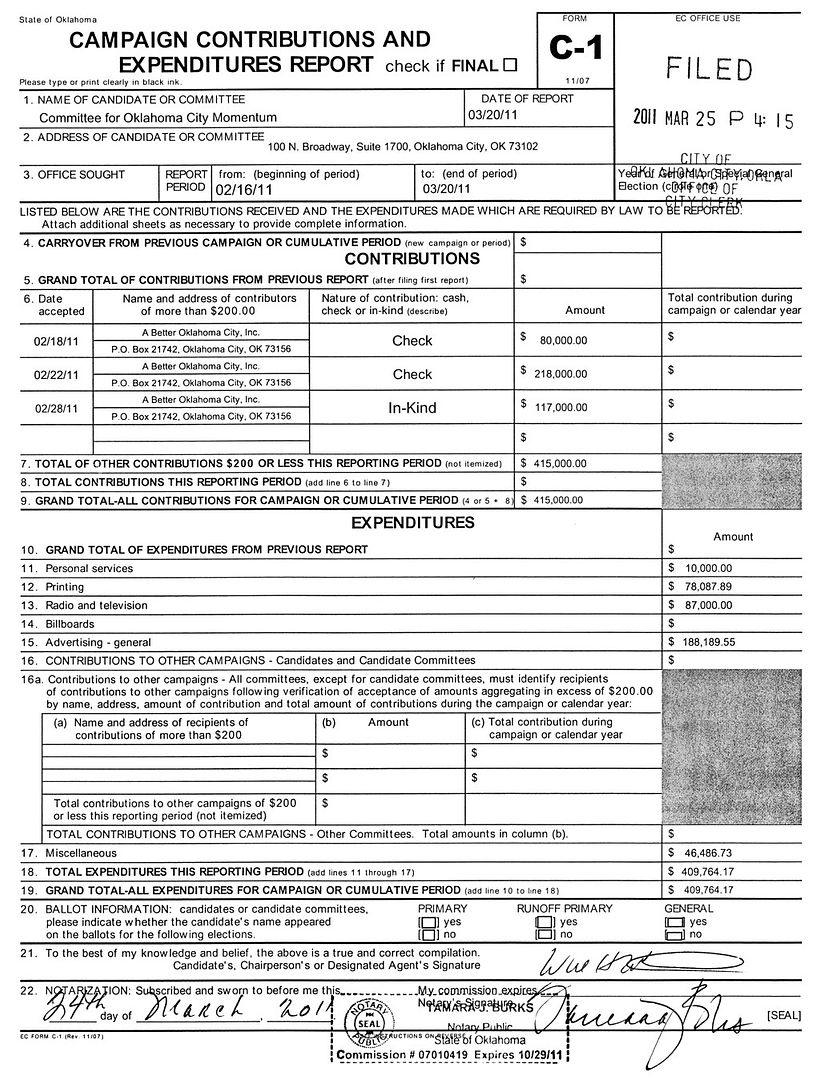
I'm having trouble understanding the current Ward 2 council race right now. Has there even been such a big-money council race in OKC's history?? The total amount being spent on this one inner north side ward is in the ballpark of a HALF MILLION DOLLARS. The "Committee for Oklahoma City Momentum" has pumped $409,000 into the races, a disproportionately large portion of it ($166,000) on behalf of Charlie Swinton. Charlie Swinton himself has directly pumped $104,000 of his own money into his campaign, and raised other contributions as well.

That's $270,000+ for ONE candidate in this race. This coming from the candidate who earlier in the race said, "When you are in a race with someone who has unlimited resources, you've got to keep running, and I don't have those kinds of resources..." His opponent is local doctor Ed Shadid. Dr. Shadid's campaign has raised $78,000. Perhaps Shadid should have made the poverty plea instead?

Another bone to pick with Swinton. It is absolutely impossible to get in contact with him, and I'm not alone in feeling that way. M3 Streetcar Subcommittee member Jeff Bezdek attempted to get in touch with Swinton after he made some disparaging comments toward rail. Swinton declined to meet this esteemed community member, who has been a very important person in the MAPS 3 process. Others have found it impossible to talk to Swinton, unless you come with a check in hand. I haven't been able to even load Swinton's website, and on his Facebook he has no contact info. He is un-reachable.

Not only does Dr. Shadid have contact info on his website which is perfectly accessible as well, but Shadid actually emailed me last month. He wanted to have a chat over coffee about issues facing the city, and talk about issues of urban planning, walkability, sustainability, and quality of life I assume. Not only did he say he was interested in these issues but he said he likes my blog. OK, well that was awfully nice of him, although I imagine he is way too busy right now to spend time reading a blog for crying out loud. I don't even know if Shadid really does read this blog, but given the way I see the "real" issues facing OKC, even if he just saw the blog and contacted me I think that says a LOT about how he sees the issues facing OKC.

So while Swinton is un-reachable, Shadid is extremely reachable. That's good in someone who is running for council. If you can't even reach a candidate, imagine how they will ignore the citizens once they're in office?

A third bone to pick with Swinton: Mudslinging. Shadid has ran a campaign arguing for more sustainability and actually producing innovative ideas. Often they are ideas about how to improve OKC's sustainability. Swinton has meanwhile used this to portray Dr. Shadid as some Green Party terror activist-extremist person, "Too extreme for Oklahoma," and the works. A very typical, unimaginative, and tired campaign line. Dr. Shadid is none of these things. In fact, Swinton took a $1,000 check from the esteemed State Representative Al McAffrey, the only openly gay representative in the state house. The Campaign for OKC Momentum is a chamber front whose goal is move the convention center up the list of MAPS3 priorities at the expense of other projects. Just calling a spade. If anything, Swinton is "too extreme for Oklahoma." And I like McAffrey, he's a cool guy that just represents his district. I like the Chamber a lot, their hard work moves OKC forward. Just pointing out how hypocritical Swinton is with his politicizing of the ward race.

Maybe that's just a poster you don't want to stand in front of, but I think it's refreshing to see someone actually "stick up" for the greenies. I would also point out that the outgoing Ward 2 councilman, Sam Bowman (who is extremely well-respected), also has a picture taken in front of a Sierra Club poster. Was Bowman "too liberal for Oklahoma" ?? What does that even mean for a CITY COUNCIL race?

It's just sad that politicizing these things often works. Look at how Mayor Mick won his first election, in a race that was Jim Tolbert's (Full Circle owner, Bricktown developer) to lose. Cornett blasted him as being an "old liberal crank" and surged to victory. This plays out time after time...

Wednesday, February 9, 2011

Chesawhat???

Something has me stumped. Can someone explain how Chesapeake has been able to demolish everything between I-44 and Nichols Hills without ever showing their cards, ever alluding to an overall plan, anyone ever knowing about it until the buildings are gone, ever actually presenting a masterplan to the city, or anything of that sort?

First of all, let me say I'm not suggesting a conspiracy, I'm truly stumped. What has me stumped is how you ca drive down 63rd and every time it's a new experience seeing another mid-rise office building gone, and you're asking yourself, "Wait, I know there was an apartment complex right there last week?? I had a friend who lived there. What on earth??" It's bizarre.

If you scour the city council agendas you will never find any mention of Chesapeake. So what is the process for this? For instance, Chesapeake demolished the funeral home long before they ever announced Whole Foods, even though it was a done deal long before. Why wait so long to make these plans public? I don't get it.

There's a great old brick office building, built in the style of most OKC Public Schools (so I guess it's an old school), that now has yellow tape around it and boarded up windows. In fact, if anyone drives by it tomorrow, they'll probably be scratching their heads wondering where it went. Or maybe someone will send me an email telling me it's already gone. Or maybe it's being gutted and renovated instead. But there's no way to tell! We'll never know, until it's finished! (I'm hoping that my writing style at this point conveys a sense of facetiousness) To be clear, I think it is going to be renovated, and not torn down.

Very frustrating, though. How are they able to get away with forcing people out of their homes left and right, demolishing virtually an entire chunk of the city in the middle of the night, and then waiting until the building permit is already in-hand to announce what it's going to be, if we're lucky? I mean, there's normally a long drawn-out process where we get to see what developers are planning. The city typically has to approve construction projects. We do not have "commercial use by right" zones like some other cities (to my knowledge), which don't require an approval process as long as there's no zoning change. We have a review process that is important in this city.

Right now, all we know is that Chesapeake has the "Triangle at the Curve" under construction now (Whole Foods, likely other big tenants), and has applied to demolish some more houses in the neighborhood behind Classen Curve for more Balliet's parking. Also, most interestingly, Stanton Young (as a long-term OCURA guy, probably one of the most informed people about development in this town), filed a suit against Chesapeake to derail plans to build 5-story condos behind his Nichols Hills mansion. Chesapeake's response: We have no such plans. Riiiiight... (the case was dismissed)

Friday, January 28, 2011

Comment on J. Park post..

I meant to respond to this earlier, but my own life has been insanely busy of late. A comment on last week's Jefferson Park post read:

"If want to see the derelict properties just take that pleasent walk down Robinson and look to the east side of the street. Better yet go down 24th towards Walker to enjoy the abondon lots and section 8housing. I am not saying the neighborhood does not have potential but I would not call it the model for what OKC should be doing."

So, I decided to do a photo tour of the aforementioned areas. Now, I forgot to check out 24th, but I already know it has some renovated apartment buildings and abandoned lots (so the above comment is half right), and there may be one or two Section 8 buildings too, but I'm not sure on that. I do know it has a few renovated upscale apartment buildings though.


Robinson really is a pleasant walk. It has a great median, with great trees, and once the median ends on the north side of Goodholm Park, it's still a pretty decent road with a good sidewalk and lots of trees. The apartment that line both sides of Robinson south of the park are called Brentwood Terrace, and you can actually tour some of their units here. But be warned: The walls are freshly painted, rooms are well-decorated, and the flooring is fresh..in other words they are a perfect example of Jefferson Park blight.

Goodholm Park really is the center of the neighborhood, especially with the way it is oriented around it. Here is the view of Robinson looking east from the park. I am a fan of these great old apartment buildings and rowhouses that line the east side of Robinson continuously all the way from 23rd to 36th. I'd hardly call them eyesores. Some aren't in great condition, some are meticulously renovated upscale properties, some are in between. The whole wall of them needs to be preserved and owners will continue to bring them up.

Is J. Park really a model for neighborhood redevelopment in OKC? I think that answer is undoubtedly yes. 200% yes. The simple reality is that J. Park is obviously not as nice and meticulous as Mesta Park and Heritage Hills. But the majority of OKC does not look like Heritage Hills. The majority of OKC, particularly historic parts of OKC, looks more like J. Park, or to put it in context, like J. Park did in the 80s and 90s when it had one of the highest crime rates in the entire city. How far it has come and the things it has done, which any neighborhood could do, in my opinion do make it the model neighborhood, more so than Mesta Park. That's not to say Mesta hasn't come a long ways from the 80s when most of its grand homes were foreclosed on, but Mesta is very elite and J. Park is clearly not elite, but still becoming a great neighborhood.

The JPNA and others doing a lot of good work in J. Park are doing a lot of things right. They pursued the beautification of Goodholm Park, new neighborhood signage, new construction that perfectly, matches historic period design, preservation of structurally sound historic bungalows, and the renovation of apartment buildings. It is no secret that a lot of OKC neighborhood have smaller bungalows and a few apartment buildings instead of stately mansions. JP turned that into a strength, and not a weakness.