Go get 'em, Steve. Apparently a number of Heritage Hills residents are raising concerns about the quality of The Edge project by Gary Brooks.
Look, I didn't like the project BEST, but I can admit it's a good project. I moved on from arguing about OCURA/Alliance's flawed selection process, and if I can move on from something, that's probably saying a lot.
But for Heritage Hills residents, I guess paying a whopping $1,000/mo rent for a 1 br apartment will spoil the neighborhood. Are these people pretending there aren't still a few flophouses still in operation around Mid-town??
Brooks has done nothing but reassure skeptics of his development with moves like the recent announcement that they'll pursue LEED certification (silver, as I recall). This will be the first LEED certified mixed-use project in Oklahoma, a designation that was probably going to go to Grant Humphreys' Flatiron before that project died.
I am a critical guy, that secret is certainly out. I am also going to be pretty outspoken about my criticisms, as I was with this project for a while. What I love, and I mean really love (what keeps me going), is when I can admit I was wrong and I have to eat my own words. I'm happily eating my words so far on this project, but I don't want to knock on wood since The Edge only just got the building permit this month.
Perhaps some Heritage Hills residents will also enjoy eating their words once this project is a pleasant surprise to them. I think it will be an excellent contribution to Mid-town.
Everything you could possibly want in this project is there: They made site plan concessions to incorporate the streetcar curve, this will be very transit-oriented. They added ground floor retail when the city pressed them on it. And as I've repetitively mentioned, it will be LEED. I think that the targeted demographics (young professionals looking to pay $1,000/mo for 1 really nice bedroom) is also just perfect.
Showing posts with label development. Show all posts
Showing posts with label development. Show all posts
Thursday, January 12, 2012


Friday, December 23, 2011
LEVEL update pics


Construction update on LEVEL: Friday, Dec. 23rd, 2011. The stucco was being applied to the south edifice--it's definitely a great touch, and looks even better than in the renderings. This is great news for those who were slightly disconcerted that the stucco might be mistaken in appearance for EIFS. The black-gray brick on the street level has been added to the east side, along Walnut Avenue, and boy is it sharp as well. Think Central Avenue Villas.
Even better is the idea that -shocking- we can take a developer at his word when he says he will design and build a quality project.
Tuesday, August 2, 2011
The game of downtown retail
I did a very, very bad thing. I sent an email many months ago to Alison Oshel, who is the wonderful Director of Community Redevelopment at the Greater OKC Chamber and did not read that she got back with me until just now. This is an especially egregious accident on my part, considering that I wrote a pretty negative appraisal of the job she is doing. She responded, basically informing me of what she does, as if she needs to. I then apologized and asked her if I could ask a few questions, which I'd put up as an "interview" on here. It probably looks like I ignored her and disrespected her, but sometimes you lose track of emails, and I feel very bad about this.
But here is the interview, and you can compare/contrast this with a rather negative post that I wrote back in 2009.
Q: How does the Chamber, or you specifically, go about recruiting retail for OKC?
A: We provide market research and site analysis. The research is assembled into marketing materials that are disseminated to our area brokers and developers for use in their recruitment efforts. We provide site analysis as needed and we update our market research continually. I have attached some samples of the marketing materials we compiled this year.
Q: What are some specific examples of this process at work?
A: We target retailers not yet in our market and meet with them. We have met with Whole Foods, COSTCO, REI, California Pizza Kitchen, Urban Outfitters, Anthropologie, Paper Source, Free People and at least a dozen others and most have indicated an initial interest in our market after we were able to demonstrate to them that OKC is a large market with high disposable income. Several of these prospects have been here for multiple site visits and at least two have requested site analyses for locations that they have zeroed in on. I believe we will see 1 or 2 of those listed above in our market within 18-24 months. We have NOT met with Nordstrom’s because they notoriously expect a giant public incentive (I heard in one case $40 million!) to come to any new market.
Q: What kind of efforts are made at conventions and on the road to meet with retailers?
A: We lease space at the International Council of Shopping Centers (ICSC) convention and build a booth with meeting rooms and a reception area. We offer our meeting rooms and brochure racks to any OKC broker or developer to use during the convention. This is the largest outlay of cash from our retail program but, in the good years, more than 55,000 retailers and developers attend this convention so it is a must for anyone trying to promote retail. Because space at the show is expensive, some of our area brokers/developers are extremely appreciative of having the ability to host their meetings in our space. This is not a trade show—it is a place to have meetings and to make deals. Both Jane Jenkins and Jim Cowan were our guests at this convention this past April.
Q: Every area of the metro, except downtown, was recently in store for a lifestyle center (most of these are now stalled)--how does downtown compete, and what is the plan for making downtown stand on its own as a feasible retail market?
A: We target national retail developers who have downtown development experience. We have met with a number of these firms to talk with them about and invite them to consider developing in Core to Shore. There are opportunities which exist in Core to Shore for concentrated retail which do not exist anywhere else in downtown. We have hosted site visits for a number of national developers. I am hosting a group from Atlanta today and tomorrow, in fact.
It’s not, by any stretch, an easy game and the fruits of our efforts which began in 2007 are just now starting to yield results. Whole Foods, and other retailers like them, already had their 2010 store openings announced when we first met with them in 2007—so if we don’t get a Whole Foods in 2010, it shouldn’t surprise anyone. But if we do get a Whole Foods in 2010, I believe the Chamber’s retail program can claim some credit. The Chamber lays the groundwork with our marketing materials and research to help “make the sale” but we must have good retail shopping centers to offer retail prospects so our development and brokerage community is tasked with “closing the deal”. So, I guess I’m saying it takes a village and, thankfully, we do all seem to be working in concert.
Lastly, retail is the hardest type of real estate development to get financed right now so as much as you may not like hearing it, the national economy has slowed or stopped much of the progress that was being made. A number of the developments that you mentioned are back to the drawing board, changing their mix of retail, housing, office and hotel space in order to get their projects financed. I am hopeful that the strong will survive and we will see some quality developments when the cloud lifts.
/end response
________________________________________
I think that is very interesting, and extremely true, that you can have the best retail development task force in the world, and if you don't have any decent developments for retailers to lease space in, you won't get the retailers. I think since this email, some of those retail development goals HAVE been met with success. We now have Whole Foods, Anthropologie, and an outlet mall--major kudos to Ms. Oshel.
I think the answer to this dilemma is obvious. We need more space, and if downtown had desirable retail space, Oshel, Jane Jenkins, and others, would work hard to get it filled with great tenants. But all of these very-capable professionals can't make banks loosen financing, and can't make developers come up with resources to put into a project featuring downtown retail. And it won't happen until there is a large, desirable, contiguous development for retail to go in--one storefront here and there won't do it, these prestigious retailers like to locate together.
OKC Business newspaper agrees, as the subtitle on an article from yesterday reads: "Despite interest from national high-end retailers, until a suitable lifestyle center is built, they won’t come"
But here is the interview, and you can compare/contrast this with a rather negative post that I wrote back in 2009.
Q: How does the Chamber, or you specifically, go about recruiting retail for OKC?
A: We provide market research and site analysis. The research is assembled into marketing materials that are disseminated to our area brokers and developers for use in their recruitment efforts. We provide site analysis as needed and we update our market research continually. I have attached some samples of the marketing materials we compiled this year.
Q: What are some specific examples of this process at work?
A: We target retailers not yet in our market and meet with them. We have met with Whole Foods, COSTCO, REI, California Pizza Kitchen, Urban Outfitters, Anthropologie, Paper Source, Free People and at least a dozen others and most have indicated an initial interest in our market after we were able to demonstrate to them that OKC is a large market with high disposable income. Several of these prospects have been here for multiple site visits and at least two have requested site analyses for locations that they have zeroed in on. I believe we will see 1 or 2 of those listed above in our market within 18-24 months. We have NOT met with Nordstrom’s because they notoriously expect a giant public incentive (I heard in one case $40 million!) to come to any new market.
Q: What kind of efforts are made at conventions and on the road to meet with retailers?
A: We lease space at the International Council of Shopping Centers (ICSC) convention and build a booth with meeting rooms and a reception area. We offer our meeting rooms and brochure racks to any OKC broker or developer to use during the convention. This is the largest outlay of cash from our retail program but, in the good years, more than 55,000 retailers and developers attend this convention so it is a must for anyone trying to promote retail. Because space at the show is expensive, some of our area brokers/developers are extremely appreciative of having the ability to host their meetings in our space. This is not a trade show—it is a place to have meetings and to make deals. Both Jane Jenkins and Jim Cowan were our guests at this convention this past April.
Q: Every area of the metro, except downtown, was recently in store for a lifestyle center (most of these are now stalled)--how does downtown compete, and what is the plan for making downtown stand on its own as a feasible retail market?
A: We target national retail developers who have downtown development experience. We have met with a number of these firms to talk with them about and invite them to consider developing in Core to Shore. There are opportunities which exist in Core to Shore for concentrated retail which do not exist anywhere else in downtown. We have hosted site visits for a number of national developers. I am hosting a group from Atlanta today and tomorrow, in fact.
It’s not, by any stretch, an easy game and the fruits of our efforts which began in 2007 are just now starting to yield results. Whole Foods, and other retailers like them, already had their 2010 store openings announced when we first met with them in 2007—so if we don’t get a Whole Foods in 2010, it shouldn’t surprise anyone. But if we do get a Whole Foods in 2010, I believe the Chamber’s retail program can claim some credit. The Chamber lays the groundwork with our marketing materials and research to help “make the sale” but we must have good retail shopping centers to offer retail prospects so our development and brokerage community is tasked with “closing the deal”. So, I guess I’m saying it takes a village and, thankfully, we do all seem to be working in concert.
Lastly, retail is the hardest type of real estate development to get financed right now so as much as you may not like hearing it, the national economy has slowed or stopped much of the progress that was being made. A number of the developments that you mentioned are back to the drawing board, changing their mix of retail, housing, office and hotel space in order to get their projects financed. I am hopeful that the strong will survive and we will see some quality developments when the cloud lifts.
/end response
________________________________________
I think that is very interesting, and extremely true, that you can have the best retail development task force in the world, and if you don't have any decent developments for retailers to lease space in, you won't get the retailers. I think since this email, some of those retail development goals HAVE been met with success. We now have Whole Foods, Anthropologie, and an outlet mall--major kudos to Ms. Oshel.
I think the answer to this dilemma is obvious. We need more space, and if downtown had desirable retail space, Oshel, Jane Jenkins, and others, would work hard to get it filled with great tenants. But all of these very-capable professionals can't make banks loosen financing, and can't make developers come up with resources to put into a project featuring downtown retail. And it won't happen until there is a large, desirable, contiguous development for retail to go in--one storefront here and there won't do it, these prestigious retailers like to locate together.
OKC Business newspaper agrees, as the subtitle on an article from yesterday reads: "Despite interest from national high-end retailers, until a suitable lifestyle center is built, they won’t come"
Sunday, May 22, 2011
How good developments go bad
This will be a post dedicated specifically to how developments get proposed, or rumors about, and then the developments halt and get to the point where they're dead on arrival. Since it's just a blog post, I'll make it short, and just focus on the primary reasons I've seen since I've been giving up my life to track OKC developments (kidding--well, mostly). The main reasons are unaccounted economic changes, incompetent development teams, what I like to call "strict 2009 adherence to 2007 ideas," and another big one is the limbo caused by big-ticket public projects, many of which are still up in the air.
 I will also try and relate this back today, with the implications of post-MAPS3 passage Oklahoma City. Remember: We were supposed to see all of this amazing amount of spin-off development.
 This is the Flatiron project, on Harrison Avenue, just north of Deep Deuce--proposed by Grant Humphreys who has been a successful, innovative urban developer. So what could have gone wrong (because this project is definitely been dead for a while, in spite of past efforts to revive it)? Humphreys was somewhat over-extending himself, especially at a time when he was still heavily leveraged in the Block 42 project which he finished a few years ago and has recently still been selling off the last units in that project. Block 42 was an innovative project for OKC because it combined townhomes and flats in a building with a striking urban design, so price points were high. It was also competing with several other projects within the immediate 3-block vicinity. The Flatiron project also called for a lot of mixed-use space, and I imagine it was difficult to find high-end commercial tenants to sign-up for an outpost location at a time when even Bricktown was losing retailers. It's a shame because it would have been an awesome project, but Humphreys will be back downtown, and is currently working on Carlton Landing at Lake Eufala.
 The Cotton Exchange is an especially interesting project because it's up there with the old "Factory" proposal as the projects I most wish could have happened. I won't get into the details of how much I love this project, but it would have been a great one. It offered prime commercial space right on the canal as well as with frontage on Mickey Mantle, and it also offered a good amount of residential which Bricktown badly needs. The Centennial was a huge success, so it begs the question why OKC can't support this kind of quality mixed-use development, even though we surely haven't seen much of it. The developer, Gary Cotton, was in trouble though. He didn't have the resources to pull the project off--he had a little bit of equity from the sale of the Bricktown "Mercantile" building. He needed other investors but didn't want to listen to other ideas, from what I've heard. It's still a shame that this didn't go forward because he was using the brokerage team that The Centennial used (which sold out, and still had many interested clients), and because other experienced Bricktown businessmen were offering lots of advice. He also benefited from not just lots of Oklahoman and blogosphere coverage, but even got TV news coverage, which downtown development rarely gets.
 Many people got very excited when Tom McDaniel announced that OCU wanted to move its law school to the gargantuan Fred Jones auto factory, which is an awesome historic building. The deal died when Tom McDaniel stepped down as president of OCU and a new guy came in, who didn't like the idea so much. But it's hard not to note the sequence of events: Chamber officials promise there will spin-off MAPS development, Tom McDaniel announces OCU will develop law school downtown if MAPS passes, MAPS passes, Tom McDaniel becomes chair of MAPS Citizens Oversight Board, downtown law school plans are nixed. I would chalk this one up to political problems, if the new leader of OCU doesn't like the idea, then I don't see how anyone is going to "force" him to follow through.
 For years, the Union Bus Station was a magnet for vagrants, which caused problems for the developers on both sides of the facility who wanted it gone. First, Dick Tanenbaum, redeveloper of The Montgomery on Walker, wanted to buy the bus station and close it down, and put a jazz club inside of it. It would have been a win-win, downtown didn't need the Greyhound station anymore, it was a blight, it attracted vagrants, he could have renovated it and turned it into a historic gem and just put a jazz club inside of it, which would have turned a problem for the neighborhood into an asset for the neighborhood. That's what you call making lemonade out of lemons. Obviously Tanenbaum, a veteran Central Oklahoma developer, had the resources to make it happen. One problem: The owner was pesky and had no intentions of moving, and was difficult to deal with. So Tanenbaum gave up and turned his files over to Nick Preftakes who was on his way to acquiring the whole block anyway. Preftakes also found the owner to be pesky, but by using his properties positioned all around the station, he was able to make it difficult for the bus station to remain there, and forced its closure that way. One problem now: The owner still doesn't want to sell to Preftakes, and harbors a grudge, seemingly. Well let's be honest, when Preftakes put up a property fence just to make it difficult for buses to make wide turns, that wasn't very nice. So I'm not sure Preftakes is going to get to include this parcel in his block in the end, anyway. I just hope the building gets restored somehow, and not leveled.
 How could I not bring this one up? haha.. The Braniff Lofts proposal, from 2006 and 2007, would have been a really vital piece toward preventing a controversy (and a tragedy) that would soon follow. A group of investors local of investors ("Corporate Redevelopment LLC"), many with significant Downtown OKC experience and have been mentioned often on this blog, were negotiating with Kerr McGee to acquire these abandoned buildings surrounding their headquarters for redevelopment purposes. The plan was to, at the very least, use the Braniff building AND the KerMac building and convert the two into lofts--the developers at the time were convinced they had a winner, and many onlookers are still convinced the proposal could have been a winner. The deal fell apart because KMG was acquired by Anadarko Energy who refused to honor the deal between the investors and KMG. SandRidge acquired the block and demolished the buildings to make way for a corporate plaza. These buildings, except for the Braniff Building which was lucky enough to already be on the historic register, are goners and lofts or mixed-use of any kind on this block will never have an opportunity to happen. I would chalk this one up to corruption at many junctions.
 It appeared to be one of the turning points of downtown development when the Downtown Ford announced it was closing and was demolished. The land owners, Fred Hall and Bob Howard announced potentially ambitious plans to redevelop the large site into a huge mixed-use development. The Jones-Hall family has been involved in other deals, and was involved in the OCU deal that fell through, and Howard has been engaged in redevelopment of of Mid-town lately, so there is no doubt that the development wherewithal and resources were in place. The site could have possibly been the largest mixed-use downtown development to date. "It's no surprise, and it fits our long-term plans to develop that site into commercial retail and housing," remarked Hall, at the time. It was lauded as a success of MAPS spin-off. Why did the deal fell through? Because it got gobbled up by a MAPS subcommittee that insisted the convention center needed to go on THE most promising piece of real estate in all of OKC.
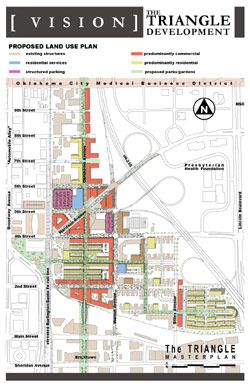 I'll make this my last one, and I think it's a big one. No matter how you slice it, The Triangle masterplan died. At a time when the possibilities for bubble-style downtown development appeared endless, the plan seemed fail-safe. A group of investors including Bert Belanger, Ron Bradshaw, among others, would team up to do a ton of development in a small area. However each one encountered difficulties selling units of their first project and then 2008 hit, and it became apparent that downtown development could not go forward purely driven by speculation on condo units. The group broke up, although they are still individually engaged in development in the "triangle" area, although hardly according to the original plan. And some new investors have popped up and added projects such as LEVEL and Aloft.
So, here you see a multitude of reasons. In every one of these cases, it is a shame that the development died, although this is not always the case--sometimes developments are bad and projects dying would be good. However, there HAS to be a way to meet over these kinds of things and compromise. Bad developments need input for improvement before they actually apply for the permit. Good developments need input to ensure their success. This goes both ways, the process shouldn't JUST be about putting pressure on bad projects. Furthermore, a lot of these reasons are preventable. Switching to a more sustainable economic model for real estate would have prevented a lot of the post-2008 development lethargy we were seeing until recently--the economy never stops, sometimes it contracts, and even that presents an opportunity (for more modest real estate deals). For instance, people still need housing when they can't afford a mortgage, which is why for-rent housing has thrived in the post-2008 economic climate. Capitalizing on that could have prevented a lot of these projects from collapsing. Also, a LOT of stuff is in limbo when we have these big-ticket items in limbo. Do you think somebody wants to build a mixed-use or housing investment when they aren't yet 100% certain where the streetcar route will go? Do you think somebody wants to invest in a huge hotel project without knowing where the new convention center and likewise, streetcar lines, will go? Of course not!
One thing that has been an absolute failure thus far is MAPS accounting for the spin-off development. It was one of the most persuasive reasons why we passed MAPS3. We wanted to buy into a vision for building a city, not just for building a single park or an isolated convention center. These things aren't being coordinated AT ALL. There is no single planning document that has more than one big-ticket public investment component in it. There are however millions of planning documents, district masterplans, streetcar route ideas, convention center proposals, and so on and so forth. Nobody is proposing that this stuff come together. Furthermore, a lot of the interests behind certain projects need to step down and realize that their project isn't the center of the universe. The end goal is spin-off development, not having a city built around a convention center. When you eat your most promising site for mixed-use development to put the convention center on it, you miss the mark. You can have your cake and eat it too. The convention center subcommittee needs to address the goals of downtown as a whole just as every other subcommittee needs to be concerned about it. Ignoring the big picture is setting us up for failure at a time that immense resources have opened up such an enormous opportunity.
Every MAPS3 subcommittee needs to be tasked with the exact goal, and it needs to be an overarching goal of what we as a city hope to create with this opportunity. Each subcommittee needs to be opening its meetings discussing this goal, whether it be attracting investment, or improving quality of life. There needs to be a singular vision shared by all. Right now what we have is a convention center subcommittee that has run amock with the process, stepping on other projects to make sure that at the very least the convention center gets done, and running completely contrary to the goal of MAPS.
These guys need to sit down and analyze universal MAPS goals. They need to ponder what they as a convention center subcommittee can do to improve quality of life and attract mixed-use development to downtown. I'll tell you one thing: You can do a LOT more to accomplish this than by eating the best real estate in the entire city for your convention center, which is going to happen anyway. That makes no sense whatsoever.
I will also try and relate this back today, with the implications of post-MAPS3 passage Oklahoma City. Remember: We were supposed to see all of this amazing amount of spin-off development.I'll make this my last one, and I think it's a big one. No matter how you slice it, The Triangle masterplan died. At a time when the possibilities for bubble-style downtown development appeared endless, the plan seemed fail-safe. A group of investors including Bert Belanger, Ron Bradshaw, among others, would team up to do a ton of development in a small area. However each one encountered difficulties selling units of their first project and then 2008 hit, and it became apparent that downtown development could not go forward purely driven by speculation on condo units. The group broke up, although they are still individually engaged in development in the "triangle" area, although hardly according to the original plan. And some new investors have popped up and added projects such as LEVEL and Aloft.So, here you see a multitude of reasons. In every one of these cases, it is a shame that the development died, although this is not always the case--sometimes developments are bad and projects dying would be good. However, there HAS to be a way to meet over these kinds of things and compromise. Bad developments need input for improvement before they actually apply for the permit. Good developments need input to ensure their success. This goes both ways, the process shouldn't JUST be about putting pressure on bad projects. Furthermore, a lot of these reasons are preventable. Switching to a more sustainable economic model for real estate would have prevented a lot of the post-2008 development lethargy we were seeing until recently--the economy never stops, sometimes it contracts, and even that presents an opportunity (for more modest real estate deals). For instance, people still need housing when they can't afford a mortgage, which is why for-rent housing has thrived in the post-2008 economic climate. Capitalizing on that could have prevented a lot of these projects from collapsing. Also, a LOT of stuff is in limbo when we have these big-ticket items in limbo. Do you think somebody wants to build a mixed-use or housing investment when they aren't yet 100% certain where the streetcar route will go? Do you think somebody wants to invest in a huge hotel project without knowing where the new convention center and likewise, streetcar lines, will go? Of course not!
One thing that has been an absolute failure thus far is MAPS accounting for the spin-off development. It was one of the most persuasive reasons why we passed MAPS3. We wanted to buy into a vision for building a city, not just for building a single park or an isolated convention center. These things aren't being coordinated AT ALL. There is no single planning document that has more than one big-ticket public investment component in it. There are however millions of planning documents, district masterplans, streetcar route ideas, convention center proposals, and so on and so forth. Nobody is proposing that this stuff come together. Furthermore, a lot of the interests behind certain projects need to step down and realize that their project isn't the center of the universe. The end goal is spin-off development, not having a city built around a convention center. When you eat your most promising site for mixed-use development to put the convention center on it, you miss the mark. You can have your cake and eat it too. The convention center subcommittee needs to address the goals of downtown as a whole just as every other subcommittee needs to be concerned about it. Ignoring the big picture is setting us up for failure at a time that immense resources have opened up such an enormous opportunity.
Every MAPS3 subcommittee needs to be tasked with the exact goal, and it needs to be an overarching goal of what we as a city hope to create with this opportunity. Each subcommittee needs to be opening its meetings discussing this goal, whether it be attracting investment, or improving quality of life. There needs to be a singular vision shared by all. Right now what we have is a convention center subcommittee that has run amock with the process, stepping on other projects to make sure that at the very least the convention center gets done, and running completely contrary to the goal of MAPS.
These guys need to sit down and analyze universal MAPS goals. They need to ponder what they as a convention center subcommittee can do to improve quality of life and attract mixed-use development to downtown. I'll tell you one thing: You can do a LOT more to accomplish this than by eating the best real estate in the entire city for your convention center, which is going to happen anyway. That makes no sense whatsoever.
Thursday, May 5, 2011
The next big development

The announcement of the Union Bus Station's closing this week prompts a discussion about this block, and more specifically, the plans of a particular developer who has slowly been acquiring all of this block. So far, with the exception of 1 city-owned office building, and this bus station that is now closing, developer Nick Preftakes has been consolidating ownership of the block--a move which began right before the announcement of Devon Tower. Such timing has many in the community questioning to what extent Preftakes and Devon are privy to each other's plans.
The most-prime piece of downtown real estate
It seems obvious that a large development is going to occur soon. I have been wondering intently for the last 2 years what exactly is Preftakes' plan for this block. There are many reasons why this is now becoming the most prime piece of real estate in downtown. They are as follows:
1. The incredible remaining historic fabric of this block, which includes three historic mid-rise buildings, and many other smaller historic buildings that form a cohesive streetwall along both Main and Hudson.
2. The nearby $750 million investment of Devon across Hudson, including the Hudson Ave frontage which will include storefronts in the new Devon garage, the Devon auditorium, and a landscaped pocket park. Thousands of new employees.
3. The improvement of Sheridan Ave further west in Film Row, which used to be known as "Skid Row"
4. The rising prominence of the Arts District and the opportunity gap for more development in that district.
5. The overhaul of the Myriad Gardens to the immediate SE as a true, active space, and more than just botanical gardens. It will now contribute to the vibrancy and activity of downtown.
6. The new downtown elementary school proposed for the site immediately to the SW, this will serve as one of the primary anchors of the downtown residential community, particularly those more family-oriented future residents.
7. The Stage Center across the street, and the countless other arts amenities within a 2-3 minute walk.
It is clear that the redevelopment of the block needs to occur with someone who embraces all of these reasons for the block's importance, and more. You can't redevelop this block and oppose Devon Tower or the Myriad Gardens, just as you can't redevelop this block and not recognize its historic importance. Granted, no buildings on this block formerly served as a state capital, but it is significant in the sheer volume of historic fabric that remains mostly in-tact on this block. Anyone who doubts this, please find a block that has more in-tact historic fabric. These buildings are unique and have a huge amount of character, they provide an opportunity for a unique development.
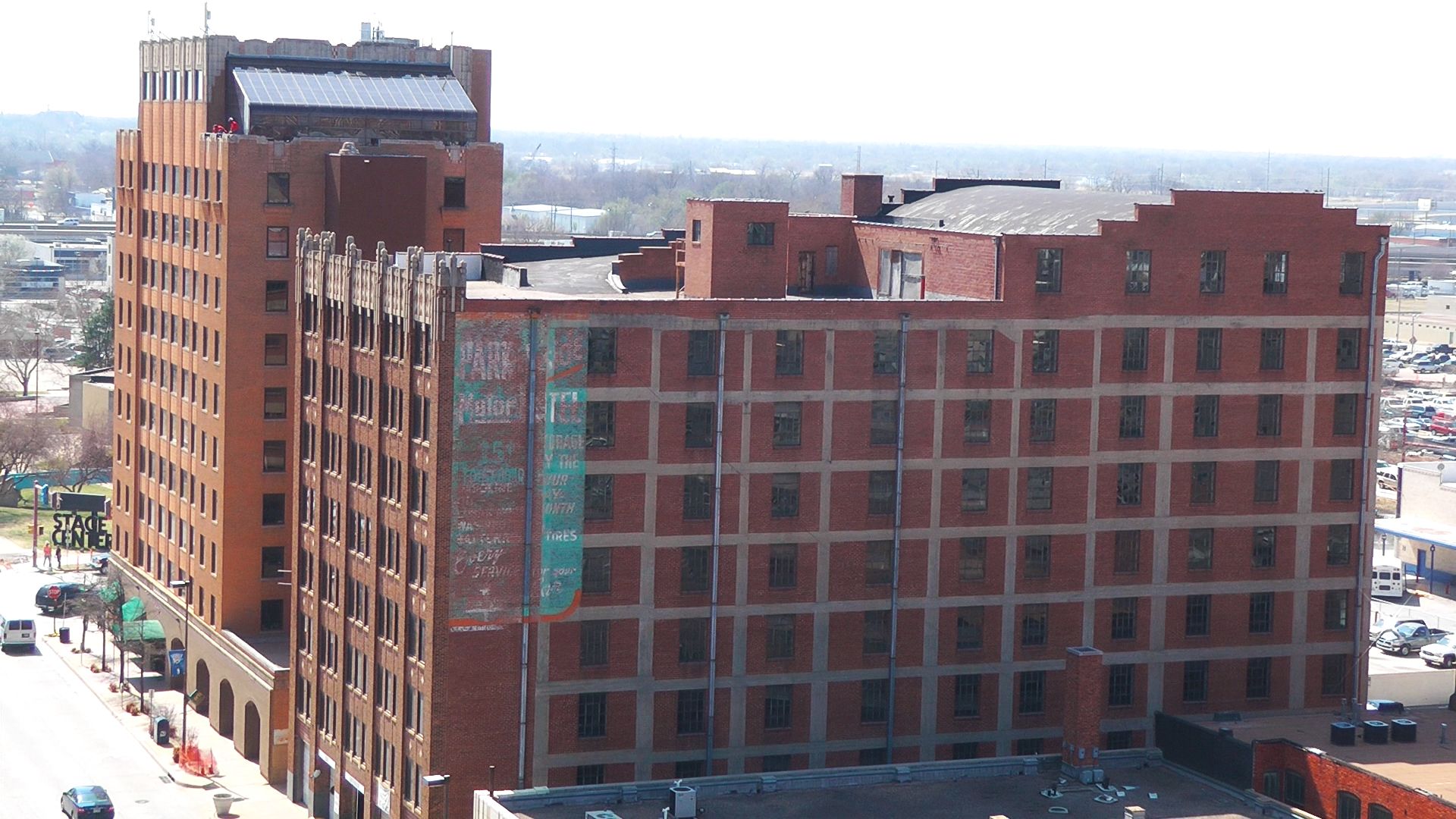 By embracing the urban and gritty character, a developer could connect this block to the history of the city and to the people who make up downtown--a move which would ensure the success of a future development. Compare it to the local attachment of Bricktown. People like historic buildings, especially when it is "made" historically relevant. Bricktown, before it was "Bricktown," was just an old warehouse district, obviously nowhere near as historically relevant as everything else we've lost. But in having so little remaining built environment from the original city, we're willing to wholeheartedly embrace a looser definition of historic relevance, and that is why we now have the Bricktown historic district.
 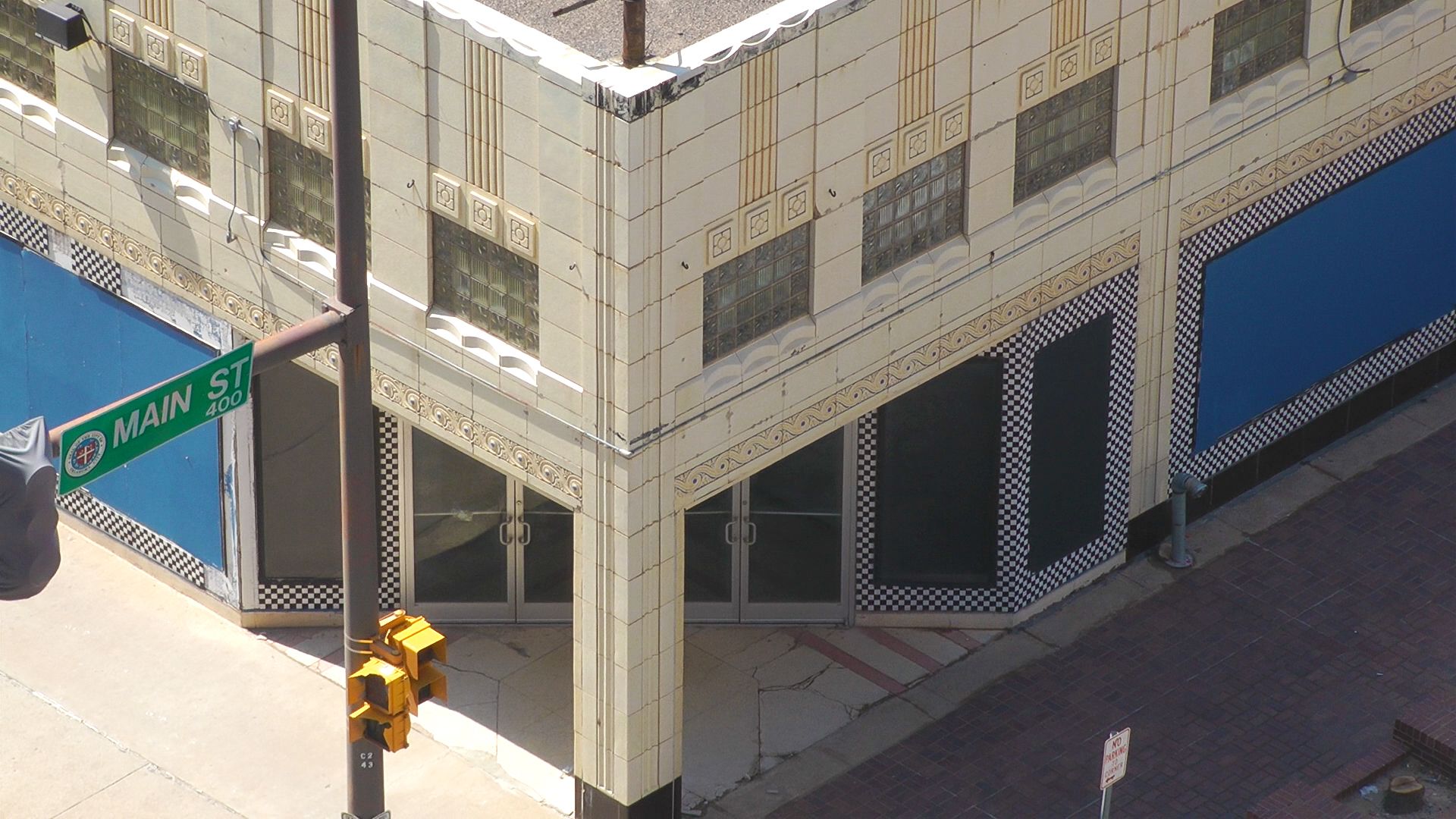 We should push for more "Bricktown" opportunities, and this could be one. The block's mid-rises, red-brick buildings of enormous quality, could make brilliant loft redevelopments. It would cost money, it would create revenue. Yes, it would involve a development deal, and making it work. The smaller buildings should be preserved, at the very least, the ones fronting Main and Hudson--these buildings fill gaps, provide invaluable character, and contribute to a cohesive streetwall--one of the things that make that stretch of Hudson and Main so attractive. The lower-rise buildings actually make perfect retail spaces--here you have a group of buildings that seems to be strategically positioned for retail, with consolidated ownership so that several retailers could come in and build necessary retail synergy,and lots of urban grit and style--the space in the former Carpenter Square Building (pictured) just screams "Urban Outfitters," whereas I could see the GAP locating in one of the Main Street storefronts. With plenty more room for other retailers, and the ability to add rooftops (housing) above, this is a great place to build mixed-use critical mass that is severely lacking downtown.
The point though is that this would be a different kind of historic district from Bricktown, which is what makes it a cool idea--this block has a decidedly more Art-Deco flair, and much denser, taller buildings. Not so much industrial, but more cosmopolitan, potentially. We don't have this kind of historically-preserved cluster in OKC--I would compare it to Washington Avenue in Downtown St. Louis, the Old Bank District in LA, or the Mercantile Bldg in Dallas. This can bring a new dimension to OKC. This could give us historic clusters of many unique flavors, with the gritty industrial vibe of Bricktown, the hey-day auto showcase vibe of Automobile Alley, and the Art-Deco cosmopolitan vibe that this block could showcase. Here, a developer could actually brand his development with its own district identity, although it should probably have an arts-based theme. This could be a huge boon to branding.
It is important that the Union Bus Station also be preserved. This is a building that could possibly make an awesome diner space. The awning next to the bus-loading area would make an awesome outdoor seating area overlooking the Myriad Gardens. The building, with its historic signage and its folksy Art-Deco architectural elements make it an awesome place to commemorate downtown nostalgia. This, if anywhere, would be a great place to open up a cool diner. It seems to be just the right size for that, too.
The question is, would Preftakes be more interested in historic preservation, or in new development? Well in the past, he's done both. Preftakes got started in the 90s, as one of downtown's very-first housing developers, with a loft project right off North Broadway. But should Preftakes be looking for brand-new revenue streams in this block, I would say there is room for new things, but in very confined spaces. The lower-rise storefronts could be added-onto, with new housing on top with staggered facades. It just depends exactly how much space is needed to make the project large enough for significant variations. In a smaller building you can't provide different price points, in a larger development that is more feasible. In the 3 mid-rise "towers" on the block, one could easily get 100 residential units, probably many more if they are smaller apartments. In the lower-rise storefronts there is room, depending whether the floors above will be connected and included in retail spaces (i.e., for larger retailers), you could presumably squeeze 100,000 to 200,000 sf of new retail space. That seems enough to get a retail critical mass going. As already discussed, the bus station is the perfect size and configuration for a new restaurant. In the middle there is currently a parking lot--the middle lot seems to be a good fit for structured parking that would even have about 100 feet of frontage on Walker--for ingress and egress. Along Sheridan, one building has already been demolished in the last year. The Lunch Box is presumably next. If new development space is necessary, here along Reno (between the bus station and the Hightower Bldg) is a very large lot that could make way for new development, across from the Stage Center. Here, a developer such as Preftakes could build whatever he wants, whether it be office, or an even larger concentration of residential--a use that would seem strategic given the nearby Devon Tower.
Please, no SandRidge!
But one thing is clear, the historic context of this block must be preserved. I would be okay with letting the Lunch Box go to consolidate some empty lots fronting Sheridan for new development. Actually, I would rather that one building have not been demolished, and I would rather see the Lunch Box either stay there or a cool new use for the building, but this is the extent of demolition that I'd be willing to see. I can see where it might make more sense from a development-financing standpoint to consolidate those lots. But one thing is clear, this block is primed to become one of the largest mixed-use developments that downtown has ever seen. The rumored involvement of a particular energy corporation across the street also brings intriguing possibilities. For one, I am excited that players with so much available capital are interested in doing things downtown. I look forward to seeing what comes next.
But, please, no SandRidge! We still have huge respect for Devon! We're talking about a name that could presumably have its way (as opposed to a particular wanna-be "energy giant" under the leadership of a strongly disliked personality), but here is hoping that "Devon's way" continues to be the best way for downtown.
Friday, February 18, 2011
The latest on UNP
Here is the new updated flier for the University North Park project. This is an absolute crime. That whole deal is as corrupt as it gets. The old switch and bait, once the citizens give the developer the TIF he wants.
What's a shame is that there are other developers who build shoddy strip mall crap, probably a little better than this, who still play by the rules and pay property taxes and don't get the city to build parks and infrastructure for them. What kind of a message does this say toward that? What kind of a message does this say in terms of validating the free market? All this is: corruption, cronyism, lack of vision, and incompetence.
And the saddest thing is that OU's foundation was behind this project from the beginning.
What's a shame is that there are other developers who build shoddy strip mall crap, probably a little better than this, who still play by the rules and pay property taxes and don't get the city to build parks and infrastructure for them. What kind of a message does this say toward that? What kind of a message does this say in terms of validating the free market? All this is: corruption, cronyism, lack of vision, and incompetence.
And the saddest thing is that OU's foundation was behind this project from the beginning.
Sunday, February 13, 2011
Choctaw Town Square
Interesting things happening in Choctaw. They actually broke ground on their new Town Square development, at 23rd and Henney.
Somewhat, urban? Interesting indeed.
Choctaw Town Square Development from Mark Seibold on Vimeo.
Somewhat, urban? Interesting indeed.
Wednesday, February 9, 2011
Chesawhat???
Something has me stumped. Can someone explain how Chesapeake has been able to demolish everything between I-44 and Nichols Hills without ever showing their cards, ever alluding to an overall plan, anyone ever knowing about it until the buildings are gone, ever actually presenting a masterplan to the city, or anything of that sort?
First of all, let me say I'm not suggesting a conspiracy, I'm truly stumped. What has me stumped is how you ca drive down 63rd and every time it's a new experience seeing another mid-rise office building gone, and you're asking yourself, "Wait, I know there was an apartment complex right there last week?? I had a friend who lived there. What on earth??" It's bizarre.
If you scour the city council agendas you will never find any mention of Chesapeake. So what is the process for this? For instance, Chesapeake demolished the funeral home long before they ever announced Whole Foods, even though it was a done deal long before. Why wait so long to make these plans public? I don't get it.
There's a great old brick office building, built in the style of most OKC Public Schools (so I guess it's an old school), that now has yellow tape around it and boarded up windows. In fact, if anyone drives by it tomorrow, they'll probably be scratching their heads wondering where it went. Or maybe someone will send me an email telling me it's already gone. Or maybe it's being gutted and renovated instead. But there's no way to tell! We'll never know, until it's finished! (I'm hoping that my writing style at this point conveys a sense of facetiousness) To be clear, I think it is going to be renovated, and not torn down.
Very frustrating, though. How are they able to get away with forcing people out of their homes left and right, demolishing virtually an entire chunk of the city in the middle of the night, and then waiting until the building permit is already in-hand to announce what it's going to be, if we're lucky? I mean, there's normally a long drawn-out process where we get to see what developers are planning. The city typically has to approve construction projects. We do not have "commercial use by right" zones like some other cities (to my knowledge), which don't require an approval process as long as there's no zoning change. We have a review process that is important in this city.
Right now, all we know is that Chesapeake has the "Triangle at the Curve" under construction now (Whole Foods, likely other big tenants), and has applied to demolish some more houses in the neighborhood behind Classen Curve for more Balliet's parking. Also, most interestingly, Stanton Young (as a long-term OCURA guy, probably one of the most informed people about development in this town), filed a suit against Chesapeake to derail plans to build 5-story condos behind his Nichols Hills mansion. Chesapeake's response: We have no such plans. Riiiiight... (the case was dismissed)
First of all, let me say I'm not suggesting a conspiracy, I'm truly stumped. What has me stumped is how you ca drive down 63rd and every time it's a new experience seeing another mid-rise office building gone, and you're asking yourself, "Wait, I know there was an apartment complex right there last week?? I had a friend who lived there. What on earth??" It's bizarre.
If you scour the city council agendas you will never find any mention of Chesapeake. So what is the process for this? For instance, Chesapeake demolished the funeral home long before they ever announced Whole Foods, even though it was a done deal long before. Why wait so long to make these plans public? I don't get it.
There's a great old brick office building, built in the style of most OKC Public Schools (so I guess it's an old school), that now has yellow tape around it and boarded up windows. In fact, if anyone drives by it tomorrow, they'll probably be scratching their heads wondering where it went. Or maybe someone will send me an email telling me it's already gone. Or maybe it's being gutted and renovated instead. But there's no way to tell! We'll never know, until it's finished! (I'm hoping that my writing style at this point conveys a sense of facetiousness) To be clear, I think it is going to be renovated, and not torn down.
Very frustrating, though. How are they able to get away with forcing people out of their homes left and right, demolishing virtually an entire chunk of the city in the middle of the night, and then waiting until the building permit is already in-hand to announce what it's going to be, if we're lucky? I mean, there's normally a long drawn-out process where we get to see what developers are planning. The city typically has to approve construction projects. We do not have "commercial use by right" zones like some other cities (to my knowledge), which don't require an approval process as long as there's no zoning change. We have a review process that is important in this city.
Right now, all we know is that Chesapeake has the "Triangle at the Curve" under construction now (Whole Foods, likely other big tenants), and has applied to demolish some more houses in the neighborhood behind Classen Curve for more Balliet's parking. Also, most interestingly, Stanton Young (as a long-term OCURA guy, probably one of the most informed people about development in this town), filed a suit against Chesapeake to derail plans to build 5-story condos behind his Nichols Hills mansion. Chesapeake's response: We have no such plans. Riiiiight... (the case was dismissed)
Saturday, December 25, 2010
Christmas Wishlist 2010
As today happens to be Christmas Day, I thought I would take some time to lay out my ideal wishlist for OKC. It could be a lot longer obviously, as virtually everything could be done differently, more efficiently, and better. But I'll stick to the main points:
 1. One thing I wish for is a serious Plan OKC process. In the coming weeks I am going to be trying to get together an urbanist group to do a Plan OKC "Meeting in a Box" over one evening. I would actually like to see OKC implement some innovative ideas (maybe even some that would make city planning conspiracy theorists' eyes bulge) that could legitimately curb sprawl. I'd like to see us creating fewer places devoid of real lasting value (thus creating future SLUMS) and like to see us move some more of our growth into the kind of development that will still be nice 30 years from now, and even still standing 100 years from now. I'm tired of cheap and low-quality being Oklahoma City's best selling-point. Even if that means prices are going to rise, we have to find a way to start building quality communities and to stop building slightly better than crappy communities. A friend once told me that OKC's motto is, "Better than crappy makes us happy." It's true, and how said is that?
 2. When it comes to one of OKC's latest greatest projects with a 7-digit price tag, I'm not even going to say I hope for any kind of abstract, feel-good process with the convention center like an open or transparent process. I could care less about that at this point, because the bottom line is that if the convention center is right next to the park with no separation, it will ruin the park environment. If they think putting commie block apartments in the convention center facade is going to work, they must be kidding themselves. A convention hotel is not a mixed-use from a convention center, either. They need to either put the convention center somewhere else or if they insist on the mysterious OG+E payments, then they need to utilize my creative solution to set it back an entire block and bring Broadway back, allowing for a slender 1x4-block district to develop in between the two. The ULI panel noted that the convention center is being put on 40% more land than it needs, even if it's going to be expanded. Furthermore, I'm tired of the suburban thinking behind Core2Shore. There are block sizes and human scales that actually matter downtown. I get it that they don't understand or care about this, but you can't just recreate a site identical to what you'd do in the suburbs and put it downtown. In the suburbs you wouldn't notice an area (similar to what would end up running all the way from Park Avenue to Oklahoma River) that consists of over 100 normal sized city blocks consolidated into about 15 huge superblocks. Right now we have a large cluster of superblocks that has killed downtown, and ALL Core2Shore looks like it will do at this point is extend that huge miserable cluster further south. Has anyone noticed how the Myriad Convention Center and the Myriad Gardens interact with eachother?? "Oh, but it will be different this time.." If anyone buys that the nature of superblocks have changed, or that they can do the exact same thing and get a better result, they need to be locked up in the mental ward. Or shipped to Tulsa.
3. Come on Nick, tell us what you're planning. I mean Nick Preftakes, not myself. Years later I am still dying to find out what Nick Preftakes is planning to do with the entire block he bought up in the Arts District. I've been telling people it's going to be a game changer, especially with Devon Tower+park+retail+auditorium and the emergence of the Film Row area (which is coming along very nicely), the Arts District could potentially be unrecognizable if Preftakes announces a major development there. It will be absolutely essential that he maintains the historic integrity of the very-historic block, but there are some boarded up buildings there with some really amazing potential. It would be so worth it, especially when you look at the new lease on life the old Montgomery Ward building across the street got. The unfolding of these plans could potentially affect other things like the streetcar route. I've been telling people that I think the Arts District could potentially be a much bigger deal than it is now.
 4. I want to see development in Bricktown get back to where it could be. I wish for Bricktown to come closer to being "completed" because once other districts get hot, it may never be able to attract more development. The big problem is that in my opinion Bricktown has gotten stale and has failed to reinvent itself in a long time, and in today's world, that can be fatal. Bricktown could suffer the same death that the West End did for a period if it fails to reinvent itself and stay fresh. It's not just for the sake of locals who have started to focus more on districts that are hotter right now, but for developers who are comparing cheaper asking prices somewhere like 10th Street or Broadway to astronomical ridiculously inflated asking prices in Bricktown, and the choice to pass on Bricktown becomes an easy one. I think Bricktown is relying too much on the streetcar spurring development along Sheridan to bother pursuing other ideas. The city absolutely is to blame, not the Bricktown merchants that put their money where their mouths are. Just because the ballpark and canal are in Bricktown doesn't mean that it's reached some invisible limit for how much city assistance a neighborhood can receive. Has the city turned its back on Bricktown?
5. The Bricktown point is a great segway into parking. Simply put, two things need to happen: It needs to be expressly codified into the city statutes that new surface parking downtown will not be tolerated, especially in lieu of previously standing buildings no matter the condition of said building, and parking lot moguls in areas like Bricktown need to be shut down and put out of business. Tell them to take their business to Tulsa or some city that will tolerate that, but we won't here in OKC, because a few of us are actually serious about building downtown up. How do you shut down the Bricktown parking lot lords? Public parking, and that can be done extremely easy. Watch closely a project that is underway with Automobile Alley to re-stripe North Broadway and take away a lane, add a turning lane, and change parallel parking to angled parking which will allow them to squeeze in hundreds more parking spaces. If they went with angled parking along every Bricktown street that is free or metered, they could easily shut down the Bricktown parking lots because more than enough parking would be available for free on the street. This should also be pursued in other districts if the results in A-Alley are as positive as it could very well turn out.
6. Oklahoma City has failed to grow downtown housing to the extent that we had hoped we would have by now. This is a simple fact in spite of the other fact that downtown housing is slowly on its way to becoming viable, with several hundred downtown residents moving in and taking up urban lifestyles. It could be more, it should have been more. The 2005 Downtown Housing Study said there was 5-year demand for thousands more units than we ended up getting built between 2005-10. Another downtown study that came out right around there recommended taking several steps to incentivize downtown development. Virtually none of those steps, except for rezoning, were actually followed through with. I assume the copies of it at the Planning Dept got filed in the big file cabinet full of other ignored downtown studies and surveys and reports and commissions. But it may be time to develop a REAL program designed to result in a boom in smaller infill projects. This needs to happen now, so that we can fix the problem with demand, before streetcar comes on line and results in a huge boom in infill and therefor makes the appearance of a problem go away. If we get the streetcar finished without an infill program, the results aren't going to be as positive as it would be if we got the streetcar in and an infill program. We need to evaluate our goals from 5 years ago, and the results we got, consider why it ended up that way (and be open-minded to reasons other than the popular excuse, "It's the economy, stupid"), and get back on track to recover lost projected units.
7. I want to see Full Circle move downtown. They could locate smack in between Heritage Hills and the booming downtown residential market. Downtown residential markets tend to be filled with creative types with disposable income WHO READ. If they went into a beautiful old building like The Packard at 10th/Robinson they'd have the potential to be one of the absolute coolest locally-owned bookstores in America. They already are, the only thing holding them back is their location in crappy (and rapidly-emptying) 50 Penn Place. Enough said.
Well that's the Top 6 at least. Quick summary: 1, Plan OKC; 2, convention center location; 3, Nick Preftakes development; 4, Bricktown development; 5, angled parking; 6, small infill program; 7, Full Circle.
I am thankful for all the really good things going on in OKC, for being included in a number of processes unfolding around downtown right now, and it's also good to be back in town. If anyone's interested in meeting for coffee or lunch, feel free to let me know, I'm always excited to meet with fellow urbanists. I know this blog doesn't get a lot of comments by the nature of the things it talks about, but I do appreciate the people who read this and hear me out on the ideas I have. Merry Christmas to all!
2. When it comes to one of OKC's latest greatest projects with a 7-digit price tag, I'm not even going to say I hope for any kind of abstract, feel-good process with the convention center like an open or transparent process. I could care less about that at this point, because the bottom line is that if the convention center is right next to the park with no separation, it will ruin the park environment. If they think putting commie block apartments in the convention center facade is going to work, they must be kidding themselves. A convention hotel is not a mixed-use from a convention center, either. They need to either put the convention center somewhere else or if they insist on the mysterious OG+E payments, then they need to utilize my creative solution to set it back an entire block and bring Broadway back, allowing for a slender 1x4-block district to develop in between the two. The ULI panel noted that the convention center is being put on 40% more land than it needs, even if it's going to be expanded. Furthermore, I'm tired of the suburban thinking behind Core2Shore. There are block sizes and human scales that actually matter downtown. I get it that they don't understand or care about this, but you can't just recreate a site identical to what you'd do in the suburbs and put it downtown. In the suburbs you wouldn't notice an area (similar to what would end up running all the way from Park Avenue to Oklahoma River) that consists of over 100 normal sized city blocks consolidated into about 15 huge superblocks. Right now we have a large cluster of superblocks that has killed downtown, and ALL Core2Shore looks like it will do at this point is extend that huge miserable cluster further south. Has anyone noticed how the Myriad Convention Center and the Myriad Gardens interact with eachother?? "Oh, but it will be different this time.." If anyone buys that the nature of superblocks have changed, or that they can do the exact same thing and get a better result, they need to be locked up in the mental ward. Or shipped to Tulsa.3. Come on Nick, tell us what you're planning. I mean Nick Preftakes, not myself. Years later I am still dying to find out what Nick Preftakes is planning to do with the entire block he bought up in the Arts District. I've been telling people it's going to be a game changer, especially with Devon Tower+park+retail+auditorium and the emergence of the Film Row area (which is coming along very nicely), the Arts District could potentially be unrecognizable if Preftakes announces a major development there. It will be absolutely essential that he maintains the historic integrity of the very-historic block, but there are some boarded up buildings there with some really amazing potential. It would be so worth it, especially when you look at the new lease on life the old Montgomery Ward building across the street got. The unfolding of these plans could potentially affect other things like the streetcar route. I've been telling people that I think the Arts District could potentially be a much bigger deal than it is now.
5. The Bricktown point is a great segway into parking. Simply put, two things need to happen: It needs to be expressly codified into the city statutes that new surface parking downtown will not be tolerated, especially in lieu of previously standing buildings no matter the condition of said building, and parking lot moguls in areas like Bricktown need to be shut down and put out of business. Tell them to take their business to Tulsa or some city that will tolerate that, but we won't here in OKC, because a few of us are actually serious about building downtown up. How do you shut down the Bricktown parking lot lords? Public parking, and that can be done extremely easy. Watch closely a project that is underway with Automobile Alley to re-stripe North Broadway and take away a lane, add a turning lane, and change parallel parking to angled parking which will allow them to squeeze in hundreds more parking spaces. If they went with angled parking along every Bricktown street that is free or metered, they could easily shut down the Bricktown parking lots because more than enough parking would be available for free on the street. This should also be pursued in other districts if the results in A-Alley are as positive as it could very well turn out.
6. Oklahoma City has failed to grow downtown housing to the extent that we had hoped we would have by now. This is a simple fact in spite of the other fact that downtown housing is slowly on its way to becoming viable, with several hundred downtown residents moving in and taking up urban lifestyles. It could be more, it should have been more. The 2005 Downtown Housing Study said there was 5-year demand for thousands more units than we ended up getting built between 2005-10. Another downtown study that came out right around there recommended taking several steps to incentivize downtown development. Virtually none of those steps, except for rezoning, were actually followed through with. I assume the copies of it at the Planning Dept got filed in the big file cabinet full of other ignored downtown studies and surveys and reports and commissions. But it may be time to develop a REAL program designed to result in a boom in smaller infill projects. This needs to happen now, so that we can fix the problem with demand, before streetcar comes on line and results in a huge boom in infill and therefor makes the appearance of a problem go away. If we get the streetcar finished without an infill program, the results aren't going to be as positive as it would be if we got the streetcar in and an infill program. We need to evaluate our goals from 5 years ago, and the results we got, consider why it ended up that way (and be open-minded to reasons other than the popular excuse, "It's the economy, stupid"), and get back on track to recover lost projected units.
7. I want to see Full Circle move downtown. They could locate smack in between Heritage Hills and the booming downtown residential market. Downtown residential markets tend to be filled with creative types with disposable income WHO READ. If they went into a beautiful old building like The Packard at 10th/Robinson they'd have the potential to be one of the absolute coolest locally-owned bookstores in America. They already are, the only thing holding them back is their location in crappy (and rapidly-emptying) 50 Penn Place. Enough said.
Well that's the Top 6 at least. Quick summary: 1, Plan OKC; 2, convention center location; 3, Nick Preftakes development; 4, Bricktown development; 5, angled parking; 6, small infill program; 7, Full Circle.
I am thankful for all the really good things going on in OKC, for being included in a number of processes unfolding around downtown right now, and it's also good to be back in town. If anyone's interested in meeting for coffee or lunch, feel free to let me know, I'm always excited to meet with fellow urbanists. I know this blog doesn't get a lot of comments by the nature of the things it talks about, but I do appreciate the people who read this and hear me out on the ideas I have. Merry Christmas to all!
Sunday, October 17, 2010
Brace for the 2nd wave of housing? (fingers crossed)
The first wave of new housing projects came shortly after the completion of the first MAPS package. We saw the completion of many projects, some that had been long in the works, others that were completed shortly after being envisioned. Some of these projects include the Legacy at Arts Central, the Montgomery, Park Harvey, the Seiber, the Harvey Lofts, Block 42, Central Avenue Villas, Maywood Park, the Centennial, and more. Then what's more important is that we saw more proposals coming out constantly so that it looked as if the second wave would come right after the first wave. All in all, I recall the total number of units being proposed between 2005 and 2008 being over 2,900.

The second wave included projects that almost unanimously fell apart at once. The Cotton Exchange. Overholser Green. Bricktown Gateway. The Flatiron. Bricktown Village. The Leslie. Maywood Hall. The Heights. And many more, and that's just residential. There was maybe ONE project from this entire wave that ever came to fruition, and that was The Lofts @ Maywood Park, which has been successful in selling smaller, reasonably-priced units to a younger demographic.
Then all of a sudden there was the silence and the frustration at the silence. Voters were asked to approve $777 million in public improvements on top of billions in the forms of other public improvements being made simultaneously downtown, and the rational is that it would spur the economy by resulting in private development. If that was so, then where's the private development? The first deal that looked like it could be a spin off was OCU moving its law school downtown--a deal which fell apart over the summer as a result of OCU's change in leadership.
 Then things started to change. Was it one project? Probably not, because we are fairly certain that the owners of the land bounded by 2nd, 3rd, Oklahoma, and Walnut have been mulling over an urban project for a while. They were already past soils testing, which occurs toward the conclusion of the planning phase, when they were ready to publicly announce their plans. But the announcement of Jim Thompson's Aloft Hotel could have possibly resulted in things heating up and interested parties suddenly getting a lot more interested. The design of the Deep Deuce Aloft Hotel, which is very unique from all the other Alofts which are still very decent, turned heads. To say the least. Could the bold statement architecture of the proposed Aloft have a hand in moving McKown forward? Could it have had a part in persuading McKown to make his project as truly urban as possible?
Regardless, I find it very hard to say that a major investment like this would be unaffected by a game-changing addition such as the Aloft.

Then add a few more folks to the picture. Dick Tanenbaum is getting back involved downtown, who is competing for the attention of OCURA on the Overholser Green site, may have a viable proposal to build something where another successful developer, Chuck Wiggin couldn't. That's 250 apartment units that Tanenbaum says he can break ground on, in January 2011 (very soon) provided OCURA makes the right decision. Add that to McKown's 227. Mickey Clagg is finally about to resume the snail's pace renovation of Hadden Hall, which will bring 18 units onto the market, on top of the 20 or so they finished earlier this year north of Saint Anthony's. There are a few more smaller single home projects, such as 626 West Main, the Waters' residence in Deep Deuce, several homes u/c in SoSA, and a few around the medical district. Clagg says he'll begin 1212 Walker in the next few months, as well. 21 units there.
So add it all up, and there's at least 550 or so units that are about be underway once again, which actually does come close to the first wave in scope, which I think justifies this as the second wave, albeit a few years in waiting, and much smaller than expected. Still, hard not to take 550 units--especially in a cycle in which only conservative, pragmatic projects are getting off of the ground. I think Tulsa is still building more units, and if not more units, certainly at least twice as many individual projects seem quite possible (OKC's count is offset by two gargantuan-sized projects, 250 and 227 units). Do we count The Hill once again, now that it seems somewhat back on track? Hard to tell. One thing's apparent, is that downtown development is possible, even in OKC. Yes, "in this economy" (if that cliche phrase hasn't been banished yet). What I mean by that is that development proposals are still gaining traction, as long as you have the money to do it and aren't relying on speculation, and it's also a great time to get involved because construction costs have gone way down for urban development (although I think to agree this is regional, and depends on how desperate local contractors are for bids, which in Oklahoma isn't very desperate lately). I also think development is very cyclical, and I can see signs where the economy in the states is improving overall, and we've all been preaching about how well positioned OKC is to make some moves once the overall economy begins to rebound.
I think that this is a bona fide wave of residential projects, several that seem to be affecting each other, all the way across downtown from Midtown to Deep Deuce. Why I chose to write about this is simple: This means we could see some more very interesting proposals very soon, as well. Have we seen pent-up demand for downtown housing fully satisfied with the 550 or so new units from the 2010 downtown housing wave? Last I checked the downtown apartment occupancy rate was still 97%, so that would probably be a..no. Who's to say that there aren't more interested parties out there waiting for the right time, who no doubt have been encouraged by the Deep Deuce and Midtown projects that could all begin within the next 4 months.

The second wave included projects that almost unanimously fell apart at once. The Cotton Exchange. Overholser Green. Bricktown Gateway. The Flatiron. Bricktown Village. The Leslie. Maywood Hall. The Heights. And many more, and that's just residential. There was maybe ONE project from this entire wave that ever came to fruition, and that was The Lofts @ Maywood Park, which has been successful in selling smaller, reasonably-priced units to a younger demographic.
Then all of a sudden there was the silence and the frustration at the silence. Voters were asked to approve $777 million in public improvements on top of billions in the forms of other public improvements being made simultaneously downtown, and the rational is that it would spur the economy by resulting in private development. If that was so, then where's the private development? The first deal that looked like it could be a spin off was OCU moving its law school downtown--a deal which fell apart over the summer as a result of OCU's change in leadership.
Then things started to change. Was it one project? Probably not, because we are fairly certain that the owners of the land bounded by 2nd, 3rd, Oklahoma, and Walnut have been mulling over an urban project for a while. They were already past soils testing, which occurs toward the conclusion of the planning phase, when they were ready to publicly announce their plans. But the announcement of Jim Thompson's Aloft Hotel could have possibly resulted in things heating up and interested parties suddenly getting a lot more interested. The design of the Deep Deuce Aloft Hotel, which is very unique from all the other Alofts which are still very decent, turned heads. To say the least. Could the bold statement architecture of the proposed Aloft have a hand in moving McKown forward? Could it have had a part in persuading McKown to make his project as truly urban as possible?Regardless, I find it very hard to say that a major investment like this would be unaffected by a game-changing addition such as the Aloft.
Then add a few more folks to the picture. Dick Tanenbaum is getting back involved downtown, who is competing for the attention of OCURA on the Overholser Green site, may have a viable proposal to build something where another successful developer, Chuck Wiggin couldn't. That's 250 apartment units that Tanenbaum says he can break ground on, in January 2011 (very soon) provided OCURA makes the right decision. Add that to McKown's 227. Mickey Clagg is finally about to resume the snail's pace renovation of Hadden Hall, which will bring 18 units onto the market, on top of the 20 or so they finished earlier this year north of Saint Anthony's. There are a few more smaller single home projects, such as 626 West Main, the Waters' residence in Deep Deuce, several homes u/c in SoSA, and a few around the medical district. Clagg says he'll begin 1212 Walker in the next few months, as well. 21 units there.
So add it all up, and there's at least 550 or so units that are about be underway once again, which actually does come close to the first wave in scope, which I think justifies this as the second wave, albeit a few years in waiting, and much smaller than expected. Still, hard not to take 550 units--especially in a cycle in which only conservative, pragmatic projects are getting off of the ground. I think Tulsa is still building more units, and if not more units, certainly at least twice as many individual projects seem quite possible (OKC's count is offset by two gargantuan-sized projects, 250 and 227 units). Do we count The Hill once again, now that it seems somewhat back on track? Hard to tell. One thing's apparent, is that downtown development is possible, even in OKC. Yes, "in this economy" (if that cliche phrase hasn't been banished yet). What I mean by that is that development proposals are still gaining traction, as long as you have the money to do it and aren't relying on speculation, and it's also a great time to get involved because construction costs have gone way down for urban development (although I think to agree this is regional, and depends on how desperate local contractors are for bids, which in Oklahoma isn't very desperate lately). I also think development is very cyclical, and I can see signs where the economy in the states is improving overall, and we've all been preaching about how well positioned OKC is to make some moves once the overall economy begins to rebound.
I think that this is a bona fide wave of residential projects, several that seem to be affecting each other, all the way across downtown from Midtown to Deep Deuce. Why I chose to write about this is simple: This means we could see some more very interesting proposals very soon, as well. Have we seen pent-up demand for downtown housing fully satisfied with the 550 or so new units from the 2010 downtown housing wave? Last I checked the downtown apartment occupancy rate was still 97%, so that would probably be a..no. Who's to say that there aren't more interested parties out there waiting for the right time, who no doubt have been encouraged by the Deep Deuce and Midtown projects that could all begin within the next 4 months.
Tuesday, September 7, 2010
Real infill coming soon
I think that phrase best explains the state of downtown development at the moment, which is actually significantly improved from last year when we were just losing major projects despite any anticipated boost from Devon Tower. Today we are better off in terms of knowing exactly what we've lost, how to come back from it, and the difference is we've come a long ways lately in gaining infill momentum. None of this is new news because you all have already seen it in the news and on the other blogs, just haven't gotten my take it due to my inactivity on here lately.

Think of Devon Tower, first and foremost. Hardly infill, when trying to analyze and assess the tower's impact on downtown, it will be equal or greater to the Ford Center or the Brick. I'm not even sure if we have a public works project downtown yet that is on that level. Maybe more on level of if Jerryworld were in downtown OKC, just call it Larryworld instead. What I can't impress enough is the importance of infill projects because they form the base of an urban environment. You can do without the major projects, you can't do without infill--right now we really do lack infill compared to the major projects in the works right now. To illustrate this problem, just think of the Deep Deuce area which is riddled with vacant lots with the downtown skyline towering overhead. It leaves an awkward impression of an urban desert (I don't know how else to say it). We have and without more infill will continue to have streets surrounded by mudpits and dried up dusty fields in the middle of our downtown, and clearly despite how wonderful that skyline is, the street-level is lacking.
There is a real need for a skyline, as it is a city's visual representation and I do believe it is important for a city's urban environment to form this representative image of that city. There is also a real need for facilities like convention centers and stadiums, because there aren't many other ways to pack that many people downtown at once--that traffic generated is much needed. However neglecting the infill projects, which are your less sexy, more practical, smaller buildings that form the surrounding neighborhoods--that's neglecting your meat and potatoes. OKC truly has a starved urban landscape if you look at it that way.
 The reason I bring up Deep Deuce's vacant lots is to transition into what we've gained. Deep Deuce development is continuing to evolve continuously. Since the sky was falling downtown (last year), construction has picked back up at The Hill. Evidently they are just finishing up on the units on 3rd backing up to I-235, but they've also cleaned up the rest of the construction site which had weeds growing up everywhere. They will wait for the units to sell before starting on others, and amazingly, they have sold several more. I still think it's the worst bang for your buck downtown, but I sincerely wish them the best of luck for the sake of Deep Deuce, and hope that anyone looking for suburbia in downtown check them out.
 Obviously the new Aloft Hotel, which I've already posted on a few times, will be major. It will compete directly with the Hampton Inn for business travelers looking for a very urban, chic hotel that they can use their corporate account on (which is where chains are good to have). The Aloft Hotel will have an advantage in competing for these travelers just because the brand image is more in line with this specific location, as opposed to the Hampton Inn which usually aren't that chic. The design is obviously going to be stunning and will create some real linkage between Deep Deuce and Bricktown.

The best project that's come onto the radar of late is a joint effort by Wade Scaramucci and Richard McKown, of Ideal Homes--an entire block bounded by Walnut, 2nd, 3rd, and Oklahoma--that will soon become 227 units with parking in the middle of the block and street level retail lining wide sidewalks. I think that the design could be anything and the product could be anything, there are just two things that are key here: This project, just like the Aloft, is financed and ready to break ground on an expedited construction schedule; and also, the project takes the last full vacant block in the Maywood Park area and turns it into the stuff cities are made of. Surrounding this contemporary apartment development on all sides will be the old Walnut Avenue Baptist Church, the Maywood Park Lofts, Maywood Park Brownstones, and the Aloft Hotel.
Deep Deuce's urban fabric resembles a horse shoe of development going around the edges that is finally being filled in, and it will be a continuous urban neighborhood from the BNSF tracks all the way to 235.
Elsewhere in Deep Deuce, Sage is also once again reinventing itself with the addition of a jazz club--returning the Deep Deuce neighborhood to its roots as a jazz hotbed. Good downtown development is not a lot of shiny new-urbanist projects sparsely scattered throughout greater downtown. When you create synergy from projects that relate to each other, bound each other, and create atmosphere is when you have good downtown development. Such as the perspective looking down 2nd Street at the new Maywood Park apartments and then the lofts fitting snugly with an equal setback, with the skyline rising over. That's the infill we need, focused where it most makes a difference right now.

And to bring it back in terms of Devon Tower, at what point with all of these major projects, do you have enough infill that there is balance? It may not even be possible. There are several billions of major projects in the works at the moment. Something like Scaramucci and McKown's apartment complex creates as much street-level density as Devon Tower despite being a miniscule fraction of the cost, possibly $10-15 million at the most probably, compared to $750 million. Maybe we don't deserve Devon Tower and perhaps it is "too enormous" a project for OKC, but we sure will take it and be glad to have it, but it does make you wonder what the right proportional amount of infill is that it should trigger?
Think of Devon Tower, first and foremost. Hardly infill, when trying to analyze and assess the tower's impact on downtown, it will be equal or greater to the Ford Center or the Brick. I'm not even sure if we have a public works project downtown yet that is on that level. Maybe more on level of if Jerryworld were in downtown OKC, just call it Larryworld instead. What I can't impress enough is the importance of infill projects because they form the base of an urban environment. You can do without the major projects, you can't do without infill--right now we really do lack infill compared to the major projects in the works right now. To illustrate this problem, just think of the Deep Deuce area which is riddled with vacant lots with the downtown skyline towering overhead. It leaves an awkward impression of an urban desert (I don't know how else to say it). We have and without more infill will continue to have streets surrounded by mudpits and dried up dusty fields in the middle of our downtown, and clearly despite how wonderful that skyline is, the street-level is lacking.
There is a real need for a skyline, as it is a city's visual representation and I do believe it is important for a city's urban environment to form this representative image of that city. There is also a real need for facilities like convention centers and stadiums, because there aren't many other ways to pack that many people downtown at once--that traffic generated is much needed. However neglecting the infill projects, which are your less sexy, more practical, smaller buildings that form the surrounding neighborhoods--that's neglecting your meat and potatoes. OKC truly has a starved urban landscape if you look at it that way.
The reason I bring up Deep Deuce's vacant lots is to transition into what we've gained. Deep Deuce development is continuing to evolve continuously. Since the sky was falling downtown (last year), construction has picked back up at The Hill. Evidently they are just finishing up on the units on 3rd backing up to I-235, but they've also cleaned up the rest of the construction site which had weeds growing up everywhere. They will wait for the units to sell before starting on others, and amazingly, they have sold several more. I still think it's the worst bang for your buck downtown, but I sincerely wish them the best of luck for the sake of Deep Deuce, and hope that anyone looking for suburbia in downtown check them out.The best project that's come onto the radar of late is a joint effort by Wade Scaramucci and Richard McKown, of Ideal Homes--an entire block bounded by Walnut, 2nd, 3rd, and Oklahoma--that will soon become 227 units with parking in the middle of the block and street level retail lining wide sidewalks. I think that the design could be anything and the product could be anything, there are just two things that are key here: This project, just like the Aloft, is financed and ready to break ground on an expedited construction schedule; and also, the project takes the last full vacant block in the Maywood Park area and turns it into the stuff cities are made of. Surrounding this contemporary apartment development on all sides will be the old Walnut Avenue Baptist Church, the Maywood Park Lofts, Maywood Park Brownstones, and the Aloft Hotel.
Deep Deuce's urban fabric resembles a horse shoe of development going around the edges that is finally being filled in, and it will be a continuous urban neighborhood from the BNSF tracks all the way to 235.
Elsewhere in Deep Deuce, Sage is also once again reinventing itself with the addition of a jazz club--returning the Deep Deuce neighborhood to its roots as a jazz hotbed. Good downtown development is not a lot of shiny new-urbanist projects sparsely scattered throughout greater downtown. When you create synergy from projects that relate to each other, bound each other, and create atmosphere is when you have good downtown development. Such as the perspective looking down 2nd Street at the new Maywood Park apartments and then the lofts fitting snugly with an equal setback, with the skyline rising over. That's the infill we need, focused where it most makes a difference right now.

And to bring it back in terms of Devon Tower, at what point with all of these major projects, do you have enough infill that there is balance? It may not even be possible. There are several billions of major projects in the works at the moment. Something like Scaramucci and McKown's apartment complex creates as much street-level density as Devon Tower despite being a miniscule fraction of the cost, possibly $10-15 million at the most probably, compared to $750 million. Maybe we don't deserve Devon Tower and perhaps it is "too enormous" a project for OKC, but we sure will take it and be glad to have it, but it does make you wonder what the right proportional amount of infill is that it should trigger?
Saturday, August 21, 2010
Q&A with Steve Mason
I am going to start a new series of Q&A with the very people who are behind the scenes building up the inner city as we speak. Last year I first got the chance to meet Steve Mason after a post I wrote (that was featured in the Oklahoman's Monday Morning Quarterback) caught his attention. Steve, the CEO of Cardinal Engineering, is highly involved in the community, from serving as president of the OKC Community Foundation, president of the Boy Scouts Last Frontier Council, and is currently serving on the boards for the Junior League, Automobile Alley, the Downtown BID, First National Bank, the Greater OKC Chamber of Commerce, the OKC National Memorial, and more. He is also a major supporter of the arts in OKC, including deadCENTER Film Festival, and the OKC Arts Council.
His decision two or three years ago to think twice about demolishing a few "decrepit" buildings on 9th Street has turned that block into one of downtown's most vibrant hotspots. Read on to learn more about what has made his developments and his vision for an urban resurgence a smashing success, where there was only blight 3 years ago. To me, the most interesting thing in this dialogue is how Steve Mason originally intended to just flip the building 1015 Broadway and then got sucked in and developed a passion for restoring life to the inner city.

Q1: What was it that first led you to get involved with Automobile Alley, and how has it compared to what you expected when you decided to get involved?
A: 1015 Broadway was purchased as a good deal with the plan to sell it again for 25% profit in 6 months. I had planned to sell 1015 Broadway and never invest in Automobile Alley so the outcome is not what I expected.
Q2: How have you been able to continue the redevelopment of properties around 9th and Broadway during the recession, when other developers can't get financing?
A: Strong personal credit, my passion, strong demand by tenants. Mickey Clagg has had similar experience in Midtown in that what he develops rents easily. Oklahoma City and other cities' urban cores have very limited land areas vs the suburbs which make these areas very valuable when there is demand. Today there is consumer demand for the redevelopment of the core of American Cities.
Q3: Why did you choose to save old buildings that everyone advised tearing down?
A: My fall, 1978, freshman environmental philosophy course at Vanderbilt University learned about Tragedy of the Commons and read Aldo Leopold’s “A Sand County Almanac.” Sand County discusses how we should value our resources and surrounding environment which we are part of. The old buildings were such a resource. Also, 4 remodeled homes on an tree-lined street are more appealing than a new red concrete box building.
Q4: Was the uniqueness of the buildings along 9th Street what attracted the diverse range of tenants?
A: Yes. Also, the initial diverse tenants are beginning the attract more diverse tenants. The group is meeting monthly which will result in incredible synergistic outcomes on 9th street. The August block party to celebrate the opening of Shop Good was a tremendous example of what is occurring. Much like a neighborhood block party, every business participated to celebrate the opening of Shop Good.
Q5: How did Rawhide become interested in the building at 1007 Broadway?
A: Ask Angie Bailey, the owner of Rawhide [for more info]. I believe that Angie understands and wants to be part of the collective vision of approximately 60 owners, tenants, and members of government with the same shared vision for the communities of Automobile Alley and Midtown. She also likes the easy access from the Centennial Expressway for her customers and the beautiful 80 year old building. Since opening in July, her sales have far exceeded her expectations.
Q6: What do you see for the potential of adding more mixed-uses (residential and retail) to Automobile Alley?
A: I hadn’t planned to have the second floor of the homes on 9th street occupied by the same person who operates the shops on the first floor but it happened. In large cities this is typical because it is more economical and provides for a very very short commute time to work or mid day naps.
Q7: What is next for your development plans in this area?
A: Rooftop patio above rawhide which is stunning. Biff Sturgess (Office of James Burnett) with assistance from J.P. Craig (Hornbeek Blatt architects) provided a quality design.
Q8: With the likelihood of North Broadway being a streetcar route, what will that do to Automobile Alley?
A: A streetcar route would add to the vibrancy of the district and strengthen the community feel. It would encourage a guest at the Skirvin to ride the streetcar to McNellie's for lunch and Rawhide to shop.
Q9: As a supporter of local events such as deadCENTER, what does that bring to the community?
A: Diversity is very important to a successful community. DeadCenter produced 2 events in Automobile Alley in June, 2010 which added to the vibrancy of our community. The Cinco de Mayo, Shop Good parties, and Tuesday taco events have similar impacts.
Q10: What could the city do to better position Automobile Alley to be successful for others?
A: The City has been wonderfully supportive by fixing the former potholes and providing two minute police response time when an occasional harmless vagrant frightens a guest. We are fortunate that the leadership of the City of Oklahoma City understands the private sector needs, are risk takers and supportive of our needs. I expect the City will continue to listen and be supportive. Parking is a challenge which will require public and private sector cooperation, creativity, and ingenuity. I estimate that without additional parking, the north end of Automobile Alley will only be ½ built out. Diagonal parking on Broadway and adjacent streets from the YMCA to 10th street will provide 200 additional, inexpensive parking spots.
Q11: What do you think is the best edible thing currently available in Automobile Alley, including 9th Street?
A: I have 3 children, Travis, George, and Marie. I love my 3 children equally on most days. I have four current children on 9th street which I cherish equally. Depending on my mood, I vary my intake on 9th street. I think happy hour food and prices quality are wonderful at Red Prime and Pachinko. The response to Tuesday Tacos at Iguana and Wednesday burgers at McNellie’s continues to amaze me. I never expected that dollar tacos on Tuesday at Iguana would result in 30 to 60 minute waits from 6 to 8pm on a street that was empty and ugly three years ago. Taco Tuesday and Wednesday McNellie burgers are important to our districts as we continue to develop our sense of community. Both events provide an opportunity for our neighbors to socialize on a consistent basis and see our friends. Within 5 years, I expect Automobile Alley and Midtown districts to become continuous so each district is important to the other district.
His decision two or three years ago to think twice about demolishing a few "decrepit" buildings on 9th Street has turned that block into one of downtown's most vibrant hotspots. Read on to learn more about what has made his developments and his vision for an urban resurgence a smashing success, where there was only blight 3 years ago. To me, the most interesting thing in this dialogue is how Steve Mason originally intended to just flip the building 1015 Broadway and then got sucked in and developed a passion for restoring life to the inner city.

Q1: What was it that first led you to get involved with Automobile Alley, and how has it compared to what you expected when you decided to get involved?
A: 1015 Broadway was purchased as a good deal with the plan to sell it again for 25% profit in 6 months. I had planned to sell 1015 Broadway and never invest in Automobile Alley so the outcome is not what I expected.
Q2: How have you been able to continue the redevelopment of properties around 9th and Broadway during the recession, when other developers can't get financing?
A: Strong personal credit, my passion, strong demand by tenants. Mickey Clagg has had similar experience in Midtown in that what he develops rents easily. Oklahoma City and other cities' urban cores have very limited land areas vs the suburbs which make these areas very valuable when there is demand. Today there is consumer demand for the redevelopment of the core of American Cities.
Q3: Why did you choose to save old buildings that everyone advised tearing down?
A: My fall, 1978, freshman environmental philosophy course at Vanderbilt University learned about Tragedy of the Commons and read Aldo Leopold’s “A Sand County Almanac.” Sand County discusses how we should value our resources and surrounding environment which we are part of. The old buildings were such a resource. Also, 4 remodeled homes on an tree-lined street are more appealing than a new red concrete box building.
Q4: Was the uniqueness of the buildings along 9th Street what attracted the diverse range of tenants?
A: Yes. Also, the initial diverse tenants are beginning the attract more diverse tenants. The group is meeting monthly which will result in incredible synergistic outcomes on 9th street. The August block party to celebrate the opening of Shop Good was a tremendous example of what is occurring. Much like a neighborhood block party, every business participated to celebrate the opening of Shop Good.
Q5: How did Rawhide become interested in the building at 1007 Broadway?
A: Ask Angie Bailey, the owner of Rawhide [for more info]. I believe that Angie understands and wants to be part of the collective vision of approximately 60 owners, tenants, and members of government with the same shared vision for the communities of Automobile Alley and Midtown. She also likes the easy access from the Centennial Expressway for her customers and the beautiful 80 year old building. Since opening in July, her sales have far exceeded her expectations.
Q6: What do you see for the potential of adding more mixed-uses (residential and retail) to Automobile Alley?
A: I hadn’t planned to have the second floor of the homes on 9th street occupied by the same person who operates the shops on the first floor but it happened. In large cities this is typical because it is more economical and provides for a very very short commute time to work or mid day naps.
Q7: What is next for your development plans in this area?
A: Rooftop patio above rawhide which is stunning. Biff Sturgess (Office of James Burnett) with assistance from J.P. Craig (Hornbeek Blatt architects) provided a quality design.
Q8: With the likelihood of North Broadway being a streetcar route, what will that do to Automobile Alley?
A: A streetcar route would add to the vibrancy of the district and strengthen the community feel. It would encourage a guest at the Skirvin to ride the streetcar to McNellie's for lunch and Rawhide to shop.
Q9: As a supporter of local events such as deadCENTER, what does that bring to the community?
A: Diversity is very important to a successful community. DeadCenter produced 2 events in Automobile Alley in June, 2010 which added to the vibrancy of our community. The Cinco de Mayo, Shop Good parties, and Tuesday taco events have similar impacts.
Q10: What could the city do to better position Automobile Alley to be successful for others?
A: The City has been wonderfully supportive by fixing the former potholes and providing two minute police response time when an occasional harmless vagrant frightens a guest. We are fortunate that the leadership of the City of Oklahoma City understands the private sector needs, are risk takers and supportive of our needs. I expect the City will continue to listen and be supportive. Parking is a challenge which will require public and private sector cooperation, creativity, and ingenuity. I estimate that without additional parking, the north end of Automobile Alley will only be ½ built out. Diagonal parking on Broadway and adjacent streets from the YMCA to 10th street will provide 200 additional, inexpensive parking spots.
Q11: What do you think is the best edible thing currently available in Automobile Alley, including 9th Street?
A: I have 3 children, Travis, George, and Marie. I love my 3 children equally on most days. I have four current children on 9th street which I cherish equally. Depending on my mood, I vary my intake on 9th street. I think happy hour food and prices quality are wonderful at Red Prime and Pachinko. The response to Tuesday Tacos at Iguana and Wednesday burgers at McNellie’s continues to amaze me. I never expected that dollar tacos on Tuesday at Iguana would result in 30 to 60 minute waits from 6 to 8pm on a street that was empty and ugly three years ago. Taco Tuesday and Wednesday McNellie burgers are important to our districts as we continue to develop our sense of community. Both events provide an opportunity for our neighbors to socialize on a consistent basis and see our friends. Within 5 years, I expect Automobile Alley and Midtown districts to become continuous so each district is important to the other district.
Wednesday, June 16, 2010
Awesome hotel to go in Maywood Park
I am so glad to see someone with the cajones to do something. Here is to Jim Thompson, OSU arch grad who develops hotels and insists on designing every one of his own projects himself. Here is the article that Steve wrote, which will grace the business section of tomorrow's Oklahoman (been a while since the business section had GOOD news).
I recognize that major projects are happening, Devon, and the public initiatives. The resign that projects like this Aloft Hotel are SO VITAL is because this represents private buy-in. The ratio cities typically strive for in return on investment for public projects downtown is 5-1. I would argue that happened after MAPS 1 was finished but when we began the new wave of public investments the private investment did not keep up.
Infill is also vital for non economic reasons. It is important just because you want the building stock. A $750 million Devon Tower doesn't make a downtown nearly as much as $750 million in smaller infill projects spread out over a dozen blocks or so definitely could, and that's the truth. This adds vitality, it adds buildings that interact, it adds complimentary uses, it adds sense of place and definition of space over a broader area and not just in front of a landmark, and it adds architectural diversity. Just take a look yourself:

For more details, check out Steve's story in today's Oklahoman. You'll find out how expensive it will be, how tall it will be, how many rooms it will have, what use will occupy space on the street, what corner in Maywood Park it will be built on, where the project currently stands, how the project came about, and get some more background information on Jim Thompson who is new to the downtown area, but certainly not OKC development (with several NW Expressway projects). Congrats again to Jim Thompson, who is taking a risk and doing something in order to add this beautiful asset to our community. I am certain that Jim will be rewarded with success, it looks like a great project, and I certain we will be talking about him and his project for a while to come..considering that aside from Devon and other things that have been talked to death already, that's all that's goin on right now.
I recognize that major projects are happening, Devon, and the public initiatives. The resign that projects like this Aloft Hotel are SO VITAL is because this represents private buy-in. The ratio cities typically strive for in return on investment for public projects downtown is 5-1. I would argue that happened after MAPS 1 was finished but when we began the new wave of public investments the private investment did not keep up.
Infill is also vital for non economic reasons. It is important just because you want the building stock. A $750 million Devon Tower doesn't make a downtown nearly as much as $750 million in smaller infill projects spread out over a dozen blocks or so definitely could, and that's the truth. This adds vitality, it adds buildings that interact, it adds complimentary uses, it adds sense of place and definition of space over a broader area and not just in front of a landmark, and it adds architectural diversity. Just take a look yourself:
For more details, check out Steve's story in today's Oklahoman. You'll find out how expensive it will be, how tall it will be, how many rooms it will have, what use will occupy space on the street, what corner in Maywood Park it will be built on, where the project currently stands, how the project came about, and get some more background information on Jim Thompson who is new to the downtown area, but certainly not OKC development (with several NW Expressway projects). Congrats again to Jim Thompson, who is taking a risk and doing something in order to add this beautiful asset to our community. I am certain that Jim will be rewarded with success, it looks like a great project, and I certain we will be talking about him and his project for a while to come..considering that aside from Devon and other things that have been talked to death already, that's all that's goin on right now.
Sunday, June 6, 2010
In the year 2010..
This post looks at goals for Downtown in 2010 that were made by the OKC Planning Department back in 2003. I think here you will see some pretty damning evidence of why downtown infill has lagged behind what was expected. (And as I always explain, a humongous earth-shattering project like Devon Tower doesn't count as "infill.")
 The report that this is based off of is not the Downtown Housing Study (which suggests a certain amount of infill should be finished by now), nor the Fixed Guideway Study (which determined OKC needed to have downtown streetcar established by a date that has long since passed), and so on. I am also not going off of planning masterplans for neighborhoods such as MidTown or the Oklahoma Health Center that are a long ways from fruition. I am simply using a plan that I think we've all forgotten about, the Downtown OKC Strategic Action Plan (click me).
The plan also outlines different areas of downtown and makes recommendations specific to the district, and also makes projections of where the district could be by 2010. I will just run through these projections and grade the city based on how we've done, per this 2003 standard.
Arts District (Pg 29): "The existing amenities located in this sub-district provide a substantial foundation on which to build future similar uses, thereby solidifying the urban cultural experience. Additionally, if properly developed this sub-district is a logical location for high-end owner occupied residential uses and related support services." Translation: More cultural institutions and perhaps some high-end residential.
Grade: A-. Since 2003 we've seen The Legacy come to fruition and provide 300 units of upscale residential units, and despite being criticized for its bland design, I view it as a brilliant urban form because of how functional it is, and it brings the street level retail to downtown. This is one of downtown's only true mixed-use developments. We've also seen the new OKCMOA, a blossoming of arts at the Civic Center, the new library open, and more. A new sculpture is set to go up in front of City Hall, too.
Automobile Alley (Pg 29): "The sub-district provides tremendous potential to connect the Business District to the historic neighborhoods north of downtown. If revitalization continues in a proper way, Automobile Alley may become a significant and vital district within the central city." Translation: More surrounding neighborhood tie-in and return to its original function as the key entry point for downtown. They were also expecting A-Alley to become something big. There was also a separate study that identified 10th and Broadway as sort of a "keystone" to the continuation of downtown's renaissance.
Grade: C. Automobile Alley largely lacks the mixed-uses we had hoped it would develop, and that the building stock's nature naturally lends itself to. To this day it is dominated by office uses and basically just serves as an extension of downtown. Not to be all harsh, there is some fantastic new energy that came about toward the end of the decade in properties that Steve Mason was involved in, and he is continuing to do cool things, including the planned opening of a new high-end furniture store, Rawhide. There were two potential deals for housing that I believe fell through, one being for lofts over the bank on the east side of Broadway, and another for "The Chandelier" which got bought by MidTown Redevelopment (or "Renaissance") and has been slow for progress since. There is still a lot of work remaining to bring the district to "vital area" status, let alone to bring a buzz of mixed-uses to fruition.
Bricktown (Pg 30): "Potential for growth opportunities and a demand for specialized attractions in Bricktown are great and there is no reason to believe this trend will not continue in the years to come." Translation: Focus on bringing in more on entertainment and tourism uses, which have been successful in Bricktown.
Grade: A+. Again, this is judging it empirically and only on the tenet of whether or not it has accomplished this goal set forth in 2003, and it certainly has. It has continued to capitalize on being an entertainment district with huge events like the Thunder Fan Fest (which was huge, hosted by Baby Bash, and other artists, maybe a thousand or more fans). Sporting events have been huge, as well. This has been where Bricktown has helped put OKC on the map. Gained more restaurants and nightlife, as well as the American Banjo Museum, and the possibility of a new toy museum coming. By my own expectations, and the common knowledge that Bricktown NEEDS housing and retail uses as well, I think we can agree that the grade I assessed is a bit generous.
Central Business District (Pg 30): Streets and thoroughfares in the Business District are predominately automobile-oriented. They, along with the underground pedestrian system, presently discourage a pedestrian-friendly character and hinder the ability to create physical or visual connections along the subdistrict’s sidewalks and streets. While office leasing activity remains slow, it is not unreasonable to expect a market will emerge for conventional office space." Translation: It needs to become more pedestrian friendly, and the market will slowly improve for office space.
Grade: A+. Since this study was completed in 2003, downtown's vacancy rate has plummeted from 34% (perhaps the highest of any major U.S. downtown) to 24%. A large part of this was as a result of residential and hotel conversions. Part of it was truly due to drastic improvement in the demand for office space. It is also here where OKC deserves major props for Devon, and yes, perhaps SandRidge (yes, I just gave SandRidge props). I tend to think walkability is also about to make drastic improvements as Project 180 will in short order redesign every downtown street and bring everything up to 2010 standards. I'd be more than happy to assess an A++++ if they would just plant grass over E.K. Gaylord or subdivide it back into plots and let OCURA take bids from developers.
Deep Deuce (Pg 31): "Also contained in the sub-district are a number of large surface parking lots and underutilized sites ideal for varied, significant development opportunities, such as infill housing." Translation: Infill development, doesn't specify price range.
Grade: B-. I am going to go out on a limb and read more into the statement than might be there at first glance. It doesn't specify price points for such infill development and we know that was an extremely heavily weighed consideration on OCURA's part in picking developers to negotiate with. That was also a major contributory factor to why development has been slower than hoped and why one, such as The Hill, was an outright failure. To the city's credit, this doesn't say the district should be finished by 2010, just that infill should be underway, and it certainly IS (or was). There are rumors emerging of an intriguing land deal with the former Maywood Park properties that could put infill development back on track in a big way, details emerging later this year. Looking at Deep Deuce from I-235 shows incredible amounts of infill and progress, looking at it from the BNSF tracks only slightly dampens my enthusiasm, despite all of the derailed development proposals we've seen (Maywood Hall, The Leslie, completion of the breathtaking Brownstones, Grant Humphreys' awesome Flatiron project, The Triangle, an addition to Momentum Market, and more).
The Flatiron (Pg 31): "Because of its proximity between the Business District and the Research Park, potential is high for the development of mixed uses that address specific development needs required to attract creative industries, businesses and workers." Sounds pretty boilerplate, but we'll roll with it. Translation: Mixed-use development, particularly capitalizing on the PHF Research Park.
Grade: F. Nothing has happened in this area since 2003 except for Momentum Market and the Untitled Art Space gallery (Rand's office was pre-2003 I think). The "Beacon of Hope" landmark project a beam of light that could be seen from outer space was a failure to do something landmark, but we may revisit that assessment and realize it as a more significant piece in the future once there is more definition of space to draw from between The Flatiron and PHF. PHF had a land development deal in the works but gave up the option to develop the site in favor of the Humphreys' project which won't go up anytime soon.
I-40 Expansion Area (Pg 32): "Development opportunities, such as infill housing, are great. A thorough Master Plan for this area will help guide development for the southern edge of downtown, thereby serving as a connection between downtown and the emerging near-south neighborhoods of Capitol Hill and South Oklahoma City." Translation: Potential for infill housing is huge. The action outlined is to create a masterplan.
Grade: A+. You could say they have created a masterplan. They have also created a new numero uno priority and calling, whether you agree with it or not.
Midtown (Pg 32): "Yet, MidTown has tremendous potential, if properly revitalized, to connect the Business District to the well established historic residential neighborhoods, located just north of MidTown." Translation: Seek out new infill development and mixed-uses that fade from office to residential as you go north.
Grade: B. Midtown is progressing. Historic renovations are underway, although it will be interesting to see if anything is finished between now and 2012 due to the deferment of tax credits for revitalizing historic properties, but nonetheless stuff will get done by then or shortly after. A lot has already been done. Many of the city's most popular restaurants are in this area of town. Residential has been finished, albeit only along Shartel. When Banta exited there was someone there to pick up where he left off. There is an interesting plan for using 2007 GO Bond Issue money for new traffic circles and a diagonal Classen Drive extension that also makes a stronger connection to the downtown core and creates some interesting triangle-site infill opportunities. More on that in an upcoming post. They saved Saint Anthony's Hospital, which was the main concern in 2003 (although not expressly stated in the study), thus the relatively positive ranking despite not a whole lot of change outside of the NW corner of MidTown.
So that's where we have come since 2003, just by narrowing the scope to judging only those things we had identified as goals in 2003. Obviously goals change and new, bigger goals emerge. Landing the NBA was not a goal we had on our radar in 2003. Nor was an 850 ft tall skyscraper. Nor was a MAPS 3. Nor was a complete Myriad Gardens renovation. Nor was the Boathouse Row stuff. Nor was making anything of the former Film Row area. And I could go on and on and on all day long. But obviously we have not done badly as defined by our neighborhood objectives.
There was a different set of objectives laid out, however. Because they recognized that infill development would not just magically happen on its own, they laid out a comprehensive short and medium term plan of action that was to be completed by 2010 that would ensure infill development go forward and be feasible.
"By 2010, downtown Oklahoma City is a vibrant and active urban place, a 24-hour destination for entertainment, arts and culture, an active and profitable center of business, with a variety of urban housing."
WRONG. So despite doing so well, for the most part, on achieving the neighborhood objectives, how did the city make so little progress on fundamentally changing the level of activity and availability of urban housing in downtown? The answer: Perhaps the second set of objectives is just as important if not more so, which commands a detailed look at how we have met those, as follows:
By the specifics (Pg 36): By 2010 downtown needs to have 2,000 new housing units, needs to go from 700 to 2,250 hotel rooms, development strategies for each neighborhood, support activities that continue urban growth, translate urban growth into economic development for the city, and so on.
Grade: D. Didn't meet the projected goals for housing or hotel rooms, although we would have had every proposed project made it to fruition. We got around 500 residential units to actually happen, a far cry from 2,250, or the near 3,000 that had actually been proposed between 2003 and the end of the decade.
So what more can we do to make developers more successful (basically do their job for them)? And yes, the city does sometimes need to do what developers should do already, just because we need them to be successful for downtown to be successful, as hard as it may be to make some of these people successful.
Short term goals (Pg 37): Develop and publish list of incentive programs and how to access them, pursue amendments to current TIF legislation to optimize their effectiveness, undertake all necessary steps to facilitate development of housing and hotel rooms.
Grade: C-B, depending on your definition of "undertake all necessary steps to facilitate development."
Medium term goals (Pg 37): Designate "Development Coordinator" in DOKC to facilitate development process, develop masterplans with design guidelines, streamline development process to reduce processing time, to be continued.
Grade: B-. No masterplan exists to my knowledge for Bricktown, the Arts District, downtown core, Deep Deuce, or other districts that aren't MidTown, Oklahoma Health Center, or Core to Shore. There are numerous positions that exist to coordinate development with both DOKC and the Chamber.
More medium term goals (Pg 37): Facilitate long-term expansion of PHF, seek major source of funding to augment existing development incentives, facilitate small scale infill development, develop long-term plan for use of all OCURA plan, to be continued.
Grade: F. PHF doesn't need to be facilitated, they own all that land and aren't yet finished (meaning they are behind their build-out timeline, but that's okay). No major source of funding has been found to augment development incentives despite the brilliant example of city-provided loans up the turnpike. No comprehensive plan exists for OCURA properties and in fact, it is not even common knowledge which land is OCURA-owned and which land is under a timeline from OCURA. There needs to be some better comprehensive effort put forth when it comes to OCURA. This was a brilliant idea.
More medium term goals (Pg 37): Talk to OU about downtown student housing, develop a comprehensive plan with downtown churches and their potential development and housing, develop specific retail and residential masterplans, promote partial adaptive reuse options for chronically vacant properties.
Grade: D+. Starting with the good news, the city gets major major props for its role in dealing with the once-chronically abandoned property known as the Skirvin Hotel. That's about it, otherwise they'd get an F-. There have been no talks with OU, despite their massive medical campus adjacent to downtown. There have been no talks with the other schools that are becoming heavily involved in downtown, either..OCU and UCO. UCO especially has massive potential with their Bricktown School of Rock. There has been no effort to plan for investment from churches located just north of the CBD mostly along Robinson. This could be beneficial to bringing new life back to Robinson, an impressively dead corridor, which could be rebranded as church central. Hey, all potential land uses are essential to a downtown, especially churches. Why not a downtown LifeChurch.tv branch or something like that?
Those were just development and incentive objectives. There are also marketing and communication objectives. I'm not going to outline all of them, but I will outline the ones that catch my eye..
Marketing objectives (Pg 39): Actively market and promote different downtown districts, coordinate the implementation of walking tours, develop cross-promotional ties with city events, amend existing ordinances to allow more street interaction (vendors, etc), promote downtown at Will Rogers World Airport, consider dedicating a Route 66 Business Route through downtown.
Grade: C-. They have done a really good job with downtown events, especially cross-promotional ones, tying in different themes and causes to downtown. Such as the Flaming Lips' Halloween march, Opening Night, Thunder Fan Fest, Festival of the Arts, St. Patrick's Day Parade, and more. They have not amended the city ordinances to my knowledge. There is no promotion of downtown going on at WRWA, which I know as someone who is at WRWA an awful lot. There are no walking tours of downtown either, which could be a really interesting proposition. Hell, I would even volunteer to lead them during the summer. Route 66 Business Route through downtown? Is it even possible, would it help, is it a good idea? Who knows.
Planning and design objectives (Pg 41-42): Determine prime locations for housing and take whatever steps necessary to ensure private development there, ensure quality design input in all public projects, develop design improvements for key streets linking downtown sub-districts, pursue discussions with Myriad Gardens Foundation about redesigning a portion of the park for higher pedestrian interaction, develop design improvements to major entry portals to downtown from highways, develop a streamlined prescriptive zoning for downtown, develop a masterplan for downtown streetscapes, coordinate with ODOT a plan for the ODOT easement that runs through Deep Deuce, narrow streets and add curb extensions to favor pedestrians, draft a list of endangered historic properties and define steps for rehabilitation, encourage/require landscaping for vacant lots.
Grade: C. No requirement for vacant lot landscaping downtown despite a requirement for green space in actual development proposals. ODOT has done nothing to beautify the gaping I-235 easement. There has been no public coordination on the housing front, hence our little progress there. No progress made on the awesome suggestion to improve downtown entry portals from highways (what out of state visitors will see). There is no list of endangered historic properties, and if there was, anything SandRidge owns would top the list. They did however get most of downtown rezoned for mixed-uses, which will greatly streamline the development process. Major props again for Project 180 and Myriad Gardens redesign.
Recruitment and retention goals (Pg 44): Develop inventory of all downtown property, consider outsourcing of parking meter enforcement to ensure "customer friendly" parking experience, develop plan for marketing downtown to developers, consider reorganization of COTPA and reassessment of responsibility for downtown parking garages, improve trolley route service, consider new tenant incubators to grow downtown tenants, aggressively facilitate reuse of historic structures.
Grade: F+. There is an inventory of all downtown property that exists. There is a plan for marketing downtown to developers that they always follow. Parking meter enforcement is way too overzealous, and putting a police station in the middle of Bricktown was the worst idea ever. Privatize, privatize, privatize. Anything to soften parking meter enforcement, OR alternatively develop a voucher program for downtown tenants which is utilized in other cities. Obviously they aren't aggressively facilitating the reuse of historic structures. The trolleys are awful and should just stop running. COTPA has gotten a lot better, but until recently, they were acting like a public entity in serious need of redefinition. Last but not least, they seriously need to build some public office space and/or public retail space to serve as downtown tenant incubators. This is a great potential idea they should follow up on. Follow the example of the new Red Dirt Marketplace in Bricktown.
I think we need to go back and accomplish all of these things, and I believe these will go a looooong ways towards getting Downtown back on track to where it needs to be in terms of mixed-use offerings and 24-hour activity. All of these recommendation of the Planning Department made in this study are completely spot-on. We only accomplished 20% of these goals, and time is up. It is for this reason that we have seen the addition of downtown housing in the hundreds, and not the thousands. It is possible that Devon Tower coming onto the market freeing up all of the space Devon currently occupies could actually be a detriment as well if we don't start pursuing these goals laid out back in 2003 that we have since apparently ignored. We may also have possibly not lost out on the Big 12 basketball tourney had we been able to provide better downtown hotel offerings. Just something to think about..
The report that this is based off of is not the Downtown Housing Study (which suggests a certain amount of infill should be finished by now), nor the Fixed Guideway Study (which determined OKC needed to have downtown streetcar established by a date that has long since passed), and so on. I am also not going off of planning masterplans for neighborhoods such as MidTown or the Oklahoma Health Center that are a long ways from fruition. I am simply using a plan that I think we've all forgotten about, the Downtown OKC Strategic Action Plan (click me).The plan also outlines different areas of downtown and makes recommendations specific to the district, and also makes projections of where the district could be by 2010. I will just run through these projections and grade the city based on how we've done, per this 2003 standard.
Arts District (Pg 29): "The existing amenities located in this sub-district provide a substantial foundation on which to build future similar uses, thereby solidifying the urban cultural experience. Additionally, if properly developed this sub-district is a logical location for high-end owner occupied residential uses and related support services." Translation: More cultural institutions and perhaps some high-end residential.
Grade: A-. Since 2003 we've seen The Legacy come to fruition and provide 300 units of upscale residential units, and despite being criticized for its bland design, I view it as a brilliant urban form because of how functional it is, and it brings the street level retail to downtown. This is one of downtown's only true mixed-use developments. We've also seen the new OKCMOA, a blossoming of arts at the Civic Center, the new library open, and more. A new sculpture is set to go up in front of City Hall, too.
Automobile Alley (Pg 29): "The sub-district provides tremendous potential to connect the Business District to the historic neighborhoods north of downtown. If revitalization continues in a proper way, Automobile Alley may become a significant and vital district within the central city." Translation: More surrounding neighborhood tie-in and return to its original function as the key entry point for downtown. They were also expecting A-Alley to become something big. There was also a separate study that identified 10th and Broadway as sort of a "keystone" to the continuation of downtown's renaissance.
Grade: C. Automobile Alley largely lacks the mixed-uses we had hoped it would develop, and that the building stock's nature naturally lends itself to. To this day it is dominated by office uses and basically just serves as an extension of downtown. Not to be all harsh, there is some fantastic new energy that came about toward the end of the decade in properties that Steve Mason was involved in, and he is continuing to do cool things, including the planned opening of a new high-end furniture store, Rawhide. There were two potential deals for housing that I believe fell through, one being for lofts over the bank on the east side of Broadway, and another for "The Chandelier" which got bought by MidTown Redevelopment (or "Renaissance") and has been slow for progress since. There is still a lot of work remaining to bring the district to "vital area" status, let alone to bring a buzz of mixed-uses to fruition.
Bricktown (Pg 30): "Potential for growth opportunities and a demand for specialized attractions in Bricktown are great and there is no reason to believe this trend will not continue in the years to come." Translation: Focus on bringing in more on entertainment and tourism uses, which have been successful in Bricktown.
Grade: A+. Again, this is judging it empirically and only on the tenet of whether or not it has accomplished this goal set forth in 2003, and it certainly has. It has continued to capitalize on being an entertainment district with huge events like the Thunder Fan Fest (which was huge, hosted by Baby Bash, and other artists, maybe a thousand or more fans). Sporting events have been huge, as well. This has been where Bricktown has helped put OKC on the map. Gained more restaurants and nightlife, as well as the American Banjo Museum, and the possibility of a new toy museum coming. By my own expectations, and the common knowledge that Bricktown NEEDS housing and retail uses as well, I think we can agree that the grade I assessed is a bit generous.
Central Business District (Pg 30): Streets and thoroughfares in the Business District are predominately automobile-oriented. They, along with the underground pedestrian system, presently discourage a pedestrian-friendly character and hinder the ability to create physical or visual connections along the subdistrict’s sidewalks and streets. While office leasing activity remains slow, it is not unreasonable to expect a market will emerge for conventional office space." Translation: It needs to become more pedestrian friendly, and the market will slowly improve for office space.
Grade: A+. Since this study was completed in 2003, downtown's vacancy rate has plummeted from 34% (perhaps the highest of any major U.S. downtown) to 24%. A large part of this was as a result of residential and hotel conversions. Part of it was truly due to drastic improvement in the demand for office space. It is also here where OKC deserves major props for Devon, and yes, perhaps SandRidge (yes, I just gave SandRidge props). I tend to think walkability is also about to make drastic improvements as Project 180 will in short order redesign every downtown street and bring everything up to 2010 standards. I'd be more than happy to assess an A++++ if they would just plant grass over E.K. Gaylord or subdivide it back into plots and let OCURA take bids from developers.
Deep Deuce (Pg 31): "Also contained in the sub-district are a number of large surface parking lots and underutilized sites ideal for varied, significant development opportunities, such as infill housing." Translation: Infill development, doesn't specify price range.
Grade: B-. I am going to go out on a limb and read more into the statement than might be there at first glance. It doesn't specify price points for such infill development and we know that was an extremely heavily weighed consideration on OCURA's part in picking developers to negotiate with. That was also a major contributory factor to why development has been slower than hoped and why one, such as The Hill, was an outright failure. To the city's credit, this doesn't say the district should be finished by 2010, just that infill should be underway, and it certainly IS (or was). There are rumors emerging of an intriguing land deal with the former Maywood Park properties that could put infill development back on track in a big way, details emerging later this year. Looking at Deep Deuce from I-235 shows incredible amounts of infill and progress, looking at it from the BNSF tracks only slightly dampens my enthusiasm, despite all of the derailed development proposals we've seen (Maywood Hall, The Leslie, completion of the breathtaking Brownstones, Grant Humphreys' awesome Flatiron project, The Triangle, an addition to Momentum Market, and more).
The Flatiron (Pg 31): "Because of its proximity between the Business District and the Research Park, potential is high for the development of mixed uses that address specific development needs required to attract creative industries, businesses and workers." Sounds pretty boilerplate, but we'll roll with it. Translation: Mixed-use development, particularly capitalizing on the PHF Research Park.
Grade: F. Nothing has happened in this area since 2003 except for Momentum Market and the Untitled Art Space gallery (Rand's office was pre-2003 I think). The "Beacon of Hope" landmark project a beam of light that could be seen from outer space was a failure to do something landmark, but we may revisit that assessment and realize it as a more significant piece in the future once there is more definition of space to draw from between The Flatiron and PHF. PHF had a land development deal in the works but gave up the option to develop the site in favor of the Humphreys' project which won't go up anytime soon.
I-40 Expansion Area (Pg 32): "Development opportunities, such as infill housing, are great. A thorough Master Plan for this area will help guide development for the southern edge of downtown, thereby serving as a connection between downtown and the emerging near-south neighborhoods of Capitol Hill and South Oklahoma City." Translation: Potential for infill housing is huge. The action outlined is to create a masterplan.
Grade: A+. You could say they have created a masterplan. They have also created a new numero uno priority and calling, whether you agree with it or not.
Midtown (Pg 32): "Yet, MidTown has tremendous potential, if properly revitalized, to connect the Business District to the well established historic residential neighborhoods, located just north of MidTown." Translation: Seek out new infill development and mixed-uses that fade from office to residential as you go north.
Grade: B. Midtown is progressing. Historic renovations are underway, although it will be interesting to see if anything is finished between now and 2012 due to the deferment of tax credits for revitalizing historic properties, but nonetheless stuff will get done by then or shortly after. A lot has already been done. Many of the city's most popular restaurants are in this area of town. Residential has been finished, albeit only along Shartel. When Banta exited there was someone there to pick up where he left off. There is an interesting plan for using 2007 GO Bond Issue money for new traffic circles and a diagonal Classen Drive extension that also makes a stronger connection to the downtown core and creates some interesting triangle-site infill opportunities. More on that in an upcoming post. They saved Saint Anthony's Hospital, which was the main concern in 2003 (although not expressly stated in the study), thus the relatively positive ranking despite not a whole lot of change outside of the NW corner of MidTown.
So that's where we have come since 2003, just by narrowing the scope to judging only those things we had identified as goals in 2003. Obviously goals change and new, bigger goals emerge. Landing the NBA was not a goal we had on our radar in 2003. Nor was an 850 ft tall skyscraper. Nor was a MAPS 3. Nor was a complete Myriad Gardens renovation. Nor was the Boathouse Row stuff. Nor was making anything of the former Film Row area. And I could go on and on and on all day long. But obviously we have not done badly as defined by our neighborhood objectives.
There was a different set of objectives laid out, however. Because they recognized that infill development would not just magically happen on its own, they laid out a comprehensive short and medium term plan of action that was to be completed by 2010 that would ensure infill development go forward and be feasible.
"By 2010, downtown Oklahoma City is a vibrant and active urban place, a 24-hour destination for entertainment, arts and culture, an active and profitable center of business, with a variety of urban housing."
WRONG. So despite doing so well, for the most part, on achieving the neighborhood objectives, how did the city make so little progress on fundamentally changing the level of activity and availability of urban housing in downtown? The answer: Perhaps the second set of objectives is just as important if not more so, which commands a detailed look at how we have met those, as follows:
By the specifics (Pg 36): By 2010 downtown needs to have 2,000 new housing units, needs to go from 700 to 2,250 hotel rooms, development strategies for each neighborhood, support activities that continue urban growth, translate urban growth into economic development for the city, and so on.
Grade: D. Didn't meet the projected goals for housing or hotel rooms, although we would have had every proposed project made it to fruition. We got around 500 residential units to actually happen, a far cry from 2,250, or the near 3,000 that had actually been proposed between 2003 and the end of the decade.
So what more can we do to make developers more successful (basically do their job for them)? And yes, the city does sometimes need to do what developers should do already, just because we need them to be successful for downtown to be successful, as hard as it may be to make some of these people successful.
Short term goals (Pg 37): Develop and publish list of incentive programs and how to access them, pursue amendments to current TIF legislation to optimize their effectiveness, undertake all necessary steps to facilitate development of housing and hotel rooms.
Grade: C-B, depending on your definition of "undertake all necessary steps to facilitate development."
Medium term goals (Pg 37): Designate "Development Coordinator" in DOKC to facilitate development process, develop masterplans with design guidelines, streamline development process to reduce processing time, to be continued.
Grade: B-. No masterplan exists to my knowledge for Bricktown, the Arts District, downtown core, Deep Deuce, or other districts that aren't MidTown, Oklahoma Health Center, or Core to Shore. There are numerous positions that exist to coordinate development with both DOKC and the Chamber.
More medium term goals (Pg 37): Facilitate long-term expansion of PHF, seek major source of funding to augment existing development incentives, facilitate small scale infill development, develop long-term plan for use of all OCURA plan, to be continued.
Grade: F. PHF doesn't need to be facilitated, they own all that land and aren't yet finished (meaning they are behind their build-out timeline, but that's okay). No major source of funding has been found to augment development incentives despite the brilliant example of city-provided loans up the turnpike. No comprehensive plan exists for OCURA properties and in fact, it is not even common knowledge which land is OCURA-owned and which land is under a timeline from OCURA. There needs to be some better comprehensive effort put forth when it comes to OCURA. This was a brilliant idea.
More medium term goals (Pg 37): Talk to OU about downtown student housing, develop a comprehensive plan with downtown churches and their potential development and housing, develop specific retail and residential masterplans, promote partial adaptive reuse options for chronically vacant properties.
Grade: D+. Starting with the good news, the city gets major major props for its role in dealing with the once-chronically abandoned property known as the Skirvin Hotel. That's about it, otherwise they'd get an F-. There have been no talks with OU, despite their massive medical campus adjacent to downtown. There have been no talks with the other schools that are becoming heavily involved in downtown, either..OCU and UCO. UCO especially has massive potential with their Bricktown School of Rock. There has been no effort to plan for investment from churches located just north of the CBD mostly along Robinson. This could be beneficial to bringing new life back to Robinson, an impressively dead corridor, which could be rebranded as church central. Hey, all potential land uses are essential to a downtown, especially churches. Why not a downtown LifeChurch.tv branch or something like that?
Those were just development and incentive objectives. There are also marketing and communication objectives. I'm not going to outline all of them, but I will outline the ones that catch my eye..
Marketing objectives (Pg 39): Actively market and promote different downtown districts, coordinate the implementation of walking tours, develop cross-promotional ties with city events, amend existing ordinances to allow more street interaction (vendors, etc), promote downtown at Will Rogers World Airport, consider dedicating a Route 66 Business Route through downtown.
Grade: C-. They have done a really good job with downtown events, especially cross-promotional ones, tying in different themes and causes to downtown. Such as the Flaming Lips' Halloween march, Opening Night, Thunder Fan Fest, Festival of the Arts, St. Patrick's Day Parade, and more. They have not amended the city ordinances to my knowledge. There is no promotion of downtown going on at WRWA, which I know as someone who is at WRWA an awful lot. There are no walking tours of downtown either, which could be a really interesting proposition. Hell, I would even volunteer to lead them during the summer. Route 66 Business Route through downtown? Is it even possible, would it help, is it a good idea? Who knows.
Planning and design objectives (Pg 41-42): Determine prime locations for housing and take whatever steps necessary to ensure private development there, ensure quality design input in all public projects, develop design improvements for key streets linking downtown sub-districts, pursue discussions with Myriad Gardens Foundation about redesigning a portion of the park for higher pedestrian interaction, develop design improvements to major entry portals to downtown from highways, develop a streamlined prescriptive zoning for downtown, develop a masterplan for downtown streetscapes, coordinate with ODOT a plan for the ODOT easement that runs through Deep Deuce, narrow streets and add curb extensions to favor pedestrians, draft a list of endangered historic properties and define steps for rehabilitation, encourage/require landscaping for vacant lots.
Grade: C. No requirement for vacant lot landscaping downtown despite a requirement for green space in actual development proposals. ODOT has done nothing to beautify the gaping I-235 easement. There has been no public coordination on the housing front, hence our little progress there. No progress made on the awesome suggestion to improve downtown entry portals from highways (what out of state visitors will see). There is no list of endangered historic properties, and if there was, anything SandRidge owns would top the list. They did however get most of downtown rezoned for mixed-uses, which will greatly streamline the development process. Major props again for Project 180 and Myriad Gardens redesign.
Recruitment and retention goals (Pg 44): Develop inventory of all downtown property, consider outsourcing of parking meter enforcement to ensure "customer friendly" parking experience, develop plan for marketing downtown to developers, consider reorganization of COTPA and reassessment of responsibility for downtown parking garages, improve trolley route service, consider new tenant incubators to grow downtown tenants, aggressively facilitate reuse of historic structures.
Grade: F+. There is an inventory of all downtown property that exists. There is a plan for marketing downtown to developers that they always follow. Parking meter enforcement is way too overzealous, and putting a police station in the middle of Bricktown was the worst idea ever. Privatize, privatize, privatize. Anything to soften parking meter enforcement, OR alternatively develop a voucher program for downtown tenants which is utilized in other cities. Obviously they aren't aggressively facilitating the reuse of historic structures. The trolleys are awful and should just stop running. COTPA has gotten a lot better, but until recently, they were acting like a public entity in serious need of redefinition. Last but not least, they seriously need to build some public office space and/or public retail space to serve as downtown tenant incubators. This is a great potential idea they should follow up on. Follow the example of the new Red Dirt Marketplace in Bricktown.
I think we need to go back and accomplish all of these things, and I believe these will go a looooong ways towards getting Downtown back on track to where it needs to be in terms of mixed-use offerings and 24-hour activity. All of these recommendation of the Planning Department made in this study are completely spot-on. We only accomplished 20% of these goals, and time is up. It is for this reason that we have seen the addition of downtown housing in the hundreds, and not the thousands. It is possible that Devon Tower coming onto the market freeing up all of the space Devon currently occupies could actually be a detriment as well if we don't start pursuing these goals laid out back in 2003 that we have since apparently ignored. We may also have possibly not lost out on the Big 12 basketball tourney had we been able to provide better downtown hotel offerings. Just something to think about..
Subscribe to:
Posts (Atom)