I have been searching for an email address for Rob Rogers that I can send him my suggestions for how to improve the SandRidge Commons proposal. Can't find ANYTHING on the web, not even on the Rogers Marvel Architects website. If anyone knows the email address, please let me know. You can leave a comment on here or email me as many readers do at moore.energizer@yahoo.com.
Thanks, and save the India Temple!
Showing posts with label streetwall. Show all posts
Showing posts with label streetwall. Show all posts
Friday, June 4, 2010


Wednesday, May 5, 2010
OKC, street-by-street
Which corridors in OKC do you think are most in-need of streetscape improvement? Truth be told, there are actually a lot of streets that the city has done an awesome job with--a lot more than we realize. These are the obvious ones like Walker, NW 16th, NW 23rd in Uptown, parts of Lincoln and Classen, and so on--also don't forget Grand Boulevard, S 25th/Commerce Street, Shartel/18th which curves through Mesta Park, parts of Robinson, and more.
Thought I would do a map to best convey the streets that I think are in need of an overhaul. It will be interesting to see if they get an overhaul.. a lot of times it seems like these streets get targeted for an overhaul and in the end they just repave it and call it done. They rarely do anything to fix the neglected streetscape aesthetics, but sometimes good projects get through, such as the streets I listed above.
Currently we know that virtually every downtown street is going to get an overhaul in the next two years as a part of Project 180. We also know that 23rd from MacArthur all the way to Penn or so is being repaved. Will they include aesthetic upgrades as well? It would be nice, but who knows. We also know Western Avenue is slated for a streetscape, but how long will the new streetscape be? Honestly, Western Avenue needs to be streetscaped (in my opinion) all the way from NW 63rd down to SW 59th, especially on the southside where it carries more traffic than any other nearby corridor--somewhat making S. Western the southside's main artery (a very blighted artery, too).
In order to read the map, which is self-explanatory.. just consider green to be the streets that the city deserves kudos for, red to be the streets that the city deserves blame for, yellow to be the streets that are alright but could/should be better. Black is for the lost causes, which is any southside street that crosses Shields and E.K. Gaylord in downtown.
E.K. Gaylord is an urban renewal error that needs to be undone and turned into a greenway or something non-concrete. Maybe the parcels with E/W street frontage can be developed and we can get some transit-oriented development out of that possibly. In the original city grid there was not a street there, and the right-of-way for it was carved out of properties with frontage along E/W streets and property lines adjacent to the tracks, so it shouldn't be hard to find a way to revert back to the old grid.
The black/yellow circle is just for the downtown construction zone, or else I would have had to label nearly every street in their red (even though we know those will be turning to green soon). Out of the existing streetscapes, Bricktown streetcapes, Walker, and Broadway all turned out pretty good. Robinson is a key corridor that's particularly in need of a streetscape..

Hopefully we can recognize the need to focus on corridors that make up the greater sum of OKC, because it's through that process that you create well-defined space and a more positive urban environment in Oklahoma City. It can only be achieved one street at a time..
Wednesday, March 17, 2010
Cityshot XXXIX

(Gasp) It's the other pesky streetwall.. maybe we should tear down some ugly inconsequential building like the Robinson Renaissance building in order to de-crowd Park Avenue.
Tuesday, March 16, 2010
Thursday means History, Streetwall, and Corporate Campus

March 18th will be the showdown at City Hall over whether SandRidge can turn OKC history into rubble and debris as a part of their newfangled makeover of the SandRidge corporate campus.
So before I make my last post before the vote, let's examine this concept..corporate campus. I think that first we have to identify the nature of SandRidge's project. Is it fair to label it as a corporate campus, and if not, what else could it be? I would argue that if it's not a corporate campus, it should be a dynamic and urban-friendly addition to downtown.
A few more questions are, if the project falls under the category of corporate campus, is that good for downtown? What are the ramifications of that?
Here's a better question, is it fair to look at this in the context of what the ideal development of this site would entail (comparatively opposed to the proposal at hand), or should we be bending over backwards just happy as a peach that someone was willing to occupy KMG Tower immediately after it was vacated?
Needless to say, this will be an objective post. For the most part.
 This is an ideal corporate campus. It is that of Chesapeake Energy, who has gobbled up land around NW 63rd and Western Ave to build the corporate campus of Aubrey McClendon's dreams. AMC, the only OKC resident on Forbes' list of billionaires, is quoted in the Gazette saying, "I want to turn 63rd and Western into the second major focal point of this community." The Chesapeake campus continues to grow by leaps and bounds as the company expands, and currently they employ 3,500 people at their OKC headquarters that currently has just under 1 million square feet. The funny thing is that the plan keeps changing and evolving, in the masterplan shown here you see "Chopt Square" or the older, uglier office buildings at the heart of the campus--as I posted earlier, those were recently demolished for a recreational green for CHK employees. The plan has also grown to include a large mixed-use village component across Western. In the mind of AMC, his corporate campus would be completely constructed now if it weren't for the pesky recession (talk about a man with vision).
But at the end of the day, the Chesapeake Energy development is a corporate campus. That is to say the epitome of "dead after 5," and it could just as well go around any major intersection in the metro, whether it be NW 63rd, the NW Expwy, Memorial Rd, May Ave, Edmond, Hefner Rd, Broadway Extn, I-240, SW 119th, Norman, or..well you get the point. You can do a corporate campus anywhere, it's a development genre that is more suited to a suburban corridor than it is a downtown, so therefor it is in essence a type of suburban development.
The strategy behind it is to have a fabulous setting to showcase a corporation's image that dominates the entire environment it is projected onto. Downtowns boost their corporate image in the form of a skyline, and that is it (for the successful downtowns at least), whereas with a corporate campus you can have wide, rangy plazas, useless green spaces, and other elements that act like a picture frame around your corporate headquarters. All of these plaza and landscaping elements don't get in the way of pedestrians or any street life or functional purpose, because it's a corporate campus, and it's functional purpose IS to make the corporation look mighty.
There is nothing wrong with corporate campuses, and the really nifty ones like Chesapeake are planning to add the detached urban village across the street from the corporate confines. They just aren't suitable for a downtown environment in most successful downtowns.
On the other hand, the whole "dead after 5" problem that people talk about with our downtown stems from the fact that from the 60s until recently, the goal was apparently to turn downtown into one large corporate campus. I would actually suggest, aside from the point I'm getting at, that today downtown has degenerated into an executive fantasy land, where on the west side of the tracks you've got the wonderful suburban office park, and on the east side of the tracks you've got the wonderful upscale gated community--all it lacks is the gate with a sign that says, "Maywood Park." And Lower Bricktown, of course, is the suburban strip mall de jour.
Obviously we in OKC are not serious about building a downtown that is designed for people, diversity, density, and PEOPLE! If we were, then we'd be boosting downtown's density, not tearing down buildings. We would be attempting to attract residential development at all different price points, and not doing everything we can to prevent development at reasonable price points (OCURA!!). And most importantly, if we were serious of course about this whole urban thang, our focus would be on the street, and framing the street--not on corporate office towers, and framing them.
For those not familiar, Tom Ward was a co-founder of Chesapeake Energy with AMC--he left on amicable terms, and now AMC is in lone charge of CHK. However, I would use this as proof to venture that Tom Ward is a suburbs man. He's a corporate campus man. He understands the potential impact that Devon Tower will have in terms of projecting Devon's corporate image on downtown, and he knows he has to keep up in terms of the community relations race (it's not enough to have commercials everywhere there's a Devon commercial, billboards everywhere there's a Devon billboard). And believe me, that 850 ft tall tower will be visible everywhere from Edmond to Norman. From Tom Ward's perspective, he's going to go with the suburban model because that's whats most familiar to him--and the whole Devon thing means that it's time to step it up. Keep in retrospect through all of this that Tom Ward didn't go downtown for reasons that he just always liked downtown..it was financially a real deal for him to move into KMG.
_________________________________________
Or is SandRidge Commons a suitable downtown development? Does it contribute to the livability, or 24/7 vitality of downtown? Does it add life downtown, or just more of the same unfortunate sameness of corporate plazas and useless parks? You be the judge.

"Oh, but this will be different. This will be nice pavement and grass." That's what they always say..
Of course, even if you are convinced of how horrible this development will be for downtown, it is still worth considering that SandRidge still has an argument. I don't think that my argument is 100% infallible, I'm not that big-headed. There are still the arguments of property rights, and whether SandRidge should have to take marching orders from the public. That said, I don't think it's too much to ask for quality developments at least in downtown. Also I think there's something to be said for how thankful we are that SandRidge is growing, here in OKC, and that they took over KMG Tower. Should we be bending over backward and let them lay waste to our downtown since they helped us with KMG Tower?
I think it's pretty obvious that this is about developing a corporate campus. This is about taking the hollowed out area of downtown around the old Kerr McGee campus and expanding it all the way to Robinson Ave, hence how SandRidge has boasted that demolishing the KerMac will "improve the sight lines of the tower." Translation: It will inflict the corporate image of SandRidge Tower, once hidden from sight on Robinson by the streetwall.
Streetwall, which I once again brought up earlier, brings me to my last point. I agree, everyone around here has been talking about streetwall lately, and I'm no different, and it's a tired argument. Except for the point that it's true. Great cities and great downtowns are made up out of well-defined space, and private property that comes together and frames the public realm, and also adds its own flavor to it. That indeed does exclude windswept plazas which contribute nothing, but actually detract in terms of possibility cost, as well as lack of definition for the public realm. What we ought to be doing with all of these plazas is start fashioning them into the surface of the moon (how about a plaza made out of cheese?), because that's about how urban they are.
But Thursday's not about streetwall. It's not about history either, even though yes, we do stand to lose significant parts of OKC History when the India Temple and KerMac are turned to rubble. It's not about urban renewal, either. It's about corporate campus, and a combination of all of those things. On Thursday, Downtown Design Review has the opportunity to say "NO" to tearing down OKC history, urban renewal in the year 2010, removing one of OKC's last streetwalls, preventing historic loft conversions, and last and not least, hollowing out more of downtown for a suburban corporate campus.
_____________________________________________
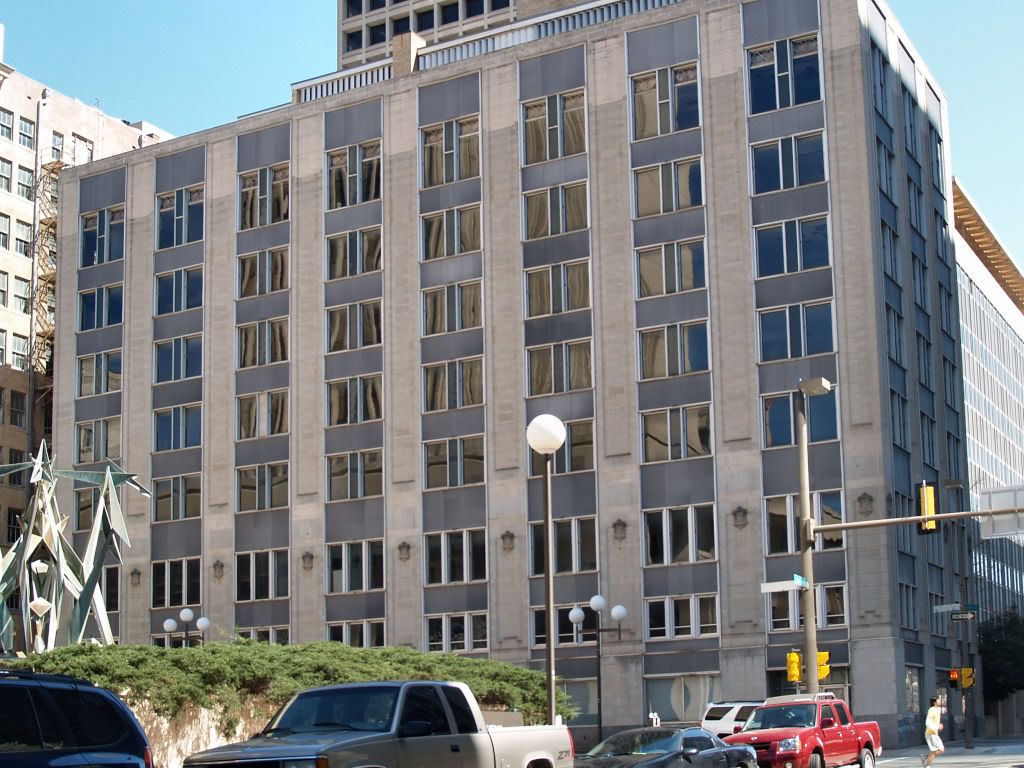 I recently discovered a REALLY COOL set of KerMac interior pics on Steve Lackmeyer's okchistory.com website. Apparently the inside of that old building is just full of old murals and paintings commemorating Kerr McGee's storied history in Oklahoma, afterall, the shabby old KerMac building IS the original headquarters for old KMG. If we have to lose the building that temporarily housed the Oklahoma Legislature for 4 years because the building is beyond saving, that's sad but so be it, but let's at least not lose the old KerMac Building that we know investors would like to convert to historic lofts. Imagine it: Kerr McGee Lofts, or better yet, Oiler Lofts.
If you're interested in a cumulative read, and have lots of time, consider reviewing the long series of posts I've written on the SandRidge demolition proposal:
Save the KerMac!
It's baaaaaaack... (Urban Renewal)
Hard to argue
Building demolition rampant
The problem with an otherwise excellent SandRidge proposal
As well as as these Cityshots:
Cityshot XVII
Cityshot XXXVI
Thursday, January 28, 2010
Hard to argue
Well, I guess it's going to be an uphill battle for any of us now that SandRidge has brought in the glowing CNBC national spotlight to their plans. Obviously the plans are interesting, and mostly good. I am still very, very concerned over the loss of the KerMac building. Time will tell if it is able to be saved.


Monday, January 18, 2010

Subscribe to:
Posts (Atom)