This is the funny thing, is that somehow OCURA or the committee advising them has warped the term experience, according to reports on Steve's blog into a positive for the Henderson proposal. The Henderson proposal includes an enormous suburban setback from Walker Ave and zero retail or anything else listed as desirable in the report.
But the experience is a particularly interesting point. If one were using actual logic diagrams to pin who has experience as a developer before, I think the report would have looked so much more different. I'm not even talking about the grids that are usually routinely used in these kinds of site decisions. I'm just talking about making a decision using logic. Neither of which were clearly done here, hell, apparently the developers weren't even allowed to make a 10-minute pitch for their project.
But, the point here is experience, and who's got it.
Mike Henderson:
Successful developer, overwhelmingly suburban
Familiar with OCURA processes
Had problems meeting deadlines in past
Had financial problems in past
Integrity issue, completely changed Legacy
Questions about delivering exactly what is proposed
Requesting HUD financing for development
Dick Tanenbaum:
Successful urban and suburban developer
Successful with apartment projects
Successful with mixed-use projects
Successful with historic projects
Not requesting HUD financing for development
Builds exactly what he proposes (in this case, a suburban complex)
Chuck Wiggin:
Successful urban developer
Successful with many DT Tulsa projects
Successful with historic projects
Successful with apartment projects
Successful with mixed-use projects
Familiar with OCURA processes
Had problems in past with deadlines
Mixed history in OKC, after Overholser Green
Requesting HUD financing
Did propose changes to OG after approval
Marva Ellard:
Successful urban developer
Especially committed to historic preservation
Successful with many DT OKC projects
Successful with apartment projects
Successful with historic projects
Familiar with OCURA processes
Got out of The Hill before it went negative
Ended up being proved right by OG
Builds exactly what she proposes
So it's funny, because if you're looking at people's PAST experience, it seems like OCURA is heavily lauding Mike Henderson. A more accurate tally would look more like, scored from 1-10:
Ellard: 10
Tanenbaum: 10
Wiggin: 8
Henderson: 6
Now obviously a lot more goes into this, because I'm not going to recommend Tanenbaum's development this time. I honestly have to wonder if he thought anyone else would submit a proposal, judging by what little attention he put into his project compared to other applicants. But if you're going by experience alone, obviously Henderson actually does not have a clear lead there. Anything but, in fact.
(I like the Wiggin and Ellard proposals.)
Wednesday, April 20, 2011


Tuesday, April 19, 2011
"Eastern Bloc" architecture = bad?
As many know, I've been a ways from OKC lately. Indeed so much has been happening lately, as many decisions are going to be coming to a head here soon. My personal life has mostly consisted of extensive travels across Europe, then returning to the north for 3-4 days at a time to placate my professors, and then departing again. For example, I spent last week in Russia. Moscow is amazing. I got back today and I have 3 days here, leaving Thursday for the Netherlands, where I've already spent quite a bit of time in the last few months. So it's been a busy time for me. Uppsala. Stockholm. Tallinn. Helsinki. Germany. Amsterdam. Copenhagen. And in the last week, Moscow and St. Petersburg.
One of the things I am struck by is the prevalence of so-called "Eastern Bloc" architecture (or more commonly called "Commie Bloc" colloquially) not just in Russia, but everywhere in Europe. Even in Stockholm, in my opinion Europe's most advanced city by a long shot, the "Eastern Bloc" is the prevalent suburban building form. Maybe it's a cold country thing, but just the idea of it doesn't seem very attractive. Likewise, Europeans are often repulsed by the idea of America's cutesy little cookie cutter houses with just enough wasted space to pretend to be landscaped. Considering that's what I grew up in, obviously I'm not repulsed by it, as much as I wish OKC would move beyond that kind of prevailing housing style. It's just the vernacular architecture, as it would be called academically.
It's very unfortunate that I haven't had much time to weigh in on the rapidly moving developments shaping downtown OKC, or even to provide some kind of narrative of my travels on here--though I will start doing that soon, especially when I stay in one place after this upcoming Netherlands weekend trip.. But one thing that's struck me is how the "commie blocs" really aren't that bad. Actually, a lot of them are renovated and fairly nice inside. Most are usually surrounded by parks that are maintained by more than one person, obviously. In effect, imagine if one neighborhood instead bundled all of its front yards and back yards and gardens into one huge green space in front of everyone's front door.
Even in Russia, where sometimes commie bloc suburbs are the slum neighborhoods (compare to American inner cities), many blocs are actually in very desirable neighborhoods. Generally, a Russian city will be comprised about half-and-half of historic center city, architecture often ranges from baroque to art deco, and beyond which are the suburb blocs. Beyond the suburb blocs is a new phenomenon of American-style suburbs, which is surprising to see, but growing very large--indicative of a very large country with rapidly expanding resources and a penchant for flaunting that. As far as the blocs go, they themselves come in many different varieties.
There are Stalin blocs, Krushchev blocs, Brezhnev blocs, and so on. Stalin may have been the most evil man to walk the planet, but at least he hired some impressive architects. Krushchev was the one who really got the ball rolling on blocs in a huge way. Krushchev was a liberal who focused on undoing the damage done by Stalin and embarked on building quality blocs to solve the USSR's housing shortage at the time, with many families still sharing cramped flats in areas that were prime real estate. Brezhnev was a conservative who presided over the USSR at a time with terrible inflation and other economic problems beginning to manifest, and the durability of blocs built under him decreased as the size of the blocs dramatically increased. Brezhnev blocs were built with the intention of replacing them every 30 years, the only problem with that is that the Soviet Union no longer existed when that 30 year timeframe elapsed and now ownership in the blocs is too haphazardly distributed to individuals (in many fmr USSR countries the flats were just handed over to the occupants at the time) to be able to organize massive improvement projects.
So in this sense, I can't help but draw parallels to American suburbs, which are often very temporary structures as well. You build one ring of suburbs, then as that clump of cookie cutters deteriorates over 30 years, the people with the means to do so just move further out while the rest of us are saddled with this problem of unattractive and generally unusable neighborhoods.
Compared to that first ring of suburbs that have since deteriorated in OKC (think inner south side, Del City, NE OKC), do you really think that these blocs in East Berlin look that bad?
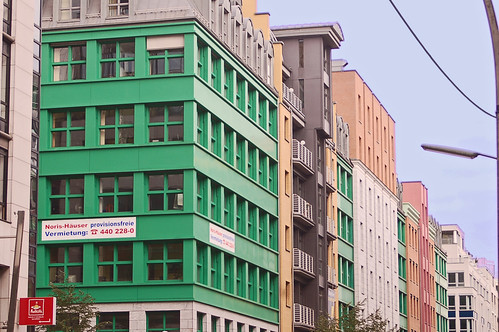
These blocs are about as archetypical as you can get, blocky style, square buildings, 5-stories, potentially ghastly colors, etc. They have been well-maintained and renovated, they are in a nice part of East Berlin, granted, but as other areas of Eastern Europe continue to improve, I'm optimistic more and more of these blocs will be renovated as such and probably sold for high rents, as is happening all over Eastern Europe already. Try getting a small studio flat inside Moscow for under $1 Million (actually, it's close to impossible).
Actually, when I see those buildings and others like them, I think that they look kinda cool and urban. They've dressed them up and given that these were actually built along a streetwall reinforcing a great street, for me it is a positive environment. There are probably some very expensive lofts, offices, or galleries in this building. Just think, what kind of adaptive reuse could someone get out of Del City-style neighborhoods?
This design for the Wiggin proposal for the former Mercy Hospital site in Mid-town has been called "Eastern Bloc" architecture. Or actually, I like the OCURA committee report's euphemism for that: "Institutional." Really? It is a blocky building, with edgy urban accents, and brick masonry. If this is "Eastern Bloc" architecture, then all of Bricktown is Eastern Bloc motif. Or, excuse me, I meant to say "institutional."
One of the things I am struck by is the prevalence of so-called "Eastern Bloc" architecture (or more commonly called "Commie Bloc" colloquially) not just in Russia, but everywhere in Europe. Even in Stockholm, in my opinion Europe's most advanced city by a long shot, the "Eastern Bloc" is the prevalent suburban building form. Maybe it's a cold country thing, but just the idea of it doesn't seem very attractive. Likewise, Europeans are often repulsed by the idea of America's cutesy little cookie cutter houses with just enough wasted space to pretend to be landscaped. Considering that's what I grew up in, obviously I'm not repulsed by it, as much as I wish OKC would move beyond that kind of prevailing housing style. It's just the vernacular architecture, as it would be called academically.
It's very unfortunate that I haven't had much time to weigh in on the rapidly moving developments shaping downtown OKC, or even to provide some kind of narrative of my travels on here--though I will start doing that soon, especially when I stay in one place after this upcoming Netherlands weekend trip.. But one thing that's struck me is how the "commie blocs" really aren't that bad. Actually, a lot of them are renovated and fairly nice inside. Most are usually surrounded by parks that are maintained by more than one person, obviously. In effect, imagine if one neighborhood instead bundled all of its front yards and back yards and gardens into one huge green space in front of everyone's front door.
Even in Russia, where sometimes commie bloc suburbs are the slum neighborhoods (compare to American inner cities), many blocs are actually in very desirable neighborhoods. Generally, a Russian city will be comprised about half-and-half of historic center city, architecture often ranges from baroque to art deco, and beyond which are the suburb blocs. Beyond the suburb blocs is a new phenomenon of American-style suburbs, which is surprising to see, but growing very large--indicative of a very large country with rapidly expanding resources and a penchant for flaunting that. As far as the blocs go, they themselves come in many different varieties.
There are Stalin blocs, Krushchev blocs, Brezhnev blocs, and so on. Stalin may have been the most evil man to walk the planet, but at least he hired some impressive architects. Krushchev was the one who really got the ball rolling on blocs in a huge way. Krushchev was a liberal who focused on undoing the damage done by Stalin and embarked on building quality blocs to solve the USSR's housing shortage at the time, with many families still sharing cramped flats in areas that were prime real estate. Brezhnev was a conservative who presided over the USSR at a time with terrible inflation and other economic problems beginning to manifest, and the durability of blocs built under him decreased as the size of the blocs dramatically increased. Brezhnev blocs were built with the intention of replacing them every 30 years, the only problem with that is that the Soviet Union no longer existed when that 30 year timeframe elapsed and now ownership in the blocs is too haphazardly distributed to individuals (in many fmr USSR countries the flats were just handed over to the occupants at the time) to be able to organize massive improvement projects.
So in this sense, I can't help but draw parallels to American suburbs, which are often very temporary structures as well. You build one ring of suburbs, then as that clump of cookie cutters deteriorates over 30 years, the people with the means to do so just move further out while the rest of us are saddled with this problem of unattractive and generally unusable neighborhoods.
Compared to that first ring of suburbs that have since deteriorated in OKC (think inner south side, Del City, NE OKC), do you really think that these blocs in East Berlin look that bad?
These blocs are about as archetypical as you can get, blocky style, square buildings, 5-stories, potentially ghastly colors, etc. They have been well-maintained and renovated, they are in a nice part of East Berlin, granted, but as other areas of Eastern Europe continue to improve, I'm optimistic more and more of these blocs will be renovated as such and probably sold for high rents, as is happening all over Eastern Europe already. Try getting a small studio flat inside Moscow for under $1 Million (actually, it's close to impossible).
Actually, when I see those buildings and others like them, I think that they look kinda cool and urban. They've dressed them up and given that these were actually built along a streetwall reinforcing a great street, for me it is a positive environment. There are probably some very expensive lofts, offices, or galleries in this building. Just think, what kind of adaptive reuse could someone get out of Del City-style neighborhoods?
This design for the Wiggin proposal for the former Mercy Hospital site in Mid-town has been called "Eastern Bloc" architecture. Or actually, I like the OCURA committee report's euphemism for that: "Institutional." Really? It is a blocky building, with edgy urban accents, and brick masonry. If this is "Eastern Bloc" architecture, then all of Bricktown is Eastern Bloc motif. Or, excuse me, I meant to say "institutional."
Wednesday, April 13, 2011
So much for that
Skirvin proposal, we hardly knew ye...
For the best. The committee now seems to be heavily leaning toward the former Bob Howard Downtown Ford site. The OG+E substation site has mysteriously risen from the grave.
For the best. The committee now seems to be heavily leaning toward the former Bob Howard Downtown Ford site. The OG+E substation site has mysteriously risen from the grave.
Tuesday, April 12, 2011
The Skirvin Proposal
I was currently in the midst of a large convention center post, with some thoughts on the progress so far from the MAPS 3 Convention Center Subcommittee. Well, evidently I was not about to have time to do such a blog post, if the Skirvin Partners would have anything to do with it. Do I think their proposal changes the game? Not in the slightest. But it becoming public does preclude anything else I might say, so perhaps it is best to just start with the now locally-famous Skirvin proposal.
I am going to cover this proposal in a completely unbiased way, since this is going to be controversial. I will give my strong opinion of this in a later post...
Background: OKC is building a new $280 million convention center. A centerpiece of the project that is not included in the budget will have to be a convention hotel, a hotel with minimum 700 rooms that can expand the convention center's ability to compete for vital larger conventions. The convention hotel, not being included in the budget, will have to be funded somehow. It will likely receive up to $60 million in city subsidies, money which will have to come from somewhere, but money which the city will likely get some ROI from (eg., it will probably be a loan).
Enter Skirvin:
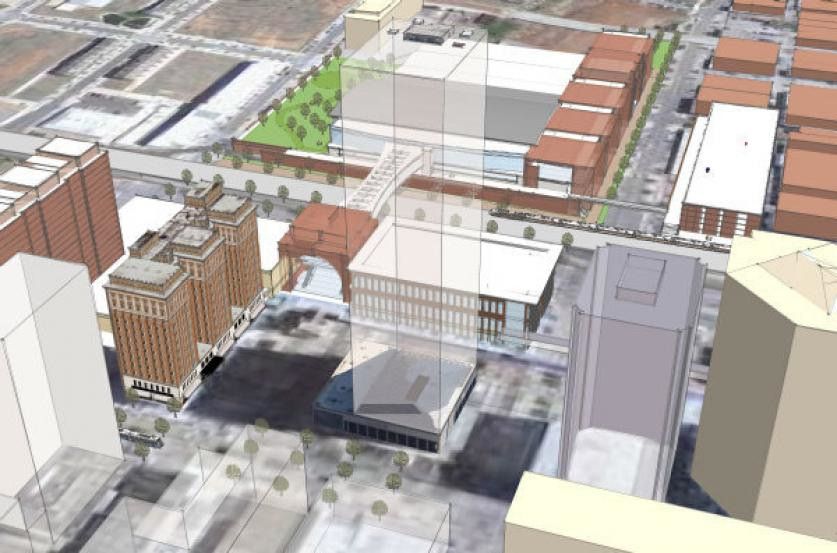
The Skirvin Partners propose that their hotel be repositioned to serve as the city's convention hotel. It is a proposal for siting the convention center between Bricktown's Main Street and Deep Deuce's 2nd Street. Essentially, across the street from the new Maywood Lofts on 2nd, and across the street from the Sherman Iron Works bldg in Bricktown.
The Skirvin currently has about 225 rooms. That's a far cry from a convention hotel, so they propose adding a second tower just to the north of their property (where there is currently a bank drive-thru) that will have 425 rooms. Then things get interesting with the razing of the Santa Fe Garage, which provides 1,518 parking spaces for downtown workers. Then to replace these parking spaces, it's proposed to build an 800-1260 space parking garage on 2nd Street, where the Sherman Iron Works bldg currently is (Main/Oklahoma in Bricktown), possibly incorporating the historic building into a parking structure.
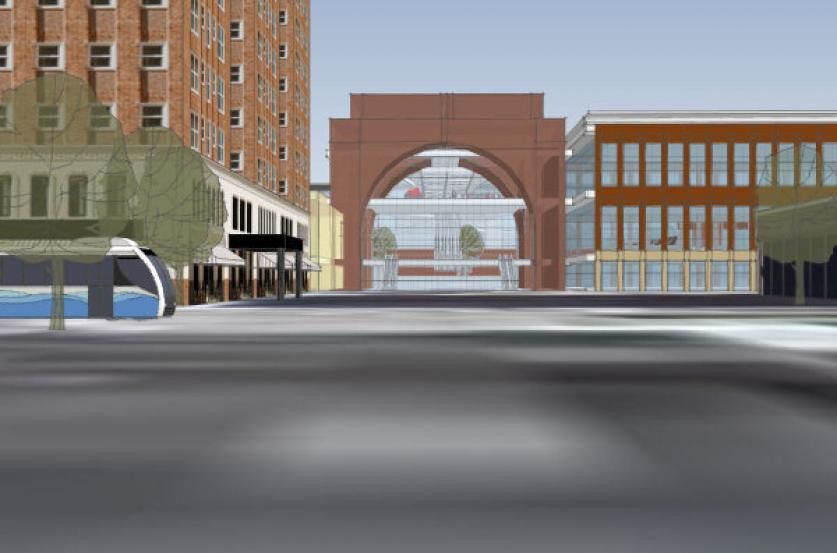
The Santa Fe Garage, which would be razed under this plan, would be replaced with a structure that features a large open "gateway," available office space that the Skirvin suggests could be ideal for the Chamber of Commerce, and more structured parking. This parking would accommodate between 575-895 spaces. Then it would ALL be incorporated with a large pedestrian bridge that crosses E.K. Gaylord and the BNSF tracks, connecting the new "Skirvin complex" and the convention center across the tracks.
One of the complexities happens to be that the site between Main and 2nd streets is currently a rail yard, one that is currently slated to become a high speed rail corridor. There is a proposed arc that cuts across the entire site (the non-utilized tracks currently veer to the north, but this would be a new arc that veers to the south merging with the BNSF tracks). The arc is important because ODOT's proposed high-speed rail corridor from OKC to Tulsa terminates where the Turner Turnpike terminates. So in order to get it further into downtown OKC, it has to come from the NE. So this will essentially be where the line changes from utilizing the BNSF track (that divides downtown and Bricktown) to where it veers to the NE toward the "Adventure District" and on to Tulsa.
While it is certainly true that high-speed rail is far from being funded at this point, especially given the current debt situation of the government, it is a salient fact to point out that there are still local plans to go forward with rail connections to the Adventure District and MWC/Tinker. These regions to the NE and E would be connected via this arc as well, with or without high-speed rail to Tulsa. Placing a convention center over this railyard could prove to be a fatal setback to rail connections to the NE. You could raise the convention center and allow the rail lines to pass underneath uninhibited, but doing so would likely put a convention center with the desired specifications well beyond the reach of $280 million.
Lastly, the Skirvin Partners have pointed to two factors that they feel make their proposal the best one for the city: 1, with the city having to come up with $60 million somewhere if they try and bring in a traditional convention hotel, they would be asking for "far less" of a subsidy. 2, they claim that Downtown OKC would not be able to absorb a new hotel with "more than 600 rooms" (ideally the convention center needs to have more than that) and they claim that using 225 existing rooms coupled with just 425 new rooms minimizes the risk of throwing off downtown's hotel room balance.
Some thoughts on this proposal coming up soon in a broader analysis of the convention center process so far...
I am going to cover this proposal in a completely unbiased way, since this is going to be controversial. I will give my strong opinion of this in a later post...
Background: OKC is building a new $280 million convention center. A centerpiece of the project that is not included in the budget will have to be a convention hotel, a hotel with minimum 700 rooms that can expand the convention center's ability to compete for vital larger conventions. The convention hotel, not being included in the budget, will have to be funded somehow. It will likely receive up to $60 million in city subsidies, money which will have to come from somewhere, but money which the city will likely get some ROI from (eg., it will probably be a loan).
Enter Skirvin:
The Skirvin Partners propose that their hotel be repositioned to serve as the city's convention hotel. It is a proposal for siting the convention center between Bricktown's Main Street and Deep Deuce's 2nd Street. Essentially, across the street from the new Maywood Lofts on 2nd, and across the street from the Sherman Iron Works bldg in Bricktown.
The Skirvin currently has about 225 rooms. That's a far cry from a convention hotel, so they propose adding a second tower just to the north of their property (where there is currently a bank drive-thru) that will have 425 rooms. Then things get interesting with the razing of the Santa Fe Garage, which provides 1,518 parking spaces for downtown workers. Then to replace these parking spaces, it's proposed to build an 800-1260 space parking garage on 2nd Street, where the Sherman Iron Works bldg currently is (Main/Oklahoma in Bricktown), possibly incorporating the historic building into a parking structure.
The Santa Fe Garage, which would be razed under this plan, would be replaced with a structure that features a large open "gateway," available office space that the Skirvin suggests could be ideal for the Chamber of Commerce, and more structured parking. This parking would accommodate between 575-895 spaces. Then it would ALL be incorporated with a large pedestrian bridge that crosses E.K. Gaylord and the BNSF tracks, connecting the new "Skirvin complex" and the convention center across the tracks.
One of the complexities happens to be that the site between Main and 2nd streets is currently a rail yard, one that is currently slated to become a high speed rail corridor. There is a proposed arc that cuts across the entire site (the non-utilized tracks currently veer to the north, but this would be a new arc that veers to the south merging with the BNSF tracks). The arc is important because ODOT's proposed high-speed rail corridor from OKC to Tulsa terminates where the Turner Turnpike terminates. So in order to get it further into downtown OKC, it has to come from the NE. So this will essentially be where the line changes from utilizing the BNSF track (that divides downtown and Bricktown) to where it veers to the NE toward the "Adventure District" and on to Tulsa.
While it is certainly true that high-speed rail is far from being funded at this point, especially given the current debt situation of the government, it is a salient fact to point out that there are still local plans to go forward with rail connections to the Adventure District and MWC/Tinker. These regions to the NE and E would be connected via this arc as well, with or without high-speed rail to Tulsa. Placing a convention center over this railyard could prove to be a fatal setback to rail connections to the NE. You could raise the convention center and allow the rail lines to pass underneath uninhibited, but doing so would likely put a convention center with the desired specifications well beyond the reach of $280 million.
Lastly, the Skirvin Partners have pointed to two factors that they feel make their proposal the best one for the city: 1, with the city having to come up with $60 million somewhere if they try and bring in a traditional convention hotel, they would be asking for "far less" of a subsidy. 2, they claim that Downtown OKC would not be able to absorb a new hotel with "more than 600 rooms" (ideally the convention center needs to have more than that) and they claim that using 225 existing rooms coupled with just 425 new rooms minimizes the risk of throwing off downtown's hotel room balance.
Some thoughts on this proposal coming up soon in a broader analysis of the convention center process so far...
Monday, April 11, 2011
An incredible realization
Remember Rocketplane? Oklahoma, as a state, was willing to throw millions and millions and millions and millions of taxpayer dollars down the drain to line the pockets of some greedy scumbags who wanted to use Oklahoma as a hub for "space travel." And the idiots at the state capital bought this. We can't have normal transit for normal people, here on earth, but they were happy to subsidize "space travel" for rich people, which never happened anyway.
How sad is that? Maybe what Oklahoma needs is for a snake oil salesman to come to town and sell mass transit to the state legislature. Maybe there HAS to be a greedy scumbag to profit behind the scenes in order for something to have a shot in the state legislature.
This is not funny, at all. This is a reason to take up drinking, actually. It's absolutely indefensible. This, as we're currently debating a proposal from the Skirvin Partners that would put a convention center over the only place that downtown OKC could ever have a high speed rail connection going the other way out of town.
It's just how things work, I guess.
Friday, April 8, 2011
Full Circle?
Just wanted to keep my badgering of Full Circle fresh, but actually, wanted to say one last thing since I am about to finally change the poll.
What will happen to Full Circle? I see three options. Stay in 50 Penn. Move north (Classen Curve). Move south (inner city/downtown). Well, I suppose there are two other cardinal directions they could move, but I'll go ahead and claim ESP by saying I have secret information that Full Circle will not locate in Bethany...no offense to Bethany.
Who knows what they will do. They all seem to be an equal shot, meaning 1/3 likelihood of staying in 50 Penn, which is not very likely, and same for moving to Classen Curve, or moving downtown. There are reasons for each. But 50 Penn ownership was recently transferred to another out of state owner. More and more of the retail court is becoming vacant. All that's left in 50 Penn now is Full Circle and Belle Isle Brewery.
50 Penn is an otherwise strong property, fully-leased for the office tower. But its days as a retail destination are truly over, despite that Full Circle has invested a lot in the location which has truly become more charming as its aged. Is the charming bookstore vibe important to them? If so, obviously an old building downtown will be better for recreating that than a new Rand Elliott-designed building in Nichols Hills.
It makes sense to move. They're in a losing situation by sticking it out in 50 Penn. Moving could be an absolutely monumental opportunity if they chose downtown, specially, Midtown or A-Alley, some of the north-downtown neighborhoods with proximity to Heritage Hills. This is somewhere that Full Circle could really thrive, and also be a catalyst for a complimentary retail mix that was far more symbiotic than 50 Penn was even in its heyday.
So what will happen? Stay? Go? Go Classen, or go downtown? Who knows. I would really hope to see them go downtown. I just think that could really create a special bookstore. There are so many great old buildings that would be awesome for Full Circle. We talk so much about how badly we want downtown retail to happen and be locally-driven at the same time. Full Circle would be a proper anchor (read: not like Bass Pro) that downtown could grow up around. Moving downtown is a move that would provide for a long, and interesting future for Full Circle. Moving further north to the newest suburban thing?
What will happen to Full Circle? I see three options. Stay in 50 Penn. Move north (Classen Curve). Move south (inner city/downtown). Well, I suppose there are two other cardinal directions they could move, but I'll go ahead and claim ESP by saying I have secret information that Full Circle will not locate in Bethany...no offense to Bethany.
Who knows what they will do. They all seem to be an equal shot, meaning 1/3 likelihood of staying in 50 Penn, which is not very likely, and same for moving to Classen Curve, or moving downtown. There are reasons for each. But 50 Penn ownership was recently transferred to another out of state owner. More and more of the retail court is becoming vacant. All that's left in 50 Penn now is Full Circle and Belle Isle Brewery.
50 Penn is an otherwise strong property, fully-leased for the office tower. But its days as a retail destination are truly over, despite that Full Circle has invested a lot in the location which has truly become more charming as its aged. Is the charming bookstore vibe important to them? If so, obviously an old building downtown will be better for recreating that than a new Rand Elliott-designed building in Nichols Hills.
It makes sense to move. They're in a losing situation by sticking it out in 50 Penn. Moving could be an absolutely monumental opportunity if they chose downtown, specially, Midtown or A-Alley, some of the north-downtown neighborhoods with proximity to Heritage Hills. This is somewhere that Full Circle could really thrive, and also be a catalyst for a complimentary retail mix that was far more symbiotic than 50 Penn was even in its heyday.
So what will happen? Stay? Go? Go Classen, or go downtown? Who knows. I would really hope to see them go downtown. I just think that could really create a special bookstore. There are so many great old buildings that would be awesome for Full Circle. We talk so much about how badly we want downtown retail to happen and be locally-driven at the same time. Full Circle would be a proper anchor (read: not like Bass Pro) that downtown could grow up around. Moving downtown is a move that would provide for a long, and interesting future for Full Circle. Moving further north to the newest suburban thing?
Wednesday, April 6, 2011
The reason for Shadid's landslide
I think there are a lot of interesting reasons why Dr. Shadid won in the runoff by a margin of 62-38, especially after trailing by a good margin in the primary election. In no particular order, here are my guesses...
1. I think the negative campaigning of Swinton was getting ridiculous. Accused of being a vegetarian?? Wow.
2. I think people realized that Shadid did represent a fresh, more progressive perspective, and I think people liked that.
3. I believe people (esp in Ward 2) are growing more and more interested in crazy ideas such as sustainability.
4. The most important MAPS project to the people is the streetcar. They want that project in hands of an advocate, not an opponent.
5. I think more urban voting demographics are tending to gravitate toward younger candidates these days.
6. Shadid was always incredibly succinct and well-worded when he spoke. Swinton relied more on Okie euphemisms a lot.
7. Shadid laid out exactly how he felt about all the issues facing the city. He had positions, he articulated them. He wasn't wishy washy, unlike his opponent.
8. And of course the specter of OKC Momentum didn't hurt..
Any reasons I missed?
1. I think the negative campaigning of Swinton was getting ridiculous. Accused of being a vegetarian?? Wow.
2. I think people realized that Shadid did represent a fresh, more progressive perspective, and I think people liked that.
3. I believe people (esp in Ward 2) are growing more and more interested in crazy ideas such as sustainability.
4. The most important MAPS project to the people is the streetcar. They want that project in hands of an advocate, not an opponent.
5. I think more urban voting demographics are tending to gravitate toward younger candidates these days.
6. Shadid was always incredibly succinct and well-worded when he spoke. Swinton relied more on Okie euphemisms a lot.
7. Shadid laid out exactly how he felt about all the issues facing the city. He had positions, he articulated them. He wasn't wishy washy, unlike his opponent.
8. And of course the specter of OKC Momentum didn't hurt..
Any reasons I missed?
Tuesday, April 5, 2011
Thursday, March 31, 2011
If you have 20 minutes...
You need to do two things. First, listen to this video, it is 20 minutes long. Then the second thing you need to do, if you have another 20 minutes on April 5th and live in Ward 2, go vote! If not, spend 20 minutes between now and then telling people who live in Ward 2 (generally OKC city limits from NW 23rd up to the other side of The Village, excl. Nichols Hills, etc.) about Dr. Shadid, who is exactly what OKC needs.
If you don't have 20 minutes right now, here are the most interesting points you would have gotten from the video.
1. Dr. Shadid talks about bringing a unique perspective the other 7 can't offer onto the "horseshoe" -- that of a physician. He talks about his insight into OKC's health and lifestyle problems, and how OKC needs to focus on not being dead last on almost every health index of major U.S. cities. Or even 500 cities in the case of walkability..
2. Dr. Shadid talks about being an advocate for BUY LOCAL and truly supporting small business, not just throwing government money at big businesses in the name of "subsidies." He talks about the harm it does to the local economy and local business when we throw money and advantages at these out-of-state businesses and retailers (i.e., BASS PRO). He cites the difference of 70/30 and 30/70; the ratios of money reinvested locally when you buy local! That is refreshing for a candidate to proclaim because it is so true.
3. He says we need to "bring streetcar into the neighborhoods." He talks about how pushing the streetcar back risks millions and millions in federal funding, without which, we simply can not make ends meet, we will not have more than a downtown streetcar system anytime soon. He talks about the opportunity RIGHT NOW at last to get $60-120 M to really bring the streetcar system up to NW 23rd and beyond.
4. He talks about being a disenfranchised voter in the past and never bothering to vote in past city elections because of the pervasiveness of the good ol' boy network in this city.
5. He wants to frame the convention center discussion in the total context of the project, which includes an addition $50 M subsidy for a convention hotel that can not be funded by M3. He calls this intellectual dishonesty with the people. Well, it is. We have to have it now that we already passed the $270 M convention center, only, they didn't mention that at the time (it was just implied).
6. He calls out public transport for what it is right now. Busing as a temporary solution. How it is not permanent and unsustainable to rely on bus systems. He talks about the need for a transit system with lasting permanence, and how you can build a city around fixed-guideway transport. He talks about the true economic benefit of rapid transit in Dallas and Portland.
7. At 15:80 he describes how he got endorsed by the police and fire departments. He describes the irony of Swinton using that endorsement against him to paint him as anti-MAPS, when Swinton went before the public safety unions just as he did and made a pitch to them for his support. They simply likes his independent and pro-neighborhood pitch over the talk of Swinton.
...And if you should have even more time, and want to really be informed on the matter (and haven't already been to Doug's blog), you should most definitely check out Doug Loudenback's reasons for supporting Dr. Shadid. Doug, as usual, has put together a true resource on the matter. Complete with quotes, stances (or soft stances, in the case of Swinton), and more background info than you can get anywhere else.
Wednesday, March 30, 2011
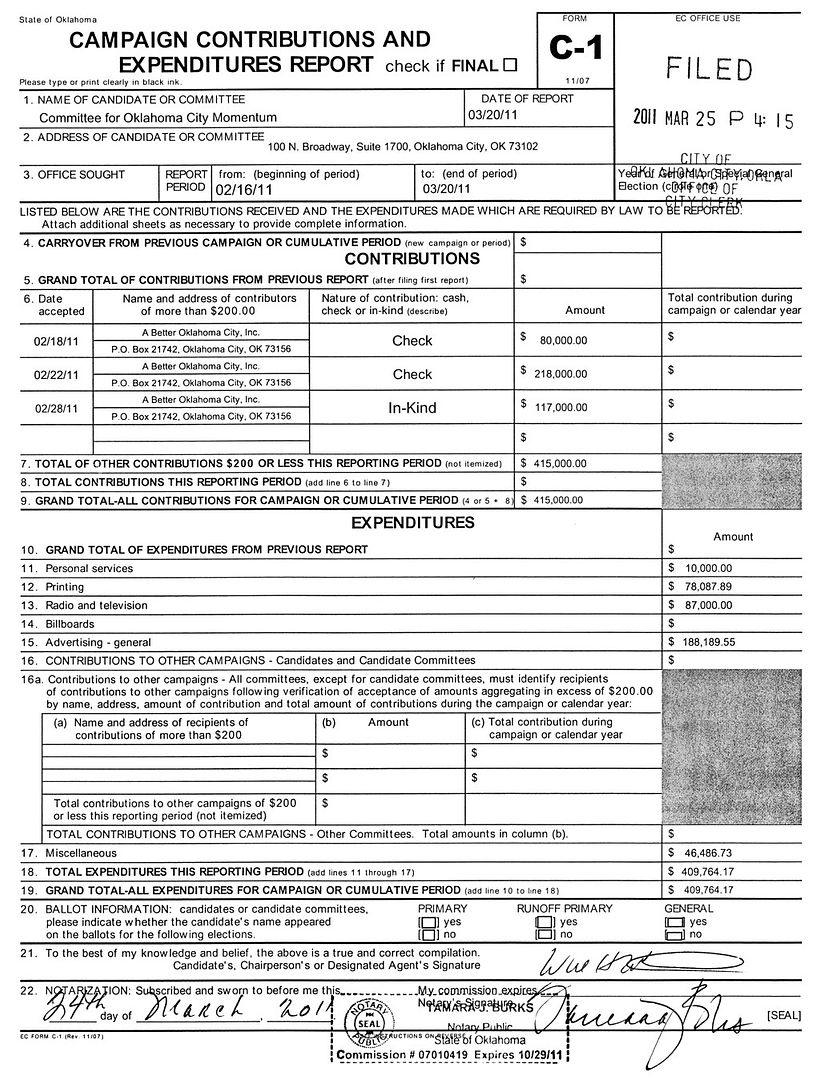
Is your vote worth $409,000?
That's $270,000+ for ONE candidate in this race. This coming from the candidate who earlier in the race said, "When you are in a race with someone who has unlimited resources, you've got to keep running, and I don't have those kinds of resources..." His opponent is local doctor Ed Shadid. Dr. Shadid's campaign has raised $78,000. Perhaps Shadid should have made the poverty plea instead?
Another bone to pick with Swinton. It is absolutely impossible to get in contact with him, and I'm not alone in feeling that way. M3 Streetcar Subcommittee member Jeff Bezdek attempted to get in touch with Swinton after he made some disparaging comments toward rail. Swinton declined to meet this esteemed community member, who has been a very important person in the MAPS 3 process. Others have found it impossible to talk to Swinton, unless you come with a check in hand. I haven't been able to even load Swinton's website, and on his Facebook he has no contact info. He is un-reachable.
Not only does Dr. Shadid have contact info on his website which is perfectly accessible as well, but Shadid actually emailed me last month. He wanted to have a chat over coffee about issues facing the city, and talk about issues of urban planning, walkability, sustainability, and quality of life I assume. Not only did he say he was interested in these issues but he said he likes my blog. OK, well that was awfully nice of him, although I imagine he is way too busy right now to spend time reading a blog for crying out loud. I don't even know if Shadid really does read this blog, but given the way I see the "real" issues facing OKC, even if he just saw the blog and contacted me I think that says a LOT about how he sees the issues facing OKC.
So while Swinton is un-reachable, Shadid is extremely reachable. That's good in someone who is running for council. If you can't even reach a candidate, imagine how they will ignore the citizens once they're in office?
 A third bone to pick with Swinton: Mudslinging. Shadid has ran a campaign arguing for more sustainability and actually producing innovative ideas. Often they are ideas about how to improve OKC's sustainability. Swinton has meanwhile used this to portray Dr. Shadid as some Green Party terror activist-extremist person, "Too extreme for Oklahoma," and the works. A very typical, unimaginative, and tired campaign line. Dr. Shadid is none of these things. In fact, Swinton took a $1,000 check from the esteemed State Representative Al McAffrey, the only openly gay representative in the state house. The Campaign for OKC Momentum is a chamber front whose goal is move the convention center up the list of MAPS3 priorities at the expense of other projects. Just calling a spade. If anything, Swinton is "too extreme for Oklahoma." And I like McAffrey, he's a cool guy that just represents his district. I like the Chamber a lot, their hard work moves OKC forward. Just pointing out how hypocritical Swinton is with his politicizing of the ward race.
Maybe that's just a poster you don't want to stand in front of, but I think it's refreshing to see someone actually "stick up" for the greenies. I would also point out that the outgoing Ward 2 councilman, Sam Bowman (who is extremely well-respected), also has a picture taken in front of a Sierra Club poster. Was Bowman "too liberal for Oklahoma" ?? What does that even mean for a CITY COUNCIL race?
It's just sad that politicizing these things often works. Look at how Mayor Mick won his first election, in a race that was Jim Tolbert's (Full Circle owner, Bricktown developer) to lose. Cornett blasted him as being an "old liberal crank" and surged to victory. This plays out time after time...
Sunday, March 27, 2011
Major news
Film Row is perhaps evolving as downtown's most under-reported news story. Not blaming Steve Lackmeyer, OKC Business, the Journal Record, the City Sentinel, or any other news outlet, but simply put, there are two major developments that have me giddy, and should have every urbanist in OKC giddy as well.
#1. Bicycle lanes in the new Film Row streetscape. These are actually the first urban bicycle lanes in OKC, ever, and probably all of Oklahoma as well. Way to be progressive! This is an occasion.
#2. Film Row's first restaurant will be Joey's Pizzeria. It's going into the Film Exchange right next to the IAO Gallery. Joey's is currently at Classen and 18th.
#1. Bicycle lanes in the new Film Row streetscape. These are actually the first urban bicycle lanes in OKC, ever, and probably all of Oklahoma as well. Way to be progressive! This is an occasion.
#2. Film Row's first restaurant will be Joey's Pizzeria. It's going into the Film Exchange right next to the IAO Gallery. Joey's is currently at Classen and 18th.
Thursday, March 24, 2011
Neat idea from Helsinki..
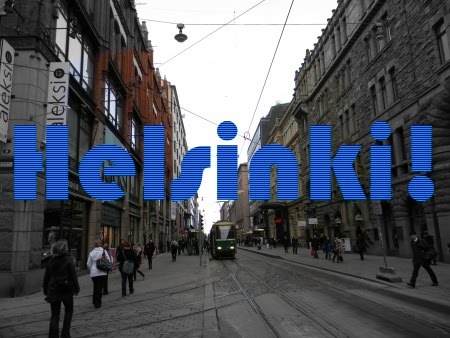
Well, I was in Helsinki this last weekend. The above "!" doesn't exactly convey the level of my enthusiasm for Helsinki..To be honest, I was pretty underwhelmed and unimpressed, and that's even considering my expectations weren't all that high. But it was a fascinating trip from an urban design standpoint, since there are so many interesting things that they've done successful and so many enormous planning blunders that I think they've made. All in all, not really a well-planned city to be honest. In fact it's probably Europe's version of Oklahoma City. But it does have a beautiful city center.
In said beautiful city center is a really fascinating idea: they have a permanent urban planning exhibition center where they have 4 really cool things:
1. An exhibit of urban planning in the Finland-Estonia region, which surprisingly has a lot of really interesting modern architecture.
2. A huge-scale aerial of the city mapping large development projects, showing a cohesive masterplan for the entire city.
3. Literature available for all of the big urban planning projects, to inform citizens of urban planning. Literature is available in Finnish, Swedish, Russian, English, and more.
4. City of Helsinki staff on hand (sitting at an actual desk) to answer questions about urban planning and talk to citizens, take suggestions, etc.
At the very least, it would be nice to have a total downtown masterplan in City Hall that shows Project 180, Devon, streetcar, convention center, Core 2 Shore, central park, Oklahoma River, and countless other major improvements. Something like this:

And of course, I can't help it but to make some sort of band reference:
Who on earth would draw lyrical-musical inspiration from the architecture in Helsinki?? Schiza! That is a very spartan reference indeed.
Wednesday, March 23, 2011
Maybe C2S needs to be scrapped
I am thinking more and more lately that Core2Shore needs to be scrapped. Not even pursued. Not a dime spent in that direction, even though it's too late..
These are the reasons: Yes, it would be nice to have a model contemporary, urban city. Yes, C2S is a neat opportunity to build that. However, I don't trust OKC to build that. I don't trust OKC to turn what is essentially brownfield into a model urban city.
The urban boulevard would have been nice.
The urban central park would have been nice.
The convention center located across the tracks would have been nice.
The urban waterfront would have been nice.
All of these things and more would have been nice.
All of them are being screwed up. Either there is a grand conspiracy to prevent urban from ever happening, or this city is simply clueless when it comes to building urban things.
Consider the boulevard. It's not going to be anything close to a model urban boulevard. The city is insisting that someone other than the city pay for it, and that means ODOT--so it's going to meet their specifications for new roads. It will have super-wide lanes, 6 or 8 lanes, and it will have pedestrian tunnels and bridges encircling it in every direction. Not people-friendly at the street level. The boulevard is already going to be a cluster, there is nothing that can happen at this point to mitigate that. The plan for that is already set in stone. The city could tell ODOT last minute to drop the project and the city could pursue it on its own, and build a much simpler boulevard on its own, but that isn't going to happen.
Consider the central park. This last week the council voted to do a new pedestrian TUNNEL underneath Robinson, presumably, between the convention center (the site the mayor is HELLBENT on) and the central park. First, I was bracing for the impact of the park just being a front lawn for the convention center. I had no idea they would take that even further and have tunnels leading from the front door of the convention center to practically the middle of the park. That is turning out to be a nightmare worse than I would have ever imagined. You don't even at least have to cross the street there. Oy veigh...
What is wrong with crossing the street? Why do we need all these pedestrian tunnels and bridges? Are we planning for some alternative future universe where humans will no longer be born with 2 legs that work?? Unless we're trying to get people across I-40 or across the tracks, that seems totally worthless and unneeded. Why are we spending money on that? Ugh.
What is wrong with simple 4-lane boulevards (2 in each direction) with a wide landscaped median or something? That would cost a fraction of what this street-level superhighway that meets ODOT specs is going to cost. It would be less of an urban nightmare, as well.
This city does not need Core2Shore. It doesn't need anywhere new to build a park and a convention center, even though the park is already being built. It doesn't need any more available land downtown. Downtown already has a huge inventory of vacant lots and abandoned buildings that aren't close to finding uses. I am scared at what OKC is going to end up building in C2S.
And I'll tell you how this will end up: It will just be a continuation of the superblock cluster. There will be virtually zero mixed-use development around the park or anywhere in Core2Shore. It will be parking enterprises and low-impact development like maybe a few restaurants and maybe a convenience store. It will have all these super-wide streets and million-dollar infrastructure pieces that nobody uses unless there is a big convention or a big event in the park. It will be absolutely dead. It will feel like an expensive, government-built ghost town. It will go down in history as the biggest urban renewal folly since the 1970s, anywhere. It will absolutely fail to attract private investment because people will not want to go there. Everything in it will probably be named after Mayor Cornett.
That's not a legacy I would want. Perhaps it is absolutely for the best that the MAPS3 Convention Center Subcommittee decided to scrap the two C2S sites from consideration. I would much rather see what they can do within the context of an existing area, which will at the very least put limitations on the project. More limitations are what we need as long as somebody very high up is listening to morons who know nothing about urban planning.
These are the reasons: Yes, it would be nice to have a model contemporary, urban city. Yes, C2S is a neat opportunity to build that. However, I don't trust OKC to build that. I don't trust OKC to turn what is essentially brownfield into a model urban city.
The urban boulevard would have been nice.
The urban central park would have been nice.
The convention center located across the tracks would have been nice.
The urban waterfront would have been nice.
All of these things and more would have been nice.
All of them are being screwed up. Either there is a grand conspiracy to prevent urban from ever happening, or this city is simply clueless when it comes to building urban things.
Consider the boulevard. It's not going to be anything close to a model urban boulevard. The city is insisting that someone other than the city pay for it, and that means ODOT--so it's going to meet their specifications for new roads. It will have super-wide lanes, 6 or 8 lanes, and it will have pedestrian tunnels and bridges encircling it in every direction. Not people-friendly at the street level. The boulevard is already going to be a cluster, there is nothing that can happen at this point to mitigate that. The plan for that is already set in stone. The city could tell ODOT last minute to drop the project and the city could pursue it on its own, and build a much simpler boulevard on its own, but that isn't going to happen.
Consider the central park. This last week the council voted to do a new pedestrian TUNNEL underneath Robinson, presumably, between the convention center (the site the mayor is HELLBENT on) and the central park. First, I was bracing for the impact of the park just being a front lawn for the convention center. I had no idea they would take that even further and have tunnels leading from the front door of the convention center to practically the middle of the park. That is turning out to be a nightmare worse than I would have ever imagined. You don't even at least have to cross the street there. Oy veigh...
What is wrong with crossing the street? Why do we need all these pedestrian tunnels and bridges? Are we planning for some alternative future universe where humans will no longer be born with 2 legs that work?? Unless we're trying to get people across I-40 or across the tracks, that seems totally worthless and unneeded. Why are we spending money on that? Ugh.
What is wrong with simple 4-lane boulevards (2 in each direction) with a wide landscaped median or something? That would cost a fraction of what this street-level superhighway that meets ODOT specs is going to cost. It would be less of an urban nightmare, as well.
This city does not need Core2Shore. It doesn't need anywhere new to build a park and a convention center, even though the park is already being built. It doesn't need any more available land downtown. Downtown already has a huge inventory of vacant lots and abandoned buildings that aren't close to finding uses. I am scared at what OKC is going to end up building in C2S.
And I'll tell you how this will end up: It will just be a continuation of the superblock cluster. There will be virtually zero mixed-use development around the park or anywhere in Core2Shore. It will be parking enterprises and low-impact development like maybe a few restaurants and maybe a convenience store. It will have all these super-wide streets and million-dollar infrastructure pieces that nobody uses unless there is a big convention or a big event in the park. It will be absolutely dead. It will feel like an expensive, government-built ghost town. It will go down in history as the biggest urban renewal folly since the 1970s, anywhere. It will absolutely fail to attract private investment because people will not want to go there. Everything in it will probably be named after Mayor Cornett.
That's not a legacy I would want. Perhaps it is absolutely for the best that the MAPS3 Convention Center Subcommittee decided to scrap the two C2S sites from consideration. I would much rather see what they can do within the context of an existing area, which will at the very least put limitations on the project. More limitations are what we need as long as somebody very high up is listening to morons who know nothing about urban planning.
Monday, March 21, 2011
Mixed emotions
Today it was finally announced that it is indeed (no shock) Continental Resources who is moving into Devon's old digs. Mixed emotions here. It's very good for OKC to gain a new headquarters of a large corporation, obviously, especially one primed for growth. And it's a good move for Continental in the end. But it is sad to see it happen to Enid, which is a nice town. You never want to cannibalize an in-state sister city for jobs. Here's wishing good things further down the road for Enid.
Wednesday, March 16, 2011
Greetings from Tram-sterdam
Just got back from a 4-day weekend in Amsterdam, which was absolutely amazing. What an incredible city. What an incredible test tube for urbanism. It's hard not to be interested in the trams from an American standpoint at this point in time, with so many cities wanting to adopt modern streetcar, and it's so easy to be quickly overwhelmed by the size and scope of some of these European transit systems. Amsterdam's trams..just wow. Unfortunately my camera died on my second day, but here's one photo:

Keep in mind, that Amsterdam is possibly one of the world's most famous cities for transit, but it's not the trams that earned it that reputation: it's bicycles. The city is the most bicycle-friendly place in the world, and it goes without saying you haven't experiences Amsterdam until you've spent an entire day on bike.
The tram system actually reminds me of a significantly enhanced version of the Toronto streetcar, with an intense network of mostly linear tram lines:

[Might have to open the pic in a new window to get to see it] So it's amazing that a city of about 800,000 people has all of these tram lines (granted at any given time tourists clearly outnumber locals). It's also amazing that it supports this in addition to a highly-developed underground metro system, commuter trains to other close-in regional cities, elevated rail similar to Chicago (they call theirs "the tube"), the bicycle-centric focus, and even the canals and River Amstel serve a transit function. It's truly a transit city. Not to mention so many areas in the Centre Ring are pedestrian-only.
I think perhaps all of these modes of transit have grown up around each other. At first it might appear to be a lot of competition for ridership--are the Dutch really that "on the move"? But then you realize, the simple fact is that having a car in Amsterdam is a nightmare! I saw it first-hand several times in the Centre Ring, and never more than when I saw a taxi trying to squeeze in with the bicycles and pedestrians through a crowded bridge a block from a busy weekend market in De Jordaan. Cars in Amsterdam simply go against the laws of physics.
Now obviously, this is not the case in any American city except perhaps NYC, and even NYC is packed full of too many cars. But the point still stands: there is no competition for ridership in a true transit-centered environment, as long as the different modes of transit each serve a real purpose. If Amsterdam was not the bicycle haven that it is, would the tram system be as well-used? Probably not. Would the commuter trains or even the inter-city trains to Den Haag and Utrecht be as heavily-utilized? Probably not.
Lesson that OKC can take from Amsterdam: In order for big-time streetcar utilization to work successfully, grow as many different complementary modes at once. This is why Project 180 coinciding with the streetcar timeline is actually an enormous opportunity, not a duplication of efforts. The city needs to do a lot to expand basic walkability and human access, including a real bicycle strategy that doesn't just involve the system of scenic park trails. That's not really what we need...
I see no reason OKC couldn't use a system of bicycle roads. Bicycle-only intersections, even bicycle round-abouts. Special bicycle lights at each intersection, some busier intersections even with dedicated bicycle left-turn lanes. Or at the very least, sidewalks on every street, that are actually usable. That would be a good start, even if it's just in the inner city! Perhaps I'm getting ahead of myself here and forgetting just how many 100s of years OKC is behind other cities in terms of basic sidewalk infrastructure. It is beyond embarrassing.
One great phrase you will never hear in OKC: Lekker fietstocht!

Keep in mind, that Amsterdam is possibly one of the world's most famous cities for transit, but it's not the trams that earned it that reputation: it's bicycles. The city is the most bicycle-friendly place in the world, and it goes without saying you haven't experiences Amsterdam until you've spent an entire day on bike.
The tram system actually reminds me of a significantly enhanced version of the Toronto streetcar, with an intense network of mostly linear tram lines:
[Might have to open the pic in a new window to get to see it] So it's amazing that a city of about 800,000 people has all of these tram lines (granted at any given time tourists clearly outnumber locals). It's also amazing that it supports this in addition to a highly-developed underground metro system, commuter trains to other close-in regional cities, elevated rail similar to Chicago (they call theirs "the tube"), the bicycle-centric focus, and even the canals and River Amstel serve a transit function. It's truly a transit city. Not to mention so many areas in the Centre Ring are pedestrian-only.
I think perhaps all of these modes of transit have grown up around each other. At first it might appear to be a lot of competition for ridership--are the Dutch really that "on the move"? But then you realize, the simple fact is that having a car in Amsterdam is a nightmare! I saw it first-hand several times in the Centre Ring, and never more than when I saw a taxi trying to squeeze in with the bicycles and pedestrians through a crowded bridge a block from a busy weekend market in De Jordaan. Cars in Amsterdam simply go against the laws of physics.
Now obviously, this is not the case in any American city except perhaps NYC, and even NYC is packed full of too many cars. But the point still stands: there is no competition for ridership in a true transit-centered environment, as long as the different modes of transit each serve a real purpose. If Amsterdam was not the bicycle haven that it is, would the tram system be as well-used? Probably not. Would the commuter trains or even the inter-city trains to Den Haag and Utrecht be as heavily-utilized? Probably not.
Lesson that OKC can take from Amsterdam: In order for big-time streetcar utilization to work successfully, grow as many different complementary modes at once. This is why Project 180 coinciding with the streetcar timeline is actually an enormous opportunity, not a duplication of efforts. The city needs to do a lot to expand basic walkability and human access, including a real bicycle strategy that doesn't just involve the system of scenic park trails. That's not really what we need...
I see no reason OKC couldn't use a system of bicycle roads. Bicycle-only intersections, even bicycle round-abouts. Special bicycle lights at each intersection, some busier intersections even with dedicated bicycle left-turn lanes. Or at the very least, sidewalks on every street, that are actually usable. That would be a good start, even if it's just in the inner city! Perhaps I'm getting ahead of myself here and forgetting just how many 100s of years OKC is behind other cities in terms of basic sidewalk infrastructure. It is beyond embarrassing.
One great phrase you will never hear in OKC: Lekker fietstocht!
Saturday, March 5, 2011
OKC Streetcar-opoly

I was in the mood to do something interesting. You'll have to click on it to view the larger version, but this illustrates some of the conflicting pressures on the streetcar process right now, just to highlight a small few.
The expedited planning process, which has worked because most of the committee members have really invested a huge amount of time in such a short period to this, has kept this streetcar project ahead and on top of all these pressures. That's the simple truth.
Thursday, March 3, 2011

Wednesday, March 2, 2011
OKC City Council stays "liberal" (aka nonpartisan)
See ya Walters.. "In a striking blow to the tea party's foray into local politics..." -today's Daily Oklahoman.
Tuesday, March 1, 2011
Real questions for candidates
Here are some real questions (not idiotic ideological questions) I'd like to see Van Manen, Hearron, or any other Tea Partying clowns answer before they set their sights on OKC civic affairs:
1. How will you balance the budget if we continue to have a sprawling population that taxes the infrastructure and funding systems?
2. How do you address quality of life, do you have a plan for it, or do you reject the notion that it matters? Is attempting to improve quality of life a "Tower of Babylon". Which is a DIRECT quote from your pastor/campaign managers.
3. How will OKC remain as economically competitive as it is now if we don't remain on the cutting-edge with our downtown?
4. How will you bring prosperity to Oklahoma if you oppose economic development measures (that have not only already passed and happened, but already been SUCCESSFUL!!!) like the NBA, downtown development, conventions, and so on?
5. What kind of people do you think are going to move to Oklahoma to keep us prosperous? Do you think we need growth, or do you reject that notion?
6. What more can OKC do to improve walkability and make the streets more accessible to everyone??
7. How would you suggest that we go about building a community for urban-minded people, or do you reject that notion? Would you insist that everyone needs to live in a suburban Dallas-style house with a yard and a dog? People who want urban living in OKC aren't insisting that suburbanites live their way.
8. Do you think OKC should have a diversity of living options, or should it only offer one kind of lifestyle? Do you think a successful city can get away with doing that? I know the Tea Party mantra is "personal liberty, freedom of choice, blah blah" but the point is that there is NOT a viable alternative to an unhealthy lifestyle in OKC. This is why it is important where you stand on even trying to foster a healthy urban lifestyle in OKC.
9. How will you work to improve the health problem (OKC is the most obese major U.S. city)? Do you believe that a change in lifestyle options can improve this, or do you reject that notion? Do you think City Hall can just continue to maintain an official diet website and expect things to change???
9B. If you answered yes to that last question, when was the last time you had your head examined?
10. Why are you opposed to the investment in fixed rail-based infrastructure systems in the name of providing transit for the "needy?" Do you recognize that transit has failed in OKC? Why do more of the same? If you acknowledge the failure that is mass transit in OKC, and the waste of money it has been and will be as long as it continues to operate in its current functionality or lack thereof, then how would you alternatively fix that? Do you really think that more BUSES is going to attract more RIDERS? Have you legitimately considered what rail transit could do for reshaping transit in OKC?
Bonus: The voters overwhelmingly responded to approve MAPS. It was passed by a margin of over 5 points if I recall correctly, which was a shock because of how close the race was down to the wire. Why are you part of the movement to usurp this vote and go around the voters to cancel the progress that was promised?? Why is the downtown streetcar system (the measure that literally carried the ballot in spite of how unpopular the new convention center was) one of the main things you criticize? Voters already approved it in a referendum strictly on those issues. An election for people is not the same, because there are so many different, more vague issues at play. What makes you think you can decide this issue, and have the right to change it when the voters already responded?
OH WAIT. We'll never get to ask these questions, because they dodged every opportunity to participate in a public debate. May the voters decide... (yikes)
1. How will you balance the budget if we continue to have a sprawling population that taxes the infrastructure and funding systems?
2. How do you address quality of life, do you have a plan for it, or do you reject the notion that it matters? Is attempting to improve quality of life a "Tower of Babylon". Which is a DIRECT quote from your pastor/campaign managers.
3. How will OKC remain as economically competitive as it is now if we don't remain on the cutting-edge with our downtown?
4. How will you bring prosperity to Oklahoma if you oppose economic development measures (that have not only already passed and happened, but already been SUCCESSFUL!!!) like the NBA, downtown development, conventions, and so on?
5. What kind of people do you think are going to move to Oklahoma to keep us prosperous? Do you think we need growth, or do you reject that notion?
6. What more can OKC do to improve walkability and make the streets more accessible to everyone??
7. How would you suggest that we go about building a community for urban-minded people, or do you reject that notion? Would you insist that everyone needs to live in a suburban Dallas-style house with a yard and a dog? People who want urban living in OKC aren't insisting that suburbanites live their way.
8. Do you think OKC should have a diversity of living options, or should it only offer one kind of lifestyle? Do you think a successful city can get away with doing that? I know the Tea Party mantra is "personal liberty, freedom of choice, blah blah" but the point is that there is NOT a viable alternative to an unhealthy lifestyle in OKC. This is why it is important where you stand on even trying to foster a healthy urban lifestyle in OKC.
9. How will you work to improve the health problem (OKC is the most obese major U.S. city)? Do you believe that a change in lifestyle options can improve this, or do you reject that notion? Do you think City Hall can just continue to maintain an official diet website and expect things to change???
9B. If you answered yes to that last question, when was the last time you had your head examined?
10. Why are you opposed to the investment in fixed rail-based infrastructure systems in the name of providing transit for the "needy?" Do you recognize that transit has failed in OKC? Why do more of the same? If you acknowledge the failure that is mass transit in OKC, and the waste of money it has been and will be as long as it continues to operate in its current functionality or lack thereof, then how would you alternatively fix that? Do you really think that more BUSES is going to attract more RIDERS? Have you legitimately considered what rail transit could do for reshaping transit in OKC?
Bonus: The voters overwhelmingly responded to approve MAPS. It was passed by a margin of over 5 points if I recall correctly, which was a shock because of how close the race was down to the wire. Why are you part of the movement to usurp this vote and go around the voters to cancel the progress that was promised?? Why is the downtown streetcar system (the measure that literally carried the ballot in spite of how unpopular the new convention center was) one of the main things you criticize? Voters already approved it in a referendum strictly on those issues. An election for people is not the same, because there are so many different, more vague issues at play. What makes you think you can decide this issue, and have the right to change it when the voters already responded?
OH WAIT. We'll never get to ask these questions, because they dodged every opportunity to participate in a public debate. May the voters decide... (yikes)
Somebody is not very smart
And that somebody works for OKC Public Works. Is this a comedy sketch or something?? Does someone at Public Works have a "What Would Amy Poehler Do?" poster above their desk or something?
First it was NE 2nd Street, which became sidewalkgate--several weeks of crucifixion by the blogosphere and anyone interested in walkability. Public Works rebuffed questions from reporter Steve Lackmeyer, refused to take responsibility, acknowledge that something was wrong, and was even lousy about getting back with the veteran reporter from the Oke.
Actually before that was an incident that peeved me, but nobody else seemed to press the issue at the time: The new Chamber of Commerce headquarters. Anyone want to guess why that beautiful new building was supposed to have an un-pedestrian friendly relationship with the surrounding street? Because Public Works refused to consider some solutions for the nightmare of navigating the Gaylord/Broadway split. Of course the Chamber didn't want people getting mowed over by motorists on Gaylord, but they took the public blame for that, and nobody pressed the real issue which was the crappy city engineers who refuse to consider "innovative solutions."
Now, they put a light pole in the middle of a handicap ramp. Seriously. On NE 10th and I-235. They must really hate the NE side of downtown or something. How could these people be THIS idiotic??
First it was NE 2nd Street, which became sidewalkgate--several weeks of crucifixion by the blogosphere and anyone interested in walkability. Public Works rebuffed questions from reporter Steve Lackmeyer, refused to take responsibility, acknowledge that something was wrong, and was even lousy about getting back with the veteran reporter from the Oke.
Actually before that was an incident that peeved me, but nobody else seemed to press the issue at the time: The new Chamber of Commerce headquarters. Anyone want to guess why that beautiful new building was supposed to have an un-pedestrian friendly relationship with the surrounding street? Because Public Works refused to consider some solutions for the nightmare of navigating the Gaylord/Broadway split. Of course the Chamber didn't want people getting mowed over by motorists on Gaylord, but they took the public blame for that, and nobody pressed the real issue which was the crappy city engineers who refuse to consider "innovative solutions."
Now, they put a light pole in the middle of a handicap ramp. Seriously. On NE 10th and I-235. They must really hate the NE side of downtown or something. How could these people be THIS idiotic??
Subscribe to:
Posts (Atom)