Wednesday, January 6, 2010

Small-scale redevelopment on track

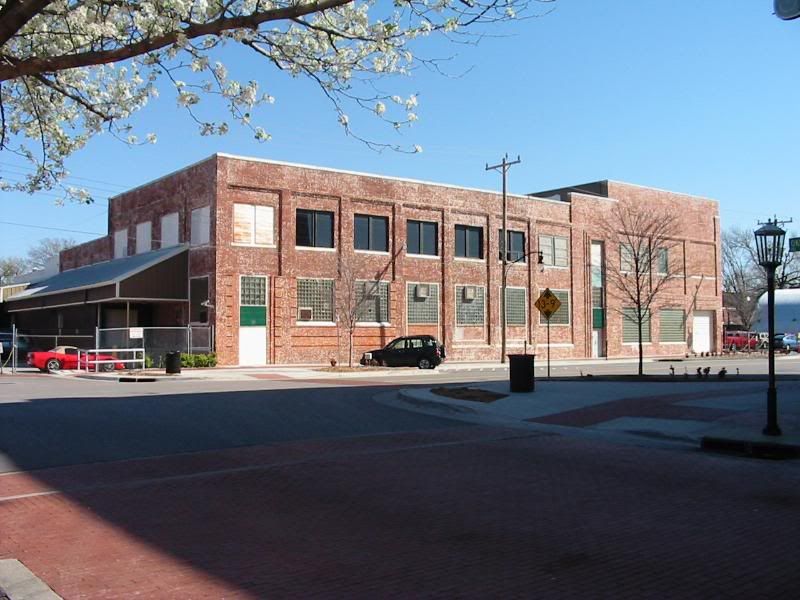
Many people may have noticed that the peach-brick 2 story building on 2nd Street across from the Lofts at Maywood Park has been having a ton of work done to it, and now recently, is being expanded with an additional level. Such extensive work to completely makeover a former warehouse into a mixed-use private abode was originally planned 3-4 years, long before Maywood Park began to surface. In fact owners Larry and Regina Waters didn't even realize that the area surrounding their building would ignite with new residential development when they were drafting plans years ago.

So why the delay? Originally the project architect was Bart Shedeck who drew up the designs before passing away, so then the Waters brought in a new architect, Bill Gumerson (who is also working on the Blue Door). Today construction is commencing "full speed."

The Clark Building, first built in 1922, has 10,475 sf on two floors, and the Waters are adding a 1,500 sf rooftop addition (they bought the building off the market for $350,000, although before that it had sold for as cheaply as $65,000, to Meg Salyer). The 2nd floor and rooftop areas will be turned into the Waters' new residence, 7,000 sf total. The first floor will be divided into a 4,000 sf retail space and a 1,500 sf apartment in the rear. Parking will be on the side where a drive drips down into the basement, which is being renovated into a garage. If anyone is interested in leasing the retail space or the apartment, here's a website to check out.

Some pictures I took yesterday when I was out and about..


The skyline backdrop is much more dramatic in person, because you have to realize that 2nd Street slopes down towards the tracks (Deep Deuce is generally a hilly area). Their rooftop patio and outdoor swimming pool area will have possibly one of the best urban views in all of Oklahoma.

Tuesday, January 5, 2010

Anyone can now comment

Just wanted to let everyone know that I found a way to take commenting off of blogger/google accounts-only so that now everyone and anyone can leave a comment. Hope that's helpful.

Cityshot XXVIII


Downtown skyline from the Centennial Plaza in Lower Bricktown.

Monday, January 4, 2010

Convention center search: The biggest just get bigger


The biggest convention centers just keep getting bigger, but do they get better? Boston Globe architecture columnist, Robert Campbell, writes that the proposed expansion of the Boston Convention Center must do more than make the facility bigger, but it must also make the convention center better for the surrounding neighborhood to take. The convention center opened in 2004 just south of Boston's Financial District and was designed by New York architect, Rafael Vinoly. With 516,000 sf of contiguous exhibition space alone it is one of the largest convention centers in the nation and the largest convention facility in all of New England. Boston officials want to double its size. Some Bostonians have criticized the efforts to expand the convention center on the basis of good urban planning.
So far, this huge new piece of Boston feels like a badly designed New Jersey office park. The streets are too wide (they’re highways in the city, really) and they are hopelessly disorienting. The signage is misleading and the buildings are too far apart to create interesting frontages. Who has ever taken a walk for pleasure in this part of Boston?

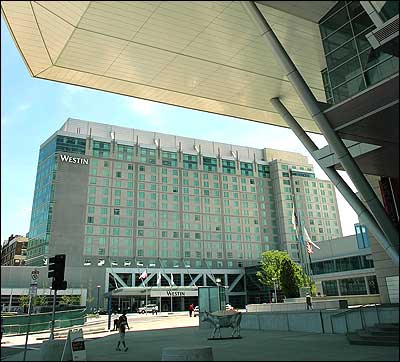
The primary criticism of the convention center has hardly been from a city planning perspective, but rather a convention planning perspective: being located in the South Boston Seaport area, it is too far south of most of Boston's main hotels, resulting in a fairly ineffective convention facility. In fact in 2005 Apple signed to be hosted at the Boston Convention Center but opted instead for the smaller and older Hynes Convention Center in the heart of Boston's Back Bay neighborhood. The hotel count issue has been solved though with the add-on of two new convention center hotels, one being the 18-story, 428-room Seaport Hotel, the other being the 16-story, 793-room Westin Hotel.

Speaking of a second convention center, Boston also has kept its old convention center, the Hynes Convention Center--built in 1988, with 193,000 sf of exhibition space, 71,600 sf of meeting space, and a 24,500 sf ballroom. The facility in the heart of the Back Bay is still in tip-top shape, and was designed to last, or at least, fit in with the historic area that surrounds it. Despite fears it might get torn down after being relegated to being the city's 2nd convention center, its events have actually increased 10% since the BCC opened, and the building fits in so well that Bostonians might actually fight to save it from demolition. Can you imagine, a 1980s convention center that people might some day fight to preserve? Freaky.

So with all the strides we've made in going back to the roots of urban planning in the last few years, is it surprising that a 1988 convention center is better than a 2004 convention center? Which facility do you think is better, and do you really think that the Boston Convention Center is really that bad for the surrounding area? You've read the analysis of other convention centers, how they relate to the human scale that surrounds the center beyond its front steps, and how these large buildings interact with the tiny ant (you) on the sidewalk. You be the judge.


Campbell also implores us to look at a handful of other convention centers. Philly as the good example, and Chicago as the bad example.

Chicago's McCormick Place was the nation's largest convention center until recently when Orlando's surpassed it. It is comprised of 4 interconnected facilities located along the edge of Lake Michigan about 2 and a half miles south of the Inner Loop in Chicago. The facility is surrounded on all sides by wide boulevards and highway systems designed to carry the huge volumes of traffic going in and out of this place. A recent 2007 addition of the West Building, featured in the picture, added 470,000 sf of exhibition space for a total of 2,670,000 sf of exhibition space. It (the 2007 addition) cost Chicago $882 million--also features a 100,000 sf ballroom, the size of a football field, one of the largest ballrooms in the world.

The facility is unlike any other in the world, absolutely huge, but there is no connectivity with the neighborhood around it. In fact there is no neighborhood around it, the convention center feels like it's in the middle of nowhere. For all of the money they've put into this thing, surely they don't want people bemoaning the site of the convention center? The West Bldg is the only part of it that really even has an opportunity for a decent frontage with a street, but it's a wasted opportunity as the facility just turns its back side to the road.

There is also a commuter rail station in the basement of the facility, transporting passengers between McCormick Place and the Inner Loop.


Is all really well in Philadelphia? I think Campbell may want to reconsider his recommendation on the Pennsylvania Convention Center, which is currently in the midst of a 878,455 sf, $800 million major expansion (the goal of which is to bring the total exhibition space at the PAC up to 1 million). Which by the way, I hope an important realization that goes without saying at this point in the Convention Center Search series is that "total sf" and "exhibition sf" are always completely different.

In the way of the expansion that shifts the convention center up to Broad Street are several historic buildings that Philly Inquirer architecture critic Ingra Saffron regrets the impending loss of. "The long, bland glass facade that Thompson, Ventulett, Stainback & Associates had designed for the convention center's Broad Street facade is a pretty meager replacement for this stout-hearted office building," said Saffron, in reference to one of the old buildings.

It's true that portions of the convention center, as Campbell wrote, are elevated above the ground level (with city life passing uninhibited underneath), but not all, and certainly not the new expansion portion to my knowledge (which consists of a quick search and skim reading on Philly issues). That still doesn't mean that there is a whole lot of interaction with the human scale, it just means that it isn't damaging the human scale (which I suppose a monolithic convention in the center of Philly could do anything but).

Campbell also celebrates the fact that the PCC is in the midst of Philly, surrounded by a great American city, whereas the BCC is removed from the heart. The tradeoff here of course is that expansions of the PCC mean great buildings must be leveled, whereas an expansion of the BCC, great buildings aren't going to be leveled, but rather, empty space built over, a new opportunity to make something urban out of something that is not.

Take it for what it is. It appears that the convention arms race doesn't slow down once a city cracks the top 10 convention centers, and in all likelihood, it will never slow down for OKC, even after building an all-new 550,000 sf facility south of downtown in addition to downtown's 1.1 million sf, 40-year old, Cox Center. The future of OKC in the aftermath of MAPS 3 is inevitably the pursuit of a convention center arms race, that's the bad news. The good news though far outweighs that negative: for once we are in the hunt with the cities we want to be, "big league" cities, and we control our destiny amongst our competition. Don't look now, but there are cities OUR size (like Nashville) adding $635 million convention centers.

Cheapo urban design example

I know a lot of times when I criticize a development I make it sound like I expect developers to barely break even. It sounds like my expectations are jumping through all these hoops and going to extreme ends to satisfy visions of "new urbanism." That isn't necessarily the case. Yeah, that would be great if every project was perfect, but you don't have to "Go green or go broke tryin!!" to make me happy. Here's an example of a (VERY) bare bones urban-smart building, a project that does FAR more to the built environment around it than any multi-million dollar projects like Lower Bricktown, the proposed SandRidge demolitions, or even The Hill.


This is the hotel/motel liquidation supercenter store thingy on NW 23rd at Walker. Yeah, it's not the best neighbor, and yeah it is kind of an eyesore for Uptown. I remember one time I actually got a desk from here years ago, after we searched the city's antique stores for a old timey desk, finally found something worn out but workable here. The place is a dump on the inside if I remember right, I don't even think they have lighting.

But I looked at it more closely while I was passing through and couldn't help but notice that the sidewalk environment is surprisingly nice. While the oversized gray/green (vomit color) metal awning that dominates the drive through Uptown is hideous and needs to go, what goes on underneath it is bearable. The sidewalk is wide enough for pedestrians to have room, they have window displays (albeit not good ones), some nice planters and patio fixtures, as well as a bench for people to wait for the bus. When you add the 23rd Uptown streetscape and the lighting, it's actually a nice environment.

If it weren't for the exhaust-stained snow drifts and the 20 degree temperature and the general malaise of activity on 23rd, there WOULD be people on that sidewalk. This building isn't adding anything to Uptown clearly, but the sidewalk environment is decent enough to the point that it doesn't detract from Uptown's walkability and it can link to more interesting elements. Granted, there really isn't a whole lot going on right now, but hopefully that will change one of these days. For now, here's an example of a low-budget building owner who is making a small, yet positive difference. I don't know the owner, or who the owner is, or if there have been issues with the owner, but at the least, I am pleasantly surprised and I think this serves as a good example on how you don't have to break the bank to be urban! It's just common sense things more of the time.

In fact, if they got rid of the hideous awning, this could very well be an attractive environment. And in case the owner reads this, I better go on a little bit more.. I definitely think that having the awning there is good for pedestrian environment, my only complaint is how hideous the awning in particular is. If it was a less overbearing and less obtrusive building element, it would be great. You could easily remove that and replace it with a simple canvas awning and you would no longer have an eyesore in the midst of a redeveloping corridor. There is potential here to have a nice building.

A spot of tea?

Hmmm, here's an idea. I'll be in OKC until the 7th, so even though it will be a busy last few days in town for me, what if I got to meet a few readers of the blog before I left? Just send me an email (moore.energizer@yahoo.com) if anyone would be interested in meeting me for coffee downtown, my treat.

I promise you won't be featured on this blog. Meeting people off of this blog for me isn't like an interview so you won't be featured on this blog, same as people I have met in the past weren't featured on this blog. I'm not a journalist, I'm a blogger..I rant and rave about things. It would be fun to meet someone who's also interested in the direction urban OKC is headed and just have a high-quality discussion, the kind of thing you can't have online.

I think I'll call it the "Downtown ontheRange downtown coffeeshop Stimulus Bailout of 2010."

Saturday, January 2, 2010

Bricktown, banned subject?

Notice how anytime someone talks about Bricktown, whether it's a positive or negative reflection, it draws so much criticism and contention and disparaging insults. You can't win for trying. If you make suggestions for Bricktown then the people who claim to be the ones in the know will tell you that you know nothing and tell you "the reality" of Bricktown, and they're ticked off that you dared to second-guess their authority.

Bricktown is all about authority and whose turf it is, don't you forget that bubba. If you hope for more development, you hear a hopeless tale of the economy. If you talk about all of the positive changes someone else forces the subject to all of Bricktown's squandered potential. If you focus too much on it then you're also bound to hear that you're ignoring all of downtown's other districts that are doing exciting things.

So what is the official stance on Bricktown? What is the accepted "PC" way to discuss Bricktown?

Rule 1. If you're not an insider, don't dare suggest ways it can improve. Leave it to the professionals.
Rule 2. Don't step on any toes, everyone who is an insider in Bricktown is working very hard and nobody is doing anything wrong.
Rule 3. Don't make other downtown communities feel second-rate, they're also just as important.
Rule 4. Don't bother attempting to differentiate between the "Bricktown That Could Be" and "The Bricktown That Is.." to everyone in OKC, they're the same.
Rule 5. Stop complaining about Lower Bricktown, unless you're Robin Williams having visions of "Redneck Venice," it is so passe to brood over the south half.
Rule 6. The one development component that is especially out of bounds (even more so than residential) is retail. Instead why aren't YOU shopping at Bricktown's whopping 5 retail establishments?
Rule 7. Don't ever, EVER, criticize the city's dedication to Bricktown upkeep. After all, they built the Ballpark. The end.
Rule 8. Don't forget that Bricktown is so 1990. It's all about Core to Shore. That's where the future of improvement is. The chances of Bricktown losing momentum are 1 to a million, not gonna happen, ever.
Rule 9. Don't sound too positive, because then you're complacent and you're not trying hard enough.
Rule 10. No matter what you say, expect critical feedback. Everyone has their own unique and highly contentious take on Bricktown these days.

I think these are some good guidelines to bear in mind for future Bricktown discussions, to avoid stepping on any toes and to promote being sensitive towards everyone involved in the process.

Or should Bricktown just be a banned subject altogether? Whatever we do, let's avoid taking a good, hard look at all costs.

Wednesday, December 30, 2009

Bricktown says "stay tuned"

See headline.. "Bricktown says 'stay tuned.'" Question: When isn't Bricktown saying, "stay tuned"? The answer is never. There has always been a collective murmur coming from the general direction of Bricktown telling us that all of Bricktown's woes and inadequacies will soon be solved by the next influx of development.

So why haven't all of Bricktown's woes been solved by now? The answer is that a lot of the development proposed fails to come to fruition, a lot of new businesses are owned by entrepreneurs who aren't prepared for Bricktown, and there may be larger overriding concerns that supersede quick fixes. It always seems like these very impressive developments are constantly cropping up from developers with strong, solid track records, so it's a real head scratcher how so few of these developments have gotten off on the right foot. It's almost as if Bricktown is the place where strong track records go to die.

For those who haven't figured out yet, this is going to be a somewhat bitter post. Why? Because over a year after the fact, I'm still really disappointed that the Cotton Exchange never happened. To me there is no reason this project shouldn't have gone through, but it couldn't get financing..banks wanted nearly every unit preleased before it could begin (unrealistic in downtown development). Developer Gary Cotton had sold off other Bricktown assets to have more capital to put into this project, and also hired the sales manager from The Centennial development, hoping to get a few names off of The Centennial's wait list (that project filled up with dozens of people missing out on units). Had this project gone through, it would have given the canal some new energy. It would have anchored the canal with residential as well as some viable retail, and closed in some of the undefined space in the area of Mickey Mantle and Reno (where buildings do a poor job of defining the public realm). If this project had gone through it very well could have solved some of Bricktown's woes.

Another project would have helped do wonders for adding density in Lower Bricktown. Stonegate Hogan's proposed Centerpoint Market, or "Building 8," was a go two years ago and then never broke ground. Rendering signs went up on the site, and they may even still be there, but one thing seems certain -- this project is going nowhere. Bummer, because it would have added a significant amount of retail along the canal (35,000 sf). I also wonder why this project never got off the ground, with Stonegate Hogan (the primary developers of Lower Bricktown) behind it. Are they also having trouble getting projects off in this economy? Retail projects (as opposed to CONDO projects)? Weird..

A new hotel around Main and Oklahoma would have been nice too.. especially if it had around 100 rooms, promised to preserve the facade of the existing historic structure, and would have adhered to good urban design. Such a hotel would have been the Holiday Inn Express proposed for Bricktown, that I also happened to mention in the last post..

Then there was the Bricktown Village, proposed by local rich dude, Bob Funk (also owner of the RedHawks and several local businesses). Bricktown Village would have had..are you ready..a massive $250 million mixed-use development with 400 residential units, 100,000 sf of prime retail, a 150-room upscale hotel, a 1,900 space garage, and more.. basically a Lower Bricktown that actually follows principles of urbanism. Imagine that? Then out of all of the incredibly exciting and disappointing ways this project could have died, it had to be the City putting the kibosh on it. Why? Mayor Mick did not want to sell the land backing up to the Bricktown Ballpark to Bob Funk, many estimate it's all about bitter tensions between Bob Funk and the business establishment of the city. So they snuffed him, and Bricktown missed out on this, or at least another exciting "crash and burn" case of a project that couldn't get financing..

Another interesting project, a renovation of a small historic building along Main Street..adding some interesting architectural features. I like it. It features a metal roof, but I don't think it's done to be cheap, I actually kind of like the contrast it poses between new and old and how it's used attractively. Dunno what happened with this one either to put it so behind schedule, I just know it's only just now..possibly starting.

There are more dashed plans from the last round of development, but those are the most prominent ones. Now, that's not to say that the last round of development didn't bring a lot to Bricktown: Candy Factory office renovation, Banjo Museum, a McDonald's that's actually urban, ACM School of Rock, renovation at 222 East Main, Hampton Inn, Stanley Systems renovation on Main, and new businesses here and there, along with some that we lost. And I won't go into failed Bricktown proposals before the most recent wave of development, including the heartbreaking failure of The Factory and going way back to Neil Horton's original vision for Lower Bricktown, but I digress. What did end up coming to fruition from the last round of proposals isn't bad at all, especially the Hampton Inn. One thing that's important to note however: the canal has lost a lot of steam. There are now more vacant spaces along the canal, businesses there doing less business, less people in general on the canal. Bricktown is growing, but the canal is losing some of its luster at this point.

On OKC Talk I brought up the age-old suggestion that Bricktown should consider a public parking solution, and I was met with the typical swarm of posters telling me that there is no parking problem in Bricktown or anywhere downtown. The problem with that is that I agree with that line of thinking, however most of OKC doesn't, and believe me, you don't have to sell the idea of shopping and dining downtown to me. It's the rest that you have to pitch the idea to, and they believe that there is a parking problem in Bricktown, so for all intents and purposes, there IS a parking problem in Bricktown. And I don't blame them -- when it's $5 to park in the old part of Bricktown (never pay, just park at Lower Bricktown and walk 2 blocks, you'll live) and $10-15 if there is an event going on at the Ford, Cox, or Bricktown Ballpark. The fact that a lot of people are still operating profitable surface parking lot enterprises gives off the impression that parking is tight.


Here's two downtowns with free public parking: Wichita's Old Town and Sundance Square in Ft Worth. Bricktown has a total of 5 retail tenants (count em: Red Dirt, The Store, Painted Door, Firefly, and candy shop). Wichita's Old Town is a similar area with 28 retail tenants, total. Is it not insulting that Wichita has so much more shopping in their historic districts--they're half our size, not as economically robust, and much lamer in every way. Sundance Square kicks our butt too with 17 retail tenants, including Barnes & Noble, as well as a more urban AMC Theatres and dozens and dozens of restaurants, including a P.F. Chang's on Throckmorton Street. What is different here? They have free public parking. Wichita's is free all day, Ft Worth's is free after 5 (the solution I would recommend). Who knows, maybe they didn't even have a parking problem before, they just wanted to make the parking problem even more convenient for FW residents that are supposed to be enjoying Sundance Square.

But Bricktown doesn't say it needs public parking. Instead, Bricktown says the next round of development will solve its problems. One Bricktown retailer who posts at OKC Talk as Urbanized, had this to say about the development in Bricktown:
I don't think many of the people on here grousing about empty space have paid much attention to all of the places recently renovated in Bricktown, projects currently underway, and of course can't know about several of the game-changing deals working down here.

The comment came as a response to my suggestions to cure some of Bricktown's ailments, so essentially it's the same answer we've gotten all along: more development is what will eventually solve Bricktown's woes. Steve Lackmeyer later corroborated Urbanized's suggestion, and I would never once doubt in the first place that at any given time there are some very exciting things being talked about for Bricktown. I'm just very skeptical about how much of this will actually end up sticking. I think in order to get a good idea on what might be to come, I can offer some educated guesses, of course sheer speculation, but nonetheless I think I have a pretty good gut feeling about some projects myself, too. Jim Cowan made a post over on Steve's blog also alluding to future developments.
I think many of you will be excited to see some developments along the Canal in the first 6 months of 2010.
Restaurants, Retail, and a couple of other surprises are coming….and long overdue!

Despite being just as vague, he sort of corroborates the same thing Urbanized said. We anticipate more retail and restaurants trickling in as smaller projects, but as Urbanized put it there will be some game-changing proposals that come out soon, or as Cowan called them, surprises that are long overdue.

Well we know of some of the retail planned. We know that Sammy's Pizza is coming back to Bricktown, being resurrected by descendants of the original owner. It will be in the Hunzicker Building right along the Canal, on the Canal-level. There will be more retail and restaurants coming, too. Brent and Brett Brewer have been renovating the Hunzicker Building on spec, which is different from how renovations are typically done in Bricktown where owners like to line up a prospective tenant before ever beginning work (build-to-suit). Spec construction is also what's known as taking the bull by the horns and making something happen, something that other Bricktown property owners should be inspired by. Yeah right, nevermind it's just the Brewers..I'm sure we'll wake up one day and be scratching our heads at how they usurped design guidelines yet again..

We also know that the Bricktown fire station is finally going to be built, just 10 years after the bond election that paid for it. The arch firm selected to do the design kept submitting woefully inadequate preliminary work, and in my opinion, the design that they're going with is still a disgrace, but you almost just want to pass it just to move on from it and get it through after 10 years of this firm submitting crappy work on the project. I just don't think LWPB has much experience in designing new construction that fits in with a historic district, but I could be wrong, and it could just be a bad rendering. But the rendering we have shows a building with an inappropriate setback, a plain facade, and no evidence of $3 million being put into it. Maybe we need a slogan, "Don't Edmond my Downtown" (a spin off of Norman's unofficial slogan)? Here Steve gives an account of the design process for the project that provides insight into how this project was just so poorly designed to the point that Bricktown Urban Design just got tired of dealing with it and passed it through.

A much more interesting proposal that will likely surface in more detail soon is the "Bricktown Gateway" project that will involve the entire block between Reno and the canal, Oklahoma Ave and the BNSF tracks. The historic buildings along the south side of the Upper Canal (Zio's) are all going to be renovated, with a handful of new retail/restaurant spots, as well as 8 lofts on the upper level and office space for Harding & Shelton (a small oil and gas company). The plans also call for renovating the old Rock Island Building at the corner of Reno and Oklahoma--lofts and retail, to my knowledge.


Where things get more interesting is with Phase 2 of the Bricktown Gateway project. The gray structures only illustrate massing studies on the maximum size of development that the site can take and how it may interact with the space, but I would definitely say some pretty major infill development is proposed.

Oh, and looks like another Bricktown owner finally found a replacement tenant for Uncommon Grounds. That site sat unprofitably for 2 years after Gary Berlin raised the lease of the popular former Bricktown coffee shop (hope everyone likes Starbucks) too high for them to afford. The new business that can afford the $1300/mo rent, CoCo Flow, is a chocolate confectionary shop relocating from N. Western Avenue.

Another possible sleeping giant of a proposal is The Steel Yard, which Bob Meinders has been behind..albeit moving very, very slowly on (for years). Demolition is moving forward on the buildings on the east end of Bricktown, which means development could begin sometime early next year. Will we hear an announcement on that soon? Possibly. This could be a very exciting development, especially if there were to be a residential component added into the mix.

The rest, if anything, is pure speculation..

I can tell you that Randy Hogan has long-term plans to build out the west end of Lower Bricktown, between The Centennial and the BNSF tracks. The back portion of which site includes the U-Haul building, which is basically an ugly metal facade covering up a historic brick warehouse. The warehouse could be restored and renovated as lofts, with more development in front. To my knowledge, the site may or may not include a canal extension in the future..

Of course before Hogan develops anything, he might consider the project he still hasn't finished--Building 8, or Centerpoint Market. Could this building be back on in the near future? I doubt it.. I doubt Hogan moving forward because they seem more interested in Jenks right now, which they're also unable to move forward on at the moment.

It would of course also be nice to see some of these hotel proposals come back. If people in the know are hinting at big things to come, perhaps this is one of them. There was the Holiday Inn Express, a possible boutique hotel on the upper floors of the Mercantile Building, and the Candlewood Suites proposed against I-235.

Who knows what the future holds for Bricktown. I think that at some point you're going to start seeing spin off from bigger projects. Obviously we haven't seen it yet. But at some point soon I think that we'll start seeing the effect of MAPS 3 passing. MAPS 3 is, in a way, the entire city backing up the private revitalization of OKC, so it's passage has to add to downtown's appeal as well as add confidence in the future of downtown. I think that at some point you're also going to see Devon Tower adding intrinsic speculative appeal to downtown in general, especially including Bricktown. But only time will tell the tale.

I think this is just one of those open-ended things for now. What do you readers want to see in Bricktown? Whole Foods? Urban Outfitters? etc etc.. so basically more retail, probably. The old adage is that retail follows rooftops, so if downtown can amass more residential, that will easily help attract more retail to downtown. Retail is also easier development to get financing for than residential, esp for-sale residential.

Monday, December 28, 2009

Building demolition rampant

It seems like with downtown revived, we're back to seeing building demolitions becoming commonplace. I don't even think anyone is beginning to notice some of these anymore. Some draw attention, others like the Community Foundation teardown, sort of fly under the radar. I think that demolitions are commonplace in downtowns that have activity, and while they're usually a bad idea, it still counts as activity. The problem with that is that revived downtowns can still make mistakes. Urban renewal was a poor response to changing times made by a downtown that was still active, but that's an easy call to make in hindsight.

It's harder to call a bad decision on time, and it's not clear-cut..I wouldn't mislead anyone to believe that everyone who studies planning is against demolitions 100% of the time. Bob Blackburn, head of the Oklahoma Historical Society and one of the foremost OKC history experts, said himself that preservation "is not saving every single building." It's about saving the ones that need to be saved. There is still always room for cities to evolve, but it has to be done smartly. Some of the demos are troubling, some are a step in the right direction in my opinion.

I know that the Community Foundation and SandRidge are probably the ones most people are aware of, especially if they read this blog, but I want to start with a proposal from 2 or 3 years ago. I don't know where the old proposal is to put in a Holiday Inn Express on the north end of Bricktown, across Main Street from the Bricktown Mercantile building..but I know that work has not begun and the old Steffen's ice creamery is still standing. That's good news, although the plan wasn't too shabby.

The Bricktown community came out against the idea of tearing down this excellent building with lots of potential at first blush, and the developers agreed to save the front facade and incorporate it into the Holiday Inn Express they had planned. I'm sad to see the project fall off the radar as there's no way to tell if the site's next owner will agree to save the front facade. Unfortunately it seems that the old Steffen's creamery has sustained major structural damage and the building can't just be saved and renovated, but even in instances like this, it's still possible to tear down the building and preserve the facade to be incorporated into a new building. So when someone tells you a great building can't be saved, eau contraire.

An urban renewal arm, the newly-created "10th Street Medical Corridor District," is demolishing an asbestos-filled building that no one will miss at the corner of 10th and Harvey. The building, the plain 1-story vacant Red Cross building, is one site that private developers didn't even want to touch due to the asbestos abatement issues. It is however a key site on the heart of the 10th Street corridor that the city is trying to spur development along, and with the public taking on the building, the site will be prime for a private developer to come along and develop something on it. The Planning Department has been in talks with MidTown developers and the demolition on this site represents a consensus on what the city can do to help move MidTown forward. The rendering isn't an actual development, but it is a rendering that the Planning Department drew up to illustrate to prospective developers what needs to go on the site. I can't agree more.

The above two are examples of how sometimes demolishing an old building can be prudent. I can't say enough how I am not one of these people who believe in clinging to every single old building, but I do get pretty irate when I see the wanton destruction of greatness. Many of these old buildings are greatness. The detail city pioneers added to structures is unparalleled to the detail you see on buildings today, and the fact that a structure is still standing a hundred years later has to say something. City code permits demolition, but it has to be done delicately, and you should be getting approval from the public.. City code also requires that development come up to the sidewalk, which is why the Planning Department recommended denial of the Chamber proposal.

So typically a demolition is fine if two things prove true: the development that replaces it comes right up to the sidewalk, and the building being demolished be insignificant enough to not be missed. A building like the old Braniff Building is very significant, a building like the 1-story white brick Red Cross building is not significant.

As I wrote in "The problem with an otherwise excellent SandRidge proposal," significant historic buildings should not be demolished no matter how good the proposed replacement is. Buildings that are so significant that they actually help define space along a main corridor of downtown such as Robinson, should especially not be demolished. Buildings that show great potential for adaptive reuse should also especially not be demolished. SandRidge sits on top of some historic buildings that truly could be assets to downtown. So what do they do? Like a typical energy corporation, they want to demolish and build over.

This should be stopped at all costs. If it goes through then we will lose even more of north downtown. I know for a fact that these buildings can be redeveloped and that there are downtowners willing to do it. McDermid and his team of developers were in fact ready to proceed with redeveloping this very building when the Kerr McGee fiasco happened and the building slipped through their hands..McDermid even sued to regain the building (KMG and McDermid did have an agreement that I guess Anadarko Energy wasn't required to uphold, despite that usually when you acquire a company you still have to honor its agreements) because he was so dead-set on restoring it. Why not a second try?

Then on 10th Street is another frustrating demolition. Where there was a perfectly good historic, red-brick building, no asbestos problems, no structural problems..the OKC Community Foundation acquires it and demolishes it. The building wasn't particularly significant, so I would be fine with this if the replacement was an improvement. The replacement: Surface parking for the Community Foundation. Completely unnecessary. Rumor has it other MidTown buildings are at risk of becoming parking lots as parking might get tighter as developments underway fill in with retail tenants. The Community Foundation can't even demonstrate a need for overflow parking to my knowledge, but I could be wrong on that.

I think that the Community Foundation demolition illustrates that we need a discussion on parking, or else we'll lose more and more buildings to the fate of surface lots as large historic districts like MidTown, Automobile Alley, and Bricktown continue to move forward. Wichita has public parking garages for their Old Town district. While some have said that Wichita's free parking has led to more crime than in Bricktown (Bricktown lots are monitored, whereas free parking lots aren't)--there is so much more retail in Wichita's Old Town, of all places, than in Bricktown, a regional destination. Not to mention that Wichita is half the size of OKC and isn't growing as fast as we are, so obviously free parking has helped Old Town and bad parking has hurt Bricktown. But if we're going to stand to lose more buildings and gain more unmonitored surface parking lots anyway, what does the city have to lose by finding a parking solution for downtown?

The answer is nothing, it just has to be done delicately. There are parking garages in the area that are completely empty after 5, like the one of 5th Street behind the YMCA. Why can't developers and businesses reach an agreement with that garage, and other garages, to use their parking after 5? Why couldn't the city try and get involved with this?--after all, the city code does regulate parking requirements for developments in the suburbs, and the city does have the goal to avoid surface parking lots in downtown. With that in mind, why shouldn't the city get involved and buy a parking garage to find a solution for parking in Bricktown or MidTown.

If parking is no longer downtown's leading capitalist enterprise, you will see a LOT less buildings demo'd for surface parking and you'll see the added bonus of the existing surface parking in Bricktown getting developed a lot faster. The only problem is that you'd be dealing with COTPA and that inept organization and it would show initiative from the city beyond the MAPS fund. I don't know..isn't it against the rules to use the general fund on downtown? I thought "general fund" was city code speech for "suburban-only fund." So obviously that won't work.


Look at all of these holes to be filled in MidTown--it makes absolutely no sense to create more. And keep in mind that MidTown is one of our more "in-tact" historic areas..it wasn't completely gutted like the Core to Shore area or Deep Deuce. MidTown still has so many great historic buildings that have a lot of life left in 'em.

Sunday, December 27, 2009

Cityshot XXVII


Here's a pic I took like a year ago, but it's one of my favorite old ones..and I think it's appropriate. This is Main Street in downtown.

Planning lessons from a blizzard..


Interesting video. The basic concept is that whenever there is a blizzard, even in places that are used to snow such as New York and Minnesota, the roads shut down. As we've seen in OKC, no major city really has the resources to instantly plow and sand every single street, even the major ones. I have relatives to the north of Omaha who have told me their streets haven't been plowed because there is too much snow and plow trucks have gotten damaged trying to get around, with their plow down. There's not a solution for clearing roads after a blizzard, but people still have that natural desire to want to get out of the house, even when weather's bad. In OKC it seems very restrictive when the TV stations are in DEFCON 1 mode and telling people not to leave their houses for days at a time, because there is NO other way to get around in OKC besides cars.

In NYC, which is actually a very walkable city when you remove the throngs of cars from the roads, the roads become littered with pedestrians getting around with more space. There is almost a peace of mind in NYC, as shown in the video, when cars are taken off the streets for the most part. Tons of people are playing out in the streets, families are safely getting some R&R outdoors, and life is great in the Five Boroughs. Pedestrians just naturally fill in the space that cars aren't taking up.

The video also brings up what a ridiculous amount of space is given to cars, even in the middle of cities. Not talking about Memorial Road, this is talking about streets like Park Avenue or Sheridan surrounded by dense environments. Do lanes really need to be "extra-wide" everywhere you go? No doubt that making all city streets accessible to large utility trucks and other trucks has compromised the environment for everything that's not a large truck. When it snows you can clearly see how wide the paths of cars are--and it's not that wide. The tracks that cars have formed from driving over the snow take up, what, half the width of the lane?

Anyone who's familiar with Tulsa knows how skinny roads are in that city. And yeah, you do kind of have to slow down in Tulsa when you're driving an SUV and the lanes are skinny, and there are pedestrians on the side, and for some reason everyone in a city known for skinny roads drives these Hummers and Land Rovers like a bat out of hell. So while you do have to slow down and drive more carefully, it is a better environment for pedestrians. So think -- do lanes really need to be as wide as they are? Do intersections need to be as wide as they are?

The wider the intersection, the harder it is to cross. A viable option that some cities have done is narrow the intersection, which psychologically affects drivers to drive slower, and extend the sidewalk. In OKC we call those "bump-outs" but I think in the video he just calls them sidewalk extensions, which is basically what they are. Think of crossing an intersection like jumping over a cliff (or imagine the street as being made of hot lava), and the bump-outs shorten the distance of lava you have to "jump" over. The shorter the pedestrian has to cross the intersection, the safer it is. Also another added benefit of bump-outs is that they help clearly define the space designated for pedestrian crossing much better than paint lines can. Damn jaywalkers!!

Just some interesting thoughts..

Frank Gehry says urban planning is dead in the U.S.

Heated words in an interview with architect Frank Gehry (don't call him a starchitect, that really gets him going) in a British newspaper, The Independent. One of my personal favorite architects (not necessarily a starchitect as bad as some of the others) had these words to say about his career in the U.S.
"We are architects ... We serve customers!" he barks. "I can't just decide myself what's being built. Someone decides what they want, then I work for them. Look, I went to city planning school at Harvard and I discovered that you never got to change a fucking thing or do anything. Urban planning is dead in the US."

Pardon his French. But there is certainly an argument to be made that urban planning is dead in the U.S., it would seem. There is also an argument to be made that it is not, it's just hiding..in places like Tyson's Corner (who would have EVER thought Tyson's could be saved??). What about OKC? Is urban planning dead or alive as ever here in OKC?

Or rather, is it like Gehry implies..you work for clients. City planners in OKC work for a client, the people of OKC. The people of OKC get pissed off if you expect them to ride public transportation, build their houses less than a half-acre apart, sit through one cycle of lights at a major intersection, or have to drive more than 5 minutes for a shopping center. For another good read, if you haven't already read it, read this post on Steve's blog about former Planning Director Garner Stoll, who was ousted for being too aggressive with streetscaping the whole inner city. Stoll focused on pedestrian-friendly strips of small, independent businesses that had urban communities built up around them. Stoll was an active threat to the sprawling ways of OKC developers.

Is current Planning Director, Russell Claus, a threat to the sprawling ways of OKC developers? Time will tell. His background is certainly interesting. He's been with the OKC Planning Department since 1996, named director in 2008. Before that he headed up the Urban Redevelopment Division and he was initially brought to OKC to head up the Murrah Revitalization Program. He also worked for a nature conservatory in New York, and interestingly, Claus grew up and went to college in Brisbane, Australia (before his masters at MIT). So there's no doubt he has an interesting, fresh perspective. He's the kind of guy I would love to get to sit down with over a cup of coffee and just have a chat with..about downtown, OKC, addresses with 5 digits, streets that begin with "200," and Frank Gehry..

About this

I've noticed lately we've picked up a few new readers, and that's awesome. Some of the new readers I'm aware of are urbanites from other cities who are admiring OKC's urban progress, a small handful of downtown's developers that I have written about, as well as urbanites living in OKC. Not to mention my mother.

I just wanted to take the time and sort of explain my blog to anyone who's just now reading it, and hopefully it'll become one of your more frequent reads. I really want to thank the handful of long-time readers, such as some of my fellow OKC bloggers, and off the top of my head guys like Steve, OK Guy, and mwheatley, and others who frequently comment..as well as those who don't! I've seen my posts featured in other urban blogs, as well as The Oklahoman, and other sources, which is awesome. I'm also extremely thankful to the people who have emailed me snapshots while I was away from OKC, like TAP's "YES" window display.

What this blog is about is the urban community. When I first began this, I had the occasional foray into national politics, suburban matters, state politics, as well as other cities..in the first months of this blog I was intent on covering Tulsa to maintain a statewide focus, but now Tulsa is only used as a measuring stick to gauge how far OKC's come. The focus of this blog, pure and simple, is the growth in Central OKC. It's not so much about downtown development as it is about "community building" -- anyone can develop a block, but there are very few people who can do so and add inherent character and value to the city. I firmly believe that if every development was sparkly and shiny and "cool-looking," downtown would be a failure. It takes special touches, people who go the extra mile to preserve boarded up buildings, pedestrian-friendly focal points, and other things that certainly aren't covered in "Downtown Development 101." In this city it's easy to build something not worth caring about and failing (The Hill), but it's also possible to build something that people will fight to preserve years from now, and in this city you WILL be successful by doing so.

In the 60s we did ourselves a great disservice when we instituted urban renewal. The mentality was one that still tends to prevail today, "We must keep up with what other cities are doing!!" Plain and simple, trends change, fads go away, when it's all said and done the only proven method of building cities we have figured out to date is to focus on the pedestrian on the street. Don't make the pedestrian on the street, the people who are "experiencing" and taking in the city, feel irrelevant. First OKC was built for people, then we tore it all down and rebuilt it for the car. We are at a point where we need to go back and rebuild OKC for people, not cars.

The men who pushed for urban renewal were visionaries who cared for their city, who wanted to make a positive change. The lesson: If we don't think all of this through, thoroughly, we stand to make painful errors with even the best of intentions. All of the players involved in downtown's progress have, undoubtedly, the best of intentions (most of them at least). My goal is to put every downtown development on the hot seat, carefully scrutinize the merits and weigh the pros and cons. With that it is my hope that progress can no longer be two steps forward and one step backward all the time, but rather two steps forward and not looking backwards all the time.

Someone may wonder why someone, especially from suburban Cleveland County, may spend so much time carrying on about downtown development. The reason is simple: I've only found two causes worth caring about, and both have to do with building communities: urban design and economic development. As it stands these are two things that OKC in particular could use a LOT of, and to be fair, it certainly is getting its fair share (esp compared to other cities). I just hope to pitch in and do what I can to make a difference. This blog is how I decided to make a difference, similarly to how blogging made a difference in people's lives in the movie Julie and Julia, I hope that the time and effort I put into advocating for urban design can truly make a difference in the growth of OKC. Perhaps some day I can even take a more prominent role in the discussions that go on.

Friday, December 25, 2009

Brookside - Tulsa

Was up in Tulsa recently and took some pictures of their Brookside area one morning. Brookside is very similar to Western Avenue -- just much more developed. Probably 10 years ahead of Western Avenue. Anyway, here's the pics.


Brookside, a stretch of South Peoria roughly between 31st and 51st, is home to a TON of local retailers and restaurants, as well as stuff like Starbucks and the state's only Whole Foods Market. Brookside features local alternatives to those as well, such as the Shades of Brown coffeeshop, and even a local alternative to Whole Foods--like the Brookside Farmer's Market (Utica Square has Petty's Fine Foods and Cherry Street is more coffee shop terrain than Brookside). If you're ever in Tulsa, definitely be sure to eat at The Brook -- an American bar & grill inside a historic cinema that's been converted. You can read more on Brookside on the district's official website.

What would it take to get Western Avenue to develop more -- to the point that there are more storefronts that come right up to the sidewalk, more of a "main street" feel, and more residential infill to the side of the main drag.

edit:
I just wanted to bring one of the comments on this post to the forefront. From Max:

There is an upcoming streetscaping plan with sidewalks, etc. That might move it more in that direction and kickstart some development.

I think I would like to see more development guidelines in the area. The vast majority of Western (36th-I44) is simply zoned C-3, which is like interstate highway commercial...anything goes. There are zero extra planning guidelines beyond that. It results in things like the IBC bank building, etc.

This stretch of Western is ripe for it though. There are plenty of parking lots that could be redeveloped. There is enough parking behind Musashi's and Wills to cover most nights, and more of these offstreet communal parking areas which encourage walking through the district and checking out different businesses are essential. IMO, Western needs to remain a pedestrian oriented area like similar districts in most cities. Anything keeping it from those ends (namely Western facing parking lots) is a bad thing.

I think a master plan and codifying it is a start. I personally consider Western Avenue a treasure in this city that is worth the inconvenience of zoning changes, to ensure it retains its character.

Merry Christmas Oklahoma!


Just wanted to say Merry Christmas to everyone in Oklahoma and elsewhere reading this blog. Wherever you are, I hope you have a good group of family that you can be with to get the most out of this Holiday Season. If you aren't with your family hopefully you have something that is a "family" to you, and I think it's fair to say Happy Hanukkah to our Jewish friends, although it's kind of late for that. Wouldn't it be kind of cool to have a Menorah or Star of David pattern in one of downtown's skyscrapers along with the crosses? That's just what I always thought at least.

One of the things that I always thought was interesting about Christmas is the stereotypes of "who Christmas is for" that we've reinforced in popular culture, being for your average "all-American" families where the family goes to church and all eats around a big table together. Personally, I didn't do any of that this year. Mass was canceled and my mom said her neighborhood was blocked by snow drifts. And we all know about the commercialization of Christmas, that has been going strong for a hundred years, so I guess that could imply that Christmas is for those who have disposable income, as well.

The funny thing about all of that though is that Jesus didn't have a traditional family, and we only know of him eating a big lovely meal around a large table banquet-style once, and that was the Last Dinner. Instead Jesus had a group of close friends and acquaintances who "were his family" so to speak. In a way Christmas is really about society's misfits, our poor and infirm, and even (especially) alternative lifestyle people. No, they certainly don't idolize eating a big lovely meal with their family around a big table, and sure most of them don't even have family in the sense that most of us do, but it would be for shame if Christmas wasn't for them too. Just as Christmas is about Jesus, who we must remember was certainly "alternative lifestyle" by the Romans' standard, hopefully Christmas helps build families today in both the traditional sense and the non-traditional sense.

Anyway, I hope people stay safe, and while it's not as bad as the drama queens on TV have made it out to be, just be sure you have 4WD and make precautions in the unlikely event you do get stuck if you're being careful! And honestly, what good urbanism blog would be complete without the time-honored tradition of bashing Mike Morgan for Christmas fun?

Just as I consider myself a part of a group of OKC bloggers that feed off each other for energy and ideas, I wanted to point out Doug Loudenback's Christmas post. His Christmas pics are excellent (Automobile Alley, Myriad Gardens, Ice Rink, Bricktown, etc) but also I think he has a nice message as well.

P.S. Anyone who really wants to see some impressive Christmas lights, check out the 2100 block of Markwell Avenue in Bethany, where neighbors have gone all out and choreographed a dancing light display to Christmas music they're transmitting on a low-frequency signal at 102.3 fm (you can only get it in 5-block area). Enter from NW 23rd in front of Putnam City West High School, and be prepared to sit in traffic.

A Merry Christmas to all, and to all, a good night.

Thursday, December 24, 2009

Cityshot XXVI


Here's a pic I've been meaning to post for a long time. Cattlemen's in Stockyards City.

Wednesday, December 23, 2009

Convention center search: Fixing the Cox (it can be done!)

I think that even if we get a real home-run convention center before 2020 that no matter what we're still in a position where we have to keep up with the Cox Center as well. Getting rid of the Cox Center after completing a new one is like taking one step forward and two steps backward. We need to analyze the heck out of what a huge mistake the Cox was, and get to a conclusion where we can fix it. And no, demolishing it is not the solution (not that it would hurt in my opinion). There is still hope for making the most out of the Cox.

Remember that the Chamber report on convention center space in OKC recommendation that we're following was adding a certain amount of convention space to the market. That means keeping the Cox, too. And personally I think that this report low-balls the actual need because you'll notice that they just talk about Oklahoma County, which only has 706,617 residents..or comparable to the Omaha or Little Rock MSAs, but I digress. Bottom line on this matter: If we want to get rid of the Cox Center we should be prepared not to invest $280 million in a new center, but more like $500 million, in order to get 300,000 sf of prime exhibition space all brand-new, even when the Cox space is still fresh from a renovation.

Aren't we going to keep the Cox for its arena anyway? Remember that "58 steps" is the only thing keeping the Big 12 Basketball Tournament from being locked up permanently by KC. With the glitz and the glam of the new Sprint Center, their Municipal Auditorium (the site of the women's tourney) is still 13 blocks from the Power & Light District -- not 58 steps (across Reno Ave). Why not just keep up with the exhibition space attached to that arena if we're keeping the arena? Even if you disagree on the value of the Cox's convention space and only see merit to keeping the arena so we can keep getting Big 12 Basketball Tourneys, you must at least see the value in not having a huge facility that's falling apart in the middle of our downtown. We have too much of that right now. Imagine if the Cox suddenly got run-down like the Century Center across the street, what kind of dispersions that would cast on all of downtown. It would be like..gasp..Tulsa.

The problem right off the bat is that the Cox Center should never have been built where it was. Imagine for a second that we never razed the better part of half of our downtown area for the I.M. Pei Plan to Nowhere. What we would have is a Bricktown and MidTown without gaps, and even more urban areas to the south and west of downtown where currently all of the superblocks and blight are. Given that such a cool, urban city needed a convention center, where would you deal with that without disrupting the urban fabric? You could go to the edge of downtown, a strategic site would be between Deep Deuce and the OHC. Or perhaps in the rail yard along East Reno, along the BNSF line, or along the North Canadian River--nothing wrong with riverfront superblocks, because the grid system is going to end anyway. Well we don't have the luxury of talking about those sites. We have to make the best out of the convention center that has lain waste to a former urban neighborhood on the south side of downtown.

I've written in the past about my theory that the Cox/Ford/Myriad cluster of superblocks having done more to kill the C2S task force region than the I-40 Crosstown Expressway ever could have come close to. In fact I think it's highly suspect that a viaduct could be blamed for forming a border in the first place--that's why I-40 was built as a viaduct in the first place, so that the city could continue underneath it. The reality is that we have taken an area where the neighborhood was contiguous with the flow of downtown, and we disrupted that motion. We killed off Broadway. We blocked Harvey. We took life away from Robinson and Hudson. We added another pointless lifeless corridor to the mix, E.K. Gaylord. Today I think E.K. would be rolling the grave at the urban travesty of a street that is named after him, especially when you look at the urban grandeur that was once the young, promising Capitol City of Oklahoma.

To illustrate my point, let's break out the crayons! It's all about "flow" :


We turned ^ that into this..


Consider the First National Bank the epicenter of downtown--consider how the addition of the superblock sites affects flow from the epicenter? From the north, you don't notice it so much. North Downtown's afflictions have nothing to do with I.M. Pei (just Kerr McGee). But from the perspective of the south side of downtown, it's everything. In this sense, yes losing all of that great urban fabric hurt downtown no doubt, BUT what hurt even more was losing the flow from the epicenter to the south end of downtown. We rue the loss of the urban fabric, but I have never heard planners rue the loss of that flow which I believe to be the real culprit of our Core to Shore woes. Flow should be the main thing we are focused on restoring, because we're doing a bang-up job of restoring activity in key nodes of downtown, there just isn't any synergy between these areas. MidTown is bustling, Bricktown is healthy, Automobile Alley is alive, Arts District getting there, we're well on our way to restoring other areas too..we just need to bring it all in and connect it all. Streetcar will go a long ways towards helping us with that, but we still need to reexamine our grid system.

Here's an example of a downtown that still has its grid intact (Downtown Dallas). Looking at the map of DTD, you'll notice that there's adequate connectivity from Downtown into Uptown/Victory/Oak Park and other areas north of the Woodall Rogers Fwy. Yes, Woodall Rogers is still a dividing line but the key thing is that it doesn't disrupt the flow! Look at several of the key streets that cross the underground freeway--Houston, McKinney, Akard, and Pearl. DTD is coming back to life, and Victory, Uptown, and especially the McKinney Avenue streetfront are booming areas. They've had such an incredible amount of urban development that there is actually a glut of residential units on the market there, so essentially, they have the exact opposite problem that we do, and I'd rather be overdeveloped than underdeveloped!

..a downtown that doesn't breathe. The important thing that you'll notice by taking a look at the crayon maps of OKC above is that downtown is dead looong before you reach the Crosstown Expressway. These streets that we killed were once bustling corridors of commerce and city life. Broadway especially, as you can see in the photograph. Just like how a city is made of up neighborhoods, a downtown is made up of corridors like this. When historians wax nostalgic on downtown, they talk about how each echelon of society in OKC had a corridor that was its own: Park Ave was the most well-to-do, reserved for city leaders, lined with ritzy businesses and residences not to mention the offices of city leaders. The streets to the north side of downtown were well-to-do, the further south you got, the grittier it got (the cooler it got). Grand Boulevard was gritty, full of people, crazy, bustling--it was the Times Square of OKC.

We killed downtown when we nullified our north-south running corridors, and let's face it: OKC is a north/south kind of city, you are always going to get to Point B from Point A by going north or south, not east or west. It's funny how the city develops like that over time, but it just does, and you can't fight it. That's why nobody really encounters downtown or any kind of "center city" activity when they cross over into North OKC from South OKC. The break in the system that hurts the most is Broadway, which was the most important street in downtown. Broadway dead-ends in front of the Cox Convention Center, so consider the intersection of Broadway and Sheridan "ground zero" for the urban butcher job.

In my opinion the Cox Center interacts well with the T-intersection of Broadway and Sheridan. It's a decently urban and walkable intersection, and you actually do see a fair share of people walking across the area, interacting with the Renaissance and Sheraton hotels (the Renaissance has a coffee shop, whereas the Sheraton has the better restaurant, so you see some degree of cross-transfer traffic) and the convention center across Sheridan. The entrances to the Cox are positioned with the crosswalks (that we are "supposed" to use LOL). The Sheridan facade is also pretty decent. I am a big fan of imitating historic architecture with contemporary materials, which is what the Cox renovation did. The glass panels and metal slats resemble how you'd see brick, mortar, and stone in a streamline Art Deco building. Overall the Cox gets a B for how it interacts with the Sheridan streetfront, so that's the sole bright spot.

The east and west sides are just huge bare walls, the only thing breaking them up is the entrance to the underground parking on Robinson and some mechanical equipment along E.K. Gaylord. F-. There is however a lot of potential for improving this though: there are some great opportunities for Santa Fe Depot-convention center synergy on the east side, as well as some great opportunities for park-convention synergy on the west side. It's just ridiculous to have an enormous bare expanse fronting those two possible diamonds in the rough.

For future reference, I plan on writing an equally long critical and provocative post in the near future on ripping out E.K. Gaylord. In this post I will talk all about the east side of the Cox, the possibilities for a multi-modal transit hub connecting multiple mass transit interfaces, and what to do about the nightmare that is E.K. Gaylord Boulevard--deadly to cross on foot, depressing to look at, the central artery of a downtown that has been plundered of its soul. So I'm just going to allude to a future post and leave the east side of the Cox alone for now, because that's a whole different can of worms.

If the Cox could be fixed from a planning perspective, imagine the possibilities for more street activity, more businesses, and more density. You could be coming up to OKC from Ft Worth on the Heartland Flyer, and once you walk out of the old Santa Fe Depot the first thing you would see is a real city. You would be surrounded by the hustle and bustle of a real major city, a feeling similar to walking outside the Union Station in cities like Chicago or Philadelphia. The area surrounding Santa Fe Depot will never be as dense and urban as it once was, but we can still make it feel like it is.

I give you the existing floorplan for the Cox Center:


An improved version:


Now keep in mind all of this is coming from someone that knows nothing about convention centers! I don't claim to be an expert on the convention industry. I just know that more has to be done to make the Cox open up to the east and west side. On the west side there appear to be hallways that dead end--take a chunk out of that bare well along Robinson and open those hallways up to the city. There could be an entrance behind meet rooms 9-12 as well as on the SW corner, where you could extend a hallway and open it up to the intersection at Robinson and Reno. Between the two entrances, the remaining blank wall space should be spruced up with art work similar to the Tulsa Convention Center exterior artwork. What I would really like to see is a huge mural depicting the urban fabric that we lost in urban renewal, not as it appears in black and white postcards, but as it would appear in 2010 with vibrant businesses and peppered with modern touches.

There should also be another grand entrance facing the intersection of EKG and Reno. Here is where there is the opportunity for cutting a chunk of the Cox Center out that doesn't look to be vital and using that space for part of an intermodal transit hub. Without getting into the technical details of all that (saving it for a future post), there would be lots of people and lots of different forms of transit. Streetcar. Amtrak. Rubber tire trolleys. Taxis. City buses. Cars. People walking. It could encompass additional structured parking for personal vehicles or utilize the underground parking already beneath the Cox, and from the exterior the hub would be a glass facility that you can see inside and outside of, very open to the outside, and connected to the Santa Fe Depot, as well as perhaps the main entrance of the Ford Center (which is on the NE corner of the Ford along Reno). The key though is that any connections between the depot, the hub, Cox, Ford, and whatever else should be open to the outdoors. It should add to the street life, not be anything separate.

And lastly, on the south side, I believe the best way to add more life to the Reno side would be by extending the Bricktown Canal along Reno. As it is Reno is a 4-lane road, with plenty of additional space between the Ford and the Cox centers--no reason why it couldn't still move traffic east and west if some of the right of way was gobbled up for an urban canal that connected to the Bricktown Canal. This way you're creating a pedestrian mall that connects the restaurants and nightlife of Bricktown to the convention center and area, and you could end it in the Myriad Gardens or at least along the south edge of it. The south side of downtown could be turned into an urban playground by smartly extending the Bricktown Canal..as opposed to taking it through Core to Shore as the Bricktown Association proposed, and using it to double the impact of the existing superblock fiasco. Any canal extension should be bridged between the Cox and Ford, but the key thing is that the linear corridor along Reno should be reinforced. The way to go would be in avoiding creating "pedestrian highways" from the entrance of the Cox to the entrance of the Ford, and instead to make sure that Reno is the dominant "pedestrian highway" through here. That will go towards bringing more inclusion from the rest of the city and breaking up the superblocks to some extent.

Maybe, just maybe, an idea that can be considered is a Broadway tunnel underneath the Cox and Ford centers. It would be expensive though, and I wouldn't call it a priority. It would be advantageous though to have traffic be able to flow smoothly from C2S straight up Broadway into North OKC. When you talk about creating connections between South OKC and North OKC, and how downtown should play a part in that, the idea of bringing Broadway could symbolize the turnaround of OKC. I wouldn't advocate it though because like said, it may be cost prohibitive to do so, esp considering the underground parking underneath the Cox, and it wouldn't be as easy as these other ideas I've thrown out there.

The ultimate idea has to be that the Cox Center is still a valuable facility. With 1.1 facility, it still has a lot to offer OKC. We have nothing to gain by demolishing it, and everything to gain by improving it. I know that we might not want to, I know that a lot of us were excited to think about a massive mixed-use development on the Cox site when we saw MAPS 3 pass. But keep this in mind: MAPS 3 convention center will only be around 500,000 sf, and 850,000 sf after an expansion. The Cox is 1.1 million sf located deep in the heart of downtown. This is Sheridan and Broadway, ground zero for where things began to go wrong with us from urban renewal. We have the opportunity to converge several different priorities and ideas out there and create real, sustainable future vitality. We want to extend the Canal. We want a transit hub for our streetcar system, and our future commuter system. We should want to do something about the Cox.