Saturday, January 29, 2011

Q&A with Chris Holliday: Coffee Talk

For those who don't know, there's a new coffee shop opening downtown. Elemental Coffee is located in the 800 block of N. Hudson in a former mechanic shop. It's actually a really cool concept. One of the proprietors, Chris Holliday, is a real coffee guru who knows his stuff. I like the blocky white look of the outside, and I understand the interior will have an interesting ambiance. Architect of Record is none other than Hans Butzer, so you know it will be very sharp.

Here's the Q&A:

1) I understand that coffee is not your day job..As a coffee buff, what was it about coffee that got you involved in trying to fill the void of it here in OKC?
I'm a natural born foodie. My life seems to revolve around eating and I really like to push my taste experiences in different directions. Coffee is both enigmatic and elegant and while we grow up knowing there is a difference between all the grocery store bags, we never really learn what makes coffees different and we are really shielded from the range of coffee's flavors. I started experimenting and researching and it simply became my hobby.

2) I read in an article that you buy 1 coffee out of every 90 that you and your business partners test--so it seems safe to say you're pretty selective and brew very high-quality coffee. What can people expect in terms of pricing?
Our retail prices range from $12.50 to $32.00 for a 12 ounce bag. This is pretty average in specialty coffee. We will probably start to offer more higher end coffees but we will introduce them slowly. Our drinks will be priced based on the coffee we use for brewing but generally inline with other specialty coffee companies.

3) My personal philosophy on coffee is that it's all about the environment, the price of a cup of coffee includes the coffee shop that you are enjoying. What type of environment for the coffee shop will you be creating?
Elemental will be a coffee and conversation place. We aim to present a sophisticated ambiance with an approachable atmosphere. There will be no doubt that we are dedicated in our approach to coffee but we also hope to make everyone feel welcomed regardless of whether they share our sentiment. Educating people about coffee can't be forced. But even the most dispassionate consumer can distinguish between horrifically prepared grocery store robusta and freshly roasted arabica that makes a clean and balanced lovingly crafted by-the-cup brew.

4) Until the coffee shop fully opens in April, how do you view the operation until then?
It will basically be a construction zone with a garage door in the alley on the South side that will be open in the early mornings as a stand up coffee bar.

5) What made you settle on Hudson Avenue, rather than some of the more notable activity hubs throughout the downtown region?
2/3's of the Elemental owners live in the Heritage Hills/Mesta Park area. MidTown is a proven and growing part of OKC.

6) What will be made of the warehouse you currently utilize on West Main? I know this is kind of off-topic and that Main is an industrial area, but how do you feel about the potential of the West Main Historic District (particularly between Western and Indiana)?
Our current location will go up for rent as soon as we vacate it. I think that part of town is still a few years away from becoming a fully utilized activity center.

7) What are some of the current local businesses that serve up Elemental Coffee?
Cuppies and Joe, Beatnix, Cafe Evoke, Forward Foods, The Wedge, Deep Fork, La Baguette and a whole host of other great shops.

8) Have you settled on a name yet for the coffee shop?
We are going to simply call it Elemental Coffee.

9) Downtown has seen some hit and misses when it comes to coffee shops. Obviously Coffee Slingers has been a success, whereas the Buzz has had landlord issues, which eventually led to the demise of Uncommon Grounds, and then BrewHaHa was just unsuccessful sadly, and so on. How do you view the opportunity for the coffee business in downtown?
I think quality served up with passion will always be successful. We have thousands of great customers all over the metro area and this is a testament for the thirst that exists in this region to be served quality products. We are going to push the quality envelop to the edge and see where it takes us.

10) One notable thing about OKC's inner city is a relative lack of Starbucks infiltration. At the surface that's always a good thing, but perhaps a stronger presence would raise coffee awareness in the city? Why are there so few good coffee shops in this city? Is that good for business?
Until recently there hasn't really been what I would call a "good" coffee shop. My assessment is that cafe operators have bought into the concept of competing with the large chain coffee shops and be content to clean up their leftovers. I believe that this short sells the consumer in this area and leaves a huge gap for those willing to deliver truly great coffees.

Friday, January 28, 2011

Comment on J. Park post..

I meant to respond to this earlier, but my own life has been insanely busy of late. A comment on last week's Jefferson Park post read:

"If want to see the derelict properties just take that pleasent walk down Robinson and look to the east side of the street. Better yet go down 24th towards Walker to enjoy the abondon lots and section 8housing. I am not saying the neighborhood does not have potential but I would not call it the model for what OKC should be doing."

So, I decided to do a photo tour of the aforementioned areas. Now, I forgot to check out 24th, but I already know it has some renovated apartment buildings and abandoned lots (so the above comment is half right), and there may be one or two Section 8 buildings too, but I'm not sure on that. I do know it has a few renovated upscale apartment buildings though.


Robinson really is a pleasant walk. It has a great median, with great trees, and once the median ends on the north side of Goodholm Park, it's still a pretty decent road with a good sidewalk and lots of trees. The apartment that line both sides of Robinson south of the park are called Brentwood Terrace, and you can actually tour some of their units here. But be warned: The walls are freshly painted, rooms are well-decorated, and the flooring is fresh..in other words they are a perfect example of Jefferson Park blight.

Goodholm Park really is the center of the neighborhood, especially with the way it is oriented around it. Here is the view of Robinson looking east from the park. I am a fan of these great old apartment buildings and rowhouses that line the east side of Robinson continuously all the way from 23rd to 36th. I'd hardly call them eyesores. Some aren't in great condition, some are meticulously renovated upscale properties, some are in between. The whole wall of them needs to be preserved and owners will continue to bring them up.

Is J. Park really a model for neighborhood redevelopment in OKC? I think that answer is undoubtedly yes. 200% yes. The simple reality is that J. Park is obviously not as nice and meticulous as Mesta Park and Heritage Hills. But the majority of OKC does not look like Heritage Hills. The majority of OKC, particularly historic parts of OKC, looks more like J. Park, or to put it in context, like J. Park did in the 80s and 90s when it had one of the highest crime rates in the entire city. How far it has come and the things it has done, which any neighborhood could do, in my opinion do make it the model neighborhood, more so than Mesta Park. That's not to say Mesta hasn't come a long ways from the 80s when most of its grand homes were foreclosed on, but Mesta is very elite and J. Park is clearly not elite, but still becoming a great neighborhood.

The JPNA and others doing a lot of good work in J. Park are doing a lot of things right. They pursued the beautification of Goodholm Park, new neighborhood signage, new construction that perfectly, matches historic period design, preservation of structurally sound historic bungalows, and the renovation of apartment buildings. It is no secret that a lot of OKC neighborhood have smaller bungalows and a few apartment buildings instead of stately mansions. JP turned that into a strength, and not a weakness.

Sunday, January 16, 2011

A true neighborhood asset in J. Park


Dear OKC Parks & Recreation,

I cannot rave enough about the tennis courts in Goodholm Park, they are a true neighborhood asset. There is nothing like decent neighborhood tennis courts to bring people out of their houses. Actually, I can't rave enough about all of Goodholm Park in general. It is one of the city's best parks. It is urban, surrounded by a dense neighborhood, it has a very well-defined (and somewhat irregular and interesting) space. The orientation of the neighborhood all around it is perfect (cute bungalows across the street to the west and north, great rowhouses across Robinson to the east). It has a great walking trail that goes all along the perimeter, you always see people jogging or taking a stroll. Great playground that is always well-used. The field also gets well-used by people walking dogs. It's just a great space, an example of what we don't have enough of.

The name is a little confusing. When you say Goodholm Park in the Jefferson Park neighborhood most people are kind of lost, so perhaps it should just be Jefferson Park, which would make sense to me. But if the city should take any action, IT SHOULD BE TO CREATE MORE SPACES LIKE THIS!!!!!!! There are too many underutilized and neglected parks just like this. Restoring those, putting in nice things like the well-maintained tennis courts, playground, and walking trail..would not only be a boon to the community, but it would inject these neighborhoods with life and vitality. I assure you that the condition of Goodholm Park has a lot to do with the boom in renovations the J. Park area has seen.

Lastly, tennis courts. Tennis courts in OKC are absolutely pathetic, and I say this as someone who really enjoys playing tennis. I took the above picture last week when we had a period of really amazing weather. Sometimes we get that in the winter, and when it happens, it really draws the people out of their houses. You'll notice there are a lot of individual courts here, all of which are being used. Actually Goodholm Park has the best backboards in the entire city in my opinion, which is important because you don't always have someone you can play with, and you can occasionally meet new people if you share the backboards, which I always end up doing.

Every time I visit these tennis courts, I find myself overwhelmed with a sense of community. The J. Park kids actually seem to have a hierarchy that's developed around the tennis courts, and I've observed that they have a system where grown-ups go there and teach the kids how to play tennis. The residents around there take care of the courts and keep skateboarders off of them. Actually I've never seen a skateboard on those courts, ever. Nothing against skateboarders, in fact, I think the city should add another skatepark since the one on South Robinson was a hit.

The reality is that OKC is the fattest city in America. Fattest, not phattest. It's been that way 3 out of the last 4 years, actually. The city has all these nifty PR campaigns to encourage people to lose weight, and there's even a City of OKC official diet program. Sponsored by Taco Bell.

Obviously we aren't serious about having a healthy city, because there is no other ostensible conclusion. We don't invest in parks. Most of OKC's parks are pretty pathetic. If they do have tennis courts, which is an extreme rarity, they are likely crumbling and then if they have backboards, another rarity, they're probably rotting wooden pieces of crap. Furthermore, we don't have sidewalks. We still aren't adding sidewalks, and don't even tell me about $10M in Maps3 for sidewalks, that's a joke. Walkability in OKC is a laughing stock. I see people get ran over all the time in the denser parts of S. OKC. I even myself come close to running people over, and I feel really guilty about that, but here's the reality: There's NO PLACE for people in OKC. Streetcar will help revolutionize the pedestrian experience downtown, and that's great, but I am not talking about downtown..I'm talking about the other 90% of our city.

Sidewalks. Neighborhood parks. Tennis courts. Skateparks. Trees. Walking trails. Not phony PR campaign diets sponsored by Taco Bell that the city needs to just terminate (before doing more damage by deluding people into thinking fast food is a "diet"). This is quality of life I'm talking about. QoL is NOT just how long you have to sit in traffic, how easy it is for you to get symphony tickets, or how attractive your community is. There are things in your environment that will directly affect your physical health, period. This city's residents are the most morbidly obese in the nation, so what does that tell you about QoL?

Furthermore, why do people even live in OKC? Oklahoma City city limits that is. In most cases, the reason someone might live in Dallas rather than Lewisville is directly because of QoL. Access to amenities, schools, jobs, and healthy lifestyle choices. Dallas is obviously tops in the Metroplex for that because it is the central city. Quality of life is the business of central cities. If you live in Gallatin, TN, you're not going to have tennis courts nearby more than likely, because you made the decision to live in a white bread cookie cutter suburb of Nashville. If you lived closer in, you'd probably have every QoL amenity you could think of, including tennis courts within walking distance. This is what we've come to expect in every central city of America.

So what is the difference between living in OKC proper and Moore or Yukon? As it is there is none whatsoever, aside from distance to downtown, and if that were vital, Del City would be a top-tier suburb.

Wednesday, January 12, 2011

Upheaval in local grocery options

It looks like with Whole Foods coming to town, there is an upheaval underway already with the local grocery scene. Consider the number of local organic grocers within 1 mile of where Whole Foods ended up breaking ground. It looks like some of them may want to move downtown after all (especially after Crescent Market has been adamantly opposed to moving downtown for years until suddenly). And so now what we're seeing is downtown finally appearing as a viable retail alternative to the Chesapeake area...as long as your niche is going to be cannibalized by Whole Foods. And to be clear, this isn't saying Crescent Market, Forward Foods, or any other gourmet and organic grocers to name a few couldn't compete with Whole Foods which is often actually a benefit to the local gourmet and organic grocery options. Local options typically compete quite well against Whole Foods and Whole Foods brings more attention to the whole idea of gourmet and organic grocery shopping in cities it goes to. My belief is that Whole Foods may have gotten an agreement with Chesapeake that they'll raise the rent on Crescent Market and encourage them to leave the area, which is exactly what they're doing.

Crescent Market appears to be looking at areas with good access to Mesta Park and Heritage Hills, wanting to stay true to its base demographic. This means looking around Walker and around Broadway. Automobile Alley appears to be getting serious consideration, but the problem with A-Alley I see is that the current Crescent Market is well over 20,000 sf. Even if they utilize a more efficient floorplan I still don't see them downsizing their operations, meaning they'll need at least 10,000 sf on a ground floor in a well-renovated building, which may be hard to come by. Two other gourmet grocers that I won't name are also looking at downtown very seriously, and I understand there is a very strong possibility that the LEVEL Urban Apartments at 2nd/Walnut will sign a lease with an existing locally-known grocer that might not necessarily relocate a store but open a new one. Or it might relocate the store.


Is it possible that Chesapeake-area retailers moving downtown could stem the tide of movement further north? For the last 2-3 years it seems like the only option for retailers leaving 50 Penn Place or others coming to town was to go into the Classen Curve development, whereas they all could have very easily and successfully gone downtown. Full Circle, looking right at you..it's time to move downtown and get out of your building. Can anyone else imagine Crescent Market, other grocers, Full Circle, Hideaway, Shop Good, Rawhide, and others all in the same neighborhood? That would go many miles toward establishing the critical mass needed in terms of downtown retail to turn the tide and get the ball rolling.

On a sadder note, it appears that this Friday is the last day for Market C on NW 23rd. A great Uptown 23rd tenant for a long time, that added a lot to the really interesting and diverse mix that has blossomed there, it is a shame that it is going away. It will be replaced with more space for Cheever's catering.

Wednesday, January 5, 2011

Somebody hurry up and fix the buses..

..before Pete White kills the streetcar. For those who saw the news tonight (a day late), streetcar is once again coming under fire after voters already approved the measure. The veteran City Councilor, known for his sharp criticisms of certain things, absolutely hates the streetcar project and has made no bones about it. He's not anti-transit, he's coming from the viewpoint that city buses are more important and that he wants the money to go to bus service.

I've been relatively quiet on this since it happened yesterday, waiting for other people to go first. I didn't want to be first because I spoke at the meeting yesterday and was in the room when Pete was being slightly disrespectful to Jeff Bezdek, a key figure behind the scenes for streetcar. I actually think Pete has the right idea, he's just going about it the wrong way. Very few people who support the streetcar don't support bus service, and the two are not at odds with eachother..they both have vital functions in any possible plan to revamp transit all over the city. It's just that he's playing a no-sum game. I'd like to opine in response to him, and I have just a few main points.

Facts that Pete White is ignoring
And when I say this I don't mean "Councilor White is the enemy." I just think he doesn't get the streetcar, or the realities of what the MAPS funding can do. I don't disagree with anything he actually says, because I can acknowledge that bus and streetcar are separate things. The idea is that you've got to divide and conquer, and come at transit from many different angles. We can't serve such a huge area as OKC without using a variety of different modes. I do agree with Mayor Mick's position that Mr. White and Mr. Bezdek are both right.

1. He's ignoring the entire idea of bus v. streetcar. He doesn't seem to understand how multiple modes of transit can work together and are needed to complete each other. He also doesn't understand WHY streetcar is better for downtown.

2. He's shown that he's out of touch with downtown. He doesn't regard it as a viable, important place--he regards it as city hall and Bricktown and that's it. He wants to talk about "normal people" who are waiting at the unsheltered bus stops at 74th and Santa Fe. To this I say: In 5 years there is no question that downtown will have more density and vibrancy than anywhere else in OKC, and it will not even be close, so there is no question where this streetcar has to go...downtown. There are even quite a few "normal people" living downtown who would use transit if they could.

3. He is not actually being proactive in presenting a solution for buses, he just wants to attack something that doesn't address buses because it doesn't address buses. I don't understand why he is playing this no-sum game.

4. He has not thought through the long-term costs of maintaining a MAPS transit system. Over 10 years you'll probably spend the same on a bus route that you will on a streetcar route, the difference being that one has enormous capital expenses and the other comes with enormous operating expenses. MAPS is a temporary tax and can not be a viable funding source for long-term transit operation, and furthermore, it is supposed to be spent on capital improvements and not operating. That at the very least IS in the MAPS 3 resolution, so they are at least legally bound there, I believe (or hope, admittedly).

5. Voters didn't approve a bus system. They approved what they voted for, which was downtown streetcar, nothing more, and nothing less. Furthermore, streetcar was the only big-ticket item that voters actually liked a lot. So to that extent, you could said the issue carried the ballot, because obviously sidewalks or senior centers that make up 10% of the overall money did not carry the measure unless voters are really really stupid.

6. He also doesn't understand what will happen as a consequence of streetcar. In fact the idea is so foreign to him that he blows it off and thinks a bus route would have the same effect.

What do we do now?
This does sort of change things. At this point, you have to start counting votes if you want to see transit actually happen. Unless you can find a compromise, it's very possible that Pete White could end up being a vital swing vote on the council, and we know what would happen then. Skip Kelly isn't going to be a reliable vote unless he feels his whole district is being served, despite that Deep Deuce and Bricktown are part of his district. Sam Bowman is going to want to see the system be bigger-picture than just downtown. Could he be placated with seeing a 10-year plan that includes expansion, or will he want to see the bigger picture represented in the first phase, and is that even possible? I understand other councilors have certain concerns and conditions of support, but I don't want to speculate on anything that hasn't been made public.

We have to evaluate how badly we want to stick to downtown, and what close-in options there are that be easily worked into a route. A downtown-only streetcar system right now (including "downtown" surrounding neighborhoods) is fool-proof in my opinion because of the geographic size of downtown (a narrow definition still gives you 2 square miles) and you can at least focus really good service on a small 2-sq mi region. It would be successful if the routes make sense. The risk with including some of downtown and some of the inner city is that you're trying to combine two incomplete systems into a complete system and hope that there is strong interaction between activity nodes. That's harder to rely on. Virtually every route I've seen that goes further out from downtown with only 6 track miles looks like a very fragmented beginning to an overall system. It's vital that the first phase be able to function as a complete system on its own because it's success will have an integral role in securing additional funding to expand the system and to do just what Pete White wants to see: offer comprehensive transit for the entire city.

Here are two examples of where we could be headed if political forces insist on the first phase going further than downtown. The top one is an example of a good downtown circulator that could be a phase all on its own, with the expansion routes already determined and just including phase 2 in the system preliminarily. So essentially, just emphasizing the future expansion of the system. The bottom example is if the first phase has to cover more ground, which is the only thing I see Pete White remotely accepting. That whole system is about 7.5 miles, so you could build all of it at once if OKC is able to secure more federal funding, or build all of except just go as far on the Plaza District line until you run out of funds.


I actually like the bottom route. I don't think it is possible to go to the south or northeast sides of the city no matter the political pressure on the streetcar process simply because of the black holes in the city that stand in between downtown and south and northeast parts of the city. You could have an urban vacuum in the middle of your 6-mile route, there has to be interest along the entire way, so that's where it's going to difficult to make a small starter system cover more ground than just downtown, which is still a larger area than we realize.

Step 1: Fix! Step 2: It!


If Pete White wants to play this no-sum game, then good lord, somebody hurry up and fix the damn bus system so we can move on! In order to do so, here's my suggestion: Actually talk about ideas for fixing the bus service. Some good ideas might include:

1. Funding. You have to make a long-term commitment to bus operating costs. There is no way to get around the fact that we simply need to increase the percentage of our annual city budget that goes toward bus service, currently it's not enough. However, it's a LOT more than what Mr. White infers. I have no idea what he's talking about when he goes off on a tangent about "scrounging around" to find $40,000 for bus service. That might be the salary of one bus driver, but I don't even know where he's coming up with that figure. OKC spends millions and millions on crappy bus service, and COTPA it still incredibly underfunded. What OKC needs to do is spend millions and millions more on bus service, and oh by the way, you can't even legally procure that from a temporary sales tax that was passed for capital expenses unless you want to spend $120 million on nothing but new buses and sheltered bus stops. That might be enough to put one out by 134th and Henney.

2. Focus more on the inner city. Ignore areas north of Nichols Hills and south of 240. There is no doubt that it will be politically difficult because there are people with transit needs all over the city, but OKC is not dense enough to justify it. All transit is subsidized, we just have to make sure revamped transit service is the most effective it can be. If it's effective and meaningful, who cares what it costs? There is no question that you have to provide public transit, and just to be clear, I certainly recognize Pete White as one of the prime proponents of that thinking. We just have too large and too sprawled a city to even come close to our goals if we don't narrow down the region that we will provide A+ bus service.


3. We have to re-do the routes. We have to get rid of the spiraling maze of confusion that is OKC's current bus route map and replace it with a grid system. Just have one or more buses follow ONE arterial for its entire length through the A+ service area. That way to get across town, from say N 36th and Walker to S 44th and Penn, just take the Walker bus down to 44th Street, and then take the 44th Street bus over to Penn. Easy.

4. Make the buses cleaner. I definitely don't want to get on a bus when my only experience with the OKC buses is being covered in fumes every time one passes me when I'm on a downtown sidewalk. They also need to introduce the blue florescent on-board lights that cities are switching to, because they prevent your fellow-riders from being able to find their vein.

Sunday, January 2, 2011

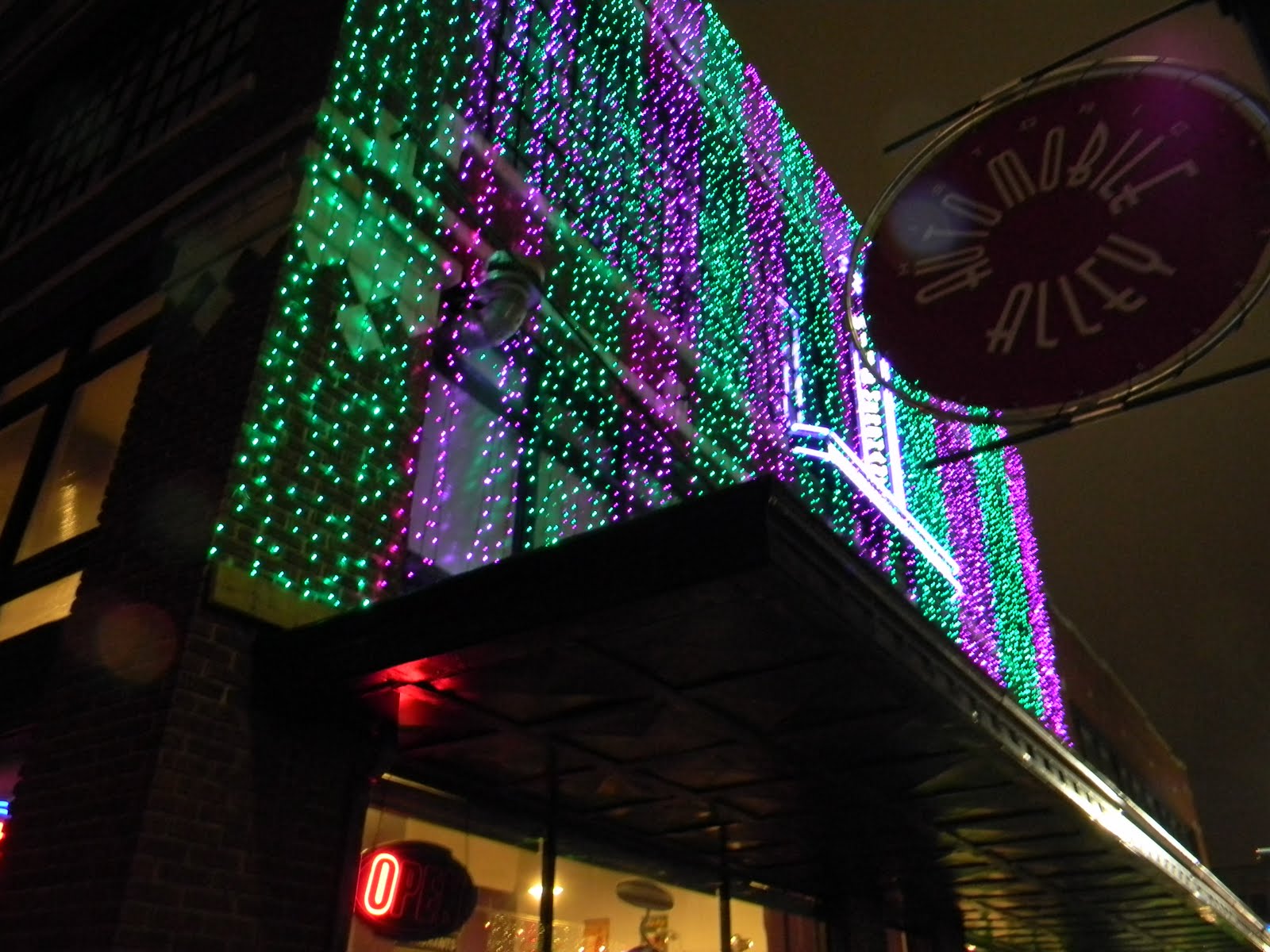
North Broadway Lights in A-Alley

Whoever or whatever was the inspiration for the lights along Broadway in Automobile Alley, was pure genius. Not hokie. Not kitschy. Not overdone. Simple, elegant, chic, and impressive. Now in its second year, it was the historic auto dealership buildings themselves that lit up downtown, veiled in bright strands of Christmas lights. When some colors look absolutely hideous individually on some ranch houses, when draped over the entire edifice the effect is really something--I hope they are doing this for a long time, as A-Alley grows in popularity in coming years.

I took a lot of pics, and I'll post more later, but here are just a few of the best that came out pretty good in my opinion. Still trying to figure out how to take decent night pics with a real camera, but I think there are a few decent ones in here:


Friday, December 31, 2010

Cityshot LXVII


Red Prime in A-Alley.

*My apologies for the quality on this one, which I just took on my phone. I do kinda like the effect of the lights and the blurriness, etc.

Thursday, December 30, 2010

A call for involvement

Dear Readers,

Lately I have been watching the PlanOKC proceedings and talking to some people, including trying to muster interest on OKC Talk, in getting together a small group of committed citizens to take part in a PlanOKC "meeting in a box." My understanding is that it would consist of going through some materials from the city and then jotting down suggestions and ideas from the group to submit.

My idea is having such a meeting sometime during the first week of Jan., or very soon after. There have been a half dozen or so interested but I'd like to try and assemble some more people to make this a healthy group.

Please email me or leave a comment (or shoot me a call/text those that have my number) and let me know if you're interested or have any suggestions. Thanks for your interest, and for caring.

-Nick

Saturday, December 25, 2010

Christmas Wishlist 2010

As today happens to be Christmas Day, I thought I would take some time to lay out my ideal wishlist for OKC. It could be a lot longer obviously, as virtually everything could be done differently, more efficiently, and better. But I'll stick to the main points:

1. One thing I wish for is a serious Plan OKC process. In the coming weeks I am going to be trying to get together an urbanist group to do a Plan OKC "Meeting in a Box" over one evening. I would actually like to see OKC implement some innovative ideas (maybe even some that would make city planning conspiracy theorists' eyes bulge) that could legitimately curb sprawl. I'd like to see us creating fewer places devoid of real lasting value (thus creating future SLUMS) and like to see us move some more of our growth into the kind of development that will still be nice 30 years from now, and even still standing 100 years from now. I'm tired of cheap and low-quality being Oklahoma City's best selling-point. Even if that means prices are going to rise, we have to find a way to start building quality communities and to stop building slightly better than crappy communities. A friend once told me that OKC's motto is, "Better than crappy makes us happy." It's true, and how said is that?

2. When it comes to one of OKC's latest greatest projects with a 7-digit price tag, I'm not even going to say I hope for any kind of abstract, feel-good process with the convention center like an open or transparent process. I could care less about that at this point, because the bottom line is that if the convention center is right next to the park with no separation, it will ruin the park environment. If they think putting commie block apartments in the convention center facade is going to work, they must be kidding themselves. A convention hotel is not a mixed-use from a convention center, either. They need to either put the convention center somewhere else or if they insist on the mysterious OG+E payments, then they need to utilize my creative solution to set it back an entire block and bring Broadway back, allowing for a slender 1x4-block district to develop in between the two. The ULI panel noted that the convention center is being put on 40% more land than it needs, even if it's going to be expanded. Furthermore, I'm tired of the suburban thinking behind Core2Shore. There are block sizes and human scales that actually matter downtown. I get it that they don't understand or care about this, but you can't just recreate a site identical to what you'd do in the suburbs and put it downtown. In the suburbs you wouldn't notice an area (similar to what would end up running all the way from Park Avenue to Oklahoma River) that consists of over 100 normal sized city blocks consolidated into about 15 huge superblocks. Right now we have a large cluster of superblocks that has killed downtown, and ALL Core2Shore looks like it will do at this point is extend that huge miserable cluster further south. Has anyone noticed how the Myriad Convention Center and the Myriad Gardens interact with eachother?? "Oh, but it will be different this time.." If anyone buys that the nature of superblocks have changed, or that they can do the exact same thing and get a better result, they need to be locked up in the mental ward. Or shipped to Tulsa.

3. Come on Nick, tell us what you're planning. I mean Nick Preftakes, not myself. Years later I am still dying to find out what Nick Preftakes is planning to do with the entire block he bought up in the Arts District. I've been telling people it's going to be a game changer, especially with Devon Tower+park+retail+auditorium and the emergence of the Film Row area (which is coming along very nicely), the Arts District could potentially be unrecognizable if Preftakes announces a major development there. It will be absolutely essential that he maintains the historic integrity of the very-historic block, but there are some boarded up buildings there with some really amazing potential. It would be so worth it, especially when you look at the new lease on life the old Montgomery Ward building across the street got. The unfolding of these plans could potentially affect other things like the streetcar route. I've been telling people that I think the Arts District could potentially be a much bigger deal than it is now.

4. I want to see development in Bricktown get back to where it could be. I wish for Bricktown to come closer to being "completed" because once other districts get hot, it may never be able to attract more development. The big problem is that in my opinion Bricktown has gotten stale and has failed to reinvent itself in a long time, and in today's world, that can be fatal. Bricktown could suffer the same death that the West End did for a period if it fails to reinvent itself and stay fresh. It's not just for the sake of locals who have started to focus more on districts that are hotter right now, but for developers who are comparing cheaper asking prices somewhere like 10th Street or Broadway to astronomical ridiculously inflated asking prices in Bricktown, and the choice to pass on Bricktown becomes an easy one. I think Bricktown is relying too much on the streetcar spurring development along Sheridan to bother pursuing other ideas. The city absolutely is to blame, not the Bricktown merchants that put their money where their mouths are. Just because the ballpark and canal are in Bricktown doesn't mean that it's reached some invisible limit for how much city assistance a neighborhood can receive. Has the city turned its back on Bricktown?

5. The Bricktown point is a great segway into parking. Simply put, two things need to happen: It needs to be expressly codified into the city statutes that new surface parking downtown will not be tolerated, especially in lieu of previously standing buildings no matter the condition of said building, and parking lot moguls in areas like Bricktown need to be shut down and put out of business. Tell them to take their business to Tulsa or some city that will tolerate that, but we won't here in OKC, because a few of us are actually serious about building downtown up. How do you shut down the Bricktown parking lot lords? Public parking, and that can be done extremely easy. Watch closely a project that is underway with Automobile Alley to re-stripe North Broadway and take away a lane, add a turning lane, and change parallel parking to angled parking which will allow them to squeeze in hundreds more parking spaces. If they went with angled parking along every Bricktown street that is free or metered, they could easily shut down the Bricktown parking lots because more than enough parking would be available for free on the street. This should also be pursued in other districts if the results in A-Alley are as positive as it could very well turn out.

6. Oklahoma City has failed to grow downtown housing to the extent that we had hoped we would have by now. This is a simple fact in spite of the other fact that downtown housing is slowly on its way to becoming viable, with several hundred downtown residents moving in and taking up urban lifestyles. It could be more, it should have been more. The 2005 Downtown Housing Study said there was 5-year demand for thousands more units than we ended up getting built between 2005-10. Another downtown study that came out right around there recommended taking several steps to incentivize downtown development. Virtually none of those steps, except for rezoning, were actually followed through with. I assume the copies of it at the Planning Dept got filed in the big file cabinet full of other ignored downtown studies and surveys and reports and commissions. But it may be time to develop a REAL program designed to result in a boom in smaller infill projects. This needs to happen now, so that we can fix the problem with demand, before streetcar comes on line and results in a huge boom in infill and therefor makes the appearance of a problem go away. If we get the streetcar finished without an infill program, the results aren't going to be as positive as it would be if we got the streetcar in and an infill program. We need to evaluate our goals from 5 years ago, and the results we got, consider why it ended up that way (and be open-minded to reasons other than the popular excuse, "It's the economy, stupid"), and get back on track to recover lost projected units.

7. I want to see Full Circle move downtown. They could locate smack in between Heritage Hills and the booming downtown residential market. Downtown residential markets tend to be filled with creative types with disposable income WHO READ. If they went into a beautiful old building like The Packard at 10th/Robinson they'd have the potential to be one of the absolute coolest locally-owned bookstores in America. They already are, the only thing holding them back is their location in crappy (and rapidly-emptying) 50 Penn Place. Enough said.

Well that's the Top 6 at least. Quick summary: 1, Plan OKC; 2, convention center location; 3, Nick Preftakes development; 4, Bricktown development; 5, angled parking; 6, small infill program; 7, Full Circle.

I am thankful for all the really good things going on in OKC, for being included in a number of processes unfolding around downtown right now, and it's also good to be back in town. If anyone's interested in meeting for coffee or lunch, feel free to let me know, I'm always excited to meet with fellow urbanists. I know this blog doesn't get a lot of comments by the nature of the things it talks about, but I do appreciate the people who read this and hear me out on the ideas I have. Merry Christmas to all!

Wednesday, December 22, 2010

Cityshot LXVI


RIP

Please, no "180" monkey wrench for streetcars

My latest concern about the stewardship of the voter-approved MAPS sales tax is the lack of urgency from COTPA and Alternatives Analysis in coming out with the streetcar route. The streetcar will probably end up being the second MAPS 3 project after the park, and if I had my druthers the streetcar would be first but I'm nobody. I will say that not putting the streetcar project first in succession will hurt the streetcar project more than it would hurt any other project, and we're talking about the issue that carried ballot and had the highest voter favorability. The streetcar needs to be the priority of MAPS 3 because voters simply did not respond as positively to the Core2Shore stuff, particularly the convention center. If they were separately voted on, streetcar might have been the only high-dollar initiative that passed, and as much as City Hall wants to pretend this was not the case, it should translate into leverage for streetcar backers. That alone is concerning.

What is most concerning however is that there seems to be no effort to publicly cooperate with the Project 180 construction, which could lead to the biggest fear of anyone looking for transparency, private cooperation. Let me rank in order the best outcomes for cooperation between MAPS streetcars and Project 180:

1. Public cooperation between the two
2. No cooperation at all between the two
3. Private cooperation between the two

Let me explain: I am afraid that COTPA's "Let's Talk Transit" and all their alleged due-diligence could be a complete farce if they don't come out with something soon. There will be major cost savings if they can figure out where the streetcar is going to go, and that's just obvious. What's less obvious is who's to say they don't know that? I would not be surprised if they don't decide to just let the city engineers behind Project 180 make the route decisions and then circle the wagon later by saying, "Well, we just didn't plan around it soon enough, because this is how the roads got built. Shucks, now we gotta put the route through here." Or however COTPA/MAPS 3 would come out and say that (probably by saying something to maintain more public confidence than "shucks" would).

There are private citizens backing this who are confident they will get the best route, and they're confident that they will be able to find common ground with COTPA and City Hall in getting a comprehensive streetcar system that pleases everyone, all the stakeholders involved. But one way COTPA can usurp the give and take process is if they use Project 180 to tie their own hands. For example: Most everyone wants Sheridan to be a transit corridor but it is impossible to lay tracks going one direction (I think west bound) down Sheridan because of the utilities underneath that side of the road. So that will not be in the route, whereas going the other way down Sheridan will work, so far as we know now. I don't think COTPA is manipulative so much as they're just a typical dumb government agency, but it is plain to see how this could throw a wrench in the planning phase. With its effect on the streetcar route, the people in charge of deciding where utilities will be buried NEED to have a talk with the streetcar route planners.

COTPA has had MORE than enough time to plan this route. They got a ton of feedback and surely it doesn't take them this long to figure out how to go against all of it. I also realize that ACOG is still doing the transit hub study. That was began at the beginning of this year, and I think COTPA is capable of talking to ACOG. I mean, they office in the exact same building (I think).

I would honestly rather there be no planning coincide between the two if it's not completely public, and have a transparent process where we get the best streetcar route even if a mistake is made and it ends up costing a few more million dollars. I'm not saying that this is what I think is happening or someone has told me something that has me jumping to a conclusion, because that has not happened. What has happened is everything you see in the news since the measure passed at the ballot box by a good margin. I just haven't seen a whole lot since then that has bolstered my confidence in this process, and over my lifespan COTPA hasn't exactly earned a great deal of good will either, and my pessimism and relentless over this is, in my opinion, entirely warranted until MAPS 3 gives more hope for transparency and COTPA gives more hope for competence.

As bad as COTPA has been throughout the last 10 years, let's face it. They're a helluva lot better than the city engineers behind Project 180..the people who refuse to let go of E.K. Gaylord (despite the Chamber's offer to "fix it" for us) and the NE 2nd Street "Sidewalkgate." I have absolutely no confidence in the ability of them to get it right, and at least COTPA is using consultants who vaguely know what this urbanism thingy is about.

Sunday, December 19, 2010

Convention center search: Site selection nearing

The city is currently undertaking once again, another convention center study. There has been a number of highly-acclaimed consultants who have vehemently advised against the parkside convention center site. There was an OU presentation that proposed other potential sites, such as the Bob Howard Ford site north of the proposed boulevard and the steel yards in the east end of Bricktown. There have even been some Bricktown merchants surprised by that idea, and the steel yards are not a bad idea because it provides good access to Bricktown and doesn't block circulation because the site would just back up to 235. I don't think the idea will go very far though because it is nearly a mile from the CBD, which is just too far.

I also don't think that the Bob Howard site, the closest proposed site to the current CBD, is going to go very far. Fred Hall announced that he's closing his family's dealership last month and is going to pursue a massive mixed-use development of the entire 6-block site, which spans from Walker all the way to Robinson, from Reno to the proposed boulevard. One of the few vital components of the Core to Shore plan that is universally agreed on is the need to focus the signature retail on that site, and Fred Hall, with his resources and connections, is just the guy to pull it off, so that's great for OKC. I don't think Mayor Mick wants to put the convention center there because he was quoted in the paper saying it would cut off circulation to downtown, which is incredibly true. I don't think that the proposed site along East Main in Bricktown works either, although it's an interesting idea--putting it in the parking lots north of the East Main storefronts.

With that said, it looks like it should be south of the boulevard. That's by process of elimination, unless someone with credibility seriously comes in and suggests Meridian or something both suburban and nutty.

Moving on, this a brief critique of the parkside site:

This site can not be allowed to happen for many reasons. The obvious one is that the park frontage would be squandered. A convention center does not bring the vitality we want surrounding the park, and the idea of having apartments in the facade of the convention center is not an innovative solution to the convention center problem. Pretend we're not even talking about a convention center, any kind of structure that is not broken up and 2-3-4 blocks long would have a negative effect, looming over the park. Hell, even if it weren't convention at all and were all apartments, a 2-3 block-long apartment building, basically an upscale commie bloc, still isn't exactly the development we're looking for. A mix of commie blox and convention center, I imagine, will have an effect fairly similar to a commie bloc and a convention center. As mentioned by the ULI report, it creates a dark wall effect and will cast a shadow on the park in the A.M., also something people will overlook but would have a potentially devastating impact on enjoying the sunrise in the park. The HOK report, another one of the many studies done, is no fan of the access to existing assets from the parkside site.

Jeff Speck though, another consultant, brought up the trump card, and probably the biggest concern for the parkside site. Superblocks. There are too many superblocks clustered together. In the above graphic, you'll notice I shaded the area of sueprblocks: in a huge cluster from I-40 all the way up to Park Avenue, there is not a single normal downtown block (except for the block with Devon's HQ and the Renaissance Hotel). A whole damn mile of urban renewal's effects. That would be truly devastating on the chances of spending all this money actually creating a world-class city. Never underestimate the importance of the little things, like the street grid. A street grid is extremely important, it impacts how the city flows. The reason the area south of I-40 died is probably not because of the I-40 land bridge itself, for proof, check out Omaha--a nearly identical city in many ways, that is seeing a lot of development in their "NoDo" area which is just on the other side of a very similar huge land bridge freeway.

The difference is that it lacks what likely did cause the death of downtown's south side--the superblocks simple cut it off from the rest of downtown. We have the Century Center, the Cox Center, the Ford Center, the Myriad Gardens, and EKG all clumped together like that. It shouldn't take a rocket scientist to tell that such a configuration of all these superblock sites right next to each other will likely cut off the circulation to South OKC. Broadway, which is normally the most important street in a city, dead-ends in front of the Cox Center. Main Street, also normally an important street in a city, dead-ends on both sides of the new Devon site, thanks to the failed 80s proposal to build a Galleria mall on those 4 blocks. So for people to claim Core to Shore will CHANGE ANYTHING by moving I-40 to make room for extending the cluster of superblocks further south is just absolutely insane. C2S's primary focus needs to actually be breaking up the superblock cluster. Restore some of the grid. Try and find ways to restore some of the N/S circulation through OKC.

Oh and by the way, the idea of a "pedestrian spine" along the Harvey axis was just killed by ODOT, who is requiring the pedestrian bridge to be moved a few hundred feet off-kilter from the proposed axis. So much for that idea.

Here are some proposed sites that I think would get Core 2 Shore a greater chance of success, and more importantly, ensure vitality around the park on at least 3 sides (assuming that the boulevard concept is going to be reworked). The key is that the park needs to be surrounded by mixed uses. Apartments in the facade, essentially the awesome combo of commie bloc AND convention center, isn't going to cut it. What will is enveloping the park with districts that will draw their identity from the park. The park is a space that needs to draw its definition of space from being well hemmed-in by streetwalls on all sides, but those walls can't be continuous, they need to be broken up, they need to be highly-interactive walls that give in to other walls, that give in the other walls. You can't eliminate the urban form and still expect urban, it just doesn't work that way, no matter how desperately you try to emulate Dallas.


Solution #1 puts the convention center in the lumberyard site and places the convention hotel next to the U-Haul building, or perhaps in the U-Haul building. What few people realize or remember is that the U-Haul building is actually not a high-rise shed, but there is a brick building with stories and a brick facade under that crappy sheet metal facade that could be totally renovated. Or the convention hotel could go next to it and leave the U-Haul building to be fixed by someone else. A pedestrian crossing could be put between the two allowing great access to the hotel and convention center. With great access to the boulevard, it's well-connected to the interstate system and within 1 block would be the park, the likely site of the transit hub, the Cox Center, Bricktown, and other hotels. Bricktown would benefit MOST from this proposed site, and keep in mind that is important because we can not risk losing what we currently have going at the benefit of possibly gaining something we can't count on. Bricktown merchants are said to rely 30-40% on business from convention guests, which is increasing as Bricktown continues to fall out of favor with locals (as it fails to reinvent itself and come up with anything new) and as OKC's convention industry continues to grow and emerge as one of the bigger convention destinations.

The convention center hotel in the corner of Bricktown could be a very nice atmosphere. The canal is eventually going to be extended to go through that block and if a convention hotel isn't built there, Randy Hogan or someone else will eventually come out with a development concept for that area. With the convention center, the convention hotel, a restored U-Haul building, and a canal extension through that area, it could be an incredibly serene, urban, and attractive environment.


This site provides medium benefit to Bricktown and Core 2 Shore. It places the convention hotel on the OG+E site, which the mayor has said will be acquired by the city out of the convention center budget no matter what, whether the convention center goes there or not. Mick Cornett is hell-bent on getting OG+E the $30 million he promised them, no matter what. Many of us have argued that the power substation does not need to move, and it can be covered with an attractive modern false facade--this has worked all over Europe, including in several cities in Germany, France, and The Netherlands. But if we're going to do this no matter what, and not even have a public debate about, we might as well develop the site that the city will own--so put the convention hotel there and invest in a pedestrian crossing with a completely safe, constantly accessible connection. The city will need to find some way to traverse Shields and the tracks--maybe with a skybridge over both, maybe with an at-grade pedestrian crossing, maybe raise Shields further up to not have to deal with it, or maybe a combination of these ideas.


This third proposal is one that I am shocked nobody has thought of yet. The ULI report stated that the city is wanting to reserve 40% more land than really needed for the convention center. I think this is a pretty major tidbit of info. In all of the above graphics I have gone with 2 blocks of medium-impact mixed-use development identical to the westpark neighborhood, but there's no reason that one block could not work in between the convention center and the park. This is extremely different from having apartments built into the facade of the convention center because the convention center is moved back up against the Shields land bridge and Broadway is brought back as a street and extended between the boulevard and the new I-40, with normal (or slightly compressed) city blocks broken up filling the room between Robinson and Broadway. This would leave Bricktown out, and Bricktown would suffer a loss of convention business, but that could be mitigated with a pedestrian corridor of some kind, but it would still be a long shot because of the sheer number of barrier to have to traverse in such a short distance. Bricktown would likely have to find a way to deal with 10-20% of its business coming from convention parties.

Please offer any kind of feedback you can think of. If you like these ideas, have come up with your own, or have any say on the matter you should probably find some venue to share your opinion on this matter with the City Council, the mayor's office, the MAPS oversight committee, or someone who is compiling the new study, or so on. There hasn't really been a public debate on this, but there should be, and it would be a doozey.

Sunday, December 12, 2010

Cityshot LXV


Took these this weekend outside the BOK Center.

Here's a real downtown streetscape


Greenville, SC

You can't help but be floored by the urban canopy here. This is how you create a timeless and amazing downtown streetscape. Not only does the continuity create an attractive, well-defined space, but it solves problems of shading. Keep in mind, this is Carolina where it is often steamy, muggy, or raining--shade is a great thing. OKC, which is in desperate need of some urban canopy of its own, not to mention well-defined spaces, could learn some things from this.

Friday, December 10, 2010

Tulsa's own West Bank smirmish

Jerry Gordon, the developer of the RiverWalk Crossing project in Jenks, was apparently a big player in a project that was proposed for the west bank of the Arkansas River in Tulsa. The great thing about these TDA & City Council-involved projects is that we only find out about them after they're dead. My personal opinion of this project is that it's a pretty rendering but it's really not too special of a project..though the harbor it integrates is kinda cool.

Their website says: "This is our newest project under design and planning on the beautiful Arkansas River looking over downtown Tulsa. It will feature a Harbor, Docks, Theater, Hotel, Amphitheater, and over 500,000 square feet of Retail, Office, and Residential."

Here's the rendering:

After the powers that be in Tulsa decided to stop working with him, which it should be noted that Gordon is a very angry individual who is currently up to his eyeballs in bankruptcy, Gordon wrote this lovely letter to Mayor Bartlett's chief of staff, Terry Simonson, and CC'd Bill Christiansen and Jim Robertson:

From: Jerry Gordon
Date: Friday, December 3, 2010
Subject:


To: "Simonson, Terry" CC: Christiansen, Bill; CC: Robertson, Jim


Mr. Simonson, This letter is to inform you that at this time I am backing down on my plans to develop the West bank as I have spent the last 7 months planning. I have to say you and the Mayor's interference in my project is legally wrong and could be fought as Tortuous (sic) interference, also known as Intentional interference with contractual relations but I think fighting that is something that this City doesn't need to go through at this time with this administration. I was trying to help MY city, not hurt it as I feel you are doing. I will warn you of this though, Please do not attempt to distribute or copy my plans in any way or I will seek legal action. I confided in you and the Mayor and expect that much out of you. One more point, when I started this process I asked of Julie Minor and Clay Byrd, in our first meeting, to please not let politics get into our planning because I have seen what can happen. You have sure shown me why Tulsa s always trailing Oklahoma City.
Jerry R. Gordon
JRG Developments,LLC

Wow. What a tool.

Tuesday, December 7, 2010

Cityshot LXIV

Saying farewell to Councilman Bowman


It was said recently in the Gazette that Ward 2 councilman Sam Bowman will not be running for reelection, and that is a loss for this city. I did not know Bowman, but I did know of him, and I could tell he was a difference-maker in Oklahoma City. He championed the causes that might be considered politically unpopular in Oklahoma and his district, the north side from the Paseo up to NW 122nd, triumphed for it. Bowman is a resident of the Cleveland neighborhood, a great neighborhood (that you don't hear a lot about) north of 23rd between Villa and May avenues.

The times that I took my issues to the City Council and spoke before them, and even the times I have gone just to listen, I have grown to like some of the councilors and dislike one in particular. That said, Bowman has been my favorite and it's clear that his priority is to keep the heart of OKC healthy. He often brought his anecdotes from functioning urban cities before the council, and when councilors react to public comment, would defend most anyone (including me) who went before the council with blistering urban planning criticisms of this city. When others like to mitigate the harshness of the reality of our maniacally sprawled city, Bowman was willing to face it head-on and be an honest broker of solutions. His frankness, his vision, and his outlook will be missed on the horseshoe.

I am certain that whoever fills his shoes in Ward 2 will be of the same high caliber of public servant that he was. This is something to look forward to, because that bar is set pretty high. If you go through history, it's actually these neighborhoods in Ward 2 that have been a gold mine of great public servants, from Edgemere Park denizens like OKC's first woman mayor Patience Latting, to Crown Heights residents such as Judge Gene Matthews and Corporation Commissioner Bob Anthony. All got their start as Ward 2 Councilman.

Sunday, December 5, 2010

Compare to Tulsa City Council wards


I present to you, a ward map that makes sense. There aren't really any wards that traverse major boundaries and each area of town is given a great sense of autonomy by these districts. They also, for the most part, have smaller wards than we do. Tulsa, a city of 389,000 in the 2009 estimate, has 9 wards at about 44,000 each. Oklahoma City, with about 570,000 in the 2009 estimate, has 8 wards at about 71,000 each. This would tend to suggest OKC needs more wards in order to have as representative a body as Tulsa, and I would argue that 44,000/ward is still high. Also consider that Tulsa pretty much has 4 wards that represent the inner city. 2 for Midtown and 2 for North Tulsa. OKC's inner south has no ward that represents it, whereas North Tulsa has 2 that represent it.


Calgary is also redrawing lines in its 14-ward City Council. Here's a great map drawn up by a Calgary blogger..the color fills represent the new wards, the black lines represent the old. This redistricting is supposed to ensure a more representative council. So apparently it can be done by just redrawing lines. I would also mention that Calgary has a ratio of about 75,000 citizens to 1 alderman. You'll see that the UC area (Ward 7) and inner-north side of Calgary is being consolidated into one ward. Presently it's a lot like Capitol Hill--an area broken up by 3 or 4 wards depending on how you geographically define it.

Maybe what's interesting is that the redistricting in Calgary is taking place now that the overwhelming majority of the inner city has been gentrified. You're just as likely to see minorities in the burbs now as you are in the inner city, the only different is that the ones downtown are much more affluent and the ones in the suburbs got bumped out by the high rent in the Beltline (south of downtown). So basically the modus operandii while the inner city was fragmented and poor was to gerrymander and split it up into a dozen different districts that made no sense as long as each had a different area of town to counterbalance the minority votes. Now that the inner city is gentrified and affluent, the modus operandii is to go back and draw lines that make a little more sense. So does anything really change? OKC will probably follow the same trajectory. We won't do it this time just yet, but next time this comes up in 2021 we probably will finally get around to some wards that make sense. Lookin at you, Capitol Hill.