Taken in front of the RCB Bank of Nichols Hills in Automobile Alley.
Sunday, June 6, 2010
Saturday, June 5, 2010
Houston traffic...
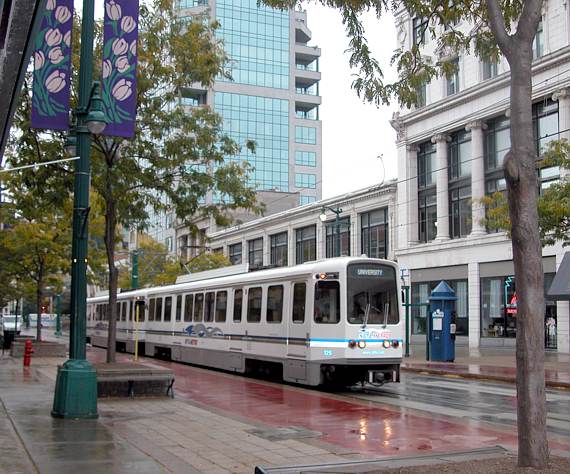
Much has been made about Houston traffic coming into conflict with the Light Rail that runs for several miles up and down Main Street between downtown and Relient Stadium (and through areas like the Texas Medical Center, Museum District, and Midtown Houston). They even did a feature on it here at LightRailNow.org. In 2004 alone there were 63 collisions with the LRT, which means more than one per week, a collision rate that is more than 25 times the national average for public transit trains that operate in street right of ways. I'll quote from LRN:
The collision rate between cars and cars in Houston also goes without saying..as being quite high. In 2002 Houston had 12.45 traffic fatalities per 100,000 people, far higher than say, New York City (4.39). These are BAD statistics.
According to the INRIX National Traffic Scorecard Houston traffic is also quite epic, and it is the thing that many people especially know Houston for, a shame. Houston ranks #6, and by comparison, OKC ranks #40 and Dallas ranks #5 (after LA, NYC, Chicago, DC). I am personally promoting Houston to #5 because in my opinion Dallas has the best traffic out of any big city due to its overblown freeway system.
Houston traffic was also spotlighted by Budweiser's Real Men of Genius:
On a side note, for anyone interested in checking out Houston's cosmopolitan and international flavor, check out this really awesome photo set on SSC. Just to balance out the negative coverage of a city I love.
So the point is, yes, there have been collisions with LRT in Houston. I've heard a lot made out of that fact. But..look at the surrounding context of HOUSTON TRAFFIC. Again, to quote from LRN:
Check out this awesome video from the Houston Metro "Danger Train." (nobody was fatally injured in any of these accidents luckily)
Houston, we have a problem. (But not any other city)
While several other cities, such as San Jose, Portland, Boston, New Orleans, Denver, and Salt Lake City, all have street-running light rail and streetcar systems, drivers in those cities for the most part seem to be able to avoid crashing into their trains. Unfortunately, that's not the case in Houston. The propensity of local drivers to smack into the new train system has even become national news.
The collision rate between cars and cars in Houston also goes without saying..as being quite high. In 2002 Houston had 12.45 traffic fatalities per 100,000 people, far higher than say, New York City (4.39). These are BAD statistics.
According to the INRIX National Traffic Scorecard Houston traffic is also quite epic, and it is the thing that many people especially know Houston for, a shame. Houston ranks #6, and by comparison, OKC ranks #40 and Dallas ranks #5 (after LA, NYC, Chicago, DC). I am personally promoting Houston to #5 because in my opinion Dallas has the best traffic out of any big city due to its overblown freeway system.
Houston traffic was also spotlighted by Budweiser's Real Men of Genius:
On a side note, for anyone interested in checking out Houston's cosmopolitan and international flavor, check out this really awesome photo set on SSC. Just to balance out the negative coverage of a city I love.
So the point is, yes, there have been collisions with LRT in Houston. I've heard a lot made out of that fact. But..look at the surrounding context of HOUSTON TRAFFIC. Again, to quote from LRN:
Furthermore, the Texas Transportation institute (TTI), which was recently hired by METRO to assess safety along the METRORail corridor, found no fundamental design flaws in the rail system itself that would contribute to the high rate of car-train collisions. However, these facts are generally ignored by local rail critics. METRO built the train down Main Street, they argue, so therefore METRO, not the city's careless drivers, is to blame.
Check out this awesome video from the Houston Metro "Danger Train." (nobody was fatally injured in any of these accidents luckily)
Houston, we have a problem. (But not any other city)
Labels:
comparing cities,
Houston,
light rail,
public transit,
transit
Friday, June 4, 2010
Rogers Marvel architects
I have been searching for an email address for Rob Rogers that I can send him my suggestions for how to improve the SandRidge Commons proposal. Can't find ANYTHING on the web, not even on the Rogers Marvel Architects website. If anyone knows the email address, please let me know. You can leave a comment on here or email me as many readers do at moore.energizer@yahoo.com.
Thanks, and save the India Temple!
This post (not) brought to you by the Big 12 Conference
The Big 12 announced its new host cities for future tournaments and the results are in: OKC has officially gotten the shaft. This will be a real brief post, and as much as I would like to spend hours going through data and old news clippings pulling out attendance figures from past times OKC has hosted the basketball tournament, let me just say that OKC has never done a bad job of hosting the Big 12 basketball tournament. The event, which was a huge boon for downtown the two times we were lucky enough to host it, was perhaps the closest we will ever be to hosting big time sports tournaments because the future prognosis does not look good for OKC.The bright news is that we have secured the Big 12 baseball tourney for 5 more years or so. Realistically though, there was no competition. Omaha, Tulsa, and Austin wanted it..but neither have the same baseball setup in Bricktown that fans from every school have absolutely loved for the last ten years or so. Nobody can come close to competing for that event which honestly is not nearly as big an event as basketball and football, and we're obviously never going to host the football championship for lack of an NFL stadium anywhere in Central Oklahoma.
But basketball is the prize we should have had our eyes on and we absolutely blew it. Because of how successful both of our ventures with the tourney were, it is a shame to settle for not hosting this event. Yes, KC was also good. But there are advantages to OKC also that should have kept us in the running and the event should have been split between the two cities. Let me emphasize: MAJOR loss. I know right now, given the general euphoria in this city, it's hard to comprehend the idea of a major loss, but this is it. Perhaps the impact is lessened by our ability to flirt with hosting an endless array of big events at once, from the Grand Prix idea, to the rowing, to other sports tourneys, and so on--but the PRIZE out of any event we could possibly host was the Big 12 Basketball Tourney and we lost out. We need to examine ourselves as a city and discover what it is that we lack and how we can better position ourselves to host major "Big League City" events like this, which would put us on a map of other cities that host conference tourneys like Seattle, Atlanta, and NYC.

But maybe it doesn't even matter and we're destined to lose relevance in hosting conference events anyway. Consider that the Big 12 is looking less and less likely to exist in a few years and the surfacing of reports today that the Pac 10 has extended invitations to 6 Big 12 teams, with another two having known (well-publicized) flirtations with the Big Ten. If the Oklahoma schools end up in the SEC, OKC isn't going to have any events to host. The SEC has anchored EVERY conference tourney in Atlanta and that won't ever change. If the Oklahoma schools end up in a "Pac 16" conference as is appearing very possible, it's going to be a hard sell for OKC to host events that fans will travel to. In fact anywhere you host a tourney in a "Pac 16" conference it's going to be difficult for fans in Texas or in California. Consider the future and the trends that appear to be emerging.. what does OKC stand to get out of all of this?
Doesn't look good in terms of hosting major events at the Ford Center. And also consider this, and this is where the impact from conference realignment could be HUGE for downtown OKC: If the primary reason for keeping the Cox Center and especially its arena in tact was the preservation of the setup with two arenas "48 steps" apart, what advantage does that extend us in the future? Is there a reason to keep that setup if we are no longer competing for men's and women's tourneys across the street from each other? That land could be prime real estate, and a huge money maker for OKC, especially if anything in MAPS 3 has cost overruns beyond $17 mil. The benefit to the general public who's not concerned with the city coffers however would be in the form of possible breaking the site back up into smaller blocks and reinstating urban infill on that site, which would much better incorporate the east edge of the Myriad Gardens.
Labels:
basketball,
Big 12,
conference tournament,
Downtown OKC,
events,
ford center,
NCAA tournament,
tourism
Cityshot LIII
Thursday, June 3, 2010
Traffic circles, streetcars, pedestrian malls, oh my!

I just want to congratulate anyone and everyone who participated in one of the Let's Talk Transit public forums and took their beliefs public. It's often so easy to sit behind a computer screen and type and keep typing until you've written a how-to essay on what you want to happen in OKC, but it's harder to make the time to meet people in person and go before a group of strangers including city leaders and state your case. Those who participated did just that and left COTPA with the impression that the community is interested and is watching. I want to thank COTPA as well for giving us the chance to do this through the public forums, for paying attention to everything we said, and also for giving me the opportunity to be the guest blogger. Without much further ado I'll go into more detail on a few key points:
Routes: We're being told that any routes we may see mapped out are only preliminary. I want streetcar planners to realize that we know these maps will be the starting point for their system planning, so we ARE going to analyze the routes. Just because they are "preliminary" doesn't mean they're only preliminary. On the Let's Talk Transit website, Walter Jenny made the following comment on a previous blog entry of mine:
- Identify the purpose of the streetcar. It's not to move people from Edmond to downtown, for example. It's to move people around downtown once they're there.
This got me thinking. I myself, and others as well, have said a LOT about the importance of connecting the Oklahoma Health Center to downtown but since stressing that importance I've been waffling on the issue. Blair Humphreys made his case in an OKC Central guest post that given the track miles we have to work with, it is not worth connecting the Health Center to downtown for the purpose of the lunch rush. Given the frequency of having streetcars run every 15 minutes and carrying less than 100 people in each run, he has a good point. Is the lunch rush the purpose for connecting both sides of I-235? Of course not, but the point remains.
One of the things I'm hearing a lot about is the lack of simplicity in any of COTPA's preliminary routes. A lot of people have suggested that the routes indicate not listening to the people who have clearly expressed a desire to see Sheridan, Walker, and Broadway. I contend however that the routes show COTPA is listening to everybody and not just the majority and the experts and FAILING to commit to ONE alignment through an area, and the complex web of streetcar they've drawn up does seem to touch virtually every street for at least one-two blocks. Someone needs to tell them it doesn't work that way. For example, you can't describe to an out-of-towner where they can catch the streetcar and where it goes without turning blue in the face. You also do need to COMMIT to a corridor and stick to those corridors instead of interweaving in order to please every proponent of every corridor. While I'm not certain of this route and while I realize it misses key areas such as Deep Deuce (although some Deep Deuce residents have told me they are used to walking), here is my proposal for SIMPLICITY:

That would be within the 7 miles we have to work with and within the physical constraints that each corridor seems to have. For instance, Sheridan can't have a double track going in both directions due to the heavy underground utilities that exist underneath the south half of the street (eastbound lanes). Other constraints involve the traffic circles, and others also involve the underpasses underneath the elevated BNSF railroad (they lack the clearance for streetcar cables). Sheridan however is by far the most popular corridor thus it NEEDS a streetcar line and more than the 3-4 blocks COTPA has proposed.
Not that the COTPA routes are all that bad. I think that the red route could be really awesome if slightly tailored, as such:

All I changed about the red route was instead of southbound cutting west to Robinson on 4th, I kept the streetcar going down Hudson until Park where it turns west to Robinson. By touching Hudson/Park you've got Arts District coverage that the streetcar didn't before. I like the idea of CBD coverage as well--most people's routes seem to touch all of the periphery neighborhoods that make up downtown but NOT the downtown skyscraper core. Just because an area doesn't currently have mixed-uses doesn't mean it lacks potential for streetcar vibrancy.
Traffic circles: In the $835 million 2007 General Obligation Bond that the citizens passed by almost 90%, apparently there was funding for several more traffic circles. Traffic circles have been making their entry to the downtown area over the last few years, most notably in the Midtown area on both sides of St Anthony's--10th and Walker has a traffic circle and 10th and Dewey also has a traffic circle. I love these traffic circles and not only do they make the intersections very efficient but they also go a long way toward creating defined space and anchoring an area with an interesting street form and well-maintained streetscapes (intensive planting in the middle of the traffic circle). These traffic circles are GOOD things. They are also helping to extend Classen Drive which cuts diagonally (NW/SE) between Midtown and Heritage Hills. In the Classen Drive extension there are new traffic circles proposed to go in at 9th and Hudson, 8th and Harvey, and I think stopping at 7th and Robinson. You can view the 2007 GO Bond projects here at okc.gov. Getting to the point: These traffic circles are going to affect the route and we need to figure out what the deal is with these traffic circles SOON and before going any further.
There are surely some solutions to cutting through a traffic circle as well. The OKC traffic circles have too sharp of a turning radius for a streetcar to actually navigate the curve normally but perhaps a traffic signaling system similar to crosswalk lights (embedded street lights in the pavement that flash, stopping traffic when a pedestrian pushes a button) could be used and the streetcar route could just cut through the center pavers inside the traffic circle. Granted, you would still not be able to have a streetcar curve or intersection in the middle of a traffic circle, you just might be able to transect it evenly. Maybe.
Funding: A lot has been said about the funding ever since I brought up my concern that system expansion is not feasibly going to happen any time soon due to the funding mechanism, and especially considering COTPA has yet to identify a maintenance funding mechanism for this current starter system. The belief (or illusion) shared by many behind the streetcar initiative is that future expansions will be funded by the feds who have already begun issuing streetcar grants to cities. Let me just say this: Any city that is counting on the feds for any streetcar-related capital investment is deluding itself and needs to get off its arse and fund the damn thing itself. I don't want my taxes paying for streetcar in every city when we here in Oklahoma will likely NEVER see a dime for fixed guideway transit of our own. The reality is that the feds are very strict when they evaluate transit proposals and go for bang for the buck as well as FEASIBILITY. And they have strict determining factors for feasibility which take into account density, not the potential for density.
Also consider the people we send to Washington. These guys do everything they can to thwart transit funding and they're not going to go out of their way to secure transit funding for OKC, believe me. Remember in the 1990s when OKC was about to get a LIGHT RAIL grant from the feds to go with the original MAPS projects and disgraced Congressman Ernest "I-Took" Istook put the breaks on that? Let me state it again. Consider the people we send to Washington, these guys aren't on board with transit and will never go out of their way to secure funding so that their own community can have as decent transit as everyone else. These guys are obstructionist, self-defeatist, they do not believe in the greater good for the community and thus do not believe in the future of OKC and they're going to bring us down with 'em if we decide to rely on them for future expansions of this system. /end rant
Pedestrian malls: Another really cool idea that I think we ought to consider is integrating a streetcar corridor with a pedestrian mall. The result would be a street that incorporates numerous transit types, virtually everything except cars. It would have a bicycle lane, street vendors, a pedestrian mall, and a streetcar corridor connecting to other areas of downtown. Since Robinson is already such a screwed up one-way then two-way then one-way corridor why don't we just use Robinson for this? Between Park and Sheridan (adjacent to the Myriad Gardens) is where we could do this. An alternative is using Broadway between Sheridan and 4th, PROVIDED that SandRidge keep their buildings and builds up a Broadway streetwall.
Think about it:


Bad Egg Restaurant Group
This post has been deleted. Keith Paul contacted me, the offending server has been dealt with, and everything is good--and I am back to support Good Egg restaurants, just not the Norman Iron Starr.
It pained me to recommend people avoid their restaurants, not just because of the impeccable attention they pay to their appearance as well as food, but also because of their genuine community support. I gain nothing in blaspheming them, so I just want to get rid of this post now that the situation is fixed.
-Nick
Wednesday, June 2, 2010
State funding for Tulsa roads
This sinkhole should be a wake-up call to the legislature that Tulsa is being sorely left behind for road funding. I myself am an OKC guy that can realize Tulsa is indeed getting the shaft here. The sinkhole will be filled, but who wants to drive on a road after there's already been one sinkhole? I can not think of a less safe road in all of Oklahoma. But it's great that we have a $600 million project to move I-40, as long as the highway builders get their money, that's all gravy.
Tuesday, June 1, 2010
An ugly development
"Pathway Development Company, LLC, is building a unique and stunning $120 million, 2.4-acre development called The West Edge near Kansas City's Country Club Plaza. Set to be completed in early 2008, the mixed-use urban development can best be described as a "hillside village" of cascading structures which will house a variety of retail and commercial units, as well as a 131-room boutique hotel. A portion of the 203,000 square feet of leasable office space will become home to Bernstein-Rein Advertising, Inc."
Sounds nice. Reality:

This development looks like a U.S. Embassy complex in some warring African nation like the Congo. It's kind of difficult to have a development with no setback from the street that is not pedestrian friendly, but they have somehow managed just that. Add to the trouble that the developers went bankrupt over this hideous project in KC's Country Club Plaza and now it's an abandoned construction site, a similar fate shared by The Hill in Deep Deuce. Kansas Citians in general seem pretty upset about this project.
Just because a project is expensive and has flashy renderings does not make it a good project, nor does it make it a positive project. Believe it or not, sometimes what developers propose is a bad idea and they need to be stopped for their own good. Sometimes what they propose to do is such a bad idea it will cause great detriment to the surrounding environs as well.
This is something we need to realize about the nature of development. Sometimes we gotta OPPOSE what they PROPOSE.
Labels:
bad projects,
comparing cities,
development,
Kansas City,
urban design
Sunday, May 30, 2010
What a great state
Just got back from a trip up and down Route 66 from OKC to Tulsa and back, although I must confess, I cheated and took the new highway back. I just wanted to make a comment about what a special, one-of-a-kind place Oklahoma really is. I realize how negative and controversial I sometimes come off, and I don't mean to sound so pessimistic, it's just one of those things where if everything's alright then nothing needs to be said. This blog is about urban change, and I say if it aint broke, don't fix it.Another thing I constantly strive to find in Oklahoma is uniqueness, and it's not hard to find. We all love to support local establishments. In the last three days or so I have been spending my time at the UCO Jazz Lab, the Paseo Arts Festival, getting my kicks on Route 66 (passing dozens of vineyards), and exploring the Philbrook collections, and grounds. And don't forget coffee and then dinner on Brookside. And yeah, Pops is absolutely awesome.
Name me one small state where summer means such a complex wellspring of arts, music, cuisine, and more.
Friday, May 28, 2010
Wednesday, May 26, 2010
3 options (that don't stink)
These are the three streetcar routes that COTPA is going to unveil at the upcoming Let's Talk Transit meeting. I am impressed by the skill, knowledge, and patience displayed by COTPA staff and particularly their consultant, Mike McAnelly..and personally, I say they've come up with some GREAT routes given the length limitations we are going to face. Wish it could have gone further down Sheridan and connected Film Row and OCU Law, but oh well.
Route 1

6.75 miles
Route 2

5.47 miles
Route 3

6.35 miles
My comments will be brief, I am MUCH more interested in what readers think about these routes. I'm not a big fan myself of the green route--I don't think it connects enough existing destinations, unless you think that a potential streetcar system needs to serve the bus station and the memorial. My main preference is probably the red route, although I like the blue route, too.
Labels:
COTPA,
Downtown OKC,
Let's Talk Transit,
MAPS,
MAPS 3,
OKC,
streetcar
We Talked Transit..apparently
Sorry I am just now getting around to writing up my recap for the Let's Talk Transit meeting waaaaay back on May 11. I've just been bogged down with work and of course, fighting SandRidge and now anti-preservation moron lawmakers--the topics that have very clearly preoccupied this blog lately.
But YES, there WAS a Let's Talk Transit streetcar public forum meeting on May 11..it was held at the usual time, 6 pm in the Hall of Mirrors, Civic Center 2nd floor.
Several points from other people first, and then I'll just finish with my own thoughts that I feel are relatively important to the subject. The format of this meeting was just open mic and attendants were encouraged to take the mic and voice their concerns for the streetcar system. In order to get us fired up, Mike McAnelly shared several potential streetcar alignments which I'm not even going to mention here because I think (hope) those were just to get us talking, and not something seriously being considered.
Jeff Bezdek: Jeff conveyed several great ideas, as usual, when he took the mic so I am going to start with him. The most important idea that he conveyed, as far as streetcar route alignment goes, is that there is a strong need to find a balance here and pick up people in destination areas in order for the streetcar to serve as an incubator for somewhere else. Put more simply, a streetcar with nobody riding on it does very little to actually invoke infill interest--it's the people that streetcar brings, not the streetcar itself. Jeff also publicly alluded to (for the first time I'm aware of) something that he privately mentioned to me at a previous meeting, so I'm going to assume it's okay to break the news: We may very possibly end up with more than $120 million for streetcar..and I don't think he is just talking about a fed contribution. I'm sure more details on this will be forthcoming when it's appropriate.
Dean Schirf: Dean, one of my co-transit bloggers, was quite possibly one of the foremost experts on rail in the room during the meeting. This, despite that he never officially headed up the campaign for streetcar nor is he the one getting paid by COTPA for consulting on streetcar. So it's with great respect and admiration when I preface this by saying that I actually have a disagreement with Dean when he said that it is important to start small and grow the system based on what we know works. He suggested that the wise thing to do would be to cautiously expand into 6 miles, in order to avoid any risks of going with a bad route. He also spoke up on the issue of the boulevard, which we can ALL agree with: The mythical boulevard still has not yet been funded, not by the city, not by the state, not by ODOT's 8-year plan, and not by the feds--and it is showing absolutely no signs of getting funded any time soon, either. So then why, on earth, is COTPA even suggesting that an E/W alignment share a route with the proposed boulevard? Yeah, it would be cool. Imagine it: A Paris-like street in the middle of OKC, lined with cafes and coffee shops and destination retail such as Nordstrom's, packed with pedestrians, super wide, with a streetcar going down it even. And then snap back to reality....
There was also a dude who showed up to argue for a $5 billion metro-wide light rail plan. He gave me a card, I lost it, forgot his name, forgot the name of his plan--but apparently he is serious about this. Personally I think he mislead a lot of people in the room into thinking that his private citizen initiative is a real deal like this streetcar project IS, but it was interesting nonetheless.
My own opinions: First, as for the "start small" concept, to me it's not a matter of the wisdom in the idea or being impatient to affect change. The bottom line is that if we do not have a system that is comprehensive and gets people everywhere they want to go, it will fail. So to that end, how does it help us to just gradually open a line that takes people up and down Sheridan and just Sheridan? When the ridership lags behind our hopeful wishes do we get to say, "Well, it's only the starter line, doesn't take people anywhere besides along Sheridan.." or is "Told ya so!" more appropriate?
I was speaking and Jennifer Eve, who was moderating, asked me to continue about how I feel about expansion..so I took a deep breath and this is what came out: The reality of this situation is really do or die for Oklahoma City. Here you have an infrastructure improvement that is so long overdue that it's easy to say just build the damn thing, whatever it is is we'll be happy with it. However, then it gets complicated. How much streetcar can $120 million buy us? That in my opinion is the MAIN QUESTION they should be asking, and NOT where can we stick 6 miles of streetcar? Because of the funding mechanism we are using for this project, any talk of expansion at the present is spurious--MAPS 4 will not even be a prospect until 2018 and a streetcar expansion can not be realized until 2025. We are committed to the overall MAPS 3 sales tax for the next 7-almost-8 years, and after that, we know the drill..voter approval, and then revenues must be collected BEFORE improvements begin. So yeah, don't even talk about expansion. What you have to do is design a system with the understanding that your hands are so tied by the funding mechanism that an expansion is not possible until 2025, or basically, a really long time.
Also my concern is with the project conception. Taking it like a scientific question, I think it asks the wrong question and has the control and variables inadvertently misplaced. The way COTPA has approached the question, the cost per mile is a constant and the route is the variable, the question being "How much can $120 million get us?" Instead I think that the route should be constant, the cost per mile should be the variable, and the question should be, "OK this is the route, now how much to spend per mile on it?"
See what I'm saying? There are certain things that make it more or less expensive per mile, and face it, the estimated $12-25 million per mile for modern streetcar systems is a HUGE range. If we come in closer to $12 million per mile, which would make me incredibly happy, then we could get 10 miles out of this system--and sure, we might not have some of the features that the $20 million/mile alternative would come with. But consider this: Which is going to attract more riders, a streetcar with bike racks and leather seats or a streetcar that connects Bricktown and Deep Deuce to the Oklahoma Health Center? We need to spend so much more focus on doing whatever we can to get slightly more than 6 miles. 8 miles would be great, and make a huge difference because in the current 6 mile system models I've seen, it is virtually impossible to do a good job connecting downtown districts and the medical district. I think that connecting the medical district is necessary due to the huge number of high-income jobs over there and the urban development growth that area is currently experiencing. But if you can't put a station in the middle of the medical district, don't even bother--there is no point in stopping at Lincoln and 8th because nobody is going to walk from 12th or 16th (OMRF) to get on the streetcar south of the medical district, basically.
Okay...so that's a LOT of issues, and a lot of debate, and a lot of respectful discourse. TOMORROW (Thursday) will mark the FINAL meeting of the Let's Talk Transit forum and it will basically consist of COTPA recounting back to us what we told them. It's a chance for us to see if they got our order right, basically. 11:30 am (lunchtime) and 6:30 pm, CITY HALL (not Civic Center).
Do 66 voices matter?
I was wondering. Even though the poll is closed after a month of voting, and I'm probably going to keep that particular poll topic up until SandRidge is settled, what does it even mean? So to get to the heart of that, here's three questions:
1. Do 66 votes on a blog mean anything? What if the blog is read by numerous developers, urbanists, and fairly educated people? What if the blog is one of the few downtown/urban specialty web sources that exist for OKC? If the 66 votes on here do or don't matter, what about the 146 votes at KeepDowntownUrban.com? By the way, the 146 votes overwhelmingly oppose SandRidge by a margin of more than 4-1.
2. Out of the 30% in my poll who supported the SandRidge Commons plan, how much of that support is conditional and not as strong as it could be if SandRidge would heed the concerns of the pro-urban community? I don't think anyone is unconditionally opposed to the project, I know I'm not, so that's to say I'm not 100% against it--but how much of that support for SandRidge is 100%?
3. Does support and public opinion even matter? Does SandRidge have a right to do whatever they want with land that they own, and does the community have any input or right to recourse if that plan is likely to endanger the common goal of bringing vibrancy back to downtown? Where is the line drawn on that sort of thing? At what income level does someone's opinion matter, then?
Cityshot XLIX
Labels:
Arts District,
Cityshot,
Civic Center,
Downtown OKC,
OKC,
photography,
skyline
Tuesday, May 25, 2010
Letter to Governor Henry
Dear Governor Henry,
I understand that you are currently reviewing a bill that would revoke state historic tax credits for developers. This would be a humongous loss for Oklahoma, economically. The losses to our state would be realized on two fronts, economically, and in terms of the historic buildings.
1. Just looking at the current list of building projects underway or about to become underway in Oklahoma that would qualify for historic tax credits, that is $185 million in rehab projects that infuses the economy and provides 3,700 jobs and a positive balance of $4.7 million in tax revenues (despite the tax credits, which are only 20%).
2. We also lose historic buildings with more character in them than anything that can be built new. We lose some seriously important character assets that make Oklahoma City and Tulsa the unique cities they are. These buildings will be demolished and paved over with parking lots because without the tax credits, rehabilitation of the buildings will not be economically viable. We lose an important growth asset as well. There is no difference in terms of new residents between 100 new tract homes built on former farmland and 100 new units inside a formerly abandoned unit. The only difference is that it can appeal to a segment of recent college grads that Oklahoma currently does not appeal to as well as other states, and this is a valuable economic argument as well--the priceless intrinsic value of urban development and historic buildings.
As for as incentives go, it is a much, much more efficient use of resources for the state to encourage historic redevelopment through these incentives than to get rid of the incentives and for us to only have sprawl for housing. Apparently myopic conservatives are willing to pay a HUGE subsidy in the way of new roads, new schools, new police and fire coverage, new water lines, power lines, sewer lines, and so on--for sprawl, but we are NOT willing to provide an alternative for smarter growth because we can't shell out the tax credit anymore.
I just can not believe what the conservatives running the state legislature have come up with now, in the interest of "saving money." I hope they realize the irrevocable damage they will do to our cities, our way of life, our state's downtowns, and so on. There are developers currently relying on getting these tax credits for projects already underway. I hope you will not let Oklahoma back out of its guarantee of these tax credits, leading to the financial ruin of everyone currently involved in historic preservation. It will send a message for a long time that historic rehab work in Oklahoma is not worth even considering, and after the moratorium is lifted, there will not be anyone remaining willing to take the chance on historic preservation again.
We will be up a creek, truly, if the moratorium is passed. I hope you will protect Oklahoma from this threat and veto the bill. Thank you very much, and for everyone thing you do.
________________________
For those who don't know, the tax credits that enable historic preservation projects in Oklahoma are currently under siege from the state capitol. The bill instituting a 2-year moratorium on historic tax credits was passed in the state legislature by people who obviously do not understand development nor economics. Letters can be sent to Governor Henry, who is currently reviewing the bill, here:
http://www.ok.gov/governor/message.php
Fixing SandRidge Commons

What if we could make some simple changes to the SandRidge Commons proposal? By making minor strategic changes, accepting Preservation Oklahoma's request to preserve historic buildings on the site, and by moving the cubist structure proposed at 120 Robert S. Kerr, you accomplish a handful of things:
1. Getting 120 RSK out of the way extends SandRidge Commons against the Park Avenue streetwall, creating more room in front of RSK.
2. SandRidge Commons becomes a viable green space because it extends it up against a straight southern edge, creating a well-defined space and a regularly-shaped space..which will lend themselves to enhanced functionality.
3. By selling the buildings the Preservation Oklahoma wants to protect, you've reinforced the streetwall along Robinson and once the buildings are restored as mixed-use redevelopment projects, you inject a ton of life deep into the heart of downtown.
4. By moving 120 RSK to Broadway, adjacent to a preserved India Temple building, you also create a NEW streetwall that reinforces Broadway.
5. Increased and improved sightlines about--from the main tower you can see straight to a clear edge on the south of the project boundary, the sightlines are improved from Broadway coming in from A-Alley, and the cubist recreational building (an awesome piece of architecture) gets enhanced visibility as well.
6. As a result of enhanced visibility for the recreational building, the restaurant on the ground level that opens up to the SandRidge park may be viable and not require a subsidy that it would if placed on Robert S. Kerr, a corridor with ZERO traffic and visibility, unlike Broadway.
An unpopular, controversial $100 million project becomes a well-loved $50 million project, an asset and a jewel for downtown. Sometimes less is more. SandRidge can sell the buildings off to prospective developers and recoup a small profit as well as save the large demolition expense. By rearranging the site plan to something that makes more sense, it is possible that the restaurant will be remarkably more successful than it would have been with less visibility.
Monday, May 24, 2010
Jenni Carlson at it again
Apparently my favorite Oklahoman columnist, Jenni Carlson, is upset about the alleged lesbian softball stereotype..just read her recent column. Uh-oh...she's at it again: Writing columns about awkward subjects that have nothing to do with sports and going places where she should not even go...
I wonder what a typical morning meeting of Daily Oklahoman sports columnists is like:
Editor: Okay guys, I need your columns in by 6 today.
Berry: Alright chief, I got a doozie today for ya..on implications of Big 12 break up!
Editor: Awesome, Rohde?
Rohde: Uh... I dunno chief, let me think for a minute. Okay I got it, I'll do a column on how OU is the greatest ever and how everyone else sucks.
Editor: Perfect, after all--that's all we write about here at the Oklahoman, right? Now Jenni..Jenni, what are you going to write about?
Jenni: How about how black people seem to like chicken?
Editor: Uhh....
Jenni: Okay, okay..what about what football positions people of different races are genetically engineered for?
Editor: Huh? Are you serious?
Jenni: Okay, fine--I know I got a lot of flack about that one last time I did it! How about...how softball players are thought of as lesbians??
Editor: Whatever, just don't get featured on Jon Stewart again..
Who the hell does she think she is? And yes, it's unfair that there's a lesbian stereotype with softball--but she missed the point. The Wall Street Journal used the stereotype against Obama's recent Supreme Court nominee by putting on the front page a photo of her playing softball with her hair rolled up in a bun, and there is no way they were oblivious to the ongoing rumors that Kagan, unmarried and child-less, is a lesbian. This is why sports writers should stick to sports, politics writers should stick to politics, and arguments about genetic engineering should be left to Dr. Mengele..not the sports page of the Oklahoman...
Subscribe to:
Posts (Atom)