Sunday, October 17, 2010

Brace for the 2nd wave of housing? (fingers crossed)

The first wave of new housing projects came shortly after the completion of the first MAPS package. We saw the completion of many projects, some that had been long in the works, others that were completed shortly after being envisioned. Some of these projects include the Legacy at Arts Central, the Montgomery, Park Harvey, the Seiber, the Harvey Lofts, Block 42, Central Avenue Villas, Maywood Park, the Centennial, and more. Then what's more important is that we saw more proposals coming out constantly so that it looked as if the second wave would come right after the first wave. All in all, I recall the total number of units being proposed between 2005 and 2008 being over 2,900.


The second wave included projects that almost unanimously fell apart at once. The Cotton Exchange. Overholser Green. Bricktown Gateway. The Flatiron. Bricktown Village. The Leslie. Maywood Hall. The Heights. And many more, and that's just residential. There was maybe ONE project from this entire wave that ever came to fruition, and that was The Lofts @ Maywood Park, which has been successful in selling smaller, reasonably-priced units to a younger demographic.

Then all of a sudden there was the silence and the frustration at the silence. Voters were asked to approve $777 million in public improvements on top of billions in the forms of other public improvements being made simultaneously downtown, and the rational is that it would spur the economy by resulting in private development. If that was so, then where's the private development? The first deal that looked like it could be a spin off was OCU moving its law school downtown--a deal which fell apart over the summer as a result of OCU's change in leadership.

Then things started to change. Was it one project? Probably not, because we are fairly certain that the owners of the land bounded by 2nd, 3rd, Oklahoma, and Walnut have been mulling over an urban project for a while. They were already past soils testing, which occurs toward the conclusion of the planning phase, when they were ready to publicly announce their plans. But the announcement of Jim Thompson's Aloft Hotel could have possibly resulted in things heating up and interested parties suddenly getting a lot more interested. The design of the Deep Deuce Aloft Hotel, which is very unique from all the other Alofts which are still very decent, turned heads. To say the least. Could the bold statement architecture of the proposed Aloft have a hand in moving McKown forward? Could it have had a part in persuading McKown to make his project as truly urban as possible?

Regardless, I find it very hard to say that a major investment like this would be unaffected by a game-changing addition such as the Aloft.


Then add a few more folks to the picture. Dick Tanenbaum is getting back involved downtown, who is competing for the attention of OCURA on the Overholser Green site, may have a viable proposal to build something where another successful developer, Chuck Wiggin couldn't. That's 250 apartment units that Tanenbaum says he can break ground on, in January 2011 (very soon) provided OCURA makes the right decision. Add that to McKown's 227. Mickey Clagg is finally about to resume the snail's pace renovation of Hadden Hall, which will bring 18 units onto the market, on top of the 20 or so they finished earlier this year north of Saint Anthony's. There are a few more smaller single home projects, such as 626 West Main, the Waters' residence in Deep Deuce, several homes u/c in SoSA, and a few around the medical district. Clagg says he'll begin 1212 Walker in the next few months, as well. 21 units there.

So add it all up, and there's at least 550 or so units that are about be underway once again, which actually does come close to the first wave in scope, which I think justifies this as the second wave, albeit a few years in waiting, and much smaller than expected. Still, hard not to take 550 units--especially in a cycle in which only conservative, pragmatic projects are getting off of the ground. I think Tulsa is still building more units, and if not more units, certainly at least twice as many individual projects seem quite possible (OKC's count is offset by two gargantuan-sized projects, 250 and 227 units). Do we count The Hill once again, now that it seems somewhat back on track? Hard to tell. One thing's apparent, is that downtown development is possible, even in OKC. Yes, "in this economy" (if that cliche phrase hasn't been banished yet). What I mean by that is that development proposals are still gaining traction, as long as you have the money to do it and aren't relying on speculation, and it's also a great time to get involved because construction costs have gone way down for urban development (although I think to agree this is regional, and depends on how desperate local contractors are for bids, which in Oklahoma isn't very desperate lately). I also think development is very cyclical, and I can see signs where the economy in the states is improving overall, and we've all been preaching about how well positioned OKC is to make some moves once the overall economy begins to rebound.

I think that this is a bona fide wave of residential projects, several that seem to be affecting each other, all the way across downtown from Midtown to Deep Deuce. Why I chose to write about this is simple: This means we could see some more very interesting proposals very soon, as well. Have we seen pent-up demand for downtown housing fully satisfied with the 550 or so new units from the 2010 downtown housing wave? Last I checked the downtown apartment occupancy rate was still 97%, so that would probably be a..no. Who's to say that there aren't more interested parties out there waiting for the right time, who no doubt have been encouraged by the Deep Deuce and Midtown projects that could all begin within the next 4 months.

Sunday, October 10, 2010

Project 180: Civic Center public square

One of the many things moving forward at a quick pace with Project 180 is the planning of a new public square where Bicentennial Park currently is. For the in-depth info and quotes on all that check out the recent article in the Oklahoman and here on Steve Lackmeyer's blog. He says that this image doesn't really do it justice:


Which is interesting, because the image means a lot more to me than the aerial which doesn't necessarily project how it will feel from the human-scale. Granted, it doesn't show the full picture which the aerial certainly does. But what's interesting is that I didn't even notice that the spherical water feature at the front of the steps to the Civic Center was separated from the elongated pool that makes up the majority of the new park. I actually like how you can walk around it and how it accentuates the focal point for the park, which is the steps of the Civic Center. It is also interesting how they're moving the vertical signage to the corners of the building. In the human scale image, it also almost appears as if the ground slopes downward toward the water features. Is this the case? I also presume they have decided to move the planned Compass Rose statue to the street corner just NW of the City Hall steps on Walker Ave. They will be moving the other public art and plaques currently in Bicentennial Park to other spots in the city.

Here is the aerial overview:


What's really interesting is that they're doing all of this for only $3.5 million, but I don't know if that includes the fundraising they alluded to or not. This space is definitely being cost-efficiently revamped..which also leads one to wonder what more could have been included in Project 180 total. I do really wish though that they would do more to reinforce Walker Ave. Like, include some hedges along it, or some benches, or something to delineate the important street cutting through the area. Speaking of Walker, I noticed that they showed cars going one-way..in the opposite direction that it currently flows. I thought they were going to make it two-way, or are they just going to reverse the one-way direction it flows in??

Ultimately, as far as this new park scheme making a difference downtown, what is going to have the biggest effect on the environment is developing the vacant lots fronting Bicentennial Park. Having those surface lots along the edge create a lot of poorly defined space that's going to be difficult to make urban regardless of how much you invest into the park's design schemes.

One interesting point:


Consider the spherical water fountain in front of the elongated water feature, and the image on the right which was a part of their study session where they examined other water features they liked in similar public squares. And then check out the image on the left of that, which are lit water spouts (that dance and change colors) on the "New U" on the University of Tulsa's campus. That would be kind of cool to bring downtown, if that's similar to what we see here.

Wednesday, October 6, 2010

Hiring a consultant..

Oh look, City Council is hiring another consultant. For the convention center, go figure. Maybe this consultant will tell them what they want? Either they must be really really hesitant to make a stance one way or another, or they just don't like what the last..7..consultants have had to say about the convention center.

I think OKC is becoming the consultant capital of the world. Might be a good business to get into, for anyone looking for a job. Does anyone else think this is ridiculous?

Thursday, September 23, 2010

Mayor Mick's a Keeper..for now

Very interesting article in the NY Times about the surge of mayoral recalls sweeping across the nation. For evidence of this close to OKC, just look at the never-ending mayor controversies in Stillwater and Tulsa. What we're seeing here in many cases is citizens loosing the ability to be rational, which does not bode well for local elected officials who are closest to the angry, irrational masses. Case in point: Daniel Varela, mayor of Livingston, Cali. was recalled and replaced by a landslide for instigating the town's first water rate increase in decades to pay for updates to water pipes that spew brownish, smelly water. Another case in point: Dayne Walling, mayor of Flint, Mi. was nearly recalled just for balancing his municipal budget amidst a fiscal shortfall much steeper than what we faced here in Oklahoma, obviously.

There has never been this many recalls in the history of the country, either. They're everywhere, other big cities that have faced them in the last months are Akron, Chattanooga, Portlant (Ore), KCMO, Toledo, and many others. More have them coming up.

Here in OKC, things are getting testy as well. We just need to stay calm and rational, which we've been good at for the last few years. Hold the politicians heels to the fire, which we've been doing. Our community, and particularly anyone who could have a recall petition against them, can ill afford shenanigans right now over the convention center site, OG+E, MAPS, and other potentially divisive issues.

Do I think progress would be stalled by a political scandal? No, I hardly doubt that. They have those all over the world, yet somehow people in Stillwater, Tulsa, Portland, Chicago, Dallas..and other cities that have had their share of recent political scandals all seem to make great municipal progress in their own ways. I just think it would be better if we avoided that. What OKC is doing requires stronger public approval than what a lot of these other cities are doing to achieve the same result, to revitalize the central city.

I think Mick Cornett has exhibited pure class about 80% of the time, and that's as good as it gets for any high-profile mayors. Even if we don't always agree with him we can appreciate his principle and appreciate his efforts to better the community. I would just say thank GOD that we don't have one of these "conservative principle" mayors who are irrationally unwilling to budge on political principles..i.e., the MAPS tax was supported by most all political moderates in OKC. I would say that today if there were a recall ballot with Cornett's name on it, I would do what I could to help defeat it. We're better with him leading and representing our city, and he's done a great job, so far.

Friday, September 17, 2010

Oh OCURA..


I originally came out as a huge proponent of Overholser Green. I argued that it was more appropriate for the location, given that the original proposal had a historic motif that fit in well with other nearby large upscale apartment buildings on the far north edge of Mid-town, such as the Seiber and the Aberdeen, among others. I thought it was urban enough that it was also appropriate for what we're trying to create in Mid-town. I also liked that it appealed to this imaginary pool of hundreds of people out there looking for million-dollar condos downtown.

I thought such a pool of people existed..why? Because that's what OCURA said, that's what DT OKC Inc. said, that's what the Chamber said, and that's what tons of other people who knew their stuff were all saying. It made sense: In order to maximize demand at every single price point we would have to work our way down, first focus on the most upscale stuff and keep out anything under $1,500/mo because that may turn away some of this prospective demand. In hindsight it sounded so great and I was so convinced by this line of thinking that I am shocked I was not advocating for downtown to be surrounded by gated entrances and ramp up efforts to keep creative types out. After all, they bring undesirable elements, and we were truly pursuing downtown development while at the same time using an economic model not at all unsimilar to Edmond real estate. Marva Ellard was obviously right all along, well before the establishment realized it, and that's to her credit..unfortunately we'll just have to wait a while till we see her next project, hopefully.

I have obviously since changed my mind. In fact I wouldn't have if I hadn't seen the mistake of all these condos selling for almost a million dollars. I wouldn't have fallen for it in the first place had I understood basic economics, but luckily, some modicum of economic understanding does come hand in hand with learning about urban planning, architecture, and sustainability--the things I CAN talk about. You start from the ground up, always, everyone knows that, and downtown was a NEW and untested residential market for the most part.

How do we apply this knowledge to public policy? Simple, bid selection. When it comes to the big downtown projects I really believe that OCURA has never engaged in a corrupt deal. They've engaged in TONS of bad, knuckle-headed deals though. Their incompetence, perhaps unfamiliarity with their own rules, and general lackluster due diligence sure screwed Anthony McDermid as well as the people of OKC who drive past a mud field backing up to I-235 every day. It's simple though, they have always preferred $$$ condos in selecting bids, because that's what we thought we needed. And to this day, they are still operating like that due to how slow they are to catch on. Even DT OKC Inc. under its new leadership has caught on and is about to release a new housing survey that will give us some more realistic advice on how best to grow downtown. I hate surveys and I think they're a waste of time, but if it truly shows what we already know, hopefully that will be the evidence that OCURA needs to slowly reshift its strategy over the next few years. Evidently they are still grasping on to the faulty economics preached in the earlier half of this decade.

Bringing it back to Overholser Green, Chuck Wiggin is still trying to get this project off, despite that Overholser Green isn't even close to resembling what was originally approved. Even without any new news on the matter, the fact that the project is already up for its second (or third, I forget) timeline extension tells you that the project is dead and it is time to move on. There is nothing going to happen here. Give Wiggin another extension and he still can't guarantee that anything will happen, and his only response/excuse is to explain why we're in a recession--this despite that his units in the Mayo 420 project in Downtown Tulsa are selling just fine. What this is about is pride and giving too many chances to Wiggin just because he has already invested $200,000 personally into this project. I understand that, and it is important to take care of important development figures because we very much want Wiggin to continue to be involved in downtown development and he's done several great projects in the past. Sour grapes over this benefits nobody, but it could even be to Wiggin's benefit that his contract be yanked by OCURA and he be forced to move on as well, before he plunks down even more change into a project that is still doomed.

Sometimes there's nothing wrong with a site, just after reformatting a project over and over, it's just time to throw the towel in and take a step back and remove yourself from the situation. The old Mercy Hospital site is a great site, but it needs a fresh set of eyes to look it over. Enter Dick Tanenbaum, stage right. Tanenbaum, who has pulled off a ton of incredibly successful downtown apartment buildings (and learned his lesson with the unsuccessful condo conversion of the Montgomery), wants to build 250 apartment units, moderately priced, with mixed-use retail on site. And he says he can get it off the ground by early next year, in fact, he already has conceptual drawings that he can show interested parties. Ladies and gents, we have a winner.

When Wiggin claims that he should be granted an extension that he still may not be able to make any progress by even if he once again completely revamps the project to some unknown format that would be more economically feasible, which could be anything and OCURA would likely not insist on due diligence with that, and on the other hand Dick Tanenbaum can show you exactly what he wants to build and says he can get it off early next year--how can you not move on from Overholser Green? I think that nobody wins by looking at this as a Wiggin v. Tanenbaum issue. Nobody wins by looking at this as an Overholser Green v. Whatever, or even Overholser Green v. Mercy Park, issue.

The two most important points that win the argument at the end of the day in my opinion, and have been sorely overlooked are:

1. This site is holding up progress elsewhere along Walker Avenue, and it is time to get a move on and finally get something going on here. The businesses along Walker Ave, such as Midtown Deli, Irma's, etc are surviving just on the lunch crowd and have only been staying open in hopes that the residential population around there will grow and be able to support dinner hours in the future. Banta would have developed the Osler and 1212 long ago had the Mercy Hospital site been redeveloped sooner, and now that those properties are in the hands of Bob Howard and Mickey Clagg, I see no reason for them to move on those properties until redevelopment commences on that site as well. I do however see every reason for them to prioritize those projects next ASAP once someone, anyone, breaks ground on the site further up Walker. That is the project that is holding a lot of the Walker Ave projects behind.

2. Even if Wiggin does revamp his project and get it off the ground, we have no say in that if he's given a contract extension, and that's not right. Developers should be awarded bids based on the project that they will build, and it is not right for developers to present a concept just to get the competitive bid and then completely reformat the project, even if they have a good excuse. The reason Wiggin got the bid was because OCURA liked his project the best, and that should be an obligation to build THAT project. OCURA should yank his bid just for deviating from the original plan, alone. OCURA should definitely not renew his contract just so that he can deviate even further from the original plan and not even present anything new to give us an idea of WHAT he's going to build, other than promise that he is working on it. OCURA should also grow some gonads, because this is how they've always operated from the start of time.

(This post is under review and will change from time to time, and I will add pictures later, so check back.)

Tuesday, September 7, 2010

Real infill coming soon

I think that phrase best explains the state of downtown development at the moment, which is actually significantly improved from last year when we were just losing major projects despite any anticipated boost from Devon Tower. Today we are better off in terms of knowing exactly what we've lost, how to come back from it, and the difference is we've come a long ways lately in gaining infill momentum. None of this is new news because you all have already seen it in the news and on the other blogs, just haven't gotten my take it due to my inactivity on here lately.


Think of Devon Tower, first and foremost. Hardly infill, when trying to analyze and assess the tower's impact on downtown, it will be equal or greater to the Ford Center or the Brick. I'm not even sure if we have a public works project downtown yet that is on that level. Maybe more on level of if Jerryworld were in downtown OKC, just call it Larryworld instead. What I can't impress enough is the importance of infill projects because they form the base of an urban environment. You can do without the major projects, you can't do without infill--right now we really do lack infill compared to the major projects in the works right now. To illustrate this problem, just think of the Deep Deuce area which is riddled with vacant lots with the downtown skyline towering overhead. It leaves an awkward impression of an urban desert (I don't know how else to say it). We have and without more infill will continue to have streets surrounded by mudpits and dried up dusty fields in the middle of our downtown, and clearly despite how wonderful that skyline is, the street-level is lacking.

There is a real need for a skyline, as it is a city's visual representation and I do believe it is important for a city's urban environment to form this representative image of that city. There is also a real need for facilities like convention centers and stadiums, because there aren't many other ways to pack that many people downtown at once--that traffic generated is much needed. However neglecting the infill projects, which are your less sexy, more practical, smaller buildings that form the surrounding neighborhoods--that's neglecting your meat and potatoes. OKC truly has a starved urban landscape if you look at it that way.

The reason I bring up Deep Deuce's vacant lots is to transition into what we've gained. Deep Deuce development is continuing to evolve continuously. Since the sky was falling downtown (last year), construction has picked back up at The Hill. Evidently they are just finishing up on the units on 3rd backing up to I-235, but they've also cleaned up the rest of the construction site which had weeds growing up everywhere. They will wait for the units to sell before starting on others, and amazingly, they have sold several more. I still think it's the worst bang for your buck downtown, but I sincerely wish them the best of luck for the sake of Deep Deuce, and hope that anyone looking for suburbia in downtown check them out.

Obviously the new Aloft Hotel, which I've already posted on a few times, will be major. It will compete directly with the Hampton Inn for business travelers looking for a very urban, chic hotel that they can use their corporate account on (which is where chains are good to have). The Aloft Hotel will have an advantage in competing for these travelers just because the brand image is more in line with this specific location, as opposed to the Hampton Inn which usually aren't that chic. The design is obviously going to be stunning and will create some real linkage between Deep Deuce and Bricktown.


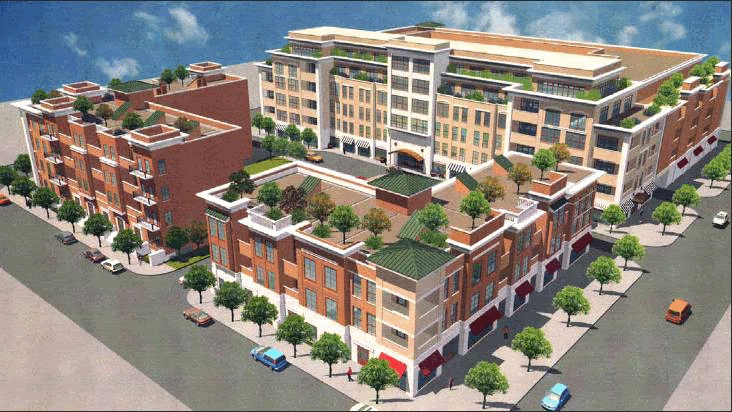
The best project that's come onto the radar of late is a joint effort by Wade Scaramucci and Richard McKown, of Ideal Homes--an entire block bounded by Walnut, 2nd, 3rd, and Oklahoma--that will soon become 227 units with parking in the middle of the block and street level retail lining wide sidewalks. I think that the design could be anything and the product could be anything, there are just two things that are key here: This project, just like the Aloft, is financed and ready to break ground on an expedited construction schedule; and also, the project takes the last full vacant block in the Maywood Park area and turns it into the stuff cities are made of. Surrounding this contemporary apartment development on all sides will be the old Walnut Avenue Baptist Church, the Maywood Park Lofts, Maywood Park Brownstones, and the Aloft Hotel.

Deep Deuce's urban fabric resembles a horse shoe of development going around the edges that is finally being filled in, and it will be a continuous urban neighborhood from the BNSF tracks all the way to 235.

Elsewhere in Deep Deuce, Sage is also once again reinventing itself with the addition of a jazz club--returning the Deep Deuce neighborhood to its roots as a jazz hotbed. Good downtown development is not a lot of shiny new-urbanist projects sparsely scattered throughout greater downtown. When you create synergy from projects that relate to each other, bound each other, and create atmosphere is when you have good downtown development. Such as the perspective looking down 2nd Street at the new Maywood Park apartments and then the lofts fitting snugly with an equal setback, with the skyline rising over. That's the infill we need, focused where it most makes a difference right now.


And to bring it back in terms of Devon Tower, at what point with all of these major projects, do you have enough infill that there is balance? It may not even be possible. There are several billions of major projects in the works at the moment. Something like Scaramucci and McKown's apartment complex creates as much street-level density as Devon Tower despite being a miniscule fraction of the cost, possibly $10-15 million at the most probably, compared to $750 million. Maybe we don't deserve Devon Tower and perhaps it is "too enormous" a project for OKC, but we sure will take it and be glad to have it, but it does make you wonder what the right proportional amount of infill is that it should trigger?

Wednesday, August 25, 2010

Talk Transit Today

COTPA is having another LTR forum today. I obviously won't be there but maybe some of you will. There will be a noon time presentation and an evening presentation. http://www.letstalktransit.com/

Can someone tell me why the taskforce study area is bounded by the Oklahoma River, Heritage Hills, the east edge of the medical center... and St. Anthony's? In other words, why are we looking as far east, north, and south as possible.. and not looking very far west?

Obviously if we're including the Oklahoma River and/or NW 13th Street, downtown goes much further west than St. Anthony's. Supposedly (I am learning from others on OKC Talk) that there are improvements planned for Classen Blvd as it goes through downtown as well. We know that OCU Law sadly won't happen anymore, but who's to say Film Row still doesn't deserve a streetcar boost?

It seems like it's already been ruled out.

Tuesday, August 24, 2010

Instead of a new $400 mil jail..

Here's an idea, and you all can tell me if I'm crazy or not.

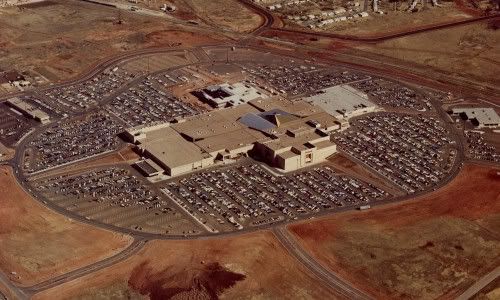
Instead of asking tax payers to pony up $400 million for a jail we really don't need to spend $400 million on, and instead of lining the pockets of Sheriff Whetsel and his "public safety" cronies--why don't we just use Crossroads Mall instead?

I mean, it's practically the best location I've ever seen for a jail. Isolated from the rest of the city and cut off by a highway interchange, with a landfill towering over it, and the city's best collection of strip joints just a jailbreak away--it's the world's most perfect site for a new county jail. It's also conveniently located near a very high-crime part of the southside and has limited ingress/egress that could easily be watched--and of course, you would encircle it with a great wall.

That kills three birds with one stone. That way people can stop talking about how to revive Crossroads, we don't have to spend public resources to bulldoze it, and we have a new solution for the county jail.

What's the asking price anyway? Probably under $5 million, just a guess. So 1/80th of the cost to build Sheriff Whetsel's dream prison.

Saturday, August 21, 2010

Q&A with Steve Mason

I am going to start a new series of Q&A with the very people who are behind the scenes building up the inner city as we speak. Last year I first got the chance to meet Steve Mason after a post I wrote (that was featured in the Oklahoman's Monday Morning Quarterback) caught his attention. Steve, the CEO of Cardinal Engineering, is highly involved in the community, from serving as president of the OKC Community Foundation, president of the Boy Scouts Last Frontier Council, and is currently serving on the boards for the Junior League, Automobile Alley, the Downtown BID, First National Bank, the Greater OKC Chamber of Commerce, the OKC National Memorial, and more. He is also a major supporter of the arts in OKC, including deadCENTER Film Festival, and the OKC Arts Council.

His decision two or three years ago to think twice about demolishing a few "decrepit" buildings on 9th Street has turned that block into one of downtown's most vibrant hotspots. Read on to learn more about what has made his developments and his vision for an urban resurgence a smashing success, where there was only blight 3 years ago. To me, the most interesting thing in this dialogue is how Steve Mason originally intended to just flip the building 1015 Broadway and then got sucked in and developed a passion for restoring life to the inner city.


Q1: What was it that first led you to get involved with Automobile Alley, and how has it compared to what you expected when you decided to get involved?
A: 1015 Broadway was purchased as a good deal with the plan to sell it again for 25% profit in 6 months. I had planned to sell 1015 Broadway and never invest in Automobile Alley so the outcome is not what I expected.

Q2: How have you been able to continue the redevelopment of properties around 9th and Broadway during the recession, when other developers can't get financing?
A: Strong personal credit, my passion, strong demand by tenants. Mickey Clagg has had similar experience in Midtown in that what he develops rents easily. Oklahoma City and other cities' urban cores have very limited land areas vs the suburbs which make these areas very valuable when there is demand. Today there is consumer demand for the redevelopment of the core of American Cities.

Q3: Why did you choose to save old buildings that everyone advised tearing down?
A: My fall, 1978, freshman environmental philosophy course at Vanderbilt University learned about Tragedy of the Commons and read Aldo Leopold’s “A Sand County Almanac.” Sand County discusses how we should value our resources and surrounding environment which we are part of. The old buildings were such a resource. Also, 4 remodeled homes on an tree-lined street are more appealing than a new red concrete box building.

Q4: Was the uniqueness of the buildings along 9th Street what attracted the diverse range of tenants?
A: Yes. Also, the initial diverse tenants are beginning the attract more diverse tenants. The group is meeting monthly which will result in incredible synergistic outcomes on 9th street. The August block party to celebrate the opening of Shop Good was a tremendous example of what is occurring. Much like a neighborhood block party, every business participated to celebrate the opening of Shop Good.

Q5: How did Rawhide become interested in the building at 1007 Broadway?
A: Ask Angie Bailey, the owner of Rawhide [for more info]. I believe that Angie understands and wants to be part of the collective vision of approximately 60 owners, tenants, and members of government with the same shared vision for the communities of Automobile Alley and Midtown. She also likes the easy access from the Centennial Expressway for her customers and the beautiful 80 year old building. Since opening in July, her sales have far exceeded her expectations.

Q6: What do you see for the potential of adding more mixed-uses (residential and retail) to Automobile Alley?
A: I hadn’t planned to have the second floor of the homes on 9th street occupied by the same person who operates the shops on the first floor but it happened. In large cities this is typical because it is more economical and provides for a very very short commute time to work or mid day naps.

Q7: What is next for your development plans in this area?
A: Rooftop patio above rawhide which is stunning. Biff Sturgess (Office of James Burnett) with assistance from J.P. Craig (Hornbeek Blatt architects) provided a quality design.

Q8: With the likelihood of North Broadway being a streetcar route, what will that do to Automobile Alley?
A: A streetcar route would add to the vibrancy of the district and strengthen the community feel. It would encourage a guest at the Skirvin to ride the streetcar to McNellie's for lunch and Rawhide to shop.


Q9: As a supporter of local events such as deadCENTER, what does that bring to the community?
A: Diversity is very important to a successful community. DeadCenter produced 2 events in Automobile Alley in June, 2010 which added to the vibrancy of our community. The Cinco de Mayo, Shop Good parties, and Tuesday taco events have similar impacts.

Q10: What could the city do to better position Automobile Alley to be successful for others?
A: The City has been wonderfully supportive by fixing the former potholes and providing two minute police response time when an occasional harmless vagrant frightens a guest. We are fortunate that the leadership of the City of Oklahoma City understands the private sector needs, are risk takers and supportive of our needs. I expect the City will continue to listen and be supportive. Parking is a challenge which will require public and private sector cooperation, creativity, and ingenuity. I estimate that without additional parking, the north end of Automobile Alley will only be ½ built out. Diagonal parking on Broadway and adjacent streets from the YMCA to 10th street will provide 200 additional, inexpensive parking spots.

Q11: What do you think is the best edible thing currently available in Automobile Alley, including 9th Street?
A: I have 3 children, Travis, George, and Marie. I love my 3 children equally on most days. I have four current children on 9th street which I cherish equally. Depending on my mood, I vary my intake on 9th street. I think happy hour food and prices quality are wonderful at Red Prime and Pachinko. The response to Tuesday Tacos at Iguana and Wednesday burgers at McNellie’s continues to amaze me. I never expected that dollar tacos on Tuesday at Iguana would result in 30 to 60 minute waits from 6 to 8pm on a street that was empty and ugly three years ago. Taco Tuesday and Wednesday McNellie burgers are important to our districts as we continue to develop our sense of community. Both events provide an opportunity for our neighbors to socialize on a consistent basis and see our friends. Within 5 years, I expect Automobile Alley and Midtown districts to become continuous so each district is important to the other district.

Cityshot LX


The alley behind Automobile Alley.

Tuesday, August 17, 2010

Welcome to St Louis

I was asked the other week by the owner of urbanstl.com to write a blog post for them, so I thought I'd might as well include it on here too. This is going to be written from the standpoint of a few things that struck me as odd about my recent urban safari through St Louis as well as some things they're doing very well that my city of OKC could learn from. I think the positive outweighs the negative clearly, so OKC readers should listen up.

DOWNTOWN


I think downtown St Louis is interesting because of how it lacks activity for the complete opposite reasons that many other downtowns are lacking activity. Most are said to be "dead after 5." Downtown St Louis is largely "dead until 5." I think it's a good problem to have, because what can happen after 5 in downtown is a lot more interesting than what can happen after 5. I think the convention center seems to be well-done and well-integrated with Washington Avenue. Wash Ave is the main loft drag through downtown, and is lined with this impeccable streetwall that would be the envy of any city. The lofts go for about 1.5-2 miles or so and I knew I had to see it because I've heard it called one of America's best urban revitalization success stories that actually clearly differentiate urban revitalization from urban renewal. The CityGarden has been a successful urban park that has injected vitality into the downtown core, but it has yet to have been conveyed into vitality for the surrounding environs in the way that Millennium Park has caused land values along Michigan Ave to skyrocket.

The culprit? There appears to be many culprits. The most obvious to me seemed to be the lack of shade. An interesting alternative was brought up in discussion on the urbanstl.com forum that awnings should be used instead of shade trees, because of how it would compliment the existing building stock downtown. There seems to be a large local consensus that downtown St Louis has too much structured parking as well, with the idea being that downtown has become auto-centric. I don't think too much structured parking can be a bad thing, I just think it poses a challenge for downtown to address storefronts. Parking garages have a tendency to be blank walls or otherwise worse facades that inflict darkness on the surrounding environs. Parking garages are buildings none the less and should be looked at the same as any building and they may need city action to encourage renovations that make the street level more attractive and in some way interactive (shops, restaurants, etc). I liked this parking garage I saw in Streeterville as a good example of how a parking garage doesn't have to look like a parking garage.

But to sum up downtown, the bottom line is it was completely dead on a Friday at 4 pm at a time that most other downtowns would be jammed with people, even if that is the only time. There were no lawyers walking to the courthouse. No business men walking to a meeting. There were no residents out walking dogs. There were no people getting off work early. Downtown was totally void of typical signs of (business) life that still go on in corporate-dominated downtowns. Perhaps the underlying reason for slow daytime activity is lingering effects from job losses? Which, would defy the urban planner's playbook of cause and effect..

NEIGHBORHOODS

Neighborhoods are the pride of St Louis, which clearly is a city of neighborhoods. Virtually no other city that I have been to has done such a good job with neighborhood revitalization and restoration and preservation as St Louis--and even throughout the white flight, which this city has been hit harder by than most, has managed to preserve the ones that matter most, and that alone is worth major kudos. St Louis also ranks highly as one of the cities with the youngest residents living in the oldest buildings (interesting study I came across). What does that mean? It means that residents live an interesting and unique urban lifestyle that defines St Louis and sets it apart. Many neighborhoods have focal points which are usually a park (i.e., Lafayette Sq) or a main street drag (i.e., Cherokee St). Most all neighborhoods are well demarcated with entrances, gateways/archways, and especially street banners.

CONNECTIONS

Well, I said it is a city of neighborhoods, not a city of streets, or even connected neighborhoods. The very neighborhoods that are the strong point of this city all feel very isolated and disconnected for the most part. There is also a strong divide between the south side and the central corridor, split by an unsightly industrial valley. Granted, it's a valley with some great views--it's also a valley with major untapped potential for urban revitalization. I think it should be the city's #1 priority, because it would make STL into a more complete city in my opinion--it would merge the central corridor and south side into one, and better connections to downtown would also go a long ways toward fixing downtown's dearth of activity. The proposed $27 million Grand Avenue bridge will go a long way toward strengthening connections. Other key corridors represent other great opportunities. If the city can focus on gentrification and dense development along these corridors the battle will be won.

One interesting point: St Louis is one of the very many cities that seem to be following the lead of cities getting rid of highways that pose barriers cutting downtown off from other parts of the city. Can someone explain to me why OKC is replacing the Crosstown Expressway land bridge, an elevated highway that people could walk under if it weren't for vagrants and the occasional falling concrete sections, with what will for the most part be an at-grade superwide freeway just 4 blocks south of the current alignment at a cost of, well, nobody has seen the latest cost surge. But you get the point. I think St Louis has a winner with actually completely removing a highway from blocking downtown to the Mississippi River. This will strengthen connections between downtown and riverside attractions such as casinos, the Laclede's Landing entertainment district (kind of a smaller version of Bricktown), and the Gateway Arch. I am disappointed with the the SOM-Hargreaves proposal to redesign the Arch grounds with two lakes and some open space--I think that it would be a great opportunity to try and lure some high-profile development around the edges of it, as long as it retains a strip of open space for viewing it down the middle.

P.S. Anyone from St Louis reading this, keep in mind I already realize that those blue/red map boundaries are probably off. Just a rough sketch showing the divide, I actually have no idea where the appropriate cut off between the central corridor and north side is, or other things.

STREETSCAPES

The urban part of St Louis, with all its grit and old buildings and streets, has some fabulous streetscapes. These are streetscapes on the cheap in my opinion. A lot of the street furniture, such as painted planters placed on street corners to block the crosswalks from cars cutting it too close, look like something you'd see at Oak Cliff's makeshift complete street. The planters lining Grand Blvd couldn't have been expensive and look like they were painted by kids in the community (they all have little hand-painted eyes on them), kind of like the decorative construction fence around the Devon Tower site with paintings from OCPS schoolkids. The planters apparently serve the role of "bump-outs" -- where the sidewalk ledge is extended at street corners sort of like a puzzle piece to make drivers take corners going slower as well as to shorten the distance at crosswalks. Virtually all the roads going through the inner city are typically made up of a sidewalk, a parking lane, and a bike lane--all three things OKC lacks. Imagine street parking on a major artery, whadaya nuts? There are a lot of streetscapes that are in desperate need of an overhaul, such as Cherokee Street which had a lot of weeds growing up through the sidewalks--but the basic form of a complete street is there all over the city, and that is what matters. It shows that you don't need a flashy $20 million/mile public streetscape project with public art in the pavement and standing up every 100 feet or so in order to have streets intended for people as well as cars. The basics are more important than these urban "bells and whistles" we prefer to focus on here in OKC.

Thursday, August 12, 2010

Please do not vote for Calvey

I happen to think that Oklahoma deserves better than the Kevin Calvey playbook of politics. Every time I see one of the guys political ads, I literally vomit in my mouth. So glad I'm far enough north now that I'm out of reach of his crap.

So if there is anything I can do to promote a brighter Oklahoma, allow me to urge any readers who may be registered Republican and live in CD5 to VOTE FOR LANKFORD. He's not that bad, really. I guess, although I liked that Indian doctor dude.

Is Calvey running for CD5 or is he running against Obama, CAIR, and other irrelevant outside factors? Why can't he talk about what he'll do for the voters of this district instead of trying to play voters who are annoyed by Chairman O's every move? I'll tell you what, I think Calvey and his ridiculous campaign of running against these unrelated irrelevant outside factors is about as retarded as Democrats running against Bush in 2008..and 2010, apparently.

Are voters in this district so stupid that they're going to fall for Calvey's crap? I hope not. I don't know what makes me want to barf more. The amateurish push calls asking NW OKC voters if they were aware Lankford supported MAPS 3 and refuses to make his campaign about CAIR, or the whole joining the Army and raising a postcard family so that one day it will serve you well in political ads?

Oh yeah, and his campaign is financed by $270,000 in unloaded stocks from his brother's Russian private equity fund, which by the way, is co-managed by the last director of the KGB. That's right, Calvey is a closet commie (ok, that may be conjecture, lord knows he would only do communism if it would work with idiot voters) who's connected to the KGB who's also illegally financing his campaign.

Tuesday, August 10, 2010

A City of Neighborhoods


I wanted to do an in-depth look at the overall inner city, which for all intents and purposes, means the north side, so here it is. The inner north side is where OKC is at its best--where OKC has the potential to step it up a notch and evolve into a city of neighborhoods; a city for people; a city with an emphasis on sustainable, healthy lifestyles. If we strengthen the inner north side we can make the most sizable dent in all of OKC's sprawl symptons--traffic, pollution, obesity, brain drain, and the pandemic of low-density places not worth caring about long-term. Ask yourself how anything being built in Moore, just to name a suburb, creates any kind of lasting legacy that is worth maintaining 100 years from now. For the answer, look no further than Crossroads Mall. Then look at the inner north side, which has a legacy that consists of beautiful landmark churches, beautiful grandiose neighborhoods, tree-lined boulevards (sometimes), great old theatre buildings, lively nightlife strips, a plethora of arts and cultural assets, and much more. We have to refocus the bulk of our civic attention on this part of town, where our urban treasures are located. It's time to restore those urban treasures and capitalize on the potential laying in the inner north side.

To assess where these neighborhoods are and how to improve this part of town, I've done a number of assessments. Essentially there are three things that we need to focus on: Corridors, neighborhoods, and landmarks. In terms of corridors, the goal is to identify which corridors strategically connect different neighborhoods. An obvious example is 23rd Street, which borders a lot of the prominent neighborhoods--despite that the Paseo is the only neighborhood bordering it that has prominent placemarking signs. The goal with neighborhoods is to identify which neighborhoods need help, which to promote, which to designate as preservation areas, which to encourage infill and new construction, and so on. The goal with landmarks should be to identify what corridors and neighborhoods are densest in terms of architectural heritage, to identify where the potential exists to tie-in with architectural landmarks, and also to identify important pieces of our architectural heritage that are in need of rehabilitation. An example of this is the Skirvin Hotel, which the city realized was important and got proactive in pursuing its rehabilitation, and look at it today. An example of a landmark that I identified that could use some help is the abandoned May Theatre at 16th and May--an old historic theater similar to the Tower or Plaza that lays abandoned. Despite being surrounded by markedly improved neighborhoods, the May Avenue corridor has remained nothing too special. That should change, and identifying landmarks such as the May Theatre is a good way for the city to actively pursue that.

IMPORTANCE OF PLACEMARKING
The importance of placemarking is that if people do not know what neighborhood they are in, they won't care what neighborhood they're in. They won't even be curious about it. Oklahoma City's neighborhoods are extremely lacking in demarcation, which impairs the inner north side's sense of identity. In city's that are neighborhood-strong, you see a lot more focus put on the identity of the neighborhoods. In OKC, it's not uncommon to see a brick entrance to a neighborhood or to see street banners within the neighborhood, but other cities go a lot further--and these placemarking elements are notably absent from the main corridors--Classen, Western, 23rd, Penn, May, 36th, etc. In Tulsa you will see a colorful neighborhood logo stuck right underneath the street signs along any major corridor. These create a strong awareness of the neighborhoods you're passing by. In St. Louis, the main corridors through the city are literally a celebration of the neighborhoods you're cutting through. It's not at all uncommon to see large stone archways, wrought-iron gates, and other awesome neighborhood entrance markers.


Not to bring up an extremely controversial issue, but I can't think of a more appropriate comparison--conservative lawmakers are pushing for legislation requiring pregnant women to at least name their child before they get an abortion, the thinking being that naming the little human being growing inside of you will endear it toward you. I know that was a horrible thing to bring up, but I think it demonstrates the power a name can have. For a while, OCU also had their PR campaign promoting their small student body as a place where "you're a name, not a number." When you name something, or make others aware of something's name, it has more value and meaning. I'd imagine that Heritage Hills is a lot more interesting to someone now that it's history and identity has been brought to the forefront of its physical appearance, and it's not just a cluster of homes most people can't afford, but it becomes a part of the city's history and the city's identity and something that everyone can feel like they have a vested interest in, therefor everyone will want the best for Heritage Hills.

On a side note (as a joke), perhaps we can motivate some of these neighborhoods to get their act together and start meeting city code by placing signs at all the entrances that say "You're now leaving OKC, and now entering the 3rd World Country known as Classen-Ten-Penndjibouti."


Here I have outlined most of the main corridors through the north side and just given them a good or bad status in terms of streetscape quality. Here, the streetscape qualities refer to the quality of the actual street infrastructure and are made irrespectively of the urban fabric quality. So for example, you see that just about the entire duration of Walker is actually a negative presence--despite that it mostly goes through great neighborhoods, especially Heritage Hills. I've always thought that something should be done to improve Walker and capitalize on it, especially because of what a historical backbone of OKC that street is, from north to south. I believe that the lanes in Walker are wide enough that you should be able to install a small landscaped median, bike lanes, or landscaping in the sidewalks--without requiring more land acquisition--this would create a real treasure of an outdoors environment going through Heritage Hills, and would create a huge asset to encourage further investment in J. Park, The Paseo, and Central Park (the latter of which could really use it).

One thing I did was also identify the more important corridors with broader lines, whereas the side roads have thinner lines. Notice that Western is hardly meeting anything near its potential. Notice the far south terminus of Classen Blvd which I marked green to indicate that between Sheridan and Reno Classen goes through an interesting plaza that hardly anyone with a permanent address ever sees, but could provide an interesting example of how to fix the rest of Classen. Point is that Classen is a scar on downtown that it can ill afford, because of its importance in framing the western side of downtown and providing that entry point from the NW. Most of 23rd is negative except for the Uptown area, and I guess maybe the area by Shepherd Mall, but I might have been too generous there since I know from first-hand experience how lacking it is from a pedestrian standpoint. May and most of Penn are also negative impression corridors, although there is a nice median in Penn once you go south of 16th towards what I actually believe to be Burger Heaven.

On the bright side, NW 10th makes a great impression, and will be a real asset once the Tenth Street Peace Park gets underway, if ever. I would say it's already affected some positive change on the north side of the Metro Park neighborhood, which actually has a great existing housing stock (albeit at least 90% of properties still severely rundown). The city had a HUGE win with the Plaza District steetscape. I normally hate bolding and capitalizing sentences, but let me just say this: I wouldn't have had the foresight to want to save 16th and anything south of 16th..clearly this area is a priority for the city and the city has had incredible success here. Had it not been for the community rising up and making a place for themselves in terms of revitalization, I would have been writing this post and limiting it to areas east of Classen. I think the city also has a winner, in the long-term, with the Asian District streetscape, although it's not going to turn the area around as suddenly as the Plaza District streetscape worked. And lastly, I'll point to the Shartel/18th bend streetscape through Mesta Park as a prime example of what can be done through a very constricting space. You don't need to do a lot of land acquisition in order to make way for sparkling new streetscape project. The result is what I think is possibly the most gentrified stretch of road in ALL of Inner OKC (Shartel/18th in Mesta Park).


Then I'd like to move your attention to actual corridor health assessments, made irrespectively of the streetscape quality, but rather the quality of the building stock along these corridors. This is similar to the last graphic I made, I just spent a little more time on it--there are three different levels of importance (example: 23rd east of Classen is the highest importance) and the darkest green = good, brown is mediocre, red is reserved for corridors that are actually really bad.

23rd for the most part, in terms of corridor health, is alright.. it would be about a 3/4 rating if I were doing it that way, for the most part. 23rd could be really nice though, and it is a long ways from that. Classen is really pretty decent, too, once you get north of 16th. Classen/Western on the western edge of downtown are just really, really bad--but what's interesting is that Western between 10th and where it merges with Classen at 13th, a full 3 blocks, is actually emerging as a sort of colony of SoSA (across the Classen Blvd ocean). I think there's 3 art galleries here, and a few more contemporary residences hidden from site on the west side of the street. What's sad is how Classen resembles just one of those classic automobile gifts from the early days of urban renewal. It makes no sense to have it and Western side-by-side, so close together, especially when they mostly go through blight and brownfield (term for industrial/urban wasteland). Urban renewal was not all bad in terms of Classen, considering the decent building stock that exists north of NW 30th, lots of great examples of interesting Mid-Century architecture. Setbacks aren't too bad, and the Classen corridor is largely a positive presence in spite of the bad neighborhoods behind it (Helm Farm).

There are a few examples where a great streetscape and great corridor health do not go hand-in-hand. The exceptions to the rules are all instances where either the streetscape is too new to be making a difference (10th Street) or where a strip has just been historically thriving, even in spite of urban renewal remedies to the inner city--such as Western Avenue. And as for this map, sorry to say, but you do kinda have to squint to be able to differentiate between the olive green and the brown. The brown (example: 16th from Penn-May) is to denote mediocre but not necessarily awful, and the olive green is to denote something that is starting to ripen and meet it's potential (portions of 16th on each side of the Plaza). Also notice that Western Ave is the darkest green on the entire map, the only other stretches that are that exact forest green shade are the Plaza District and the Shartel-18th bend through Mesta Park. If you want to see a street that resembles a perfect set of stairs from good to bad, check out Penn from NW 23rd to NW 10th--which, interestingly enough, goes contrary to the streetscape ratings I gave Penn in the previous map.


This is the exact same map as above, just turned 90 degrees to the right. I did this on accident, but on a whim decided to keep it because I think it actually helps people understand circulation patterns through the inner north side a little better. OKC is a very augmented city, with all of its little parts very detached from each other--I like how this different orientation shows the inner north side beside downtown and not really attached to it. Here you see what a vital corridor NW 23rd Street is, serving as this part of town's Main Street. The historic neighborhoods north, erm I mean west, of Penn are also not as old as those east of Classen Blvd, so I like how it shows them being "uptown" of Heritage Hills. When this city was being built around the turn of the century, the city's first developers and founders such as Anton Classen and (forget first name) Putnam did not build out in every direction. They started with one linear corridor, which typically had a streetcar route in the middle of it, and went all the way north and then moved a little to the west and started another corridor going north out of downtown. This is how "streetcar suburbs" (most American inner cities to this day) evolved.


Ah yes, the neighborhood quality assessment. The Planning Department actually did their own version of this exact concept for the entire city back in 2000, but I have no idea where the locate it--each neighborhood was rated from 1-4. At any rate, it's time for a new one especially in regards to the inner north side where conditions have overwhelmingly improved in the last 10 years. I would even not be surprised if the mean average for the whole area has gone from 2 to 3.5 (their assessments were somewhat more generous than mine in 2000 terms, if such a thing is possible given how generous I think I was as someone who is more than willing to give an urban neighborhood the benefit of the doubt). There are actually 4 different shades of green, two shades of yellow, and two shades of red..so you could say they're rated from 1-8. So in case some of the shades are hard to differentiate, I'll go ahead and announce each rating (pretend we're at a neighborhood awards assembly, which apparently actually exists).

BEST OF THE BEST
These are your name-brand neighborhoods, most of which are on the National Register of Historic Places in their entirety. The lone exceptions on that are Linwood Place and Edgemere Heights. These neighborhoods, with the exception of Mesta Park, mostly feature large homes on large lots that dwarf those in the nearby neighborhoods. Mesta Park features large homes on much smaller lots (in comparison to those across Walker), giving it a very dense feel. It has strong building/lot proportionality. In no particular order:

Heritage Hills
Mesta Park
Edgemere Park
Crown Heights
Edgemere Heights
Putnam Heights
Linwood Place

GREAT NEIGHBORHOODS
These are your other neighborhoods that typically come highly recommended to anyone looking to move closer to downtown. Some of them just recently turned the corner (like the Paseo) thanks in part to a huge wave of investment right before the financial collapse, others have been gentrified for a while (like Shepherd) and just happen to have smaller, less grandiose homes than you'd find on 19th Street in Linwood Place. And just to rationalize one of them, there is no such "Helm Historic District"--it was considered part of the highly run-down Helm Farm neighborhood by the OCPD crime reports..I just need to do some more looking into it because this area feels like a very separate neighborhood, particularly where there's been a lot of well-organized preservation and restoration along NW 38th. In no particular order:

Jefferson Park
The Paseo
Helm Historic District
Gatewood
Plaza District
Shepherd
Cleveland
Crestwood
Miller
Milam Place

GOOD NEIGHBORHOODS
These are your neighborhoods that may be turning the corner still, but certainly are good neighborhoods, that are mostly tidy. Some, such as Douglas Park, are actually great neighborhoods that are just limited by the building stock being mostly smaller homes that will be difficult to fetch much more than $100,000, where I expect more homes to be valued at. And I think I might have underrated Denniston Park. Any trends you may notice with the names is totally unintentional. In no particular order:

Asian District
Uptown
Douglas Park
Woodland Park
Military Park
Venice Park
Denniston Park
Reed Park

NOT BAD NEIGBORHOODS
These hoods could do a lot of improving. I just didn't want to put them on my list of bad neighborhoods, mostly because they do have clusters of restored homes or newer homes. West Main Street actually has some huge potential, and is still an active business/industrial corridor, with well-maintained warehouses. In no particular order:

May-Penn
Memorial Heights
West Main Historic District

SOMEWHAT ROUGH HOODS
These are your neighborhoods that I'm not gonna cherry coat, they have a lot of work ahead of them. These neighborhoods are salvageable and have huge potential, they just have so much work to be done right now. And yes, I specifically put the OCU campus on a list of rough hoods, because their campus is terrible. They have some beautiful buildings, they have zero landscaping, and they clearly do not understand the concept of what a campus is. I have seen high school campuses that feel more college campus-like. They need to work on creating a campus feel or they will forever stay on my list of rough hoods. Of course, it doesn't help that the surrounding Epworth neighborhood is also very rough. Central Park is also a neighborhood that needs to be city-action targeted..apparently the city doesn't even maintain its own medians in Shartel. In no particular order:

Central Park
Epworth
OCU campus
Putnam Heights West
Sequoyah
Las Vegas
Lyons Park

TEAR-DOWN DISTRICTS
I think that these are the neighborhoods that represent the best candidates for new infill housing. They need the SoSA treatment. The main thing separating these neighborhoods from the "somewhat rough hoods" is that the building stock is going to limit its ability to improve much. It is largely somewhat disposable, and you all know what a brickhugger I tend to be. Classen-Ten-Penn is alright around most of its boundaries (Western, Penn, 16th), but the further south you go, the rougher it is--that's where the Flaming Lips reside. In the Aurora neighborhood there have already been a number of tear-downs, and I think I saw two new contemporary residences on a short drive through. If preservation everywhere else is enforced, it may actually be feasible to reposition these neighborhoods as the appropriate catchment areas for wide-scale redevelopment through tear-downs, and new infill housing. In this sense it is in the best interest of Classen-Ten-Penn to not allow any new construction in neighborhoods not named Classen-Ten-Penn, if that logic makes sense. Every neighborhood in this part of town has the potential to serve a purpose, and this is by far the best outlook for these neighborhoods. Hopefully someday they may resemble the Rice Military area of Houston. In no particular order:

Helm Farm
Classen-Ten-Penn
Youngs-Englewood
Aurora

DANGEROUS HOODS
Don't be fooled by Westlawn Gardens' pretty name. I wouldn't even recommend driving through these areas. Metro Park actually does have some potential, great building stock, maybe a small number of houses that look like they have been restored, others that have great potential, maybe one or two new infill houses. It's not as dangerous as the others but I'm sure that after dark it's still pretty bad. I imagine that the 10th Street improvements will help out over the longterm. The others are just industrial blight areas for the most part with dilapidated shacks mixed in for good measure. These areas will not even be a candidate for redevelopment because the city intends to relocate homeless services to this area. The new "WestTown" homeless shelter is currently u/c on Virginia, in Rock Island.

Metro Park
Rock Island
Westlawn Gardens

STRENGTHENING NEIGHBORHOOD CONNECTIONS

The neighborhoods forming a linear progression north from downtown form a "Central Corridor"--mostly the oldest neighborhoods in the city. These neighborhoods are connected in my mind, and there lays the potential to create stronger connections and through that, further gentrification of some neighborhoods that aren't yet where Mesta Park is. This happens through improvements to Shartel and Walker in particular, and strengthening crossings at 23rd and 36th. Perhaps even adding pedestrian crossings, like the mid-block light proposed in front of the Tower Theater on 23rd.

As you can see here, a connection between downtown and Fair Park are inhibited by the blight, homeless services, and dangerous neighborhoods in the way of such a path. In the future you may hear this area considered for redevelopment and westward downtown expansion. This would seem like a crap shoot at best, although I know the points will be raised in the future because they have been raised in the past. I have read in one of Lackmeyer's books that city leaders used to envision downtown stretching from Lincoln to Penn, hence why we have the bizarre Linwood Blvd. I think Linwood Blvd has opportunities that may even be worth revitalizing. I think Main Street has even more. I think though that the idea of redevelopment in these areas is preposterous because of everything else we're trying to redevelop. A huge amount of our city's demand will have to be spent on Core2Shore. It won't take a lot to keep the momentum going in the inner north side neighborhoods, but it will take up some of it--hopefully here you can divert some suburban demand though. I also think that Deep Deuce, MidTown, Arts District, Bricktown, Lincoln Blvd--all these existing areas of downtown are so far from being finished. Can it all be done in the next 30 years? Maybe, maybe not. But you can go ahead and write off the idea of downtown stretching as far west as Penn--not until our urban population balloons to at least Dallas-proportions. I do think thought that this due-west corridor between downtown and Fair Park represents a great opportunity to try and push any and all undesirable elements that way. That can be a helpful thing, and in that way, Rock Island and Westlawn Gardens can also serve an important purpose.

16th and most importantly 23rd Street resemble the most important corridors for circulation between neighborhoods in this part of town. 16th is obviously slower and residential in nature and should reflect that, whereas 23rd Street is a former Route 66 alignment. I'm not saying it should service the north side as an auto-centric highway, but it is the main business drag. There are weaker neighborhoods up the center stripe of the inner north side, bookended by the May Ave and Walker Ave clusters--strengthening E/W connections can bridge that divide and spread the forces of gentrification around.

Classen/Western Ave and NW 23rd Street are clearly the two main corridors that connect the inner north side to the beyond. Not only are these corridors important to the overall health of the area because they bring people in from the suburbs or downtown, but they also resemble really important areas to make an impression on people, to say that you are in the inner north side. Unfortunately, that's kind of a week name "inner north side" to use to promote strong branding, but I'll address that as a last point. What I want to stress are the importance that when ice storms hit, these routes are clear. The city should also consider branding for the entire part of town and not just the particular sub district you're presently in when you're along Classen or NW 23rd. Classen and Western, being only two blocks apart from each other, are a combined "system" in my opinion, all the way from I-44 down to I-40.

I also think rebranding the entire part of town, and coming up with a name for it, will be important to furthering these goals. Here are some examples of well-branded inner cities.


Houston's gentrified inner city is known as the Inner Loop. St. Louis refers to a collection of strong neighborhoods in a line west out of downtown as the "Central Corridor." And everybody who reads this blog is probably very well aware of Midtown Tulsa.

So what do we call the inner north side of OKC? Some possibilities..

Uptown--Uptown could collectively refer to the whole inner north side because it is up from downtown. Uptown 23rd Street isn't very well branded, and could just re-identify itself as the Uptown Main Street (similar to Capitol Hill/big part of town v. Capitol Hill Main Street/Commerce Street). Or the Tower District, or something else. It would also work well, logically, with the natural progression of Downtown, then Midtown, then Uptown. In Tulsa, Downtown is the furthest "up" from Midtown, and "Uptown" is in between the two--none of which makes any sense unless you just accept it.

The Heights--the north side is somewhat hilly, and it could help combat the reputation of OKC as being flat as a pancake, which is actually not necessarily true. There is also Crown Heights, Putnam Heights, Putnam Heights West, and Edgemere Heights. The "Heights" is a recurring trend in some neighborhoods, and could provide a unique title for the area other than the usual "uptown" or "midtown."

Flaming Lips City--because Flaming Lips Alley is already taken.

If anyone has any other good suggestions, I'll include them in a poll I intend to do on the matter later. And now, without any further ado, I am finally retiring to bed after working on these maps for days and spending 5 hours tonight putting it all together.

Huh?

What is this Transport Politic article about? Gotta love it when outsiders bungle articles.. and in the comment section, talk about hijacked by Tom Elmore (LOL)..

Saturday, August 7, 2010

Walkable OKC? Throw out your demographic assumptions.

If anyone were to check out OKC's "walk score" on www.WalkScore.com, you might be somewhat surprised to see their map of the most walkable areas of OKC city limits. ^ Posted above.

Apparently the most pedestrian-friendly areas of OKC, after downtown, are Lyrewood Lane, NW Expressway/May, Western/I-240, Quail Springs, and Crown Heights. I presume this is pretty unscientific raw data where they just matched residential density to commercial density and decided that any overlay is "pedestrian-friendly." Still, I can kind of see where there are arguments for some of these areas. Lyrewood Lane might not be a "great urban environment" but that doesn't mean walkable.

While all of these urbanist buzz words are not mutually exclusive of each other, I think there is a novice misconception out there that where one exists they all exist.. "Walkability, attractiveness, urban design, density..blah blah.. it's all the same, right?"

Obviously some concepts are a lost cause for the majority of OKC. Try rescuing Lyrewood Lane from an urban design standpoint. Doesn't mean it doesn't have density, and it doesn't mean that it can't have walkability if you consider the concept loosely without assessing quality values (I for one wouldn't enjoy taking a stroll down Lyrewood Lane, let along driving down it, despite how accessible or plausible such a method of getting around may be).

True urbanism is urbanism without the snootiness and snobbery. We've had some awesome urban infill projects downtown, but they all cater to a certain income group. What is the difference between a gated community and residential parts of downtown? All that's missing is the gated entrance, because OCURA has been so proactive in keeping out anything affordable by, you know, normal standards.. (anything under $300,000 or $1,000/mo).

Perhaps the truest urban neighborhood in all of OKC is Crown Heights. It's got live, work, dine, play.. it's got density.. it's got charm and historic qualities.. it's got proximity to downtown.. it's got diversity.. it's got urban design.. it's got walkability.

Plaza done right..or is it?


Pretty spiffy urban plaza in front of the Old Post Office in downtown St Louis. Took this picture when I came through, on my way back from Chicago. The tower rising behind it on the left side is condos, and they are adding a restaurant to this plaza right now, apparently.

And let me just say, about those scrubby little trees adorning the edges, what a beautiful urban ecosystem! This plaza also maintains other resemblances to the SR Commons..it improves sight lines for the condo tower, it also requires that you STEP UP onto it because of the vertical separation between the plaza and the street level at the edge. Very anti-pedestrian, anti-urban.

I think you'll notice that there are a total of 2 people (plus myself, so I guess three) in existence on the entire plaza. This picture was taken at 4 pm on a Friday afternoon, when I'm sure even BOk Plaza in downtown OKC is more "bustling" than this.

I will say that you could make a stronger case for the need for a plaza in St Louis than in OKC, too--corporate towers in St Louis do not typically come surrounded by a moat and drawbridge like that they do in OKC (or in other words, a corporate plaza). Aside from the new elongated 3-block long "Citygarden" (green park) in downtown St Louis, there is very little open space.

And this, my friends, is the best-planned plaza I've seen in a LONG time.

Thursday, August 5, 2010

Excuse my absence

Excuse the fact that I haven't had a whole lot to say lately. Just got back from spending some time last week in Chicago. That was..a lot of fun. Still a little sad about SandRidge. Don't know what to say. I also ship out, back to school up in the north country, here in a bit.

I suppose any week that Devon Tower is continuing to rise is a good week for downtown, all things considered. We are a very lucky city right now.

I'll probably find some topics to tackle before I leave, just lack motivation right now. Anything you guys think needs to be looked into, and talked about? There are probably some more planning documents that never saw the light of day or heeded any attention or notice by officials that I can highlight..those are fun.